One Hundred Years from Now

I saw an inspirational sign over the weekend. It said…

I saw an inspirational sign over the weekend.  It said:

One Hundred Years from now it will not matter what kind of house I lived in, how much money I had, nor what my clothes were like, but the world may be a little better because I was important in the life of a child. 

All of us are children, some just older than others.  We each have the capacity to inspire, and to be inspired.  We each have the capacity to challenge, and to be challenged.  We certainly have the capacity to teach, and to be taught.  

Our openness to both sides of the equation is what’s most important.

Happily Ever After

In fairy tales (and many books and movies), we spend most of the story learning how our happy couple meets and falls in love.

In fairy tales (and many books and movies), we spend most of the story learning how our happy couple meets and falls in love.  We learn about the challenges they must overcome in their quest to be together.  Suspense builds to a fever pitch as the forces of evil do everything in their power to keep this couple from fulfilling their destiny…togetherness forever.  If the story has a happy ending (and most do), they live happily ever after.  The End.

Real life is all about the happily ever after part.  It’s about what happens after the couple rides off into the sunset in their horse-drawn chariot, or charcoal grey Honda Civic.  Happily ever after requires curiosity and a spirit of adventure.  It’s nurtured by a willingness to work and grow together.  It requires the triumphs of success and the lessons of failure.  It requires faith, hope, and most of all, happiness.

Happiness doesn’t come from anywhere but within.  Couples (hopefully) learn quickly that their happiness (both individually, and as a couple) is driven by their thoughts, attitudes, and actions.

Our pathways alone bring neither happiness, nor sadness.  We bring these ourselves, wherever we go.

As my wife and I celebrate 25 years of Happily Ever After today, I am eternally grateful for the happiness she brings to our journey every day.

No One is “Just a…”

Listen closely, and you’ll hear the “I’m just a…” phrase applied in many circumstances. You may even use it yourself. I’ve inflicted it on myself a time or two (or three).

“I don’t know the answer, I’m just a temp.”

“I can’t authorize that refund, I’m just a cashier.”

“Clearly, nobody here cares what I think.  I’m just a worker bee.”

“I could probably help those wounded veterans, but I’m just a private citizen.  I’m sure there’s a government agency for that.”

“There’s no way I could ever do that job.  I’m just a high school graduate.”

Listen closely, and you’ll hear the “I’m just a…” phrase applied in many circumstances.  You may even use it yourself.  I’ve inflicted it on myself a time or two (or three).

Ownership is risky.  It requires personal responsibility, a willingness to step up, make hard choices, and be held accountable for your actions.  “I’m just a…” is a ticket to minimizing the expectations we place on ourselves.

The Dark Side

“Just a…” has an even darker side.  It can be used to limit the expectations we place on those around us:

  • “John’s a decent manager, but he’s really just a guy keeping the trains coming in on time.  I doubt he could step into anything new.”
  • “She’s just a summer intern, so I don’t expect her to light the world on fire for us.”
  • “He’s just a beginner, so we need to cut him some slack.”
  • “She’s just a kid.”
  • “He’s just a drug addict, so he will never amount to much.”

When expectations are minimized, minimized outcomes usually follow.

Applying the “just a…” phrase to anyone, including ourselves, ignores potential.  It ignores our ability to grow, change, improve, and amaze.

I Got in a Fight Today (almost)

I stepped back to avoid the shove that I knew was coming. He stopped short and stood there, waiting for me to escalate.

As a crazy trail runner, I look forward to days like today.  My truck’s outside temperature reading showed 93 degrees as I embarked on my run.  I planned to take the slightly less strenuous route, which meant I’d save the biggest hill climbs for the middle part of the run, rather than the beginning.  As usual, I stopped at each bench for a round of push-ups…ten at each bench, rather than the usual fifteen.  Giving myself a break in the heat seemed like a good plan.

My run up Big Red, the highest peak in the park, had gone well, meaning  I was able to make it to the top without stopping.  The good news is there’s a bench at the top, so I was obliged to stop and do push-ups, and catch my breath.  I looked forward to descending the back side of Big Red, and reaching the turnaround point where I’d be heading into the wind.  Running into the wind, and catching a bit of shade from the trees next to the trail would help me cool off and recover from the first couple miles of the run.

I had just started enjoying the shady portion of the run when all of a sudden a guy on a mountain bike whizzed by me on the left.  In fact, he was so close that he actually clipped my left elbow on his way by.  I yelled,”IT’S ON THE LEFT, JACKASS!  TRY HAVING SOME TRAIL MANNERS!”  I didn’t think he heard anything and I continued down the trail.

As I came up to the only bench with a roof (we refer to it as The Bus Stop), there was Mr. Mountain Biker.  He was off his bike, and seemed to be waiting for me.  I thought about just running by, acting oblivious.  But, it was a bench, and I’m required to do at least ten push-ups at each bench.

I approached the bench and just as I started my push-ups, Mr. Mountain Biker asked, “What’s the deal with you?  You veered across the trail just as I was about to pass!  What were you yelling?”

I finished my ten push-ups, and took a nice swig of water from my water bottle.  Maybe I should have skipped this bench was the first thought that came in to my mind.  I generally like my runs to be solitary affairs.  There’s nothing like pushing against my physical limits to clear my mind.  “Have you seen the signs around the park?  Bikers yield to runners, and runners and bikers yield to horseback riders.”  I caught my breath and continued, “I didn’t hear you coming since you didn’t say ‘ON YOUR LEFT’ like most bike riders do.”  Then came the fighting words before I could stop them.  “Do you know anything about trail etiquette?”

That last question didn’t sit well with Mr. Mountain Biker.  He tossed his bike aside. “I asked you what you were yelling at me, butthead!”  He stepped toward me, and I thought he was about to shove me in the chest like seventh graders do at the beginning of fights.

I stepped back to avoid the shove that I knew was coming.  He stopped short and stood there, waiting for me to escalate.  I couldn’t help noticing that I was about six inches taller and at least 50 pounds heavier than Mr. Mountain Biker.  I think my subconscious mind noticed as well and that’s when the words started flowing.  “Buddy, you picked the wrong guy to mess with.  Sure, I’m a trail runner, but this is just for conditioning.  My real hobby is Jiu Jitsu, and I’m a personal injury attorney, always looking for new plaintiffs.”

He stepped back a couple steps.  I’m not sure if it was the Jiu Jitsu part, or the attorney part, that scared him the most.

“My trainer is going to love this!  I actually get to use some of the submission moves he’s been teaching me, outside the gym!

He stepped back another couple of steps, and moved to pick up his bike. “Dude, relax!”

“I am relaxed!  I just wanted you to know what you’re up against.  Besides, I’m the one who got hit, so I’m trying to figure out what your deal is.”

Mr. Mountain Biker was looking for the quickest way to exit the scene.  “Sorry about your arm.  I’ll be more careful next time.”  He hopped on his bike and headed down the trail…luckily in the opposite direction from where I wanted to go.

Thankfully, the rest of my run was uneventful.

As I listed my hobbies for Mr. Mountain Biker, I failed to list my favorite.  Fiction writer.  Fiction writing is basically writing lies for fun (and profit, if anyone buys your stories).

I am a trail runner.  I occasionally watch a UFC fight, but the blood makes me queasy.  My friends never let me live down the time I actually fainted while watching a UFC fight.  I work with corporate lawyers on a regular basis, but I’ve never even met a personal injury attorney.

Oh yeah, about Mr. Mountain Biker.  He doesn’t exist either.  Isn’t fiction great!

Happy First Anniversary!

Hard to believe that one year ago today, Janet and I had 16 guests and a bride-to-be in our house…

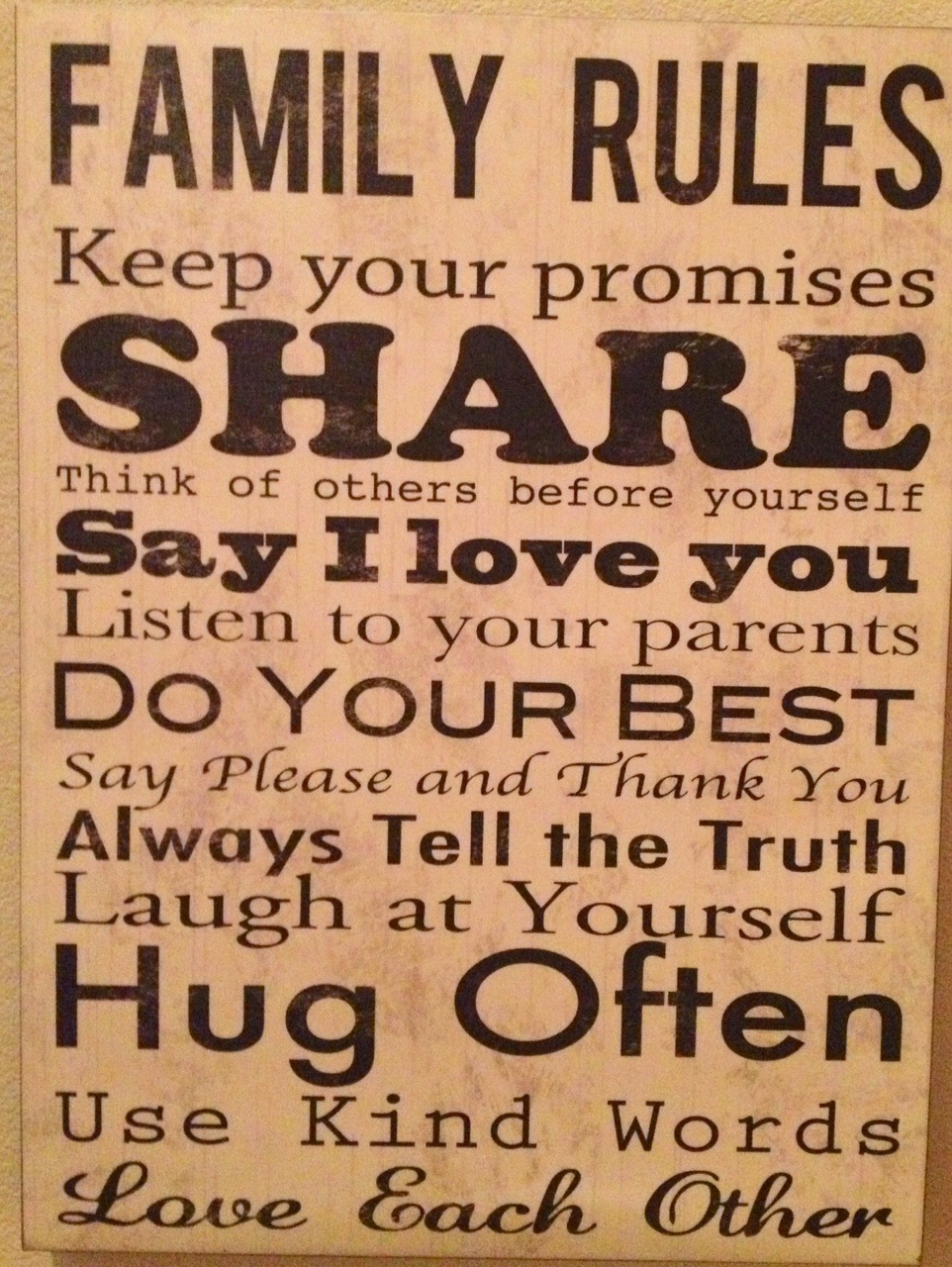
FamilyRules

Hard to believe that one year ago today, Janet and I had 16 guests and a bride-to-be in our house, getting ready for the Flather wedding that would start later that day.  The night before, they worked out a system of 15-minute bathroom assignments that began at 6am, and ended with the entire bridal party, and support crew, heading out the door at 9:30am for photos…all on schedule.

As anyone who has planned a wedding knows, they are events filled with countless details, and memories that last a lifetime.  One detail that I remember vividly is the Father-of-the-Bride toast.  Writing the toast wasn’t difficult.  Saying the toast was an entirely different matter.  Each rehearsal ended with me crying about halfway through.  I’d be doing great, and then it would hit me without warning.

Seeing my hopeless situation, Janet agreed to share in the toast duties with me.  She would take the most “troubling” parts, and we determined that we’d just “wing it” from there.  I don’t have a clear memory of the actual toast, but I know I couldn’t have done it without Janet’s love and support.

In honor of the Flathers’ one-year anniversary, and just in case we missed something during the actual toast, here’s the original text.  By the way, I still can’t read it all the way through without welling up, and I wouldn’t have it any other way:

When Steven stopped by our house on that fateful night, about a year ago, I think we had a pretty good idea what he wanted to talk to us about. He wanted to ask our daughter to marry him. It wasn’t a surprise to us, but that moment is certainly burned into our memory. Obviously, Julianne said Yes! And, we couldn’t be happier for them. Steven is quite a catch, and he comes from a great family that we’ve gotten to know quite well over the years.

I’m pleased to see that Steven’s tuxedo doesn’t have any grease spots…yet…and I’m sure it’s killing him keeping it clean!

This is the NASCAR section of the toast when I thank all the people who made this celebration possible. Let me just start by thanking everyone who came here last night (and this morning) to help setup this hall. We had around 40 people here yesterday afternoon and evening, helping us convert an empty hall into this wedding picnic wonderland you see today. But, even before that, we had numerous work parties at our house, addressing invitations, preparing the candy, the candle holders, and all of the flowers. If you are a friend of mine on FaceBook, you’ve seen the pictures and updates.  We’d also like to thank many of you in advance for volunteering to help us convert this wedding picnic wonderland back into an empty hall tonight!

Although we have a picnic theme going, we could just as easily call this a “barn-raising.” The same way a community comes together to help one family build their barn, we are blessed to have just about everything in this wedding come from our own community of friends and family. Thank you for all of your help. We will always cherish the time we’ve spent with each of you as we prepared for this wedding celebration.

Someone recently asked us how we’d feel on our daughter’s wedding day, giving her away, and all. We don’t look at it that way.  Instead, we are adding a very fine son-in-law to our family. As parents, we all strive to see our kids grow into solid citizens. I can tell you from first-hand experience, Steven and Julianne are VERY SOLID CITIZENS. We are very proud of both of you!

So, Steven and Julianne, we raise our lemonade high, in your honor. May your love for each other grow as you greet each new day together!

TEDx ChapmanU

TED Photo

I heard about TED talks from a friend many years ago.  TED was started in 1984 as a conference to bring together people from three worlds:  Technology, Entertainment, and Design.  TED talks are limited to no more than 18 minutes in length, and cover a wide array of topics, all focused on “ideas worth spreading.”  More than 1,400 talks are available for viewing on-line.  We heard today that TED talks have over one billion combined views.

Janet and I were excited to see a TED event in person today at Chapman University.  Our youngest daughter, Jennifer, is home from school for a couple weeks, so an added bonus was having her attend with us.

Here’s a quick taste of what we learned today from the fourteen speakers (twelve “live,” and two on video), in no particular order:

Shawn Achor told us that 90% of our happiness is internal, 10% from our surroundings.  He also said that people who view stress as a challenge and not a threat are much happier.  He was incredibly funny, and one of the fastest talkers I’ve ever seen.

Phil Hansen told us to embrace the shake.  He is an artist with a condition that makes his hand shake.  He left his art for about three years because of it.  When he went to a doctor to see what could be done, the doctor informed him that nothing could be done, and that he recommended that Phil embrace the shake.  Phil found that by embracing our limits, we find ways to go beyond them.  Let go of outcomes, failures and imperfections.  Don’t be encumbered by results.  Show up for the process and allow the limitations to harness your creativity.  His artwork is awesome.

Allyn Rose talked about her decision to have a double mastectomy to prevent getting breast cancer.  She had lost three family members, including her mother, to breast cancer.  As she said, the odds were very high that she would be afflicted by the disease at some point.

Lisa Sparks talked about improving healthcare-related communications.  80% of all medical errors are a result of communication problems.  She talked about ways for the healthcare provider, the patients, and the patient’s family to arrive at shared meanings on the wide array of topics that surround a person’s health and their healthcare decisions.

Ali Nayeri discussed String Cosmology Theory as a basis for understanding the universe.  He showed how the theory can be used to describe the behavior of galaxies in multiple dimensions, not just flat like the current theories would dictate.  It was at this point that he lost at least half of the audience, including me.  I felt like I recovered when he showed a diagram of two universes flowing from one side to another through a symbolic sideways hourglass.  The idea is that there are really two universes with one contracting and the other expanding.  The point where they cross looks to the observer like an origin, or singularity (the Big Bang).  He showed how String Theory supports the existence of these two universes and that there wasn’t really ever a Big Bang.

Jennifer Sullivan talked about Frictionology.  Between 1860 and 1890, 500,000 patents were issued.  This was 10x more than the previous 70 years combined.  During that time, she said that there was limited competition, and no friction.  With competition, people get choices, and there is friction.  Understanding friction is important, since friction is where the money is made.  Good friction equals access to, and curation of, the good stuff, and dumping of the bad stuff.  People have discovered that content is the best way to sell other stuff.  She ended her talk by saying that a big trend now is not Do It Yourself, but Make it Yourself.  Consumers want the tools and they will make the rest.

Michael Goldsby talked about the future of medicine.  With the ubiquity of smart phones and other easy-to-use data capture devices, it’s  possible to capture a tremendous amount of data about a person in real time.  All of this real time data can be analyzed to create actionable insights for the patient.  He talked about how smart phones and their apps can become a digital sixth sense from a medical perspective, and can be a foundational part of the coming Internet of Everything.

Kathy Thomson talked about her company, the LA Times, and the things they are doing to remain relevant and valuable in the age of digital delivery.  She said that the challenge for them isn’t so much the content, but ensuring that they can put it where, when, and how the reader wants it.  She discussed the maverick/mainstream paradox.  How do they innovate in sometimes radical directions, while continuing to preserve their mainstream values that make their content so valuable.

Prince Gomolvilas, the only Thai-American playwright (according to himself), talked about maintaining your integrity and your ideals, even when faced with overwhelming financial threats.  He told a riveting story about a play he wrote for a “very fancy private school” in the Bay Area for their 8th grade class.  The theme of the play ran counter to what the school’s largest donors thought was acceptable.  He had a choice of either modifying his play and its theme, or keeping it as originally written.  The potential consequence was alienating the large donors and causing huge financial harm to the school.  You will have to watch the video on the TED website to learn what he decided.

The Orange County Youth Symphony Orchestra had two of their percussion representatives perform an extremely complicated drum duet, based on a native American rhythm.  They didn’t say anything and let their instruments do all the talking.

Kristen Howerton told us about being in Haiti with her six-month-old daughter, visiting her soon-to-be-adopted son on the day of the horrific earthquake.  To cope with the devastation, and her inability to do anything except care for her daughter and soon-to-be son, she focused attention on packing and re-packing her suitcase so she’d be ready to leave whenever a plane became available.  It became a diversion and coping mechanism for her.  The “punch line” to the story:  when a plane was available at the US Embassy, there was no room for any luggage, and she had to give up her coping diversion in order to get home.  She related this to other diversions in our lives, like the internet.  She called the internet the diversion to end all diversions, and said that we need to be willing to leave it behind enough to take the time to experience the feelings of real life.  As a psychologist, she said, “The only way to work through crappy feelings is to walk through crappy feelings.”  Diversions often prevent this process.

Mark Pampanin talked about why being an icon isn’t all it’s cracked up to be.  Specifically, he discussed the tokenizing of gay men.  Look at most television shows…he described the “token” gay man in every show.  As a gay man, he said that he’d rather we all just treat each other as people, and not the “token anything.”

Liz Fiacco discussed transferrable skills, specifically the skills we hone using computer games, and their application to our real lives.  The power of games comes from their rapid teach and test cycles.  She proposed greater use of computer games as teaching tools.  She described how a computer game was used to figure out how to fold proteins within a few weeks, after being something that stumped scientists for years.

Reggie Gilyard talked about leadership in the New Normal World of Rapid Change.  He talked about Circuit City, Egypt, and Lehman Brothers.  All are organizations that were unable to respond to the rapid changes happening around them.  CEO’s set direction, organize, select people, motivate, and establish systems and processes for their companies to operate.  Running through all of these tasks is the need to establish signals that allow them to see and manage risks, manage time, and understand their customers’ behaviors.  Think fast, and move faster.

Gwynne Shotwel talked about the need for increased investment and focus on STEM (Science, Technology, Engineering, and Math) education in the US.  Engineers are never satisfied, they always want to improve on what they’ve built.  The best solutions are the simplest ones…less complexity wins.  If only one person can do something, that means that someone else can too.  She related this to how her company, SpaceX, decided to build heat shielding tiles in-house since there was only one supplier out there, and they didn’t want to get “screwed” by that sole-source provider.  She peppered her talk with video highlights of SpaceX’s rockets.  Rockets are cool.

I highly recommend attending a TED event.

A great thing happened last night…

Our phone, internet and cable TV stopped working.  We used my cell phone to notify our provider and schedule a technician to visit this morning.

Janet had an early morning appointment, so she was up and out of the house early.  Rather than eat my breakfast while watching some Sunday morning show, or something I had previously recorded, I sat out on the patio and enjoyed my Coach’s Oats with a cut up banana…and a hot chocolate.

Far from silence, I was sitting in the middle of a chorus of bird songs.  The flutter of wings, and the squeaks of hummingbirds greeted me as I sat there.  Everything else was quiet, and while I sat motionless, a flock of quail strolled in to sample the seeds I had put out on the hill behind our house.  They didn’t even notice me as they milled about, chirping at each other and eating.

After finishing breakfast, I didn’t check my email.  I didn’t check my news feed in FaceBook.  I didn’t check out my Twitter feed.  I didn’t pop-up Zite.  I didn’t fire up my favorite Pandora channel.

I grabbed my Kindle and read.  This is something usually reserved for the final sleepy minutes of my day, around bedtime.  A big reading session at that time is about fifteen minutes.  This morning, I read for about two hours.  It’s amazing how fast I can read when I’m actually awake and not distracted.

Of course, there were times when the bird action around me was so intense that I couldn’t help but stop reading and enjoy the show.  I also heard an argument going on up the hill from our house between a mom and her twenty-something daughter.  It’s sad that they were spending their early Sunday time arguing.  Seems like a waste of a glorious morning.

I hear the technician arriving out front.  I wonder if I should answer the door when he knocks.

P.S.  Since you’re seeing this post, you guessed it…I answered the door.  We may be back on the grid, but we plan to make this house a grid-free zone on a regular basis going forward.

Your Ten Best Days

What if you could choose the ten best days in your life and relive them as many times as you want?  You only get to choose ten.

How would you go about choosing your ten best? Here are some possibilities to kick-start your thought process (in no particular order):

  • The day you learned to ride a bike
  • The day you lost your first tooth
  • The day you hit your first homerun
  • The day you got your driver’s license
  • The day you graduated from high school
  • The day you graduated from college
  • The day you received your first paycheck
  • The day you bought your first car (which might have been the day after you got your first paycheck)
  • Your wedding day
  • The day you finished your first marathon
  • The days your children were born
  • The day you became the boss
  • The day your trained someone else to be the boss
  • The days your children graduated from high school…how about college?
  • The days your children were married
  • Your first visit to the Grand Canyon
  • The day you went to the top of the Eiffel Tower
  • The day you and your family swam with dolphins
  • The day the doctor told you that you were cancer free
  • The day you watched your grandson being born (a definite front runner for me)
  • The days you visited your children’s first homes
  • That super hot day when you and your kids went to the Angel game and tried to keep cool with spray bottles
  • The day you zip-lined through a rainforest
  • The day you retired
  • The day you first had a Tommy’s Burger
  • The day you helped a complete stranger

The possibilities are infinite, and everyone’s list is different.  Have you chosen your ten best days yet?  What pictures flash in your mind as you try to decide?

Here’s some good news:  you don’t have to choose just ten.  And, you get to relive your best days any time you’d like.  All you have to do is picture them in your mind, like you just did.

Here’s one more piece of good news:  many of your best days are still in front of you, yet to be enjoyed.