
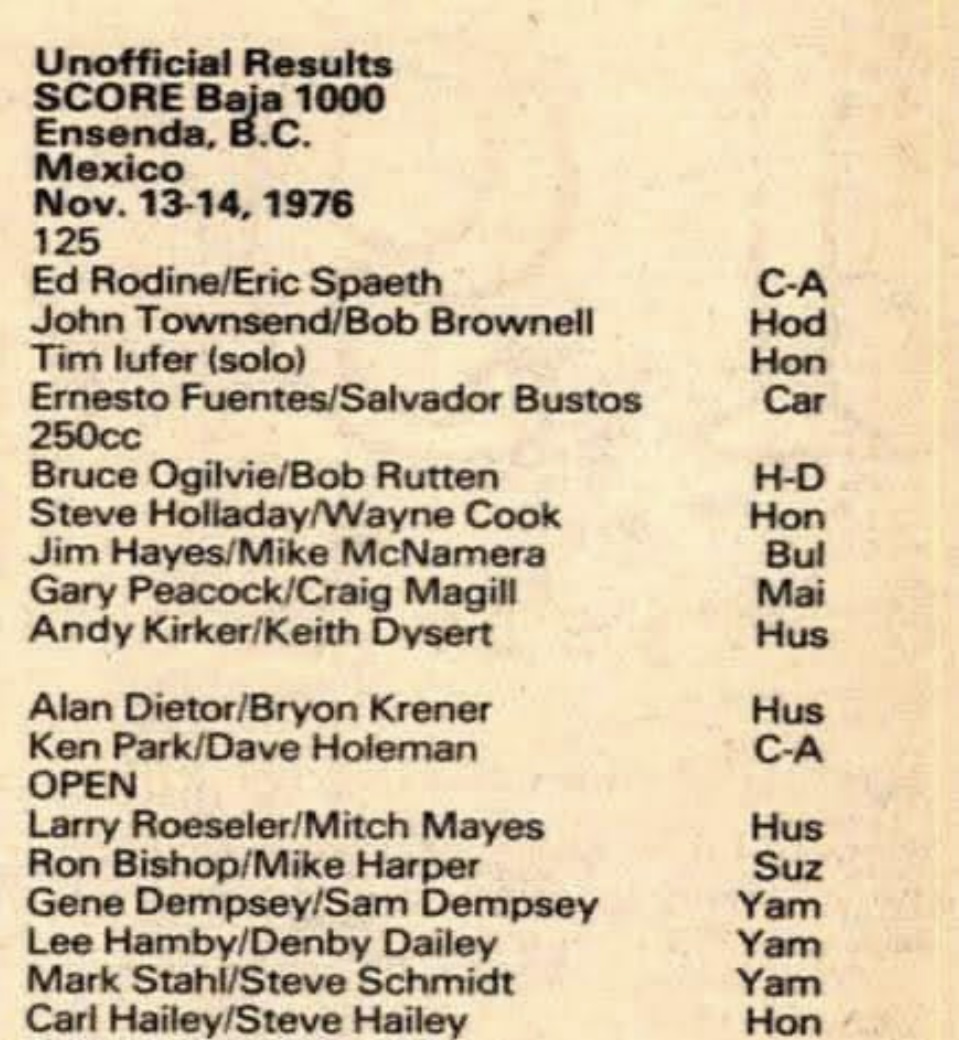
A few days ago, someone posted a results sheet from the November 1976 Baja 1000.
The page was filled with names I recognized. Many went on to become legends in off-road racing. But two names, in particular, caught my attention.
Lee Hamby and Denby Dailey.
Denby is my uncle, and Lee was his co-rider. Together, they finished fourth in the Open motorcycle class on a Yamaha…a TT 500.
The result is clean and simple.
Two names. A motorcycle. A finishing position.
Fifty years later, that’s what remains on the page.
But I know some of the stories behind that result.
The week of the race, torrential rains hit Baja. Ensenada flooded. At the time, race vehicles were placed in an impound area after tech inspection so teams couldn’t make further modifications before the start.
That year, the impound area flooded.
Riders and crews had to wade into the water, pull out their motorcycles, assess the damage, and get them running again. Before the race had even begun, they were already rescuing their equipment and solving problems they could never have anticipated.
And the flooded impound yard was only the beginning.
My parents were there as part of the support team for Denby and Lee. They spent the race trying to reach pit areas, carrying fuel and supplies, and trying to be ready when the motorcycle arrived.
Their stories were filled with floods, pouring rain, mud, washed-out roads, close calls, and long hours trying to move through Baja while the race continued around them.
I heard the stories many times growing up.
We traveled to Baja to support other races through the late 70s, 80s, 90s, and 00s. Every now and then, while driving one of those roads or waiting at a pit, a story from the ’76 race would come up.
One person would talk about the rain.
Someone else would remember pulling out that van that had flopped over on its side, blocking the only way in and out of a pit area.
Another would remember a river crossing, a mechanical problem, or a moment when it seemed unlikely that anyone would make it to the next pit.
That’s the thing about a race like the Baja 1000. There’s never just one story.
The racers are focused on the course in front of them. They’re watching the terrain, listening to the motorcycle, managing fatigue, and trying to complete their part of the race.
Meanwhile, the pit crew is living a completely different race.
They’re navigating highways and back roads, hauling tools and fuel, finding remote locations, improvising when plans fall apart, and trying to arrive before the racers.
The riders rarely know what the pit crew is going through. The pit crew rarely knows what’s happening to the riders.
Yet they’re all part of the same team, working toward the same goal.
Each person is carrying a different piece of the effort. Each is solving problems the others may never see. Each is building a collection of memories while remaining focused on their next task.
Only afterward does the full story begin to emerge.
The racers finish. The crew gathers. The urgency fades.
Someone finds a shower. The grime starts to wash away. Cuts and bruises are finally noticed. A meal appears. Many beverages are opened.
Then the stories begin.
Did you make it past that washed-out road before they closed it?
How did you get the bike running?
What happened at that river crossing?
You did what?
Only then can everyone begin to understand what the others endured. Only then can the team see the full depth of what they accomplished together.
And if they’re lucky, the racers may receive a trophy and a small check that hardly covers the cost of the fuel burned during the race.
The official result still looks simple. Fourth place.
It says nothing about the mud, the darkness, the fatigue, or the danger.
Nothing about the parents, spouses, friends, mechanics, and volunteers racing from one remote pit to another.
Nothing about the separate struggles that came together to produce that one clean line on a page.
Seeing that results sheet nearly fifty years later brought back more than a racing memory.
My parents have passed away. My Uncle Denby died last year. Lee is still with us, but I haven’t seen or spoken with him in more than a decade.
The people who lived that story are slowly disappearing.
But their story remains.
It remains in the photo Lee’s son, Scott, shared. Racers in their prime, doing what they loved and doing it well.
They couldn’t have known that half a century later, someone would look at those images alongside a yellowed results sheet and remember everything that page could never contain.
We spend much of our lives pursuing results that may someday look just as simple.
A name. A date. A title.
A finished project. A successful deal. A race result.
The record preserves the outcome, but it misses most of the story.
It leaves out the people carrying unseen burdens. The problems that were solved against all odds. The risks taken without fully realizing them. The exhaustion, improvisation, fear, laughter, camaraderie, and relief.
Fifty years later, the results fit neatly on a single page.
But oh, the stories they could tell.
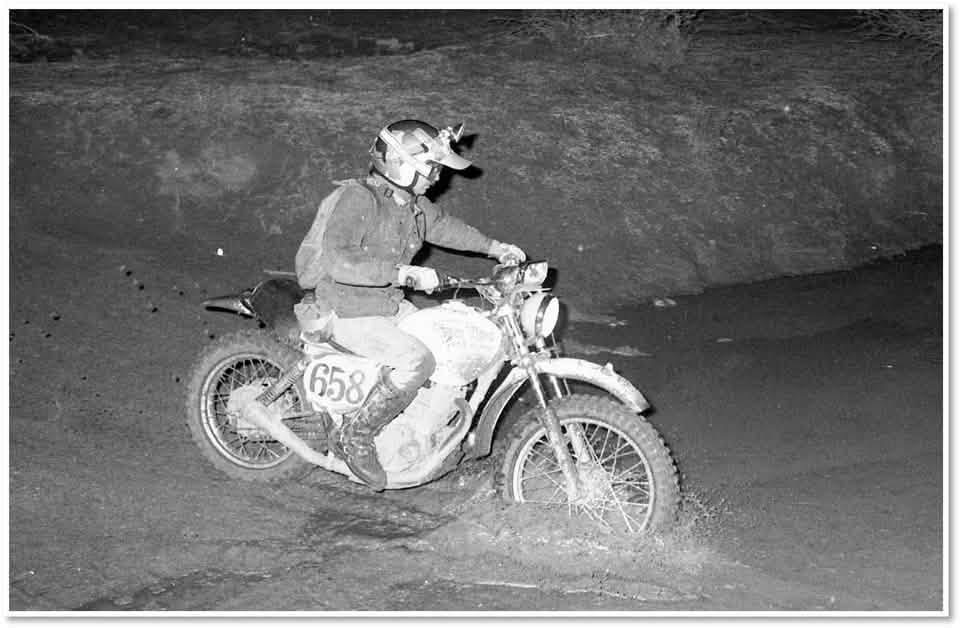
That’s Uncle Denby at a water crossing, probably before sunrise. Notice the small headlight, maybe 8 inches of travel in the shocks, and a battery-powered headlamp on his helmet. I think that was powered by a big cube-shaped lantern battery in his backpack.
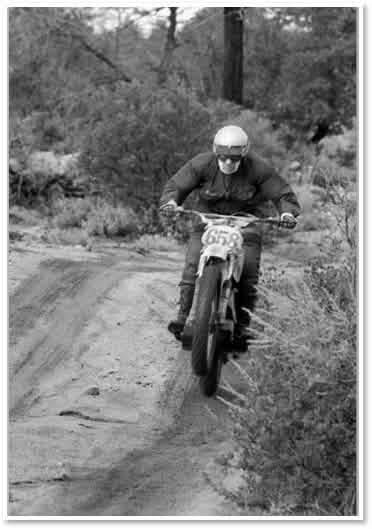
That’s Lee looking smooth!


