The Stories Behind the Results

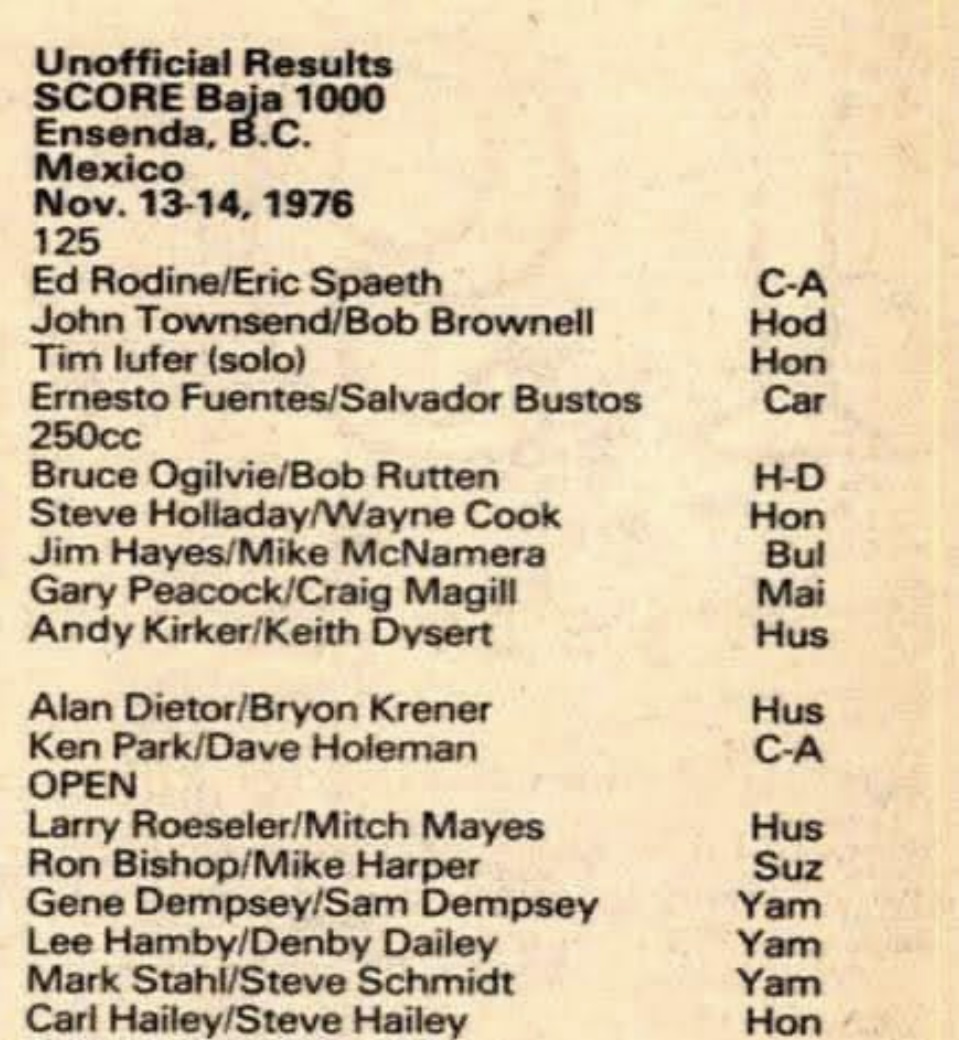
A few days ago, someone posted a results sheet from the November 1976 Baja 1000.

The page was filled with names I recognized. Many went on to become legends in off-road racing. But two names, in particular, caught my attention.

Lee Hamby and Denby Dailey.

Denby is my uncle, and Lee was his co-rider. Together, they finished fourth in the Open motorcycle class on a Yamaha…a TT 500.

The result is clean and simple.

Two names. A motorcycle. A finishing position.

Fifty years later, that’s what remains on the page.

But I know some of the stories behind that result.

The week of the race, torrential rains hit Baja. Ensenada flooded. At the time, race vehicles were placed in an impound area after tech inspection so teams couldn’t make further modifications before the start.

That year, the impound area flooded.

Riders and crews had to wade into the water, pull out their motorcycles, assess the damage, and get them running again. Before the race had even begun, they were already rescuing their equipment and solving problems they could never have anticipated.

And the flooded impound yard was only the beginning.

My parents were there as part of the support team for Denby and Lee. They spent the race trying to reach pit areas, carrying fuel and supplies, and trying to be ready when the motorcycle arrived.

Their stories were filled with floods, pouring rain, mud, washed-out roads, close calls, and long hours trying to move through Baja while the race continued around them.

I heard the stories many times growing up.

We traveled to Baja to support other races through the late 70s, 80s, 90s, and 00s. Every now and then, while driving one of those roads or waiting at a pit, a story from the ’76 race would come up.

One person would talk about the rain.

Someone else would remember pulling out that van that had flopped over on its side, blocking the only way in and out of a pit area.

Another would remember a river crossing, a mechanical problem, or a moment when it seemed unlikely that anyone would make it to the next pit.

That’s the thing about a race like the Baja 1000. There’s never just one story.

The racers are focused on the course in front of them. They’re watching the terrain, listening to the motorcycle, managing fatigue, and trying to complete their part of the race.

Meanwhile, the pit crew is living a completely different race.

They’re navigating highways and back roads, hauling tools and fuel, finding remote locations, improvising when plans fall apart, and trying to arrive before the racers.

The riders rarely know what the pit crew is going through. The pit crew rarely knows what’s happening to the riders.

Yet they’re all part of the same team, working toward the same goal.

Each person is carrying a different piece of the effort. Each is solving problems the others may never see. Each is building a collection of memories while remaining focused on their next task.

Only afterward does the full story begin to emerge.

The racers finish. The crew gathers. The urgency fades.

Someone finds a shower. The grime starts to wash away. Cuts and bruises are finally noticed. A meal appears. Many beverages are opened.

Then the stories begin.

Did you make it past that washed-out road before they closed it?

How did you get the bike running?

What happened at that river crossing?

You did what?

Only then can everyone begin to understand what the others endured. Only then can the team see the full depth of what they accomplished together.

And if they’re lucky, the racers may receive a trophy and a small check that hardly covers the cost of the fuel burned during the race.

The official result still looks simple. Fourth place.

It says nothing about the mud, the darkness, the fatigue, or the danger.

Nothing about the parents, spouses, friends, mechanics, and volunteers racing from one remote pit to another.

Nothing about the separate struggles that came together to produce that one clean line on a page.

Seeing that results sheet nearly fifty years later brought back more than a racing memory.

My parents have passed away. My Uncle Denby died last year. Lee is still with us, but I haven’t seen or spoken with him in more than a decade.

The people who lived that story are slowly disappearing.

But their story remains.

It remains in the photo Lee’s son, Scott, shared. Racers in their prime, doing what they loved and doing it well.

They couldn’t have known that half a century later, someone would look at those images alongside a yellowed results sheet and remember everything that page could never contain.

We spend much of our lives pursuing results that may someday look just as simple.

A name. A date. A title.

A finished project. A successful deal. A race result.

The record preserves the outcome, but it misses most of the story.

It leaves out the people carrying unseen burdens. The problems that were solved against all odds. The risks taken without fully realizing them. The exhaustion, improvisation, fear, laughter, camaraderie, and relief.

Fifty years later, the results fit neatly on a single page.

But oh, the stories they could tell.

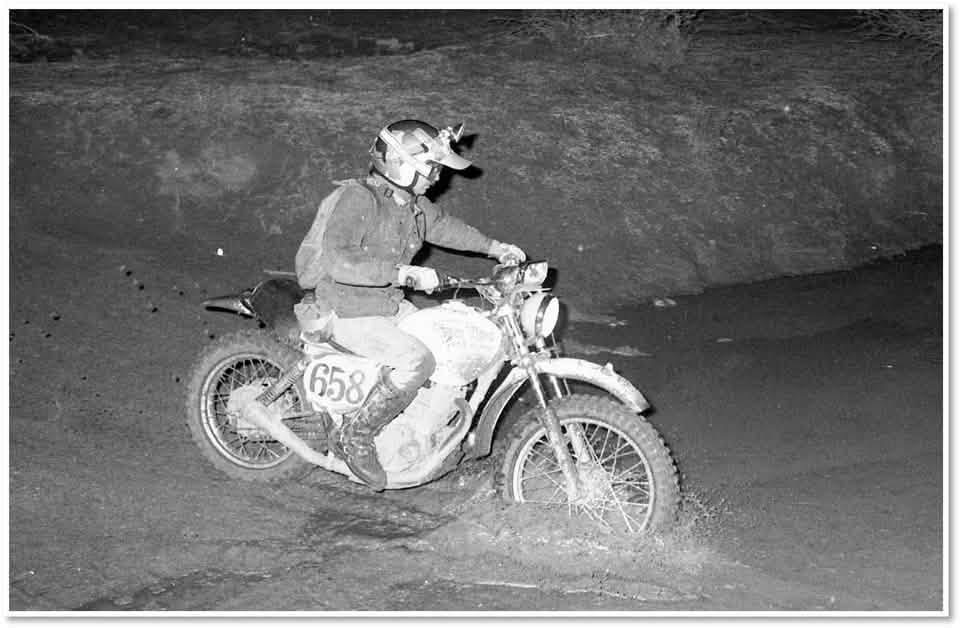
That’s Uncle Denby at a water crossing, probably before sunrise. Notice the small headlight, maybe 8 inches of travel in the shocks, and a battery-powered headlamp on his helmet. I think that was powered by a big cube-shaped lantern battery in his backpack.

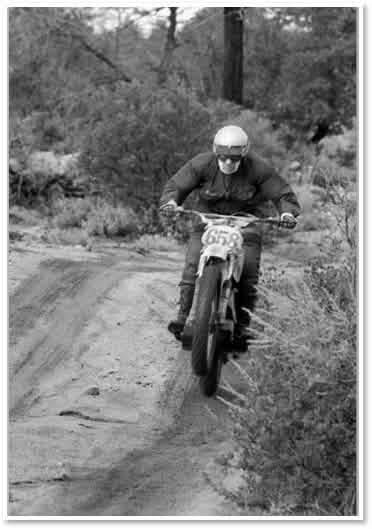
That’s Lee looking smooth!

Die Young at an Old Age

One day, someone will describe your life in a sentence.

Think about that.

Thousands of days. Millions of decisions. Victories. Failures. Friendships. Heartbreaks. Quiet acts of kindness no one else ever noticed.

Ordinary moments that turned out to matter far more than anyone realized.

One sentence.

Last week I heard someone say, “Your goal should be to die young at an old age.”

I didn’t come up with it. I don’t even know who did.

At first, it sounds backwards.

Then you realize it may be the best definition of a life well lived.

We spend enormous effort trying to add years to our lives. Maybe we should spend just as much effort adding life to our years.

Aging takes something from all of us. Our body reminds us of that every morning.

We move a little slower. We feel the miles we’ve traveled. Recovery takes a little longer.

We gradually surrender abilities we once took for granted.

None of us escape this reality.

But somewhere along the way we’ve confused physical aging with becoming old. They’re not the same thing.

Our physical abilities may decline.

Our capacity to think, reason, create, encourage, inspire, and love can continue to rise.

In fact, they should.

Judgment should become steadier. Perspective should become broader. Patience and compassion should become easier. Humility should become more natural. Our wisdom should become richer.

The tragedy isn’t growing old, but growing stale.

We’ve all met people who became old at forty.

They stopped asking questions. They stopped taking risks. Somewhere along the way, they chose to stop learning and lost their sense of wonder.

They became experts on yesterday while quietly withdrawing from tomorrow.

And we’ve all met people in their seventies, eighties, and nineties who make us feel like we’re the old ones.

They’re curious, joyful, building, mentoring, reading, writing, learning new technology, planning new adventures.

They’re planting trees whose shade they’ll never sit beneath. They expect tomorrow to matter.

They don’t have smooth skin or endless energy.

But they know life still has something left to teach.

Don’t tell me your age.

Tell me what you’re learning, what you’re building. Tell me whose life is better because you’re in it.

Tell me the dream that still excites you. Tell me what prayer you’re still praying.

Tell me what you’ve started that you may never see completed. Tell me who you’re investing in with no expectation of being repaid.

Then I’ll have a much better idea of how old you really are.


Time is a poor teacher. It doesn’t make us wiser…it just makes us older.

Reflection makes us wiser. Humility keeps us teachable. Gratitude keeps us joyful. Purpose keeps us moving.

The calendar measures the years of our life. Our character measures the life within our years.

Life eventually gives all of us the same raw materials.

Success. Failure. Disappointment. Joy. Love. Loss. Betrayal. Regret.

No one gets through life without carrying each of them.

The question isn’t whether you’ll experience them. The question is what they’ll produce.

They will either deepen you…or harden you.

A hardened person becomes cynical instead of wise. Guarded instead of generous. Slow to trust. Closed instead of curious.

More certain than teachable. Quick to criticize. Slow to hope.

A deepened person finds patience. They are compassionate. Grateful. Calm. Quick to forgive. Comfortable saying, “I was wrong.”

Age should deepen us. Never harden us.


If you’ve lived long enough, you’ve made mistakes.

Good. So have I.

The mistakes themselves aren’t the gift. The lessons are.

Every failure can become a warning light for someone else. Every scar can become a guidepost.

Every wrong turn can become directions for the person following behind you.

Don’t just tell people what you’ve learned. Show them.

Show your children what integrity looks like. Show your grandchildren what perseverance looks like.

Show younger leaders what humility looks like. Show your friends what forgiveness looks like.

Live in the opposite direction of your greatest regrets.

That’s how wisdom becomes believable.

I think that’s what it really means to die young at an old age.

To refuse cynicism. To refuse complacency.

To refuse the lie that your best contribution is already behind you.

To wake up believing there’s still something worth learning. Someone worth encouraging. Something worth creating. Someone worth forgiving.

A prayer worth praying. A mountain still worth climbing.

One day, someone will describe your life in a sentence.

I hope it isn’t about your title. Or your wealth. Or how much power you accumulated.

I hope they remember your curiosity. Your courage. Your generosity. Your faithfulness.

The way people stood a little taller after spending time with you.

The way difficult moments became lighter because you were there.

The way your life continued to bear fruit long after many people would have settled into comfort.

Growing old is a privilege. Growing stale is a choice.

So don’t spend your final decades preparing to die. Spend them preparing to live.

Live with open hands. An open mind. An open heart.

Keep learning. Keep building. Keep serving. Keep encouraging.

Keep becoming.

And when your final day arrives, may it interrupt a life that is still growing, still giving, still grateful, and still full of hope.

May you be young at a very old age.

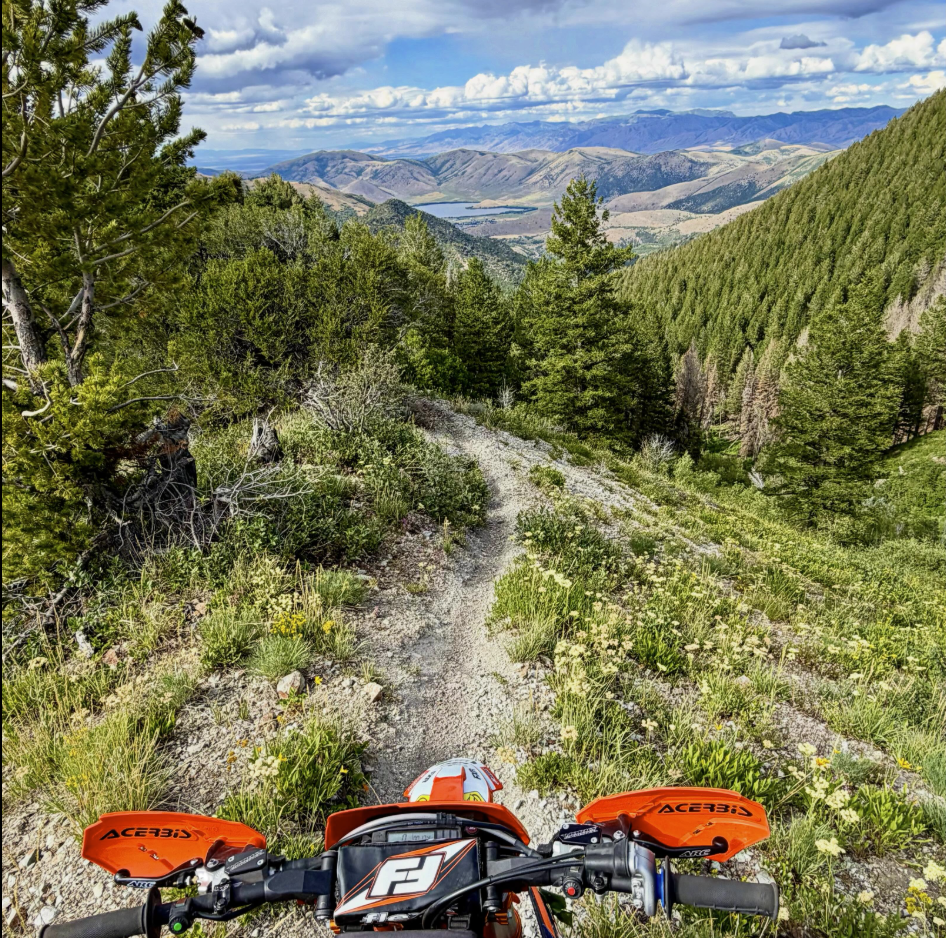
Photo by Destry Abbott – The next bend may hold the best part of your journey.

The Pressure Inside

Every now and then, I think about people who are no longer here and ask myself what they left with me. A lesson. A phrase. A moment I still can’t fully explain.

Mr. McNally left me a question.

He was teaching us about entropy in his AP Chemistry class and asked why the air in a bicycle tire doesn’t simply settle to the bottom.

Air has weight. Gravity acts on it. So why doesn’t all the air sink to the lowest part of the tire like a pile of sand? Why does it keep pressing outward against the walls?

It’s a simple image, which is probably why I still remember it almost fifty years later.

The air inside the tire is made up of tiny particles moving rapidly in every direction. They collide with each other, and with the inside wall of the tire. Those collisions create pressure.

Gravity is present but its pull is weak compared to the thermal energy of all those molecules.

The air fills the space it’s given. It presses outward. It resists settling.

That old chemistry question came back to me recently as a life question.

What keeps us from settling? From succumbing to the gravitational pull in all of us.

Staying where life feels familiar. Waiting for more certainty. Keeping the pattern because changing it will cost us something.

Waiting sounds reasonable. It borrows the language of patience, prudence, and practicality. And at times, those are the right virtues. Wisdom often tells us to slow down.

But inertia can dress itself up as wisdom. Fear can call itself realism. Comfort can pretend to be peace.

That’s when we begin settling to the bottom of our lives.

The air doesn’t fulfill its purpose by collecting in the lowest place. It fills the available space. It presses against the walls. It creates pressure because motion is still happening inside.

Human life has its own version of that energy.

Purpose. Discipline. Faith.

These keep us from sinking into the lowest-energy version of ourselves.

The tire reminds us that pressure comes from movement. A life with purpose has an outward push to it. It presses against fear, complacency, and inertia. It expands into the space it has been given.

We don’t have to be reckless or maintain constant motion. But we need enough internal purpose to overcome the quiet pull of our internal gravity.

I’m grateful Mr. McNally asked that question all those years ago. At the time, it was a chemistry lesson about entropy, motion, and pressure.

Decades later, it’s still teaching me.

The tire doesn’t fight gravity. It just has something inside it that never stops moving.

I think that’s all any of us can ask of ourselves.

Photo by Leon Seierlein on Unsplash

For Uncle Lou

Uncle Lou lived a life that, on paper, sounds larger than life.

He was a thoracic surgeon who quite literally saved lives on a regular basis. He could have filled every family gathering with stories of operating rooms, impossible cases, and professional milestones. But that’s not the way Uncle Lou did things.

Uncle Lou was far more interested in our stories than his own. He wanted to know what we were learning, what we were building, what we were excited about. He led with curiosity and humility when he had every reason to lead with his own accomplishments.

He was a craftsman in the truest sense of the word. One of his hobbies, passion really, was working in his woodshop. His healing hands created fine wood furniture that he mostly gave away to family and friends. We are blessed to have a miniature grandfather clock that he made for us, and a wooden inlaid box that sits on my nightstand.

He was an excellent golfer. I wasn’t good enough to golf in his circle, although I think he may have caught video of me hitting a tee shot backwards once (that’s a story for another time).

I learned how to play a mean air trombone from Uncle Lou. A skill he showed off many times.

Did I mention that he was an avid hiker? His retiree group, the Kaiser Retired Association of Physicians (KRAP) hiked all over the greater San Diego area. It’s clear that the KRAP group is filled with like-minded super talented, but humble, individuals who get a well-earned kick out of the acronym for their group.

His curiosity never retired. Even as his body slowed in recent years, his mind never did. I remember recent conversations with him about computers, AI technology, and rockets. He approached new ideas the same way he approached everything else…with interest, openness, and the quiet confidence of a lifelong learner. I suspect he was still reading about something new right up until the end.

As I was putting the finishing touches on this post, I realized I had left out one more facet of Uncle Lou’s amazing life. He was also a pilot. He flew his plane far and wide, often to sample the cuisine at a distant airport diner, but always for the simple joy of seeing the world from above. It seems perfectly fitting for someone so curious and alive to experience life from every vantage point. A true Renaissance man if ever I knew one.

Uncle Lou’s legacy isn’t only in the lives he saved, the furniture he built, the miles he hiked, the miles he flew, or the videos he recorded of family moments. He always made you feel you were worthy of his full attention.

Uncle Lou reminds us that a life of great achievement shines even brighter when it’s paired with humility, curiosity, and genuine interest in others.

I’ll miss his wry grin, and that twinkle in his eye that let you know he was a very serious person who didn’t take himself too seriously.

Godspeed, Uncle Lou.

The Short Memory of Institutions

“The King is dead. All hail the new king.”

For centuries, those words marked a moment of transition in a monarchy. They acknowledged loss while declaring that the kingdom would continue.

One reign ends. Another begins. The work continues.

Modern organizations operate in much the same way, just without the ceremony.


When the Ball Changes Hands

Sometimes the transition is visible. A retirement announcement made months in advance. A company-wide gathering, a slideshow of memories, a few stories capturing the arc of a career. Handshakes and hugs. People are grateful for the chance to say thank you.

Other departures unfold quietly. A decision formed over time. A conversation held in private. Recognition that the moment has arrived for something different to begin.

At times, the individual chooses the timing, sensing it’s time to redirect their energy or reclaim parts of life that have waited patiently. At other times, the organization makes the call.

It’s like a manager walking to the mound and asking the starting pitcher for the ball. The pitcher may have thrown well and kept the team in the game. A new batter steps in, and the situation calls for a different arm. The decision reflects what the moment requires. What the pitcher deserved is a different conversation.


The Half-Life of Professional Memory

Spend any time inside large organizations and you’ve witnessed what follows.

A respected leader leaves after a long and meaningful tenure. Their name surfaces occasionally.

Over time, new colleagues arrive who never worked with them. New leaders establish their own ways of operating. The organization adapts.

Work progresses while memories fade into the background.

Institutions carry short memories because continuity is the center of their purpose. Time spent dwelling on the past subtracts from their responsibility to build what comes next. This quality allows organizations to endure. From the inside, it can still be painful.


The Grief No One Mentions

We rarely dwell on the plain truth that this process hurts.

Years of personal investment in people, in solving problems, and in creating a supportive culture eventually become part of who we are. When the organization moves forward without us, it can feel like we’re diminished. Like our work didn’t matter as much as we believed.

That feeling deserves to be called grief. The natural response to losing something we genuinely loved.

Our mistake is letting that grief become a verdict.

The organization’s short memory says nothing about the value of what we contributed. It says something about how institutions are built to function. They’re designed for mission and continuity, with memory serving a different purpose. Understanding the difference doesn’t make the feeling disappear, but it does change what the feeling means.


Where Influence Actually Lives

Our work never disappears. Its impact simply resides in a different place.

The confidence someone discovers because we believed in them. The standards we upheld when it would have been easier to compromise. The steadiness we showed under pressure. The thinking patterns others continue to use long after they’ve forgotten the source.

These moments accumulate.

Lasting influence rarely lives in titles, completed initiatives, or improved metrics. Those matter deeply in their time, yet they rarely define what lasts.

Most of us can trace core insights to a teacher or mentor who shaped us. Someone who challenged us to think beyond ourselves or our capabilities, changing how we see the world. Their insight became part of who we are.

In the same way, we become that teacher in someone else’s story.


The Metric That Matters Most

Leaders who sustain themselves over the long term tend to live with dual awareness. They engage fully and care deeply about the organization’s mission. They invest in people and outcomes.

At the same time, their sense of self rests on something broader. Family, faith, health, curiosity, service, and community form a foundation that holds steady regardless of their title.

They recognize that one day the organization will continue without them, and they choose to lead in ways that remain meaningful regardless. This awareness strengthens their commitment rather than weakening it, because it clarifies what actually matters.

Eventually, each of us hand over the ball. The badge stops working. The inbox grows quiet. Someone else takes the chair.

Our opportunity is to contribute in ways that remain useful long after our names fade from conversation. Lessons carried forward through people we may never meet.

And that is enough.

Photo by Robert Stump on Unsplash

Living Inside History

Every generation believes it’s living through extraordinary change.

And in a way, every generation is right.

Economic strain, political division, conflict, and rapid technological change appear in different forms, but the underlying tension remains the same.

Ray Dalio describes what he calls the Big Cycle. The rise and decline of nations shaped by debt, money, internal division, and shifting global power. He would say we’re late in that cycle, marked by high debt, widening wealth gaps, and growing competition among world powers.

Harry Dent approaches history through demographics, studying population growth, and generational spending patterns. From his view, today’s economic strain reflects aging populations, slower growth, and the unwinding of decades of expansion.

Different perspectives. Similar conclusions.

Neither claim to predict the future with precision. Debt cycles, demographic waves, generational moods, technological revolutions, and geopolitical tensions move simultaneously. Understanding these forces and their patterns helps us recognize the currents. How we live within them is still our responsibility.

I remember the OPEC oil embargo of the 1970s and gas lines stretching for blocks. I was in elementary school as interest rates climbed above twenty percent. I watched the Reagan Revolution reshape economic thinking and bring supply-side theory into the mainstream.

I lived through the Iranian Revolution in 1979, the taking of US hostages, and the subsequent spread of militant extremism across parts of the Muslim world over the next four decades. I watched an airplane strike the World Trade Center in real time.

I grew up under the shadow of the Cold War, when nuclear conflict felt possible at any moment. I saw the optimism that followed the fall of the Soviet Union and then watched China open to the world after decades of isolation. I remember the theories about how expanding capitalism in China might soften their communist approach to governing.

I witnessed the savings and loan collapse, multiple stock market crashes, the Great Recession, and a global pandemic that disrupted economies, institutions, and families alike. I watched how strongly governments grasp control when certainty disappears.

I saw personal computers and then the internet transform daily life, followed by the digital economy, smartphones, social media, and now artificial intelligence reshaping work itself.

I can think of countless other historical events that have happened in the span of one life. Each moment felt unprecedented. Each reshaped the world, sometimes positively, sometimes negatively.

And yet, life continued.

When history is written, it focuses almost entirely on macro events. The narratives are dominated by wars, collapses, elections, revolutions, and markets. What rarely appears are the countless individual lives unfolding quietly alongside these events.

History does not record families eating dinner together during times of high inflation. Nor does it record weddings that took place during recessions or children born during wars. It overlooks the laughter that survived fear and the quiet courage required to just keep going.

But these individual experiences of life form the definition of humanity.

For every name preserved in textbooks, millions of people were doing what people have always done. They worked. They loved. They raised children. They cared for neighbors. They hoped tomorrow might be a little better than today.

Macro forces shape conditions. They influence opportunity and may narrow our options. They may, unfortunately, end our life or the lives of someone we love. But they don’t define a life.

Inside every macro upheaval exists our “micro” life. The life lived within the headlines rather than dictated by them.

The world may determine interest rates. It does not decide whether we act with kindness. It may influence careers, but it does not control our integrity. It may introduce hardship, but it does not determine how we respond.

Our response is where freedom still lives.

Viktor Frankl understood this more clearly than almost anyone. After enduring unimaginable suffering in Nazi concentration camps, he observed that nearly all external freedoms can be taken from a person. One freedom remains intact. The ability to choose one’s attitude and response to circumstances.

Events may constrain us. They may demand adaptation. They will never own our human spirit.

In my office, I have a wall filled with photographs. Family gatherings. Wedding days. Trips taken together. Beautiful places. Ordinary moments that became lasting memories.

When I step back and look at this wall, patterns appear.

We worked hard.

We made time for one another.

We traveled together.

We celebrated milestones.

We were living out our hopes and dreams, and we still are.

My wall has no charts or financial forecasts. No macro trend lines. But it tells the story of what matters most.

None of these moments waited for ideal conditions. They unfolded alongside inflation, recessions, political change, and uncertainty. The photographs capture lives shaped by ordinary but important choices made amid extraordinary times.

As we traveled, we met families across many countries. Different customs. Different faiths. Different governments. Yet everywhere we went, the hopes sounded familiar. Parents wanting the best for their children. Families striving for opportunity. Communities longing to contribute and belong.

The differences emphasized by the world shrink quickly when people speak about those they love.

Human aspirations remain remarkably consistent.

History changes its outward form. The heart changes very little.

You will live through upheavals of your own. Some will be frightening. Some will be unfair. Some will test your trust in institutions or leaders.

Remember this.

You are not responsible for controlling history. You are responsible for how you live inside it.

You will not choose the history that surrounds you. You will choose the values you carry through it.

You choose how you treat people.

You choose how to adapt.

You choose how you show up for your family.

You choose whether uncertainty hardens you or deepens your compassion.

You choose whether fear leads or faith steadies you.

These are your choices. Always.

Humanity endures because ordinary people continue to build their lives amid uncertainty. They love, they work, they fail, they adapt, and they hope, even while larger forces move around them.

While empires rise and fall, families persist.

That is the quiet march you belong to. Rarely captured by historians yet carried forward by generations.

History happens around you.

Life happens within you.

Live your life well. Love deeply. Work honestly. Stay flexible. Hold your faith. Care for one another.

If you do that, you will live a meaningful life regardless of when you were born.

As I was finishing this post, I found these quotes from George Bernard Shaw. The words come from two different writings of his from the early 1900’s. Together they express something important about what it means to live well within whatever history hands us.

“This is the true joy in life, the being used for a purpose recognized by yourself as a mighty one; the being a force of Nature instead of a feverish, selfish little clod of ailments and grievances complaining that the world will not devote itself to making you happy. “

“I am of the opinion that my life belongs to the whole community, and as long as I live it is my privilege to do for it whatsoever I can. I want to be thoroughly used up when I die, for the harder I work the more I live. I rejoice in life for its own sake. Life is no ‘brief candle’ for me. It is a sort of splendid torch, which I have got hold of for the moment; and I want to make it burn as brightly as possible before handing it on to future generations.”

h/t – Atkins Bookshelf

Photo by Federico Giampieri on Unsplash

If this post resonated with you, feel free to share it with someone who might appreciate it as well.

You can also listen to the Grandpa Bob Encouraging Leadership Podcast, where I share short reflections on leadership, life, and learning.

Thanks for reading!

Grandpa Bob Encouraging Leadership — A New Podcast

Over the last 15 years, I’ve written a lot of words.

Words shaped by work and leadership challenges.

Words that grew out of quiet reflection or things that caught my attention at just the right moment.

Many of them were also shaped by family, faith, mistakes, and moments that stayed with me longer than I expected.

More than a few people have suggested I start a podcast. They’d tell me it’s a lot easier to listen than it is to keep up with a bunch of new reading assignments each week.

While my mom was still alive and living with significant vision loss from macular degeneration, I gave the idea serious thought. Listening would have been the only practical way for her to “read” my posts.

Unfortunately, that “serious thought” didn’t turn into action in time for her to benefit.

Ironically, for someone who usually believes in starting, then figuring things out along the way, I let all the steps required to set up a podcast get in the way of beginning.

Until now.

So today, I’m launching a new podcast:

Grandpa Bob Encouraging Leadership

This podcast is a series of short reflections on leadership, life, and learning. I’m sharing them first and foremost with my grandchildren…and with anyone else who might be listening in.

The episodes are intentionally brief, thoughtful, and unhurried.

They’re the kind of reflections you can listen to on a walk, during a quiet drive, or at the start or end of your day.

They’re meant to create space, not fill it.

Who it’s for

At its heart, this podcast is for my grandkids.

Someday, years from now, I want them to be able to hear my voice and know what mattered to me.

The things I noticed. What I learned the hard way. What I hope they carry with them as they find their own way in the world.

But leadership lessons rarely belong to just one audience.

So, if you’re listening, as a parent, a leader, a teacher, or simply someone trying to live well, you’re welcome here too.

What we’ll talk about

Each episode explores a simple idea. Here are some examples:

-Showing up when progress feels slow

-Letting go of certainty

-Choosing gratitude over entitlement

-Learning to wait without drifting

-Leading with trust, humility, and patience

-Paying attention to what’s quietly shaping us

    There won’t be hype. There won’t be slogans. There certainly won’t be any fancy edits.

    I’ll discuss questions worth talking about, and observations a loving grandfather hopes to pass along to his grandkids.

    An invitation

    You can find Grandpa Bob Encouraging Leadership wherever you listen to podcasts.

    Don’t worry if you can’t listen to every episode.

    Please feel free to disagree with anything I say. I don’t have a monopoly on the right answers.

    If even one episode helps you pause, notice something new, or steady yourself a little, then it’s doing what it was meant to do.

    Thanks for listening.

    And if you’re one of my grandkids reading this someday, know that I believe in you and I’m always rooting for you.

    If you’re listening alongside them, the same is true for you.

    Photo by Patrick Fore on Unsplash

    A Parenting Prayer

    Parenting is one of the clearest places where faith meets daily life. It calls us to humility, patience, courage, generosity, and the kind of love that stretches us far beyond what we believed we could give.

    It invites us to trust God with the people most precious to us, even when the path ahead is uncertain and far beyond our view.

    The prayer below is one I’ve been working on for a while. It’s a prayer for parents at every stage of life…those just beginning, and those watching their grown children take their first steps into adulthood. It’s also for those whose children are becoming parents and carrying this calling into a new generation.

    It is a reminder that God accompanies us in the noise and the silence, the ordinary and the holy, the days that feel long and the years that pass so quickly.

    May this prayer strengthen your heart and deepen your hope as you walk this sacred calling.

    A Parenting Prayer

    God, please grant me
    The wisdom to guide my children with patience, clarity, and love
    And the humility to grow alongside them as they grow.
    Teach me to choose presence over hurry,
    Trust over fear, and connection over control.

    Give me the courage to admit when I am wrong
    And the grace to show my children that learning never ends,
    Not at 7, not at 17, not at 70.

    Help me see the world through their eyes,
    Eyes that understand wonder,
    Eyes that welcome the new with unguarded joy.
    Let their curiosity rekindle my own,
    So our home becomes a place where questions are celebrated
    And imagination roams freely.

    Give me integrity in the quiet moments,
    When my child is learning from what I do.
    Give me a heart strong enough to support them
    And gentle enough that they always feel safe coming to me.

    Teach me to treasure the small things:
    The bedtime stories,
    The long drives,
    The conversations over tacos,
    The ordinary afternoons that turn into lifelong memories.
    Remind me that these simple moments
    Will matter far more than the schedules we keep
    Or the outcomes we chase.

    Loving God,
    Free me from comparing my family to others.
    You did not design my children to fit anyone’s timeline but Yours.
    Help me trust the pace of their becoming
    And see their strengths even when they are wrapped in struggle.

    Guard me from chasing achievements that impress the world
    But neglect the souls under my roof.
    Let our home be defined by gratitude, peace, and laughter,
    With the quiet confidence that love is our foundation.

    Help me pass down what truly endures:
    Character over perfection,
    Kindness over victory,
    Service over status,
    Gratitude over entitlement.

    May the stories I tell, the choices I make,
    And the way I show up each day
    Become part of the heritage my children carry forward.
    Help me become an example worth following,
    One who lives with faithfulness, honesty, and a willingness to learn.

    Give me strength for the hard times
    And calm for the anxious nights.
    Give me a long view of parenting,
    Seeing not just who my children are today
    But who they are becoming by Your grace.

    Teach me to listen more than I lecture,
    To encourage more than I correct,
    And to guide without stifling the person
    You created them to be.

    Grant me the courage to give responsibility as they mature
    And the faith to let them walk their own path,
    Even when that path stretches beyond my view.

    Lord, may our home reflect Your kingdom,
    A place of welcome, forgiveness, generosity, and joy.
    Let my children feel seen, valued, and deeply loved,
    Not for what they do, but for who they are.

    I invite You into every step of this sacred calling.
    Walk with me in the noise and the silence,
    In the exhaustion and the celebration,
    In the days that feel long
    And the years that pass too quickly.

    Grant me the peace that comes from Your eternal and infinite love,
    Now and forever.

    Amen.

    Photo by Hu Chen on Unsplash

    The Pathways to a Rewarding Life

    Finding Purpose at Every Age

    From thirty thousand feet, the land below looks like a patchwork of roads and fields. Each marks a choice someone once made about where to go. Some stretch straight and steady. Others twist through hills or fade out of sight. Together they form a map of movement and direction, a living story of people who kept choosing the next road.

    Life feels the same way. The routes change, but the invitation stays the same. Keep moving to find greater meaning.

    The most rewarding paths often pass through three places. Serving others, staying curious, and daring to pursue new goals.

    Service opens our heart. When we give to something beyond ourselves, our life expands. For the younger generation, it teaches them that purpose grows through generosity and connection. Helping a friend, joining a cause, or showing up for someone who needs encouragement builds an identity rooted in contribution. Later in life, service transforms experience into legacy. It turns lessons into guidance and presence into impact. Every act of service whispers that we still matter.

    Curiosity keeps that whisper alive. It invites discovery and reminds us that wonder never expires. For young adults, curiosity shifts attention from comparison to possibility. It fuels creativity and builds resilience (because nobody said it would be easy). For those further down the road, curiosity revives joy. Learning something new, exploring unfamiliar tools, or asking deeper questions renews their spirit.

    Big goals complete the trio. Ambition alone can fade, but big dreams shaped by purpose bring hope to life. For the young, bold goals turn uncertainty into motion. For the experienced, they rekindle the thrill of becoming. The thrill of pursuing. Every goal, whether to build, create, teach, or grow, reminds the soul that movement still matters. Hope rises with every goal we dare to pursue.

    Many people never take these paths. Fear of failure, fear of embarrassment, fear of losing face…they each build fences where we can hide.  Quiet excuses convincing us to play small and call it wisdom.

    Fear says, “Stay comfortable.” Curiosity says, “Let’s see what happens.”

    When fear wins, both young and old lose sight of their forward motion. The young adult who fears being judged easily drifts into hopelessness. The older adult who hesitates to dream again slips into quiet surrender. The reasons sound different, yet the root feels the same. Fear has taken the wheel. Stagnation and hopelessness follow.

    Purpose waits just ahead. It lives in the next act of kindness, the next mystery to be solved, the next dream still worth chasing.

    The pathways to a rewarding life have no finish line. Every act of service, every curious step, every daring goal breathes new life into our soul.

    When we explore these paths, joy and fulfillment will be our companion.

    Photo by Line Kjær on Unsplash – I wonder what’s in the next valley.  Let’s go find out. 

    Now and Then

    The days feel long, but our years disappear. I’ve been thinking about how easily “someday” turns into “back then.” We spend so much of life working toward what’s next that we sometimes forget we’re already living the moments we’ll one day remember with gratitude.

    This truth reaches us at every age. Whether we shape our future with intention or let it unfold on its own, it arrives and quietly invites us to participate. This reflection is about the sweetness of now and noticing that these moments become the story we’re creating together.

    Each day arrives on its own, small and full of potential. It doesn’t ask for much. Only our attention, our care, and our willingness to be here. The hours move like honey, slow and golden, rich with sweetness if we take time to notice. Yet the years rush by quietly. One morning we look up and realize the future we worked toward has become the past we cherish.

    What we dreamed about for so long is happening now. This day, with its imperfections, interruptions, and small joys, is the life we once hoped to reach. It’s the tomorrow we imagined, already unfolding beneath our feet.

    Time helps us see backward with gratitude and forward with wonder. We remember the faces and laughter that have softened into memory. We hold them gently, realizing how meaning hides in ordinary moments.

    Each day is a life of its own. Complete, sacred, and fleeting. When we let its minutes open slowly, like sunlight through leaves, we find gratitude sweetening everything it touches. Our wonder grows in quiet places.

    “Then” is always born of “now.” When we live this moment with attention, kindness, and a sense of awe, it never really fades. It simply changes shape, becoming the stories we tell, the lessons we pass along, and the love that lingers long after the moment has gone.

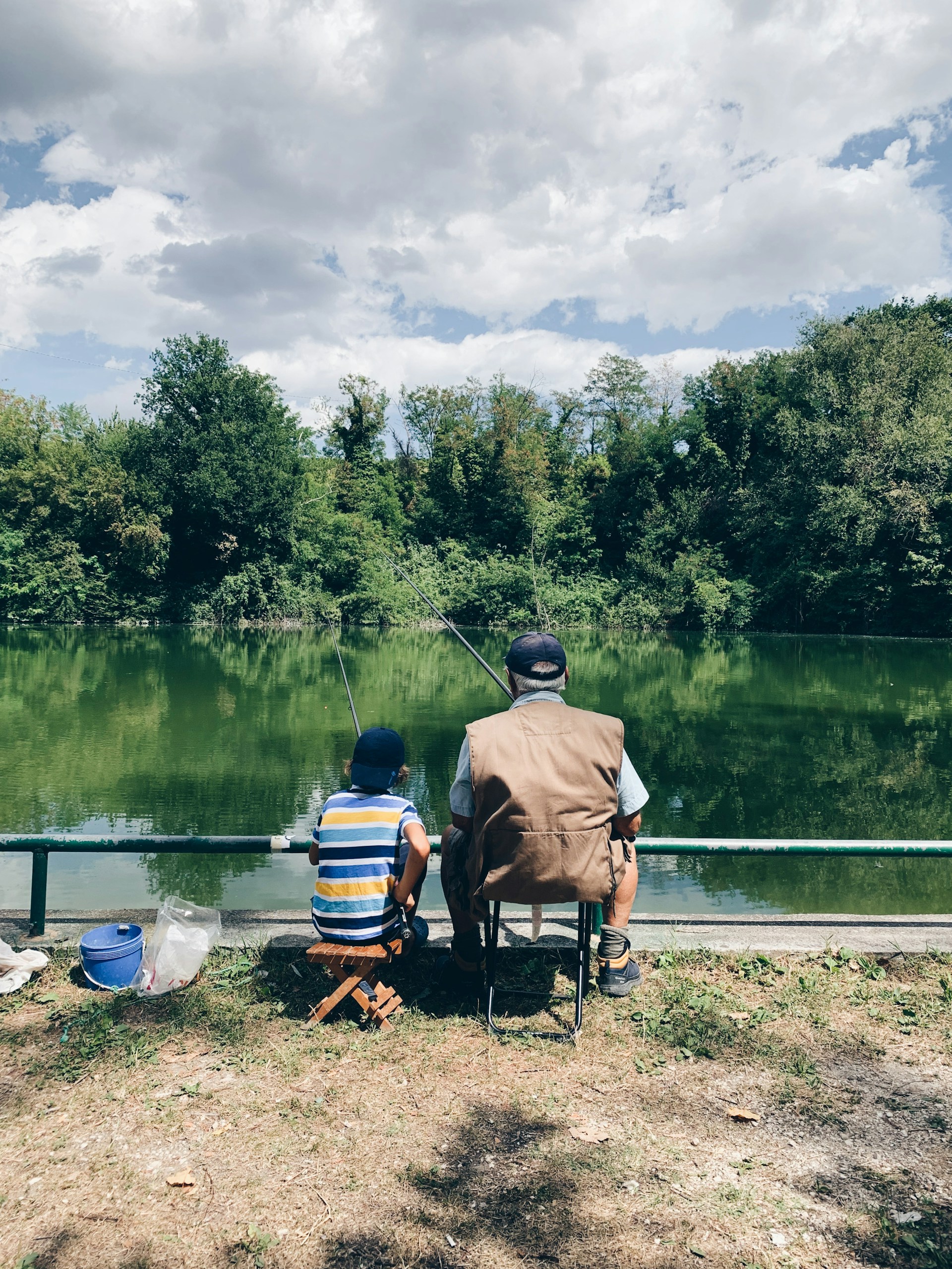
    Photo by Stephen Crane on Unsplash