From yourself. Expect to learn, grow, contribute, follow through, and occasionally surprise yourself.
From your relationships. Cultivate depth, honesty, presence, and care. Treasure the people who know you well, but don’t let your full life become a closed circle.
From your curiosity. Keep asking questions. Keep learning things you don’t understand. Stay willing to be a beginner.
From your body. Expect your body to do what it reasonably can, but don’t be afraid to push against its limits. Protect your strength, mobility, endurance, and ability to do things for yourself.
From your work. The things you choose to work on should be useful, meaningful, interesting, and worth doing well.
From your courage. Admit when you’re wrong, try things you might fail at, and choose the less comfortable path when it’s the right one.
From your attention. Decide what deserves your attention instead of surrendering it to whatever is loudest, newest, or easiest.
From your ability to contribute. Always look for ways to be useful. Teach, encourage, help, listen, solve a problem, share what you know, give your time, or carry part of the load.
From what’s still ahead. Don’t assume the most interesting parts of life have already happened. Leave room for new work, new friendships, new places, new ideas, and versions of yourself you haven’t met yet.
From your standards. Don’t let convenience or laziness redefine what you consider good enough, especially in the areas you care about most.
From your sense of wonder. Keep noticing beauty, craftsmanship, nature, music, ideas, people. Familiarity can make remarkable things seem ordinary if you let it.
From your sense of possibility. Don’t become too quick to decide what can’t happen, what won’t work, or what’s no longer for you. Some doors close. Others are easy to overlook because you’ve stopped checking them.
From the life you have now. Don’t wait for everything to be settled before you fully engage with your life. There will always be another problem to solve. Problems aren’t interruptions to the life you’re trying to get to. They’re part of the life you’re living.
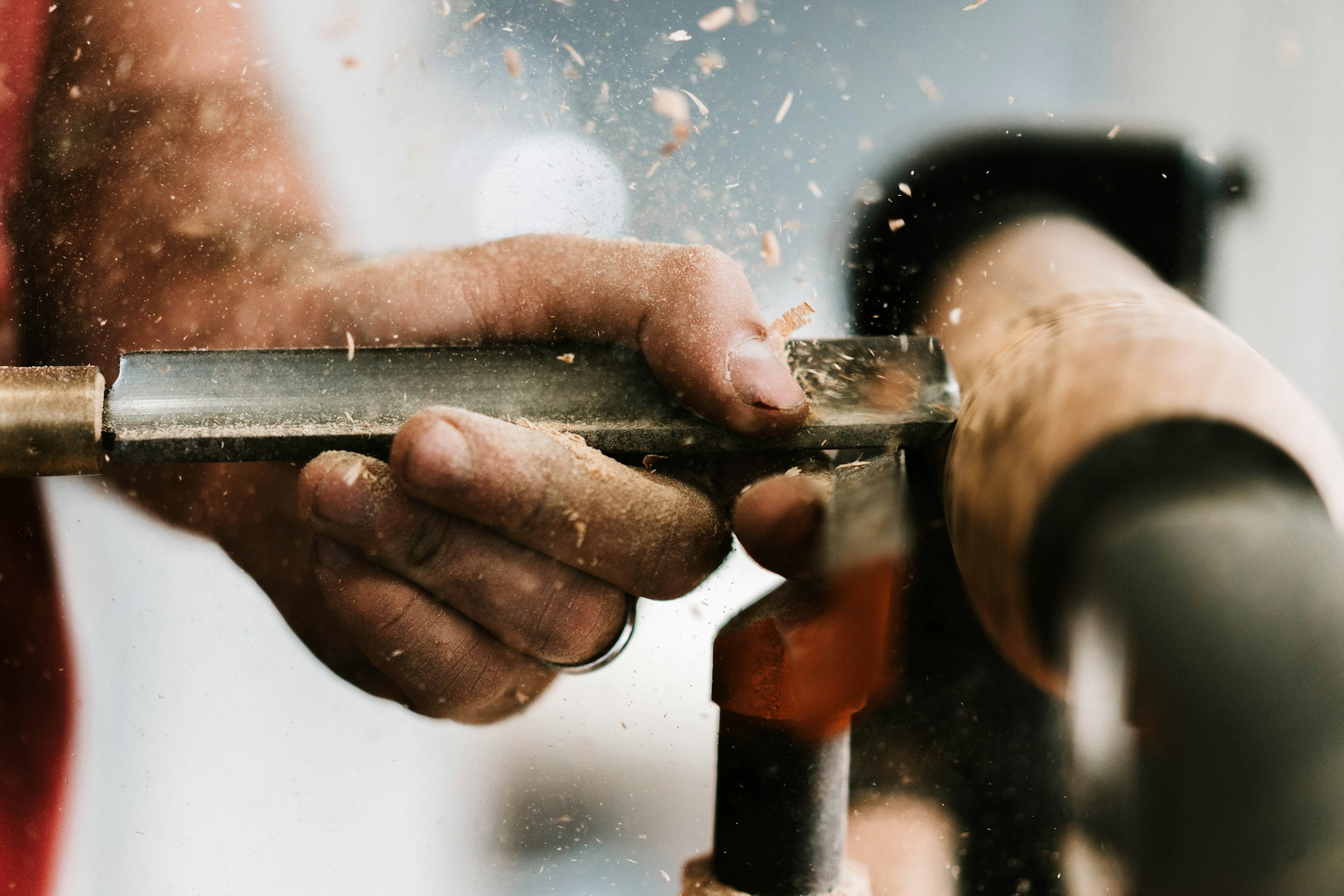
Photo by Austin Ramsey on Unsplash – With every revolution, something new is revealed.
Every now and then, I think about people who are no longer here and ask myself what they left with me. A lesson. A phrase. A moment I still can’t fully explain.
Mr. McNally left me a question.
He was teaching us about entropy in his AP Chemistry class and asked why the air in a bicycle tire doesn’t simply settle to the bottom.
Air has weight. Gravity acts on it. So why doesn’t all the air sink to the lowest part of the tire like a pile of sand? Why does it keep pressing outward against the walls?
It’s a simple image, which is probably why I still remember it almost fifty years later.
The air inside the tire is made up of tiny particles moving rapidly in every direction. They collide with each other, and with the inside wall of the tire. Those collisions create pressure.
Gravity is present but its pull is weak compared to the thermal energy of all those molecules.
The air fills the space it’s given. It presses outward. It resists settling.
That old chemistry question came back to me recently as a life question.
What keeps us from settling? From succumbing to the gravitational pull in all of us.
Staying where life feels familiar. Waiting for more certainty. Keeping the pattern because changing it will cost us something.
Waiting sounds reasonable. It borrows the language of patience, prudence, and practicality. And at times, those are the right virtues. Wisdom often tells us to slow down.
But inertia can dress itself up as wisdom. Fear can call itself realism. Comfort can pretend to be peace.
That’s when we begin settling to the bottom of our lives.
The air doesn’t fulfill its purpose by collecting in the lowest place. It fills the available space. It presses against the walls. It creates pressure because motion is still happening inside.
Human life has its own version of that energy.
Purpose. Discipline. Faith.
These keep us from sinking into the lowest-energy version of ourselves.
The tire reminds us that pressure comes from movement. A life with purpose has an outward push to it. It presses against fear, complacency, and inertia. It expands into the space it has been given.
We don’t have to be reckless or maintain constant motion. But we need enough internal purpose to overcome the quiet pull of our internal gravity.
I’m grateful Mr. McNally asked that question all those years ago. At the time, it was a chemistry lesson about entropy, motion, and pressure.
Decades later, it’s still teaching me.
The tire doesn’t fight gravity. It just has something inside it that never stops moving.
I think that’s all any of us can ask of ourselves.
Graduation has a way of making ordinary questions feel enormous.
What are you going to do next?Where are you going to school?What trade are you going into?Where are you going to work?What are you going to do with your life?
That last question is the one that sneaks into our subconscious. It turns our celebration into a test. It makes a young person feel like their next decision carries the weight of the next fifty years.
Trust me. It doesn’t.
You’re not choosing your whole life this year. You’re choosing the next step.
That next step still deserves careful thought. Some choices will open doors; others will close them…and some will make the road harder than it needs to be.
But don’t hand this one decision more power than it deserves.
Your first job isn’t a life sentence. Your major isn’t your permanent identity. Your first trade, internship, military assignment, certification, apprenticeship, or business idea marks where the road begins, not where it ends.
Most lives travel roads we couldn’t have mapped in advance. One small opportunity today may connect you to a person who changes your direction entirely. One ordinary job may teach you something that becomes useful ten years later. A disappointment may save you from staying on the wrong road for too long.
You may move around. You might take a job that makes sense now and later discover it doesn’t fit who you are or what your life requires. Your priorities will change. The economy will change. A job can be a great opportunity, but it is rarely a lifetime guarantee.
Employers may invest in you when you serve their needs and (fairly or unfairly) move on when they believe you no longer do. Doors may close for reasons having little to do with your effort or character. That doesn’t mean you failed. It means you’re living in a world that keeps moving. Knowing that can help you walk into each opportunity with your eyes open.
Character, hard work, and skills all carry weight, but many opportunities come through people. The people who trust you, teach you, recommend you, challenge you, and remember how you treated them may influence your future in ways no resume ever could.
Build your life on something stronger than the assumption that one company, one industry, one credential, or one carefully written plan will carry you safely from here to retirement.
Learn how to add value. That phrase sounds like a business platitude, but strip away the jargon and it’s the oldest human question. Can people count on you for something real?
Can you solve a problem? Can you make something better? Can you be trusted with responsibility? Can you communicate clearly? Can you tell the truth when it would be easier to hide? Can you learn something new without treating the need to learn as an insult?
Can you help the people around you succeed? Can you walk into a messy situation and leave it better than you found it?
People who can do these things will usually find a way forward. Maybe not on the exact timeline they imagined. But useful, trustworthy, curious, steady people tend to create options for themselves over time.
Graduates hear a lot about jobs, majors, trades, degrees, salaries, and careers. All are serious things, and they deserve real thought. It’s good to learn skills. It’s good to earn your living and eventually support a family if that becomes part of your life. It’s good to contribute useful work to the world.
But your career isn’t your whole life.
A great resume with a lonely heart is still a lonely life. A strong paycheck with shallow relationships won’t feel as rich as you think it will.
A respected title can’t sit with you at the kitchen table. It won’t laugh with you around a campfire. It can’t pray for you, forgive you, challenge you, remember old stories with you, or show up when things are going wrong.
Much of your deepest joy will come from the relationships you cultivate. The people you love. The people who love you. The friends who walk with you. The family you stay connected to. The conversations you remember years later. The long drives. The late night talks.
The unexpected kindness. The forgiveness given and received.
By the time you graduate, you may already know some of the people who will still be part of your life fifty years from now. You won’t know which ones yet. Some will drift away. Some will surprise you and stay.
And after graduation, you’ll meet more. Pay attention. One may become your spouse. Some will teach you. Some will test you. Some will need your help. Some may help save you from yourself.
The world will ask what you do. But life will eventually ask better questions.
Who do you love? Who can count on you? Who tells you the truth? Who do you encourage? Who do you forgive? Who have you helped carry a burden they couldn’t carry alone? What are you doing with your soul?
These questions will stay with you long after the name of your first employer has faded into the background.
Choose the school, the job, the trade, the service path, or the next assignment with as much wisdom as you can gather. Ask questions. Do research. Talk to people who have walked farther down the road.
Listen to your parents, even when you think they don’t fully understand the world you’re entering. They may not understand every tool or pressure you face, but they know more than you think about disappointment, responsibility, sacrifice, and love.
Then move.
Do the work in front of you. Show up on time (which is 15 minutes early). Tell the truth. Be easy to trust. Learn the tools. Respect the people. Ask better questions. Pay attention to what gives you energy and what drains it. Notice where your abilities meet someone else’s needs. Be willing to change direction without turning that change into a personal crisis.
A wise life is rarely built from one perfect decision made at eighteen or twenty-two. It’s built from thousands of smaller decisions made over time. Some will be mistakes and that’s part of the deal.
The goal isn’t to live without mistakes. It’s to tell the truth when they happen, learn what they have to teach, repair what you can, and keep walking with a little more knowledge than before.
Graduation is worth celebrating. You finished something difficult, and finishing should be honored. Enjoy the moment. Thank the people who helped you get here.
Then take a deep breath.
You don’t have to solve your whole life before the celebration is over. You won’t know every turn, every job, every friendship, every disappointment, or every joy waiting along the way.
You have enough to take the next step with care, humility, gratitude, and hope, trusting that life will teach you more as you walk.
I spent an evening recently with a group of old friends. Some of us have known each other for nearly forty years.
We sat around an old poker table, laughing like no time had passed at all. The betting was fierce, of course. Quarter bets. Fifty-cent raises. The occasional dollar wager from the high rollers at the table.
As the cards moved around the table, so did the stories.
We talked about back surgeries and strange new ailments. About retirement and semi-retirement. After all the years of working, preparing, striving, building, and planning, some of us are finally approaching this new stage of life. Others are already there. We compared notes on life after full-time careers and our changing focus from building wealth to stewarding time.
We talked about the crazy new toys (tools) some of us have acquired since we were last together. Tractors, airplanes, boats, trailers, CNC machines, and 3D printers. The kinds of purchases that make complete sense when practicality and childhood fascination peacefully coexist.
We talked about trips around the world. Cruises through the Panama Canal. Journeys to India and South America, Thailand, New Zealand, Australia and Malaysia, Greece and the Canary Islands. Places we probably never imagined visiting when we first knew each other.
We shared tragic updates too. Losses. Wounds. Stories that carry real pain even when told calmly. The room would go quiet. Respectful. The kind of quiet that only comes when people trust each other enough to say the hard things out loud.
And then there were the stories of redemption. Recovery. Healing. The moments where life knocked someone down and, somehow, they found their footing again.
The conversation moved naturally between laughter and seriousness the way it often does when people have enough history together.
We traded lines like “You haven’t changed,” and “My God, you’ve gotten old.”
Both statements are somehow true at the same time.
Old friends see something unique in each other. They remember earlier versions of us that still exist somewhere underneath the gray hair, reading glasses, surgeries, accomplishments, disappointments, and miles traveled. Old friends carry evidence of our lives in our shared memories.
It’s comforting to realize we’ve all aged together. Nobody escaped it. We all crossed the years side by side, whether we saw each other often or not.
The poker game became a kind of metaphor for life. Checking. Raising. Calling. Bluffing a little. Winning a few. Losing a few. Staying in the game long enough to laugh about it afterward.
It’s probably a stretch to call the games we played “real poker.” The bets were small. The real stakes had nothing to do with money.
We left carrying fresh memories, renewed connections, and that warm sense that our lives are tied together across past, present, and future. Even after long gaps between gatherings, we can still sit down and pick up the conversation almost exactly where we left it.
Not everyone gets friendships that last thirty or forty years. That kind of shared history is one of life’s greatest treasures.
Sometimes it shows up around an old poker table. A deck of cards. Some unhealthy snacks. And decades of history that nobody can explain.
Our oldest grandson turned 13 this week. In honor of this auspicious occasion, here’s some advice from a grandpa’s perspective…
Turning 13 feels important because it is.
You’re not a little kid anymore, but you’re not grown either. You’re standing in that in-between place where life starts opening up in new ways. You begin to think more for yourself. You start noticing the world differently. You begin asking bigger questions.
Who am I? What am I good at? What do I want to do with my life?
All excellent questions, and you don’t need perfect answers yet. In fact, you’ll ask the same questions at 18, at 25, at 40, and again at 60. Life keeps moving and we keep growing. The answer you give today isn’t supposed to be your final answer.
So don’t panic if you don’t know exactly what you want to do with your life. Most people don’t.
Having your whole future mapped out right now isn’t the priority. Becoming the person who can handle that future is.
Hold on to your integrity.
Tell the truth. Keep your word. Do the right thing, especially when there’s nothing in it for you. That last part matters more than most people realize. It’s easy to do the right thing when someone’s keeping score. The real test is what you do when no one is.
Don’t trade your character for attention, approval, popularity, or convenience. A lot can be rebuilt in life. Trust is hard to rebuild once you break it.
Stay close to God.
You won’t understand everything all at once. Nobody does. But keep your heart turned toward Him. Pray. Ask for wisdom. Pay attention. Learn to trust that there’s more going on in life than whatever feels big in the moment. Your faith will steady you when your feelings don’t. It’ll remind you who you are when the world tries to define you by something smaller.
Stay in a service mindset.
Look beyond yourself. Learn to help. Learn to notice when someone needs encouragement. Learn to carry your share. Learn to be useful. Be someone people can count on.
A life built only around what do I want gets very small in a hurry. A life that asks how can I help or how can I add value grows deeper and more meaningful. You’ll find a lot of what matters in life while serving, building, learning, and staying faithful in ordinary things.
Work with everything you have, even when no one is watching.
Somewhere along the way our culture started treating hard work as just a means to an end, something we do to get paid or get ahead. But there’s a much older and better way to think about it.
Quality work builds character. It builds discipline. It builds something larger than the task in front of you. Every time you give full effort to something ordinary, you’re quietly shaping the excellent person you can be. That adds up in ways that are hard to see at 13 but impossible to miss at 30.
Half-effort becomes a habit just as easily as full effort does. The habits you build at 13, 14, and 15 will be the ones carrying you at 25 and 35.
Don’t wait for someone to be watching before you give your best. Work hard at school. Work hard at home. Learn to finish what you start. Learn to be corrected without falling apart. Learn to keep showing up even when it’s hard and nobody’s clapping.
None of this sounds flashy because it isn’t. A lot of what makes a strong life is built quietly.
You’ll fail at things. Do it anyway.
At some point, you’re going to try hard at something and still come up short. You’ll miss the cut. You’ll bomb a test you studied for. You’ll lose a game that matters. You’ll say something wrong at the worst moment. That’s part of being alive and actually trying. It says nothing about whether you’re good enough.
What happens after you fail is the part that defines you. You can let it pull you back, make you more careful, more afraid to try. Or you can let it teach you something and keep going.
Most of the people worth looking up to in life have a longer list of failures than you’d expect. They just didn’t stop.
Don’t be so afraid of failing that you stop reaching. And when you do fail, get back up, figure out what you can learn from it, and go again.
Don’t compare yourself to everyone else.
You’ll be tempted to measure your life against what everyone else seems to have, seem to be, or seems to be doing.
Comparison is a thief. It steals your happiness. It distracts your focus from your own path and wastes your attention on someone else’s highlight reel. The person you’re comparing yourself to is probably doing the same thing in a different direction.
Run your own race. You’re not behind. You’re not ahead. You’re exactly where you should be. The question isn’t why do they have what I don’t. It’s what am I going to do with what I’ve been given.
Stop assuming the world is against you.
This one is worth learning early so you don’t waste years that could have been spent building. When things go wrong, and they will, your first instinct will be to look for someone to blame. A teacher. A coach. An umpire. A parent. Your boss. The system. Sometimes that blame might even be partly true.
None of that matters. You don’t control what other people do. You control what you do. The moment you decide that your success or failure is mostly someone else’s responsibility, you hand over the most powerful thing you have. Your own effort and your own choices.
Work on what you can control. Improve your attitude. Improve your skills. Improve your effort. Stop waiting for circumstances to be fair before you try. Life isn’t always fair. The people who accomplish things don’t wait for it to be.
About your parents.
They really do want what’s best for you. That may be hard to believe sometimes. They won’t always explain things perfectly or get every decision right. They’re human, just like you. Beyond the rules, the questions, the concern, and the occasional frustration is something very simple. They want you to have a good life.
Try to remember that when you feel misunderstood. Talk to them. Listen to them. Let them help you.
And one day, if life takes you far away geographically, stay connected. Call home. Answer texts. Show up when you can. These relationships are worth more than most people realize when they’re young.
About your brothers and sisters.
Yes, they may annoy you. Yes, they may know exactly how to push your buttons. That’s part of the deal. But they’re also part of the very small group of people who know your whole story, where you came from, and what you’ve been through. They know parts of you the rest of the world never sees.
Be there for them. Don’t let small things turn into long separations. Give grace. Stay loyal. Repair things when you can. A strong family is one of life’s great blessings. Don’t treat it casually.
Pay attention to who you spend your time with.
We tend to become a version of the people we’re closest to. Not instantly, and not completely, but over time the people around us shape how we think, what we tolerate, what we aim for, and the person we grow into. Look at the five or ten people you spend the most time with and you’ll get a pretty honest picture of the direction you’re heading.
That doesn’t mean you have to be cold or calculating about friendship. But you should choose your close friends carefully. Find people who are honest with you, who push you to be better, who you actually respect. Be the kind of friend who does the same for them. And if you find yourself around people who consistently pull you toward things you know aren’t right, it’s okay to create some distance. Let them go. That’s not disloyalty. That’s wisdom.
Your words have more weight than you realize.
What you say about people, how you say it, and what you say behind their backs follows you longer than you’d think. At your age, a lot of the cruelty that happens between people happens through words. It often feels small in the moment, like just joking around or venting. But words land hard, and sometimes they leave marks that last a long time.
Be someone known for building people up more than tearing them down. Speak honestly but speak with care. Don’t traffic in gossip. Don’t pile on when someone’s already down. You won’t always get this right, but making it a habit to think before you speak is one of the best habits you can build right now.
Take care of your body. It affects everything else.
We only get one body. Take care of it as if your life depends on it (because it does).
This doesn’t need to be complicated. Sleep matters more than most teenagers believe it does. What you eat affects how you feel and how clearly you think.
Regular exercise probably isn’t a challenge at your age. But as you get older and take on more responsibilities, making this a priority will be difficult. Moving your body regularly, whether that’s a sport, working out, or just staying active, will serve you well for decades to come.
You’re building habits right now that will follow you into adulthood. The kids who learn to get enough sleep, stay reasonably active, and not wreck themselves with junk will have a real advantage over the ones who don’t. That gap grows over time.
Your body is going to carry you through a long life. Treat it accordingly.
One more thing.
You don’t need to impress everybody. You don’t need to look older than you are. You don’t need to rush into every version of growing up just because the world makes it look cool.
There’s no prize for becoming cynical early. There’s no prize for being hardened before your time.
Real strength tells the truth. Real strength keeps going. Real strength is teachable. Real strength can laugh, can apologize, can be trusted.
You don’t need to become everything right now. You just need to keep growing, one good choice at a time, one hard thing faced instead of avoided. One day at a time.
And when you don’t know exactly what comes next, go back to the basics. Stay honest. Stay close to God. Love your family. Help where you can. Work hard. Keep learning.
This path may not answer every question immediately, but it’ll keep carrying you toward a life that means something.
Many of us have felt it. That quiet, persistent yearning for life to just settle down for a while.
We imagine a stretch of road where the strain lets up, the demands lighten, and we can move forward without so much weight on our shoulders. We tell ourselves that after enough years, enough lessons, enough work, and enough milestones, there ought to be a time when things begin to coast.
That hope is understandable. We carry a lot. We get tired. We get worn down.
But easy rarely waits for us around the bend. More often, what comes instead is something better.
Perspective. Wisdom. A clearer sense of what’s worth our energy and what’s worth leaving behind.
With time, we may carry life with more grace. We may stop pouring ourselves into things that never deserved that much from us. We may learn the wisdom of laying down false guilt, unnecessary fear, stale resentment, and the crushing expectations that come from trying to live someone else’s life.
A good bit of suffering comes from carrying weight we were never meant to bear.
Of course, knowing what to set down is its own kind of work. It takes honesty to name what we’ve been carrying needlessly. It takes courage to actually let it go.
But even after we set those things down, effort remains. That’s a feature, rather than a flaw, in life’s design.
Work requires our attention. Relationships ask for our patience. Growth brings discomfort. Purpose calls for sacrifice, and faith asks for trust.
Effort remains part of a life that’s awake and engaged.
Sometimes what we call easy is really just familiarity. We know the terrain. We know the language. We know how to move around in it. That can feel easier, but familiar things can still cost us. They can still ask for endurance, humility, steadiness, and resilience.
Maybe relief is the most honest word for what we’re seeking.
We want a little less pressure. A little less uncertainty. A little less disappointment. A little less striving. We want room to breathe.
There’s nothing wrong with that. Relief is human. Rest is holy. Recovery matters.
But relief differs from a life free of demands. And deep down, most of us would find such a life unsatisfying.
We may say we want to coast. We may fantasize about “easy street.” We may imagine how nice it would be if everything just ran smoothly for a while. But too much ease has a way of hollowing us out, leaving us restless, a little purposeless, quietly bored with ourselves.
We were made for engagement. We want to build, help, solve, shape, encourage, contribute, and grow. We want to know that our presence still counts for something.
That’s why a completely easy life, if such a thing existed, would probably disappoint us pretty quickly.
We were made for meaningful effort, and that’s where we find ourselves most alive.
The question, then, is less about whether life will ever become easy and more about whether we’re giving ourselves to things that build something in us and around us. Things connected to purpose, love, responsibility, service, growth, and calling.
Giving ourselves to the right things helps us stop feeling sorry for ourselves and start paying attention again. It steadies us for the chapter we’re in, rather than the imaginary one we hope will arrive.
As long as we’re here, there’ll be something in front of us asking for effort.
Some of the fears running things in our lives were never ours to begin with. We watched someone lose and decided losing was the lesson. We watched someone speak up and get burned, so we got quiet. We watched someone try and then called their failure a warning. We told ourselves we were being realistic when we were just hiding safely behind their wreckage.
We rarely see the whole picture of someone else’s failure. We don’t see the blind spots, the ignored warnings, the weak foundation, the compromises nobody talked about, or the timing that was just off. We only see the ending, and then we build ourselves a new law out of it.
Something inside us says, See? That’s what happens.
No. That’s what happened.
One word. One syllable. The difference between a lesson and a life sentence.
Fear is a fast learner. It sees one example and it moves. It doesn’t wait for data. It doesn’t wait for context. It doesn’t wait for us to think.
Sometimes that’s exactly right. Some roads do end in ruin. Some boundaries are wisdom. There are dangers in life that should be taken seriously the first time, not the fifth.
But fear can collapse categories too quickly. It can treat a predator and a conversation as though they deserve the same response.
One difficult conversation becomes I’ll never bring that up again. One rejection becomes I’m done. One betrayal becomes Trust no one.
Fear stops being a warning. It becomes a tyrant. And tyrants imprison more than they protect.
Sometimes it isn’t safety we’re protecting. It’s our pride. Our delicate image. The deep terror of being seen trying and coming up short. That type of fear can sound like logic. It can sound like experience. And it can rob us quietly for years.
I’ve seen people let one example define them. One disappointment. One humiliation. One loss. One story, often somebody else’s story, lodged deep in their imagination.
But one example is a terrible god. It asks for too much. It explains too little. And it leaves too many good things untried.
Fear only needs one example.
Our wisdom must decide how much authority we give it.
The idea was simple. If you look closely at life, you’ll see that everyone is climbing something.
A career. A relationship. A difficult time in their lives. A personal challenge.
Life has a way of placing mountains in front of us. Or maybe…we’re just good at finding them.
As I wrote back then, the climb only makes sense from the inside. Watching others or hearing their stories are no substitute for taking it on yourself.
There was another part of the metaphor that mattered even more.
Many of us start the climb with backpacks full of things that make our journey harder than it needs to be. Old resentments. Lingering disappointments. Criticism that stuck with us longer than it should have. Sometimes we even carry baggage that belongs to someone else.
Years later, I came across a Buddhist parable that gave a new wrapper to this idea. It described people walking through life carrying large boulders. Anger. Ego. Grudges. The suffering didn’t come from the boulders themselves. It came from choosing to pick them up.
Whenever a hill approached, I had a habit of shifting into an easier gear before the climb even began. It felt like preparation. It felt like the smart thing to do.
One day I tried something different. Instead of downshifting, I shifted to a higher gear and pushed harder.
To my surprise, I climbed much faster than before, without bonking like I thought might happen.
Sometimes growth means discovering we’re stronger than we realize.
That experience raised questions I still ask myself.
Where else in life do I downshift before the hill arrives?
Am I protecting myself from difficulty…or underestimating what I’m capable of?
Recently, I read a post by Tim Ferriss about the “self-help trap.” He described sitting around a campfire one evening with a small group of close friends, the kind of unhurried night where the conversation slows down enough for truths to surface. He found himself thinking about the fire, and then realizing the fire wasn’t the point. The people sitting around it were.
He described how easily we can become so absorbed in optimizing ourselves, tracking progress, chasing improvement, climbing toward our next summit, that we lose sight of why we started climbing in the first place.
Summits will eventually fade. Our achievements will blur with time. Recognition disappears quicker than we expect.
Perhaps the real work of self-improvement is simpler than we think.
The rocks we’re carrying were never necessary.
The hills we fear are usually smaller than we imagine, or remember.
And the fire, the one worth tending, isn’t the one powering our ambition. It’s the one we gather around with the people we love.
Over the last 15 years, I’ve written a lot of words.
Words shaped by work and leadership challenges.
Words that grew out of quiet reflection or things that caught my attention at just the right moment.
Many of them were also shaped by family, faith, mistakes, and moments that stayed with me longer than I expected.
More than a few people have suggested I start a podcast. They’d tell me it’s a lot easier to listen than it is to keep up with a bunch of new reading assignments each week.
While my mom was still alive and living with significant vision loss from macular degeneration, I gave the idea serious thought. Listening would have been the only practical way for her to “read” my posts.
Unfortunately, that “serious thought” didn’t turn into action in time for her to benefit.
Ironically, for someone who usually believes in starting, then figuring things out along the way, I let all the steps required to set up a podcast get in the way of beginning.
Until now.
So today, I’m launching a new podcast:
Grandpa Bob Encouraging Leadership
This podcast is a series of short reflections on leadership, life, and learning. I’m sharing them first and foremost with my grandchildren…and with anyone else who might be listening in.
The episodes are intentionally brief, thoughtful, and unhurried.
They’re the kind of reflections you can listen to on a walk, during a quiet drive, or at the start or end of your day.
They’re meant to create space, not fill it.
Who it’s for
At its heart, this podcast is for my grandkids.
Someday, years from now, I want them to be able to hear my voice and know what mattered to me.
The things I noticed. What I learned the hard way. What I hope they carry with them as they find their own way in the world.
But leadership lessons rarely belong to just one audience.
So, if you’re listening, as a parent, a leader, a teacher, or simply someone trying to live well, you’re welcome here too.
What we’ll talk about
Each episode explores a simple idea. Here are some examples:
-Showing up when progress feels slow
-Letting go of certainty
-Choosing gratitude over entitlement
-Learning to wait without drifting
-Leading with trust, humility, and patience
-Paying attention to what’s quietly shaping us
There won’t be hype. There won’t be slogans. There certainly won’t be any fancy edits.
I’ll discuss questions worth talking about, and observations a loving grandfather hopes to pass along to his grandkids.
An invitation
You can find Grandpa Bob Encouraging Leadership wherever you listen to podcasts.
Don’t worry if you can’t listen to every episode.
Please feel free to disagree with anything I say. I don’t have a monopoly on the right answers.
If even one episode helps you pause, notice something new, or steady yourself a little, then it’s doing what it was meant to do.
Thanks for listening.
And if you’re one of my grandkids reading this someday, know that I believe in you and I’m always rooting for you.
If you’re listening alongside them, the same is true for you.
“There is no Frigate like a Book / To take us Lands away.”
Emily Dickinson wrote these words in her quiet room, understanding something I didn’t grasp for decades. The greatest journeys begin within.
I know her poem only because of my 11th grade AP English teacher, Mr. Cox. As a rambunctious and cocky 11th grader, would I have taken any of my “super valuable” time to read poems, sonnets, short stories, even books? No way.
But because of his work (and the work of countless other teachers along the way), I did read. A lot. I learned tons of material and information that didn’t matter to me at the time…but matter a lot today.
My focus back then was simple. Be the best student, get the highest test scores, pass as many AP tests as possible, and earn varsity letters in multiple sports. Mostly, I wanted to beat everyone else, pure and simple. It helped that I was blessed with an almost photographic memory and could recall facts and formulas with ease (sadly, not so much nowadays).
I carried that mindset into college. I loved being the student who defined the grading curve for the class. I was annoyed if I didn’t get every single point on an assignment, midterm, or final. I had an almost uncontrollable drive to outshine everyone…as if that was all that mattered.
I was completely wrong.
On the bright side, that drive and motivation made me a successful student and propelled me into my early career.
On the other hand, seeing everyone as my competition, and less as people, meant I probably missed out on a lot of fun. And lots of friendships that never happened. I was so focused on the destination that I forgot to notice who was traveling with me.
That realization connects me back to Dickinson’s frigate in ways I never expected. She saw the book as a vessel capable of carrying anyone, anywhere, without cost or permission. But what I’ve learned over nearly fifty years since high school is that I was asking the wrong question. It was never “How far can I go?” It was “Who am I becoming, and who’s helping me understand?”
My journey from that hyper-competitive teenager to what I hope is a much more caring, thoughtful, empathetic, nuanced, and life-giving person has been propelled by those same teachers I mentioned earlier, and a longer line of guides who keep showing up at the right time in my life.
I didn’t realize it then, but those books, poems, and teachers were all part of my fleet of frigates. Each one quietly helped me close the distance between knowledge and understanding, between my ambition and wisdom.
My mentors, family, and friends have all been vessels that carried me through changing seas. Some taught me to sail straight into the wind. Others reminded me that drifting for a while can be part of my journey as well. Each lesson mattered, even the ones that didn’t make sense at the time…especially those.
Over time, life has a way of sanding down our sharper edges, revealing something deeper underneath. My focus slowly shifted from being the best at something to becoming the best version of myself.
Now, when I think about Emily Dickinson’s frigate, I picture something far greater than a book. I picture a lifetime of learning, carried by the people who invested their time, wisdom, and patience in me. Mr. Cox, and others who gave freely of their time and wisdom, helped me see that the destination isn’t solely becoming the top of the class. It’s finding a profound depth of understanding, the expansion of empathy, and the ability to see beauty and meaning in small, unexpected places.
If I could go back and talk to that 16-year-old version of myself, I’d tell him the real tests aren’t scored on paper. They’re graded every day in how we treat people, how we listen, and how we show grace.
I’d tell him that the frigate he thinks he’s steering alone has always been guided by grace. The true measure of his voyage will be how much space he makes for others to come aboard.
We’re all learning to sail, carried by the steady hand of God.











You must be logged in to post a comment.