A friend posted a short video this week asking about the “when” of things. When do you act? When do you wait? When do you pivot?
I just turned 60, so that probably changed how I heard his questions.
I can’t think of many important decisions where I thought, I’m completely ready for this. And I’m increasingly convinced we have readiness backward.
It’s easy to imagine that first we’ll prepare, then gain confidence, our uncertainty will disappear, and finally we’ll be ready to take action.
Life doesn’t always work that way.
Sometimes, the only way to gain confidence in something is to do it. The doing becomes part of the preparation. It creates clarity we can’t get from thinking alone.
Does that mean we should always move first and prepare later?
Nothing is that simple.
Preparation and thinking are important. But past a certain point, more analysis is just another excuse for waiting.
The harder part of these “when” questions may be determining our level of commitment.
Being ready isn’t the same as being casually willing to try. It means I’ve prepared as well as I reasonably can, accepted that I may still be uncomfortable, and decided that uncertainty no longer gets the deciding vote.
But if I’m not willing to bring the commitment required to see something through, I shouldn’t start.
Turning 60 is a reminder that our time is finite, whether we think much about it or not. Every decision to wait is also a decision about how we’ll spend that precious time.
I have no idea what the next decade will bring. The best parts of my first six were mostly unpredictable.
There’ll be more opportunities, more decisions, more things worth building. Also, more uncertainty, doubt, and hesitation.
Wisdom isn’t knowing exactly what to do, or precisely when to do it.
It’s recognizing when we’ve thought enough, prepared enough, listened enough, prayed enough, and waited enough.
Then committing to move.
Photo by Gennady Zakharin on Unsplash – Sometimes we have to start moving before the path makes sense.
Some people are sitting together in a conference room. Others are joining remotely. Some cameras are on, some are off. Microphones are muted. A few people are listening closely. Others are answering email, reading messages, or looking at whatever happens to be open on another screen.
A simple question comes before the group. It has little strategic importance. No customer will ever know what this group decides.
The committee simply needs to agree on how to handle a small part of a recurring process.
The discussion that follows is an amalgam drawn from years of committee meetings, planning sessions, governance discussions, and executive conversations. The details change, but the dynamics are remarkably consistent.
Someone introduces the question.
Someone else asks whether an existing procedure covers it.
A person lower in the organization looks around to see what a person higher in the organization thinks.
Nobody wants to get too far ahead of the room. People qualify their statements. Suggestions are floated as questions, offered softly enough to be withdrawn later.
The senior person tries to avoid dominating the conversation. They ask what others think. They may even be hoping someone on the team will step forward, offer a recommendation, and take ownership of the next step.
Some stay on mute as if they’re watching a livestream podcast.
Eventually, the opinion of the most senior person becomes clear, and the room begins moving toward agreement.
The decision is made.
Even then, it isn’t firm. We may change it at our next meeting.
When I’m in this type of meeting, I wonder what would happen if this same group had to make a decision that actually mattered. One that determined the future of their company.
This isn’t just a corporate thing. It’s a human thing.
Get a group of friends together and ask where they want to go for dinner.
Everyone says they’re flexible. One person suggests Mexican food. Someone else had Mexican food yesterday.
Another person suggests barbecue. Someone is trying to eat healthier, so that’s out. Italian sounds good, but the good Italian place will probably be crowded.
Of course, that person will usually care quite a bit once the choice has been made.
No one is willing to own the choice. They’d rather evaluate a decision someone else makes than be the one making it.
Organizations take this ordinary human tendency and surround it with hierarchy, titles, politics, performance reviews, and memories of what happened the last time someone took a risk.
Sometimes people hesitate because their organization conditioned them to hesitate. A manager tells people to take ownership, then second-guesses every choice they make. Work is delegated, but authority remains at the top.
After a while, the team learns the rules.
Don’t decide too quickly.
Sound out the boss first.
Find out what the boss’s boss thinks.
Ask for more information. Schedule another discussion.
Use words like alignment, validation, and further review.
Above all, avoid being the person whose fingerprints appear on a decision the senior leaders might dislike.
That explains a lot of the hesitation. But it doesn’t explain all of it.
Sometimes the authority is available. The decision boundaries are clear. The organization genuinely wants people to think, act, and lead.
People still hesitate.
Avoiding embarrassment becomes more important than the decision. Their recommendation might be challenged. Their strategy may fail. The plan they present might expose their incomplete thinking. They may be criticized.
It feels safer to ask another question or merely stay on mute.
Committees bring together experience, technical knowledge, and organizational perspective that one person might overlook. All of us are smarter than one of us, as the saying goes.
But shared deliberation can quietly become distributed ownership.
Everyone contributes a sentence. Nobody owns the paragraph.
If the outcome is good, the committee made a wise choice. If it goes badly, the decision belongs to the process, or to the group as a whole.
There’s an opportunity hidden within all this hesitation.
When a room is circling a decision, watching the hierarchy, qualifying every opinion, and searching for ways to avoid ownership, one clear voice can change the conversation.
That person doesn’t have to be the most senior person in the room. They don’t need to dominate the discussion or pretend uncertainty has disappeared.
They need to listen, understand what’s being debated, and separate the important concerns from the noise surrounding them.
Then they can say something like:
“Here’s what I’m hearing. Here’s the decision we’re trying to make. Here’s the path I recommend, and here’s why.”
That’s leadership.
The willingness to place a reasoned judgment before the group when everyone else is waiting to see where the room will go.
Your recommendation may be challenged. The group may improve it or choose another path. Either outcome moves the group forward. All of it was made possible by one small act of leadership.
Leadership helps people move from uncertainty toward clarity, and from discussion to action.
In rooms filled with capable and experienced people, ownership and leadership are often the scarce resources.
The next time a decision is dancing around the room, pay attention. What looks like a search for more information is usually a search for someone willing to accept ownership.
The group is waiting for someone to lead them.
That someone may be you.
Photo by Marc Wieland on Unsplash – This post has nothing to do with sailing, but I love this image. A clear view ahead begins with someone willing to take ownership, chart the course, and help others see the way forward.
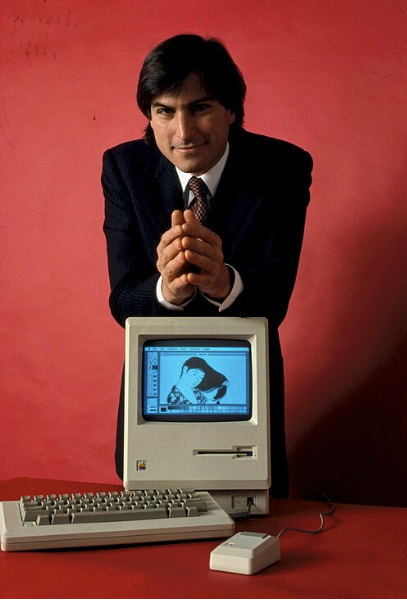
Jobs was speaking at Lund University in Sweden, long before smartphones, search engines, or the AI tools we use every day. His hope was that someday we might capture the underlying worldview of a great thinker like Aristotle within a computer, so a future student could ask him questions and get answers.
It sounded futuristic then, but that future is here today.
We can open an AI tool and ask it to explain Aristotle, compare him to another thinker, or respond in a way that tries to reflect his philosophy.
That doesn’t mean we’re talking to Aristotle. We’re talking to a machine-generated synthesis, built from writings, interpretations, and patterns available to the model. Worth remembering, especially in a minute.
Jobs saw computers becoming more than storage devices. He saw interactive learning companions that could move us from consuming information to questioning it, testing our understanding, and entering into a dialogue with the past.
So, I ran a little experiment. I asked an AI tool to respond as if it were Aristotle, drawing on his known writings and philosophy, then I asked three questions…two about leadership, one about relationships.
Here’s what I learned, before you even read the answers. The AI handed me answers that sounded wise. It couldn’t do anything with what the answers asked of me. That work stayed mine, every time. Keep that in mind as you read the three exchanges below. Each quote is the AI’s synthesis, in Aristotle’s voice, not a historical record of what he actually said:
Question 1: Aristotle, what makes someone a good leader?
A good leader must first be governed within himself. He cannot guide others well if his own desires, fears, and ambitions are disordered.
Leadership is not merely a matter of authority or skill. It is a matter of virtue. A leader needs practical wisdom to judge what should be done, courage to do it, justice to give others what they are due, and temperance to restrain his own appetite for power, praise, or comfort.
The good leader does not seek the good of himself alone. He seeks the good of the community entrusted to him.
That answer sounds about right. Confidence, drive, decisiveness, and the ability to win can carry a person a long way. But without character or virtue, those same strengths eventually start working against the people they’re supposed to serve.
Whether it’s true of me is a separate question.
Question 2: Aristotle, how should a leader make decisions when the right answer isn’t obvious?
In uncertain matters, the leader needs prudence. No rule can fully replace wise judgment, because human affairs are too varied and particular.
The prudent person considers the purpose of the decision, the facts of the situation, the people affected, and the likely consequences. He also considers his own motives. A decision can appear reasonable while still being driven by pride, fear, anger, or vanity.
Good judgment is formed over time. It comes through experience, reflection, correction, and the habit of choosing what is noble rather than merely what is easy.
Most leaders want clarity. We want the right answer to announce itself. The spreadsheet, the policy, the consultant, the precedent that makes the decision obvious.
Unfortunately, difficult decisions usually live where the information is incomplete, the tradeoffs are real, and the consequences land on people who are more than names on an org chart.
But, he asks an even harder question. What’s happening inside me as I make this call? Am I deciding from courage or fear? Justice or favoritism? Humility, or the need to be seen being right?
AI can organize the options. It can summarize the arguments. It can show me possibilities I might have missed.
But it won’t clean up my motives. That responsibility remains with me.
Question 3: Aristotle, what makes a friendship or relationship worthy of trust?
The highest friendship is rooted in virtue. Some relationships exist for usefulness. Others exist for pleasure. These are not necessarily bad, but they are fragile because they depend on what the other person provides.
A deeper friendship is different. It is based on willing the good of the other person. Such a relationship is steady because it rests on character, not convenience.
To be worthy of trust, a person must be truthful, faithful, and committed to the good of the other. A trustworthy relationship helps both people become better than they would be alone.
We understand relationships of usefulness. Work relationships, customer relationships, networking relationships, even friendships that lean heavily on shared convenience.
But, are we willing the good of the other person? Do we want what’s good for them, or only what’s useful to us? Do we want them to become better, or only to make our life easier?
Seeing this short exercise, I think Mr. Jobs would celebrate how close we’ve come to his 1985 vision. We have more access to information than any generation before us. We can retrieve facts instantly, summarize books in seconds, compare ideas across centuries before lunch.
That’s amazing!
Yet the more powerful the tool gets, the more responsibility shifts back to the person using it.
Ask Aristotle about leadership, and I have to ask whether I can govern myself.
Ask him about prudence, and I must examine my own motives before I decide.
Ask him about friendship, and the real question is whether I’m willing the good of the other person or just protecting what’s useful to me.
AI tools can generate answers. Wisdom starts when we let those answers question us back.
The machine can help us ask Aristotle a question.
It can’t make us become the kind of person who can live the answer.
There’s a big difference between having an opinion about what’s broken and taking responsibility for making something better.
We live in a time when commentary is easy.
We can criticize from the sidelines. We can point out what’s wrong. We can explain why the system is broken, why the leaders failed, why the plan won’t work, or why the people in charge should have known better.
And much of that criticism may be true.
Something really may be broken. People may have failed. The system may need to change.
But is criticism going to be our only contribution?
Creating rather than complaining is an act of disciplined hope. It says I can see what’s wrong, but I’m still willing to work.
Complaining usually says, “Someone should fix this.”
Creating says, “I can improve one piece of this.”
That shift moves us from the sidelines onto the field.
Some problems aren’t ours to carry. We shouldn’t excuse the people who caused them. We don’t pretend the risks aren’t real or the damage doesn’t exist.
But we refuse to stop at frustration.
We must ask better questions.
What can I build? What can I repair? What can I encourage? What can I organize? What can I make clearer, stronger, more honest, more useful, more human?
And what can I do even if I didn’t create the problem?
That’s leadership.
Leadership isn’t only authority or title, position, budget, or permission.
Leadership is seeing a gap and stepping into it.
It’s making the call no one wants to make. Writing the note. Cleaning up the mess. Telling the truth. Taking the first small step.
We don’t have to fix everything to make something better.
That’s important to understand, because the size of the problem can become an excuse for doing nothing.
If I can’t fix the whole system, why bother? If I can’t change the whole culture, why try?
But that’s spectator thinking.
Builders think differently. Builders understand that every useful thing starts smaller than the problem it hopes to address.
A bridge starts with a first beam. A book starts with a first sentence.
A movement starts with a first conversation.
A better future starts when someone decides their contribution will be more than complaint.
It says I may not be responsible for the whole problem, but I am responsible for what I do next.
It says tomorrow can be better than today, and I’m willing to put something in motion.
The invitation is simple.
Don’t let your only contribution be commentary.
Find one thing you can improve.
One process. One relationship. One decision. One conversation. One neglected corner of the work.
Start there. Build there. Serve there.
The system may still be broken. The leaders may still have failed.
But the future belongs to the ones who choose to create anyway.
Photo by Alex Gruber on Unsplash – The future is shaped by people willing to begin.
A decision comes up. It sits right in front of someone. It falls within their role and their authority. And the response comes almost automatically.
“Let me check with my boss.”
Sometimes that’s wise. Alignment matters. Context matters.
That’s not the situation we’re thinking about here.
We’re thinking about the reflex. The lazy habit. The moment a leader has the ball and immediately hands it back up the chain.
“I’ll get back to you.”
“Let me confirm before we move…”
Ownership just left the room.
One instance feels harmless. But a regular occurrence starts to define the culture.
Decisions begin to climb instead of moving forward. Time stretches. Energy fades. Momentum slips away, one small deferral at a time.
Every time a leader defers a decision that belongs to them, the team hears something unspoken.
“I have the title. But I’m still waiting for permission to lead.”
There are reasons this shows up. A leader may have learned that their decisions will be second-guessed. A leader may want to avoid risk. In some cases, the habit settles in because it feels efficient in the moment.
It never is.
Leadership is not a forwarding function. Leadership is a decision function. When decisions don’t happen where they should, everything slows down.
Consider a different kind of decision environment.
Naval destroyers move through the Pacific at night. Visibility is limited. The stakes are high. Decisions carry immediate consequences.
Arleigh Burke commanded Destroyer Squadron 23 during World War II. He pushed his ships to full speed when it mattered, earning the nickname “31-knot Burke.”
He once said, “The difference between a good officer and a great officer is ten seconds.”
Ten seconds.
In that environment, ten seconds could determine who struck first and who absorbed the hit. There was no version of that moment where a commander paused to seek permission for a decision that was already theirs to make.
Burke’s point wasn’t about speed alone. It hinged on readiness.
A ten-second decision is formed long before the moment arrives. It’s shaped through preparation, and thinking clearly about what matters and what doesn’t. When the moment comes, the leader recognizes it and moves.
Most of us aren’t making decisions in the middle of a night battle at sea. We’re making decisions in conference rooms, over email, in conversations with our teams, and in small moments where direction is needed.
A customer is waiting. A team needs clarity. Our decision will either create movement or stall it.
In those moments, the difference comes down to a single response.
“Let me check.”
Or
“Here’s what we’re going to do.”
The gap between these two responses is only ten seconds. But what fills that gap, or fails to, defines the kind of leader you are.
The leaders who move in those moments aren’t guessing. They’re drawing on work they’ve already done. They’ve thought through the tradeoffs. Formed principles that guide their decisions. They understand the scope of their responsibility. They trust their preparation and their judgment.
Because of that, they don’t need to look upward for every answer. They don’t need to defer decisions that belong within their role.
They lead.
Create unnecessary delays, and uncertainty spreads. Energy drains. People begin to fill the gaps with their own assumptions.
A leader who steps forward brings clarity into the room.
The next time that familiar reflex shows up, pause for a moment and ask a better question.
Is this mine to decide?
If it is, then decide. Step forward. Move.
The distance between good and great leadership rarely shows up in dramatic events. It shows up in small decisions, repeated over time, where someone chooses to act, or chooses to wait.
Burke’s destroyers didn’t win the night by waiting for permission. They won it by being ready when the moment came.
When I heard that my friend Paul was in the hospital and things weren’t looking good, I can’t say I was shocked. When he passed away a few days later, what stayed with me most was the loss of everything he still had ahead of him.
Paul had been in a self-destructive pattern for a while. I recognized it early, having seen something similar play out in my own family years before. Still, knowing the path doesn’t make the ending any easier.
Paul was my brother’s best friend since high school. More than that really…another brother. Like brothers often do, they didn’t agree on everything, but they agreed they were in it together, and that wasn’t going to change.
I first met Paul when he was probably a sophomore or junior in high school. I was home visiting from my freshman year in college. I remember that mullet like it was yesterday. Business up front, party in the back. He wore it with absolute confidence, as if it were the only reasonable hairstyle.
He was quick-witted and cocky, but in a good way. Sure of himself, without yet knowing what his future held. Which, in hindsight, makes him a lot like the rest of us at almost any age.
Paul had a way of knowing everyone. If he didn’t already know you, he would by the end of the day. His personality filled whatever space he walked into. He remembered names after meeting someone once, a gift I’ve always envied. He asked questions, was genuinely curious about people, and he made everyone feel seen. Paul appreciated people, and people felt that.
He was always ready to dive into big ideas and big projects. He liked to say, “I don’t have a stop sign on my chest.” While others talked about racing off-road “someday,” Paul made it real. With my brother and a group of equally committed friends, he jumped headfirst into building and racing a Class 10 buggy.
What did Paul know about off-road fabrication or racing at speed in the desert? Not much. That didn’t stop him. He’d figure it out along the way. Thursday nights in his garage turned into a ritual. Fabricating, wrenching, laughing, getting ready. Lots of Saturdays were spent in the desert testing and tuning, trying to make the car race ready.
My brother was his co-driver, mentor, and probably the unofficial crew chief. I don’t know how many races they finished, maybe one or two, but they often led the first lap and looked great until something small failed. A cheap part. A loose wire. A power steering pump. One tiny thing ending the day.
They were frustrated, but they didn’t quit. Eventually the Class 10 car gave way to a Class 8 truck. Everything got bigger. More horsepower, bigger suspension, more parts, higher speeds. More complexity. More commitment. More Thursdays. More Saturdays. More races.
Paul used to joke that the only things standing between him and winning were experience, capability, and funding. All probably true. Where most people would see that as a reason to stop, Paul saw it as part of the adventure. He believed he’d learn as he went, and he’d have fun doing it.
I was lucky to pit for Paul at a few of his races. But where I really got to see him shine was pitting for Team Honda in Baja and Team Kawasaki in Nevada. I learned that Paul knew the words to every Metallica song, and nearly every other song that came on the radio…rap, country, classic rock. He knew them all.
One Nevada race stands out. We were assigned the first pit of the day, then relocated to be the final pit later the same day. It’s always fun to be able to do two pits in the same day.
We scouted the location the day before. A desolate stretch of desert about 50 miles from the start. We rolled out early from our little motel the next morning in the dark to get set up.
We thought it would be cool to have an official Kawasaki awning over the spot where the bikes would stop for gas and service. It looked great. We forgot one detail. Securing that awning.
As the first rider, a Kawasaki (of course), came rolling in, Paul had the fuel dump can ready. We could fill a tank in about ten seconds. Everything was smooth. Then the desert wind kicked up, and the awning took off, cartwheeling across the landscape in spectacular fashion right as fueling began.
There was nothing to do but keep going. Rider one laughed as he pulled out. Did I mention there was film crew there? They laughed. We laughed. Thirty seconds later, rider two came in and out just as fast.
When we finally went to retrieve the awning that had rolled about a half mile away, we expected wreckage. Instead, it was mostly fine. Scratched, dusty, but intact. At the final pit of the day, we remembered to tie it down.
When I think of Paul, that’s what comes to mind. The sprinkling of chaos. The laughter. The way nothing ever quite went according to plan, and how little that bothered him or any of us. We were having fun together and that’s what mattered.
I’ll miss Paul’s infectious grin, his laugh, and his refusal to wait for perfect conditions. He left too early. But he left us with stories, friendships, and a reminder that life isn’t meant to be watched from the sidelines.
Rest in peace, my friend.
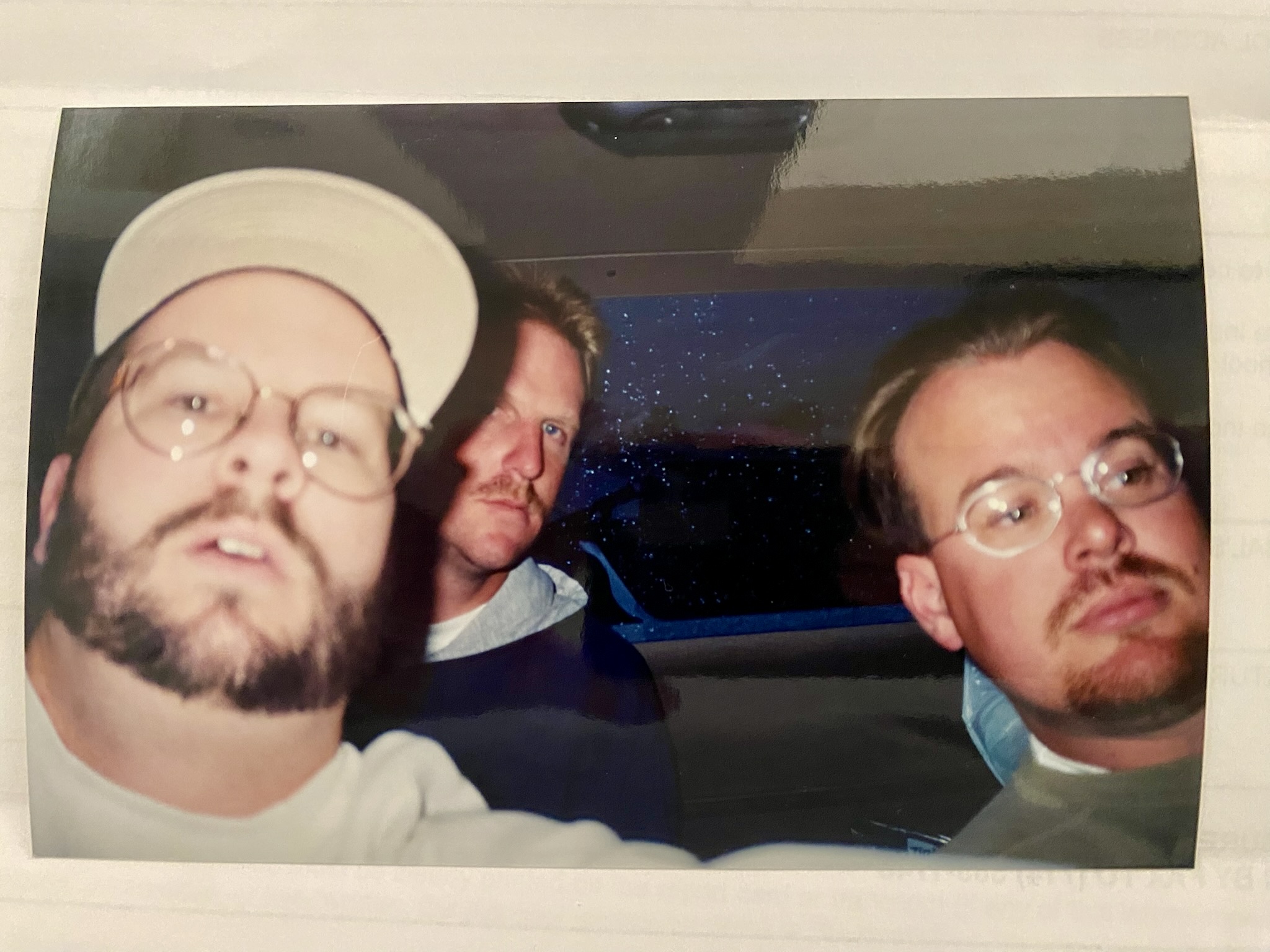
Photo – a selfie back when selfies were taken with film cameras, at least 30 years ago. Three knuckleheads driving to the desert way too early. That’s my brother and I on the left and my brother’s other brother, Paul, on the right. We’ll miss you, Paul.
Imagine two managers sitting at their desks, both using the same AI tool.
The first asks it to write the same weekly report, just faster. Three hours saved. Nothing new learned. Box checked.
The second uses the AI differently. She asks it to analyze six months of data and search for hidden patterns. It reveals that half the metrics everyone tracks have no real connection to success. Two new questions emerge. She rebuilds the entire process from scratch.
Same tool. Different questions. One finds speed. The other finds wisdom.
This is the divide that will define the next decade of work.
For a long time, leadership revolved around structure and repetition. The best organizations built systems that ran like clockwork. Discipline became an art. Efficiency became a mantra.
Books like Good to Great showed how rigorous process could transform good companies into great ones through consistent execution. When competitive advantage came from doing the same thing better and faster than everyone else, process was power.
AI changes this equation entirely. It makes these processes faster, yes, but it also asks a more unsettling question. Why are you doing this at all?
Speed alone means little when the racetrack itself is disappearing.
Curiosity in the age of AI means something specific. It asks “why” when everyone else asks “how.” It uses AI to question assumptions rather than simply execute them. It treats every automated task as an opportunity to rethink the underlying goal. And it accepts the possibility that your job, as you currently do it, might need to change entirely.
That last part is uncomfortable. Many people fear AI will replace them. Paradoxically, the people most at risk are those who refuse to use AI to reimagine their own work. The curious ones are already replacing themselves with something better.
Many organizations speak of innovation, but their true values show in what they celebrate. Do they promote the person who completes fifty tasks efficiently, or the one who eliminates thirty through reinvention? Most choose the first. They reward throughput. They measure activity. They praise the person who worked late rather than the one who made late nights unnecessary.
This worked when efficiency was scarce. Now efficiency can be abundant. AI will handle efficiency. What remains scarce is the imagination to ask what we should be doing instead. Organizations that thrive will use AI to do entirely different things. Things that were impossible or invisible before.
Working with AI requires more than technical skills. The syntax is easy. The prompts are learnable. Connecting AI to our applications isn’t the challenge. The difficulty is our mindset. Having the patience to experiment when you could just execute. The humility to see that the way you’ve always done things may no longer be the best way. The courage to ask “what if” when your entire career has been built on knowing “how to.”
This is why curiosity has become a competitive advantage. The willingness to probe, to question, to let AI reveal what you’ve been missing. Because AI is a mirror. It reflects whatever you bring to it, amplified. Bring efficiency-seeking and get marginal gains. Bring genuine curiosity and discover new possibilities.
Here’s something to try this week. Take your most routine task. The report, the analysis, the update you’ve done a hundred times. Before asking AI to replicate it, ask a different question. What would make this unnecessary? What question should we be asking instead?
You might discover the task still matters. Or you might realize you’ve been generating reports nobody reads, tracking metrics nobody uses, or solving problems that stopped being relevant two years ago.
Efficiency fades. What feels efficient today becomes everyone’s baseline tomorrow. But invention endures. The capacity to see what others miss, to ask what others skip, to build what nobody else imagines yet.
The curious will see opportunity. The creative will see possibility. The courageous will see permission. Together they will build what comes next.
The tools are here. The door is open. Work we haven’t imagined yet waits on the other side. Solving problems not yet seen, creating value in ways that don’t exist today.
Writing a song is like fishing, Kenny Chesney once said. Some days you catch something beautiful. The melody, the moment, the truth. Other days, you sit there all day with nothing but frustration and a stubborn belief that it’s still worth being out there.
That kind of wisdom transcends genres. Ernest Hemingway spent his life circling the same idea. That real art happens when we show up. Whether facing a blank page, a marlin that wouldn’t bite, or a battle that couldn’t be won, he believed the only way to live fully was to move, to act, to engage.
His work embodied a simple truth. The shortest answer is doing the thing. For him, wisdom wasn’t found in thinking about life, but in living it. No clever phrasing. No shortcuts. Just the act itself. Simple, honest, alive.
We spend so much of life thinking about what we might do, planning what we should do, waiting until we feel ready to begin. But readiness rarely arrives on its own. The line stays slack until you cast it. The song stays silent until you play it. The story remains untold until you write it.
Sometimes we catch something incredible. Other times, nothing.
Either way, we were there. Present. Awake. Participating in the work and wonder of life.
Maybe that’s the whole point.
A life well-lived must first be lived.
Photo by Shojol Islam on Unsplash – I wonder if he’ll catch something on this cast. Maybe. Maybe not. But, he’s in the game, giving it his best shot and that’s what matters.
When we look toward the future, two voices compete for our attention. Fear tells us to run away. Curiosity invites us to step forward.
Fear whispers, “It’s too much. I can’t keep up. Better to stop trying.” Curiosity responds, “I don’t understand…yet. Let’s see what happens.”
Fear closes.
Curiosity opens.
Fear imagines disaster.
Curiosity imagines possibilities.
Fear isolates.
Curiosity connects.
The world is changing quickly. The pace can feel overwhelming. Many will react with fear. A curious spirit asks questions. It wonders what could be.
Curiosity doesn’t remove uncertainty but transforms how we deal with it. When we lead with curiosity, we move from paralysis to participation. We see the unknown as a chance to grow.
“Never let the future disturb you. You will meet it with the same weapons of reason which today arm you against the present.” – Marcus Aurelius
We already have the tools we need. Curiosity and our ability to learn. What we need is the courage to use them.
Psalm 91 promises safety from dangers both visible and invisible, from “the terror by night” to “the arrow that flieth by day.”
In verse 6, we read: “Nor for the pestilence that walketh in darkness; nor for the destruction that wasteth at noonday.”
The Desert Fathers, those early Christians who left the cities around the third and fourth centuries to live in the desert, drew on this verse to describe one of their deepest spiritual struggles. They called it the noonday devil.
This devil represents an interior battle, a weariness of the soul that crept in at midday when the sun beat down, the silence grew heavy, and the temptation to abandon their prayer and vocation felt overwhelming.
They named this struggle acedia. Sometimes it’s translated as sloth, but it is much more than that.
How many kids have said to their parents, “I’m bored.” We remind them that boredom is in their heads. They can use their imagination, find a book, or play outside. And if that doesn’t land, we parents always have another cure for their boredom: chores.
It’s amazing how quickly boredom vanishes when a child is handed a rake, a shovel, or a basket of laundry to fold.
Boredom is what happens when we can’t see the meaning in what we’re doing. Acedia is boredom’s older cousin. Spiritual weariness with much deeper stakes.
It’s restlessness, a refusal to care, a loss of joy in the very things that give life meaning. It can show up as distraction or busyness. Acedia tempts us to walk away when the middle of the journey feels too long and too heavy.
I think of the countless days spent inching along in rush-hour traffic, morning after morning, just to get to work. I’d put in a full day’s work, then crawl through another hour or more of brake lights to get home. The next day brought the same routine. After a while, it was easy to think maybe the whole thing had no meaning.
That’s the noonday devil at work.
The midpoints of life test us in a similar way. Paying bills, the daily grind of a career without clear progress, responsibilities that seem to grow heavier without much relief. Our internal voice asks, “How can I escape? Should I look for something easier?”
Jean-Charles Nault’s The Noonday Devil: Acedia, the Unnamed Evil of Our Times says this ancient struggle is alive and well today. It shows up in constant scrolling, in working ourselves to exhaustion to avoid deeper questions, in chasing novelty because the present moment feels too heavy.
The Desert Fathers found the answer was to persevere through, but with far more than sheer willpower. Keep praying, even when prayer feels dry. Stay faithful to commitments, even when they feel heavy. Lean into your community rather than isolating from it. Practice humility and remember that perseverance is possible only by God’s grace.
What does this look like? When we feel the pull toward endless scrolling, we might instead text a friend or call a family member. When work feels meaningless, we can remember the people our efforts serve, even if indirectly. When prayer feels empty, we show up anyway, trusting that faithfulness itself has value beyond our feelings in the moment.
The noonday devil tempts us to think that only extraordinary lives matter. But as Oliver Burkeman points out in his idea of “cosmic insignificance therapy,” recognizing our smallness frees us to find profound meaning in ordinary acts.
The daily work of caring for children, preparing meals, or showing up for neighbors and friends carries as much weight as anything could. These acts may never make headlines, but in God’s eyes they shine with eternal value.
Persevering in small, steady commitments resists acedia and helps us discover joy in the very places where meaning often hides.
Psalm 91 carries a promise, “He shall cover thee with his feathers, and under his wings shalt thou trust.”
God invites us to rest beneath His wings, to trust Him in the heat of the day, and to discover joy at the very heart of our journey.
Faithfulness in the ordinary is never wasted. Under His wings, even the smallest acts take on eternal meaning.
h/t – Hallow app – Noonday Devil; Tim Ferris – Oliver Burkeman’s Cosmic Insignificance Therapy











You must be logged in to post a comment.