Strong leaders find ways to align the two, so the right behaviors are worth choosing.
That alignment can come through compensation, recognition, autonomy, opportunity, trust, or simply making sure people aren’t punished for doing what the organization says it values.
When incentives point one way and stated goals point another, people usually follow the incentives.
The strongest systems make it easiest for people to advance their own interests while also advancing the organization’s.
Every now and then, I think about people who are no longer here and ask myself what they left with me. A lesson. A phrase. A moment I still can’t fully explain.
Mr. McNally left me a question.
He was teaching us about entropy in his AP Chemistry class and asked why the air in a bicycle tire doesn’t simply settle to the bottom.
Air has weight. Gravity acts on it. So why doesn’t all the air sink to the lowest part of the tire like a pile of sand? Why does it keep pressing outward against the walls?
It’s a simple image, which is probably why I still remember it almost fifty years later.
The air inside the tire is made up of tiny particles moving rapidly in every direction. They collide with each other, and with the inside wall of the tire. Those collisions create pressure.
Gravity is present but its pull is weak compared to the thermal energy of all those molecules.
The air fills the space it’s given. It presses outward. It resists settling.
That old chemistry question came back to me recently as a life question.
What keeps us from settling? From succumbing to the gravitational pull in all of us.
Staying where life feels familiar. Waiting for more certainty. Keeping the pattern because changing it will cost us something.
Waiting sounds reasonable. It borrows the language of patience, prudence, and practicality. And at times, those are the right virtues. Wisdom often tells us to slow down.
But inertia can dress itself up as wisdom. Fear can call itself realism. Comfort can pretend to be peace.
That’s when we begin settling to the bottom of our lives.
The air doesn’t fulfill its purpose by collecting in the lowest place. It fills the available space. It presses against the walls. It creates pressure because motion is still happening inside.
Human life has its own version of that energy.
Purpose. Discipline. Faith.
These keep us from sinking into the lowest-energy version of ourselves.
The tire reminds us that pressure comes from movement. A life with purpose has an outward push to it. It presses against fear, complacency, and inertia. It expands into the space it has been given.
We don’t have to be reckless or maintain constant motion. But we need enough internal purpose to overcome the quiet pull of our internal gravity.
I’m grateful Mr. McNally asked that question all those years ago. At the time, it was a chemistry lesson about entropy, motion, and pressure.
Decades later, it’s still teaching me.
The tire doesn’t fight gravity. It just has something inside it that never stops moving.
I think that’s all any of us can ask of ourselves.
Many of us have felt it. That quiet, persistent yearning for life to just settle down for a while.
We imagine a stretch of road where the strain lets up, the demands lighten, and we can move forward without so much weight on our shoulders. We tell ourselves that after enough years, enough lessons, enough work, and enough milestones, there ought to be a time when things begin to coast.
That hope is understandable. We carry a lot. We get tired. We get worn down.
But easy rarely waits for us around the bend. More often, what comes instead is something better.
Perspective. Wisdom. A clearer sense of what’s worth our energy and what’s worth leaving behind.
With time, we may carry life with more grace. We may stop pouring ourselves into things that never deserved that much from us. We may learn the wisdom of laying down false guilt, unnecessary fear, stale resentment, and the crushing expectations that come from trying to live someone else’s life.
A good bit of suffering comes from carrying weight we were never meant to bear.
Of course, knowing what to set down is its own kind of work. It takes honesty to name what we’ve been carrying needlessly. It takes courage to actually let it go.
But even after we set those things down, effort remains. That’s a feature, rather than a flaw, in life’s design.
Work requires our attention. Relationships ask for our patience. Growth brings discomfort. Purpose calls for sacrifice, and faith asks for trust.
Effort remains part of a life that’s awake and engaged.
Sometimes what we call easy is really just familiarity. We know the terrain. We know the language. We know how to move around in it. That can feel easier, but familiar things can still cost us. They can still ask for endurance, humility, steadiness, and resilience.
Maybe relief is the most honest word for what we’re seeking.
We want a little less pressure. A little less uncertainty. A little less disappointment. A little less striving. We want room to breathe.
There’s nothing wrong with that. Relief is human. Rest is holy. Recovery matters.
But relief differs from a life free of demands. And deep down, most of us would find such a life unsatisfying.
We may say we want to coast. We may fantasize about “easy street.” We may imagine how nice it would be if everything just ran smoothly for a while. But too much ease has a way of hollowing us out, leaving us restless, a little purposeless, quietly bored with ourselves.
We were made for engagement. We want to build, help, solve, shape, encourage, contribute, and grow. We want to know that our presence still counts for something.
That’s why a completely easy life, if such a thing existed, would probably disappoint us pretty quickly.
We were made for meaningful effort, and that’s where we find ourselves most alive.
The question, then, is less about whether life will ever become easy and more about whether we’re giving ourselves to things that build something in us and around us. Things connected to purpose, love, responsibility, service, growth, and calling.
Giving ourselves to the right things helps us stop feeling sorry for ourselves and start paying attention again. It steadies us for the chapter we’re in, rather than the imaginary one we hope will arrive.
As long as we’re here, there’ll be something in front of us asking for effort.
Some goals are big enough to carry us for a long time.
They lift our eyes. They fill ordinary days with meaning, connecting our work to something larger than the moment in front of us.
That vision matters.
It gives shape to sacrifice. It helps us endure hard things because we can see where we’re trying to go.
But big goals have a way of becoming heavy.
Sometimes the distance feels too great. The work takes too long. The gap between where we are and where we want to be can leave us discouraged before we’ve gone very far at all.
That’s when it helps to bring the goal down to just the next step. The next mile. The next call. The next page. The next hour of honest work.
We don’t accomplish great things all at once. We get there by doing the next thing that needs doing.
The small task gives us traction. It pulls us out of vague ambition and back into motion.
But this has its own challenge.
Sometimes the next step feels too small. Repetitive. Disconnected. We can lose heart in the middle of faithful effort simply because the work in front of us seems too ordinary or meaningless.
That’s when we need to lift our eyes again. Remember why we started. Who this serves. The person we’re trying to become.
Focusing only on the big vision, we risk becoming dreamers who admire the mountain and never climb it. Living only in the next task, we can become people who just keep moving and slowly forget why.
Our strength comes from learning to move between the two.
When the goal feels too big, narrow the focus. When the next step feels too small, widen the focus.
The vision gives meaning. The step gives traction. We need both.
As we enter 2026, it’s tempting to look for a new system, a better plan, or the perfect moment to begin.
Most of the time, the real answer is simpler.
Just show up.
The secret to progress isn’t brilliance or motivation. It isn’t certainty or confidence. It’s presence.
Show up every day. Show up when it’s easy. Show up when it’s uncomfortable. Show up when you don’t know what comes next.
Show up and be present. Show up and handle your business. Show up and figure it out as you go. Show up for the people you love. Show up for the work that matters. Show up for yourself.
When you’re unsure what to do next, don’t overthink it. Show up and take the next step. Clarity usually follows movement.
The alternative is standing down. Waiting. Drifting. Quietly giving up ground you were meant to claim.
You’re stronger than that.
Progress is rarely dramatic. It’s built through consistency. Through ordinary days stacked on top of each other. Choosing to show up when no one is watching.
The hard things happen because you showed up. The meaningful things happen because you stayed. The impossible things only happen when you refuse to disappear.
There’s another truth hidden in showing up.
When you show up, you give others permission to do the same. Your presence becomes proof. Your consistency becomes encouragement. People notice. They realize they can take the next step too.
So how do you crush your goals in 2026?
You don’t wait for the perfect plan. You don’t wait to feel ready.
You show up. You make it happen.
Because that’s what you do. And this is how things get done.
Somewhere along the way, I’ve noticed a quiet truth.
The thing I was working toward (the goal, the vision, the project, the finish line) always required other steps. Preparation. Research. Practice. Training. A foundation. A warm-up.
While I tried to focus on the thing I wanted to do, most of my time was spent doing all the other things that needed to happen first.
Building a deck means hauling lumber, squaring the posts, digging holes…and at least three trips to Home Depot. Writing a book means staring at blank pages, deleting paragraphs (and chapters), and researching obscure details that may never make it to print. Staying in shape means lacing up your shoes at dawn when no one else is watching. Starting a business means filling out countless forms, talking to lots of people who say no, and revisiting your reasons why, countless times.
These tasks are not detours or distractions. They are merely steps on the journeys we’ve chosen.
If we can learn to love these quiet and often unnoticed tasks that prepare the way, we may find the joy we’re seeking was there all along.
We might discover that the thing we’re chasing isn’t the prize. It only led us to the road we were meant to walk. To meet the people we were meant to meet.
So go ahead. Lace up your shoes at dawn. Cut that first board. Tape off all the areas you don’t want to paint. Make that first sales pitch. Get to know people you never expected to meet.
Embrace all the steps that come before the thing.
It turns out, they are the thing.
“Give me six hours to chop down a tree and I will spend the first four sharpening the axe.” — Abraham Lincoln
July 2nd is about a week away. That will be the 183rd day of the year. The halfway point.
I usually think of the summer solstice as the halfway point since the days start getting shorter after that.
Either way, it’s a good time to reflect.
Think back to January. Back then, you were probably wondering how to shed a few of those extra pounds you gained over the previous two weeks.
While sipping your leftover peppermint cocoa on New Year’s Day, what goals or intentions were on your mind? Did you write them down? Did you share them with anyone?
Be honest with yourself. What have you done that moves you closer to achieving any of the goals you set six months ago? Even small steps count.
Do those goals still matter to you? Have you added new goals since then?
Whatever your answers, write them down. Pick one thing to act on this week to get back on track. Movement builds momentum, and maintaining momentum is the key to achieving any goal.
Don’t forget to celebrate. A new productive habit. A relationship strengthened. A busy season endured (every industry seems to have one).
These quiet victories matter. They deserve your recognition.
Halfway through the year, the invitation is simple. Reflect. Realign.
Begin again.
Side note: Consider doing this exercise with an even larger time horizon.
-What were your goals 10 years ago? 20 years ago?
-Are those goals still important to you?
-Have you made progress on any of them?
-What are your goals for the next 10 years? 20 years?
-What concrete steps will you decide to take over the next 6 months to make progress on at least one of your 10-year goals?
Photo by Elliot Pannaman on Unsplash – why this image out of the thousands I could have chosen from Unsplash? My focus wasn’t on the stark, still, wintry vibe (although that’s nice). I was captured by the story it conveys. In my imagination, this person set out to cross the entire lake. Clearly, their chosen path wasn’t successful. Poor planning? Lack of vision? Who knows?
But the halfway point is a moment like this. A pause at the edge, where we get to decide if our goal still matters. If it does, it’s time to retrace, replan, and re-commit to accomplishing what we set out to achieve.
Ask someone how their day went, and odds are, they’ll say, “Busy.”
Dig a little deeper, and you’ll hear about the fires they had to put out, the urgent requests from their boss, or the upset customers they had to talk in off the ledge. Everyone’s racing from task to task, reacting to whatever pops up next.
What you don’t hear—at least not often—is someone saying, “Today I worked on our 30-day goals,” or, “I spent the afternoon exploring how AI might streamline our operations,” or, “I studied what our competitors are doing better than we are.”
Most people are caught in an infinite response loop. The big questions get pushed to tomorrow, especially if the boss isn’t asking about them anyway. And often, he’s just as busy reacting to his own list of urgent problems.
Response mode is easy. You don’t have to choose what matters most. Just deal with what’s in front of you. There’s no time for stepping back, rethinking the process, or preventing tomorrow’s fires today. You stay busy. That way, you can tell yourself you’re still needed.
And when the day ends, you can point to everything you handled and feel like you earned your paycheck.
But the real questions are: Did you move any of your monthly, quarterly, or annual goals forward? Do you even know what they are?
For many, the answers are no and definitely no.
Working in the business is the default. It’s safe and familiar. It keeps your hands full.
Working on the business is different. It takes time, thought, and courage. It means facing questions without clear answers. It means exploring new tools, unlearning old habits, and imagining better ways to serve your customers.
No fires today? Is your boss on vacation? Sounds like an easy day.
But if no one thinks about what’s next, if no one is asking what should change or improve, and if no one is steering the ship, that ship will eventually drift. Maybe into a storm. Maybe into the rocks.
And no one will notice until it’s too late.
So, ask yourself: Are you steering, or just responding?
Side note: These questions apply outside of work. If we’re not actively steering in our personal lives, we can just as easily find ourselves in a storm we could have avoided, running aground on some rocks, or drifting aimlessly out to sea.
To assume that delays are normal. That long lead times are just “the way things are.” That bureaucracy is an immovable force we’re all meant to quietly and endlessly orbit.
But here’s the question we should be asking: Does something really take months to get done…or is that just the rut talking?
Ruts are sneaky. They dress up as policies, forms, regulatory frameworks, meetings, approvals.
They start small. Maybe with one postponed decision or an overcautious email. Before long, they’re a deep trench. One that feels safer to live in than escape.
Some processes do require time. Some decisions need careful research and thoughtful consideration.
But not everything takes as long as we pretend. And if we’re being honest, we often lean on red tape as a crutch. To justify inaction, to mask fear, to cover for indecision, to avoid risk. Maybe to avoid the work altogether.
We say things like:
-“That’s how our system works.”
-“These things take time.”
-“We’ll have to check with Legal.”
-“I’m waiting on approvals before I can move forward.”
But what if we stopped waiting?
The 10 Million Dollar Question:
If you or your organization were promised $10 million the moment this project is completed—this thing you’re currently delaying—how long would it actually take to finish?
-How focused would you suddenly become? -How many hurdles would get knocked out of your way? -How quickly would meetings be scheduled, decisions made, and steps taken?
If your answer is “much faster,” then the rut is running the show. You’re not stuck. You and your organization are settling for the slow lane.
What if we challenge the assumptions about how long things should take?
What if we stop admiring and massaging the problem and started solving it?
What if we stop delegating or offloading the issue to another department, and just fixed it ourselves…today?
Organizations that resist the rut move faster. They ask better questions. They take the time to consider how to eliminate hurdles. They focus on outcomes, not just process. They know when structure helps, and when it hinders. They trim what’s unnecessary and protect what’s essential.
This isn’t about being reckless. It’s about refusing to be lulled into complacency. It’s about bringing urgency back to the table.
It’s about remembering that progress often begins with someone brave enough to say: “Why not now?”
If you’re feeling stuck, ask yourself: -Are you really bound by rules and timelines? Or just by a habit of delay?
Resist the rut.
Challenge the default.
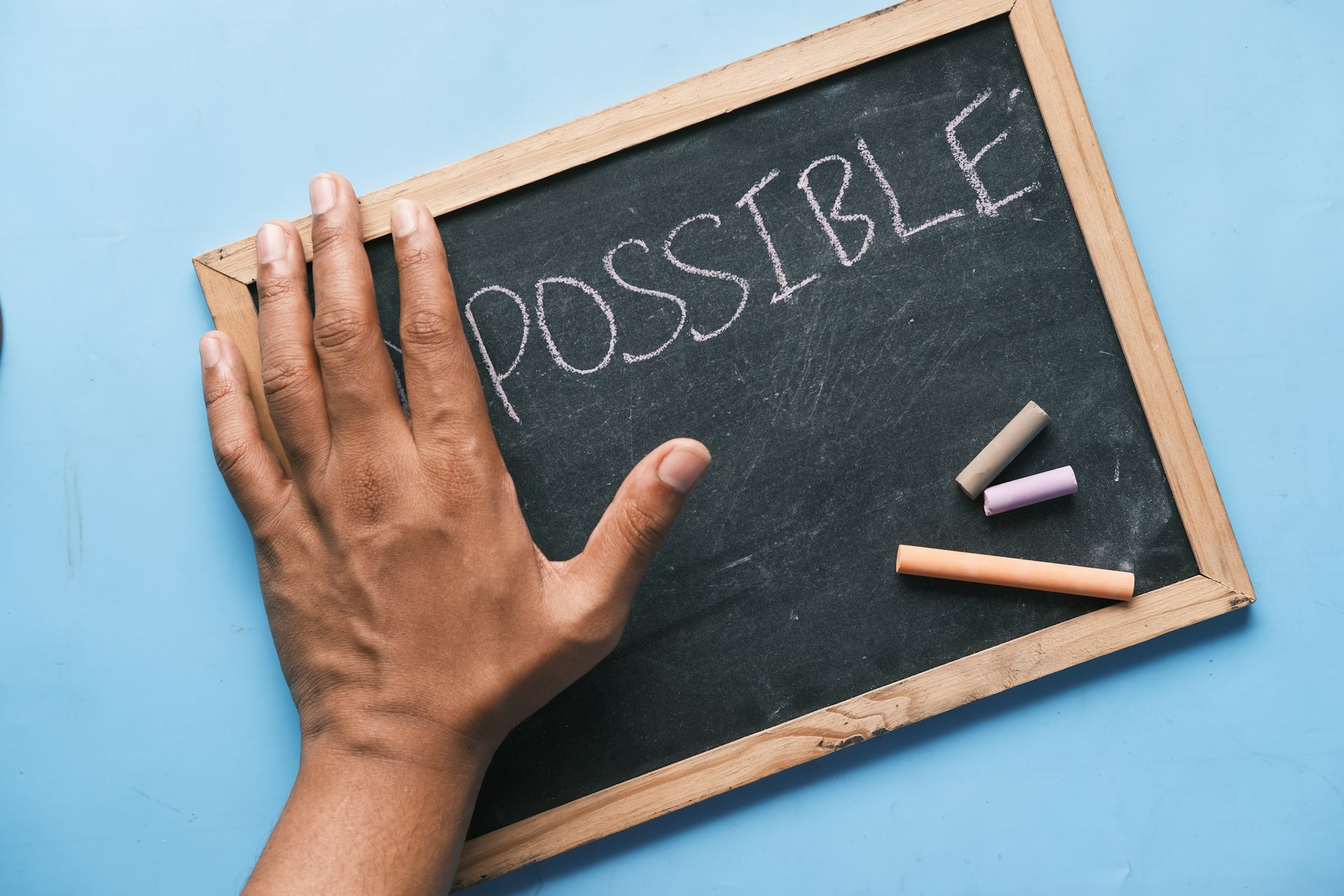
Challenge the impossible and make it possible.
Push for better.
It might take less time than you think.
h/t – my colleague, Jacob Smith. An extremely productive and prolific software development manager who regularly challenges the default and always pushes for better.
The blinking cursor on a blank document. The empty stretch of land where you’ll soon be building a shop. The new web application your company wants to develop that will revolutionize your industry. These are just a few examples of standing on the edge of something new, something important, yet feeling completely unsure of where to begin.
You might have a vision of the final result—the finished document, the completed shop, the fully functioning app. But that doesn’t mean you know how to get there.
It’s easy to get lost in the variables and the endless possibilities. What if I make the wrong decision? Are there more resources out there? What do other people think? Should I read more articles? Watch more videos? Seek more advice? What if I mess it all up?
In every case, the hardest part is starting.
It’s taking that first step. Writing the first sentence. Sketching out the first screen of an app. Nailing the first stakes into the ground—the ones you’ll attach a string to, so you can visualize where your new shop will go.
It’s a commitment to action over hesitation. A moment of bravery that marks the beginning of making something real.
An amazing thing happens when you start. Your mind shifts from a place of endless “what-ifs” to a place of positive motion. You begin to focus on the next steps and real solutions. All the challenges you imagined before starting—that, in many cases, won’t even come to pass—are forgotten. The path ahead becomes clearer, and each small step forward makes your next decision easier.
Does this mean everything goes perfectly after you start? Of course not. You’ll make mistakes, adjust, learn, and pivot along the way.
But here’s where starting becomes crucial: it provides a tangible foundation. It gives you something to measure against, something to refine, something to edit. You might completely change your initial idea, but you wouldn’t have discovered the need to change if you hadn’t started.
Starting is hard, but it’s also the most important part.
Take the first step, even if it feels uncomfortable. You’ll learn more from those first few steps than you will from standing still…wondering what might happen.
Once you start, momentum kicks in. And from there, the possibilities are endless.









You must be logged in to post a comment.