
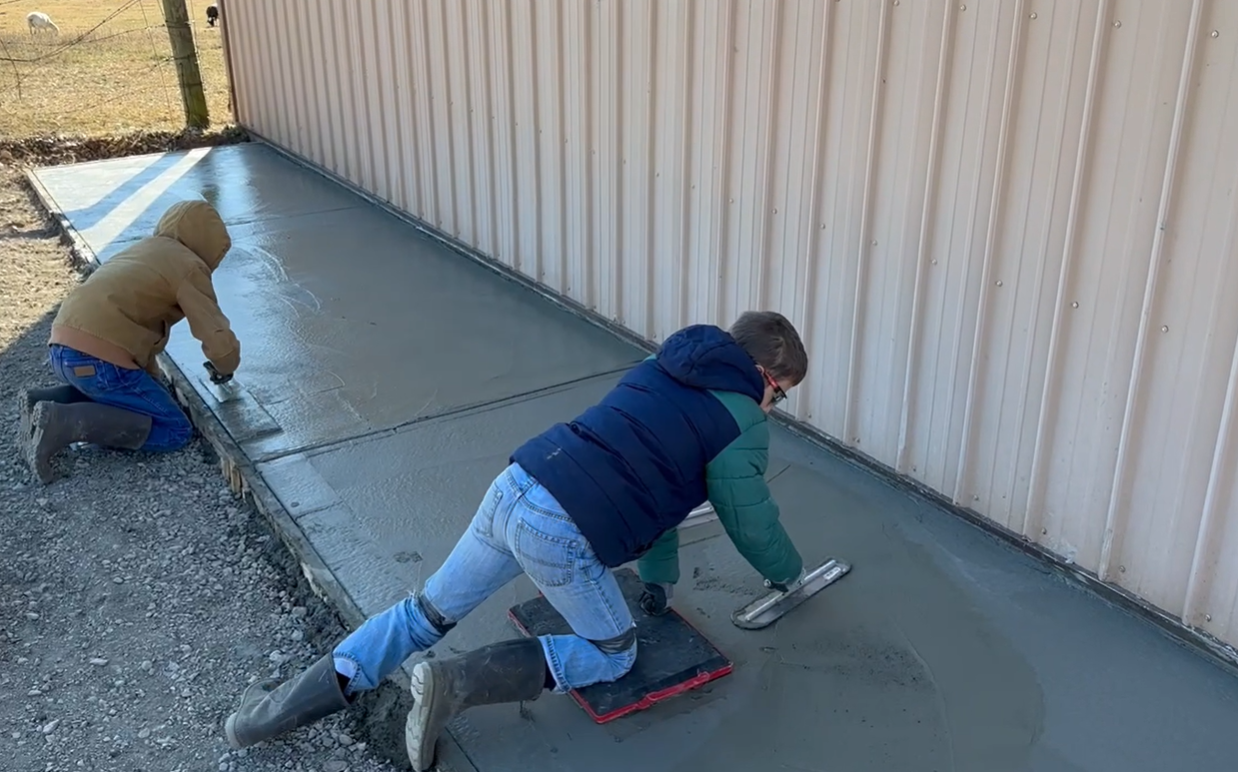
You can watch someone prepare and pour a concrete slab.
You can see how they set the forms, grade the dirt, calculate the concrete they’ll need, screed it, float it, edge it, and apply a perfect broom finish. You can study the tools. Watch videos explaining every step.
That’s still a long way from doing it yourself.
Doing it requires moving every shovel of dirt by hand. You have to decide how the grade should run and where the water will drain. You wonder if the forms are strong enough, if the slope is right, and whether the finished slab will look terrible.
Then the truck arrives. The clock starts.
Tools that looked simple in someone else’s hands feel entirely different in your own. The concrete is heavy. It pushes back. Your shoulders hurt. Your back aches. The clock is ticking.
You begin to see things you couldn’t see before. Low spots. Ridges. Edges that need attention. Sections that are ready for the next step and others that need to be left alone.
Maybe the slab turns out great. Maybe it’ll suck.
Either way, you’ll know a lot more at the end of the day than you knew that morning. The work changes your eye, your hands, and your judgment.
An AI tool can help you prepare. It can list the materials, calculate the volume, explain the tools, identify common mistakes, and suggest videos.
But it can’t simulate the way the trowel feels moving across the concrete. It can’t tell you when you’ve worked it enough and it’s ready to broom.
I’ve been thinking about that distinction after reading a piece by Shawn Smucker that Tim Ferriss highlighted in his Friday email.
Smucker wrote about what we may lose when we turn to AI too quickly. Instead of calling a friend who knows how to cook, camp, fix something, or solve a problem, we can ask an AI tool and have an answer in seconds.
The answer may be good. It might even be clearer than what our friend would’ve told us. But the answer is probably the least valuable part. Calling our friend could lead to a story, an old memory, some unexpected advice, or a forty-five-minute conversation about what’s happening in their life.
Ferriss also shared Kurt Vonnegut’s story about going out to buy one envelope rather than ordering a hundred online. Vonnegut wanted the trip. He wanted to see people, notice things, and have whatever little encounters came with buying that one envelope. The inefficiency was part of the experience.
We spend a lot of time trying to remove friction in the pursuit of efficiency, especially the friction that drains us. Repetitive paperwork. Unnecessary steps. Work that adds very little value.
But some friction asks more of us. Forcing us to pay attention, make new decisions, correct our mistakes, and develop judgment we didn’t have before.
The tricky thing is that both types of friction feel exhausting while we’re experiencing them.
AI is great at removing friction. It can research an unfamiliar topic, organize an idea, compare alternatives, create a first draft, write code, build a prototype, or break a daunting project into manageable steps.
That’s good stuff.
But AI can also produce polished-looking work long before the person using it can see what’s missing. That polish can create confidence the work hasn’t fully earned.
A lot of what we recognize as “AI slop” grows out of that premature confidence.
Friction develops the eye that can see past the polish. When we’ve felt low spots under a trowel, we can see them in someone else’s slab. When we’ve fought a stubborn argument into shape on the page, we can see the soft spot in someone else’s paragraph.
Skip that resistance and we skip more than the difficulty. We skip the experience that teaches us how to judge the work.
A working software prototype is a long way from a dependable product. A quick draft is a long way from a finished piece of writing. The distance between them is filled with the kind of friction AI helps us postpone but can’t remove entirely.
Remember wax on, wax off?
Daniel LaRusso thought he was doing random chores. Mr. Miyagi knew the repetition was developing movements and instincts Daniel would need later.
A lot of formative work is like that. We understand what it was building in us only after we’ve stayed with it long enough to grow.
Friction builds more than the finished product.
It builds the person who can tell when the product is finished.
Photo – My four grandsons were my crew for this job. This was their first concrete project. The two older boys got their first chance to finish concrete, while their younger brothers are already looking forward to taking a turn on the next one. That was a fun day and that little sidewalk turned out great!



You must be logged in to post a comment.