Finding Your Authentic Swing

What about the inevitable shanks, worm-burners, wicked slices, massive hooks, and just plain misses?

BaggerVance


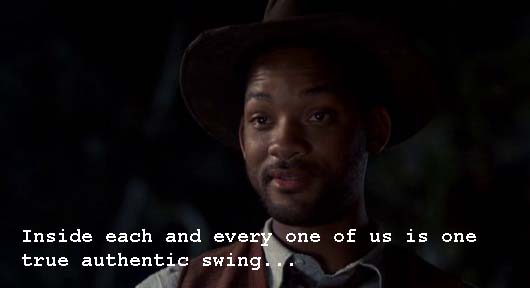
“Yep… Inside each and every one of us is one true authentic swing… Somethin’ we was born with… Somethin’ that’s ours and ours alone… Somethin’ that can’t be taught to ya or learned… Somethin’ that got to be remembered… Over time the world can, rob us of that swing… It get buried inside us under all our wouldas and couldas and shouldas… Some folk even forget what their swing was like…”

-Bagger Vance

The Legend of Bagger Vance is filled with good stuff.  It’s a movie that moseys along with a subtle, southern rhythm.  It conveys a depth of meaning without trying.  The movie challenges each viewer to look at themselves as much as the characters.

I do agree that our authentic swings can get buried under the wouldas, couldas, and shouldas of life.  They can just as easily be uncovered by the leaps, possibilities, why-not’s, and I’m-in’s.

That being said, I must disagree with Mr. Vance’s notion that we each have one true authentic swing.  I rather think we have more than one authentic swing, if we choose to search.  Not only that, we have a lot of clubs in our bag.  We have an almost infinite number of authentic-swing-and-club combinations to choose from when our time comes to stand over the ball, and deliver.

What about the inevitable shanks, worm-burners, wicked slices, massive hooks, and just plain misses?

The best among us are the ones who find a way to recover, and swing again.

Will Smith at his best…


Photo Credit

Blindness and Elephants

The story of the blind men and the elephant originated in India.

elephant

The story of the blind men and the elephant originated in India.  It then spread across the world and through history in various versions.  Here’s the main story line:

Once upon a time, there lived six blind men in a village. One day the villagers told them, “Hey, there is an elephant in the village today.”  They had no idea what an elephant was. They decided, “Even though we would not be able to see it, let us go and feel it anyway.”

“Hey, the elephant is a pillar,” said the first man, who touched his leg.

“Oh, no! It’s like a rope,” said the second man, who touched the tail.

“Oh, no! It’s like a thick branch of a tree,” said the third man, who touched the trunk of the elephant.

“It’s like a big hand fan” said the fourth man, who touched the ear of the elephant.

“It’s like a huge wall,” said the fifth man, who touched the belly of the elephant.

“It’s like a solid pipe,” said the sixth man, who touched the tusk of the elephant.

They began to argue about the elephant and each of them insisted that he was right. It looked like they were getting agitated.  A wise man was passing by and saw this.  He stopped and asked them, “What is the matter?”

They said, “We cannot agree what the elephant is like.” Each one of them told what he thought the elephant was like.

The wise man calmly explained to them, “All of you are right. The reason every one of you is telling it differently is that each of you touched a different part of the elephant.”

What part of the elephant are you holding onto?

Are you willing to listen to the way others describe the elephant?

Are you aware of your blindness?

Your Talent Won’t Be Enough

Enough for what?

There are very few truly one-man (or one-woman) shops.  Show me a successful sole proprietor, and I’ll show you someone who leads, and relies upon, a team of talented individuals…whether they realize it or not.

How can this be?  Doesn’t the definition of sole proprietor mean that one person is the sole talent?  Well, sort of, but not quite.

Imagine that you’re an awesome flower arranger.  Your bouquets are exquisite.  Their beauty is unmatched.  You decide to take a risk and open your own flower shop.  Your confidence is high.  After all, your flower arrangements are incredible.  Customers will come from miles around to buy your arrangements.

A few weeks into the process of opening your new shop, you discover that flower shops don’t run on flower arrangements alone.  There are building leases to negotiate, furniture and fixtures to procure, point-of-sale systems to deploy, website interfaces to create (if you’d like to receive orders from some of the national flower delivery services), suppliers to line up, insurance coverage to purchase, merchant account services (if you plan to take credit cards), and payroll systems (for the one or two part-time employees you’ll be hiring, just for starters).

You’ll need to connect your talent with the talents of a wide array of other people, just to open your shop.

It’s the same thing in a larger company.  Your ability to build trusting relationships across your company, and across your industry, will have more to do with your long-term success than individual talent.  Creating a reservoir of trust with talented people, and relying on them, just as you’d rely on yourself, is critical to your success…and theirs.

Your talent, alone, won’t be enough.  Enough for what?  Enough to accomplish whatever your definition of success is.

We Are All Mountain Climbers

Until you face a climb yourself, you can never fully understand what it takes.

AlanAroras--Mt Everest 2013

There it is…Mount Everest from the air.  Each year, about 150-200  climbers attempt to reach its summit, 29,029 feet above sea level.  There are thousands of other mountain peaks in the world, but Everest is the highest, and most challenging.  Of course, from this angle it looks pretty tame.

That’s the thing about mountains.  Perspective is everything.  Until you face a climb yourself, you can never fully understand what it takes.  Watching others make the climb, or hearing their stories about what it was like, are no substitute for taking on the climb for yourself.

Look around you.  If you look closely, you’ll see that each of us are climbing a mountain.  Some mountains are short and easy, while others are as high or higher than our friend, Mr. Everest.

This is the point where I could wax on poetically about striving for the highest peaks in life, chasing ever higher summits, new vistas, and new challenges.  Yes, do all of that.  Don’t let anyone stop you…especially yourself.

No, I’m not going to talk about the standard, inspirational mountain stuff.  Instead, I’m going to talk about weight.

When embarking on a climb, is it better to carry twenty pounds, fifty pounds, or one-hundred pounds of gear on your back?  Obviously, all things being equal, less weight is better.  Gravity is not your friend.

How much weight are you carrying on your climb?  Only the essentials?  Anything extra?  Are you carrying baggage that won’t be used?  Why?  Carrying all that extra baggage isn’t helping you reach your summit.

What about your fellow climbers, especially those closest to you?  How much extra baggage are they carrying?  How much of it is yours?

The best strategy for extra baggage (and its unnecessary weight) is to avoid packing it in the first place.


Photo Credit:  Alan Arora, who owes me some details on how he was able to be in the cockpit jump seat of an Airbus A319 at the perfect time to capture such a beautiful shot of Mount Everest.

The First Question People Ask About Any Change

There’s one question above all others that people ask when a change comes into their life.

There’s one question above all others that people ask when a change comes into their life. It doesn’t matter if the change comes in their personal or professional life. The change can be mundane or momentous. Gas prices went up. Your company is acquired by another company. You get a new boss. Road construction blocks your favorite way to the office. Your wife is pregnant. Your daughter just introduced you to her new boyfriend. Your dad was just diagnosed with cancer.

It doesn’t matter whether the change is good or bad (whatever the definitions of “good” or “bad” are to you). It doesn’t matter if the change impacts someone else more than you. Whether people admit it or not, the first question that comes into their head when confronted with a change is:

How will this change affect me?

Does this mean we are instinctively selfish or self-centered? Maybe. More on that later.

People making a change that impacts others have the luxury of getting to answer this question, long before their change is sprung on anyone else. This fact is often forgotten by people driving changes in an organization. People need time to understand the answer to this question, before they can move beyond and start to answer all of the other questions that your change may bring.

About the selfishness question…Your dad was just diagnosed with cancer and your first question (to yourself) is, “How will this affect me?” Does this make you selfish? That all depends on your second question (the one you say out loud).

One Hundred Years from Now

I saw an inspirational sign over the weekend. It said…

I saw an inspirational sign over the weekend.  It said:

One Hundred Years from now it will not matter what kind of house I lived in, how much money I had, nor what my clothes were like, but the world may be a little better because I was important in the life of a child. 

All of us are children, some just older than others.  We each have the capacity to inspire, and to be inspired.  We each have the capacity to challenge, and to be challenged.  We certainly have the capacity to teach, and to be taught.  

Our openness to both sides of the equation is what’s most important.

Moving Boulders

The boulder was huge. By all estimates, it weighed at least a ton.

The boulder was huge.  By all estimates, it weighed at least a ton.  It had rolled down the mountain and was blocking the main road into town.  Various city departments sent their top managers out to assess the situation.  All came back with the same assessment:  the boulder was huge, and there was no way their department could move it off the road.   

The road department recommended that they build a new road to go around the boulder.  Given the urgency of the situation, that was seen as the best option.  They worked around the clock to build the new road.  Within four weeks, they had successfully rerouted the road around the boulder.  The road department was hailed for their work and sacrifice in helping the city avert the crisis brought about by the boulder.     

Success?  Not really.

Sure, the city attacked the problem with its best minds.  They came up with a novel approach to solving the problem.  The road department employees put in a heroic effort to re-open the vital artery into the city.

But, something was missing (other than jackhammers and tractors).  In this case, the most vital ingredients to problem solving were missing from the story.  Those ingredients are trust and teamwork.

Each manager sought a solution from within the artificial boundaries of their own department, their own experience.  Their assessments were correct, from their limited perspectives.  None had the resources to move the boulder.  Each fell victim to, and tacitly supported, a culture that ignores (or avoids) cross-departmental teamwork.

Imagine what would have happened if even two of the departments had trusted each other.  Imagine if they found a way to pool their resources and ideas.  The power of teamwork lies not in having more hands to do the work, but in broadening the array of available solutions.

How does your organization deal with boulders blocking the road?  What are you doing to change it?