Yo Ho, Yo Ho, A Pirate’s Life for Me!

What makes this ride so popular? Definitely not the speed. Is it the “escape” into another world? Maybe. But, is it really an escape?
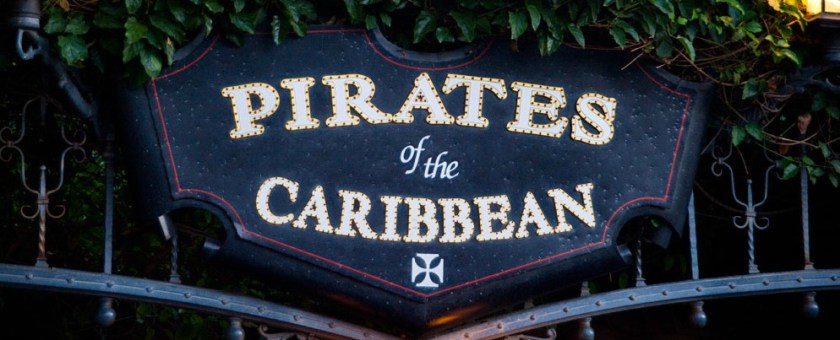
Disneyland-POTC_sign

If you’re like me, you know the only way to turn at the end of Main Street USA is left.  Left, toward Adventureland, and New Orleans Square.  Sure, you could go for one of the “speed” rides like Space Mountain over in Tomorrowland.  Buzz Lightyear (Astro Blasters) is a good one.  Or, maybe Thunder Mountain.  The Matterhorn is re-opened, if you like to have your spine compressed (not sure why they didn’t fix that problem during the most recent refresh).

But, the best rides are definitely in Adventureland.  The Jungle Cruise, Indiana Jones, Pirates of the Caribbean, and the Haunted Mansion.  Don’t even get me started on how awesome Tom Sawyer’s Island is.

The Jungle Cruise is all about the puns.  Indiana Jones is (mild) sensory overload and a neat cave walk to and from the ride.  The Haunted Mansion is a cross between Tim Burton’s vision of the world, and old school special effects that are still cool.

The best of all is Pirates!

First you’re in a New Orleans bayou.  Crickets are chirping, a few frogs are croaking quietly, and fireflies dart about.  It’s dark, quiet, and lazy.  The swamp guy sits on his porch, smoking a corn cob pipe.  The sound of slow banjo picking comes from his house.  Do swamp guys have CD’s?  Electricity?  Does he have a banjo-playing friend in the house?  Then, total darkness, a quick drop, and we enter a pirate’s lair.  It’s clearly seen better days.  Tons of treasure gather dust and cob webs.

I’ve never known what a New Orleans bayou has to do with being in a pirate’s lair, but over the years, I’ve learned it doesn’t matter.  “Dead men tell no tales!”  Just as you figure out that all the riches and treasures in the world didn’t do these dead pirates any favors, a foggy curtain projects an apparition of Davy Jones, warning us about the cursed lives of pirates.  Our boat ignores the warning and carries us into this cursed world.

We enter a pitched battle between a pirate ship with cannons blazing, and the shore defenses firing back.  It’s a desperate battle with explosions and lots of yelling.  Somehow the shots never hit anything vital, or do they?  The battle rages on, but we pass safely under the line of fire.

The harbor comes into view.  Not just any harbor, but a “Yo Ho, Yo Ho, a pirate’s life for me,” harbor from long ago.  Pirates are drinking and singing.  Some of the less fortunate are dunked endlessly in a well.  A vain search for Captain Jack Sparrow.  Others are sold as brides.  We see drunk pirates singing to themselves and no one in particular, scheming ways to find more treasure.

The scene shifts again to a prison where the only hope of escape lies in convincing a dog to give up the keys.  The dog never budges, but always looks like he might.  Hopefulness mixed with despair.  If only the prisoners would realize that their only salvation is to find a new strategy, a new direction.  Of course, they never make this connection.  We slowly pass under a collapsing ceiling, and back into the harbor.

The town is ablaze, but nobody cares.  We know the flames spell disaster, but that’s lost on everyone in the scene.  They continue to drink, sing, and chase each other in a search for the next moment.  Some fire randomly across the water at their friends.  “Yo Ho, Yo Ho, a pirate’s life for me!”

The dichotomy of the celebratory singing and the evil that humans do to one another isn’t the point…or, maybe it is.  All the while, our boat floats lazily through the scene.

We begin our slow climb out of this cursed world as Jack Sparrow tell us to, “Drink up you laddies!  Yo Ho!”

What makes this ride so popular?  Definitely not the speed.  Is it the “escape” into another world?  Maybe.  But, is it really an escape?

Each of us can relate to being the pirate.  We’ve been dunked in the proverbial well…sometimes we do the dunking.  We’ve fired aimlessly at our enemies (and our friends) at one time or another.  Oblivious to the pain we may cause.  We’ve focused solely on the now.  Ignored the future.  We’ve looked for treasure.  Maybe we’ve found it…and yet, our search continues.

Are we nothing more than passengers on the boat, passing lazily through the scenes of life, yet never connecting to any of it?  Hopefully not.

A pirate’s life, indeed.  Time to get in line for the next ride!


Real People. Not Actors.

Are real people supposed to be more honest than actors…

There I was at the gym, climbing the StairMaster (it’s what competitive stair climbers do for fun), and I noticed a commercial on one of the TV’s.  I don’t know what the commercial was trying to sell.  I only know that the people who looked so excited were Real People. Not Actors. That’s what it said on the screen.

I wonder if actors like being thought of as not real people.

Are real people supposed to be more honest than actors?

Don’t we all act just a little bit everyday?  If that’s true, who’s the real person, and who’s the actor?

Real people choose to act in a certain way, everyday.  They may choose to act unhappy, irritated, belligerent, impatient, frustrated.  Or, they may choose to act happy, supportive, patient, welcoming.

We’re all actors…and real people.  We choose how we act.

When we choose, it’s real for everyone, including ourselves.

Taking Time to Grieve

Grieving is unavoidable, no matter how busy or tough we think we are.

When someone we love dies, we often hear about the grieving process.  We hear that we should take time to grieve.  It’s something we can’t skip.

Grieving is unavoidable, no matter how busy or tough we think we are.

I remember when my Grandma Anne died (over twenty years ago).  My cousin, Devin, told me about DAWA, the four stages of the grieving process that he’d learned as a policeman:

Denial—we deny that the person has died, or that this is really happening.  We may also deny that it’s impacting us emotionally, or deny that we even understand the mix of emotions that are welling-up inside of us.

Anger—we realize this is real.  We wonder what we could have done differently.  We wonder how something like this could have happened.  We may question the justice in the universe, or how God could allow this.  Bargaining phrases like, “if only…” come into our mind.

Withdrawal—sometimes the only way to cope with the reality of our loss, and the emotions we can’t control, is to withdraw.  This may be within ourselves, or to some place where we can be alone.  Denial is giving way to reality.  Anger is turning to sadness.  We look within ourselves for the strength to overcome our sadness.

Acceptance—we begin to get our head wrapped around what is happening.  We start to make peace with this new reality.  Acceptance doesn’t mean we’re “over it,” or that there isn’t an irreparable rip in the fabric of our soul.  It means we start to understand how to go forward with our life.

It’s easy to list these stages and assume grief is a simple process with a beginning, middle, and end.  It doesn’t work that way.  Some people never get through all the stages, or, they may cycle through one or more of the stages numerous times.  It’s a process without a true endpoint…only the hope of eventual acceptance.

The grieving process applies to more than our loved ones passing away.  It can apply to losing just about anything else we love (whether we realize it or not).

Maybe it’s a friend who we don’t get to see anymore, a hobby we can no longer participate in, moving into a new house (and leaving the old one behind), graduating from college and saying goodbye to our friends, losing that job we thought we’d have for many years to come.

It doesn’t matter if we’re the ones driving the change in our life, or if the change is thrust upon us without warning.  It doesn’t matter if our loss is a stepping stone that leads us to something even greater (which is often the case).

The loss is real.

And, so is the grieving process.

The Most Important Question…

If the customer is so important, why are urgent things getting in the way?

I’ve found an interesting theme among those I’m coaching lately. When I ask about customers, I get various versions of blanks stares, or platitudes about how they are trying to stay focused on their customer.

Rather than customers, they are usually focused on some sort of internal organizational issue, the latest restructuring project, the next budget presentation, or hitting the number (whatever number it may be). Don’t get me wrong. These are important; at least urgent.

But, this blank stare when it comes to customers is interesting. After all, isn’t the customer why we’re in our business in the first place? We have a product or service that our customers need or want (hopefully both). We may be the only source for our customer. Or, more likely, we’re one of many providers of the products and services they want.

If the customer is so important, why are urgent things getting in the way? Simple. It’s easy to get caught up in the urgent, often internal, issues. Being busy can feel rewarding.

It’s harder to remember that your organization only matters if your customers think it matters.

Sounds harsh, but that’s all there is…you and your customer.

See if you can answer these questions about your customers. Before you jump ahead, there’s one rule. Write your answers in the form of direct quotes from at least five of your customers:

  • How do your customers use your products and services?
  • Why do they use your products and services?
  • How do your products and services make them more successful?
  • What worries your customers?
  • What are you doing to help with the things that worry them?
  • What do they see in their future?
  • Will you be a valuable part of their future?
  • How can you help your customer get to their future faster?

And, the most important question of all:

  • Does your organization really matter to your customer? Why? (Or, why not?)


Who’s With Me?

Leadership lessons from Bluto (John Belushi) in Animal House, circa 1978…

Bluto--whos with me


Leadership lessons from Bluto (John Belushi), circa 1978…


Bluto: Hey! What’s all this laying around s***? 

Stork: What the hell are we supposed to do, ya moron? We’re all expelled. There’s nothing to fight for anymore.

D-Day: [to Bluto] Let it go. War’s over, man. Wormer dropped the big one.

Bluto: What? Over? Did you say “over”? Nothing is over until we decide it is! Was it over when the Germans bombed Pearl Harbor? Hell no!

Otter: [to Boon] Germans?

Boon: Forget it, he’s rolling.

Bluto: And it ain’t over now. ‘Cause when the goin’ gets tough…

[thinks hard of something to say]

Bluto: The tough get goin’! Who’s with me? Let’s go!

[Bluto runs out, alone…]

Other than not being in the script, why didn’t anyone follow Bluto at this point?

Simple. He didn’t outline the mission, or why it was important. He didn’t engage the early adopters, the risk takers.

He didn’t capture the imagination of any thought leaders in the group. Sure, he conveyed some intense emotion.  He may have even motivated a few of his team members to think a bit, and ignore Stork and D-Day’s surrender. But, take action? Not a chance.

[Bluto returns, looking frustrated…]

Bluto: What the f*** happened to the Delta I used to know? Where’s the spirit? Where’s the guts, huh? This could be the greatest night of our lives, but you’re gonna let it be the worst. “Ooh, we’re afraid to go with you Bluto, we might get in trouble.” Well just kiss my ass from now on! Not me! I’m not gonna take this. Wormer, he’s a dead man! Marmalard, dead! Niedermeyer…

Otter: Dead! Bluto’s right. Psychotic… but absolutely right. We gotta take these bastards. Now we could do it with conventional weapons, but that could take years and cost millions of lives. No, I think we have to go all out. I think that this situation absolutely requires a really futile and stupid gesture be done on somebody’s part!

Bluto: We’re just the guys to do it.

[Boon and D-Day stand up] 

Boon: Let’s do it.

Bluto: [shouting] “Let’s do it”!

[all of the Deltas stand up and run out with Bluto]

How did Bluto turn the tide? He challenged the team to face their fears. He outlined the (crazy) mission, and why it mattered.

Most important…he ignited a thought leader in the group.  Otter took emotional ownership of the crazy mission and vision that Bluto (sort of) outlined.  Otter gave it clarity, and made it safe for everyone to support.

Once Otter (and D-Day and Boon) stand in support of Bluto’s crazy idea, the rest of the team unites. The exact plan isn’t clear, but the thought leaders create the wave of support it needs to launch.   The rest is detail.

All Bluto has to do is add:  “We’re just the guys to do it.”

He doesn’t ask, “Who’s with me?” when he leads the team out the second time.  He already knows, and so does his team.

Who are the thought leaders in your organization?

How do you influence them? How do they influence you?

What are you doing to harness their power?

Who’s with you?  That’s up to you and your thought leaders.

http://youtu.be/q7vtWB4owdE

What the Flock is Going on Here!?!?

Which are you, predator or prey?

Lots of animals live and move in groups.  Cows, sheep, wildebeest, mackerel, geese, humans…just to name some examples.  We’ve come up with lots of names for these groupings:  herd, flock, school, gaggle, gang, company, industry trade group, union, political party.

Each of these groupings have one primary purpose:  defense.  There is safety in numbers, or so the saying goes.  Groups moving in unison appear larger to predators.  Their coordinated movements confuse and intimidate those who would otherwise do harm to the individuals in the group.

When predators attack, they pick the weakest and most vulnerable in the group to attack first.  That’s okay with the group, since protection of the group as a whole is paramount.  Any particular individual is less important than the survival of the entire group.

Predators often travel alone.  Eagles, bears, cheetahs, sharks, jaguars, Tesla…all loners.  Sure, some predators travel in groups.  Lions have their pride.  Wolves have their pack.  Orcas and dolphins have their pods.  The primary goal of a predator, whether alone or in a group, is offense.  They work in a coordinated effort to maximize return on their energy investment…capturing the most prey with the least amount of energy output.

Nothing is safe in the animal kingdom.  The food chain takes no prisoners.  The hunter often becomes the hunted.  The same is true in human enterprises.  In the (hopefully) never ending capitalist cycle of invention, construction, destruction, re-invention, and reconstruction, the roles of predator and prey can switch on a moment’s notice.

An instinctive drive for safety leads to new alliances.  Predators who would never think of joining a defensive flock are drawn in by the promise of safety from some new, common enemy.  Defense against the enemy becomes the rule of the day.  Thoughts of maximizing return on investment, or re-inventing the future, are replaced by a focus on defending the status quo of the flock.

In a uniquely human twist, the defensive flock may even take on a new mission.  The defensive flock goes on offense.  This flock actively seeks out the lone predators, the re-inventors.  They marshal all of their creative energy toward destroying predators before their new ideas wreak havoc on the flock.  Protection of the group is all that matters.  The individual is less important.

Which are you?  Predator or prey?  Loner, or flock member?  Are you a former predator, now seeking the safety of a new flock?  Are you defending the status quo, or throwing in with the crazies who are re-inventing the future?  Are you on offense, or defense?

Are you making this choice for yourself, or are you allowing the flock to make the decision for you?

Curiosity and Zombies

Curiosity is better than shotguns…

Are you genuinely interested in how something works, why things happen, what people think?

Do you look at articles describing how some industry you’re not a part of is facing a new market or regulatory challenge?

Are you entertained to learn that Starbucks Frappuccinos and iced coffees may be changing ice cube usage customs in Europe?

Do you click on links to articles about Africapitalism and venture philanthropy?

Have you ever imagined what it would be like to “fly” off a cliff wearing a Wingsuit?

Do you wonder how the education systems of the US can be improved by the proliferation of MOOC’s and alternative learning services like Udacity, Khan Academy, and others?

Do you marvel at how a rocket engine made mostly of solid rubber can power a spaceship launch?

Do you look at things as they are, and imagine how they could be changed by process improvements, new inventions, or new technology?

Are you an “early adopter” of new ideas?

The ultimate question is:  Are you curious?

The happiest and most successful people I know are curious.  They choose to be explorers in a modern world.  Pursuing answers to what, where, who, how, and (of course) why is what makes them tick.  Their curiosity is the key to an engaged existence.

They may not find, nor like, all of the answers.  That doesn’t stop their insatiable curiosity to learn more.

Show me someone lacking curiosity for life, and I’ll show you the closest thing to a living, breathing member of the walking dead.  Who knew curiosity would be better than shotguns against zombies?