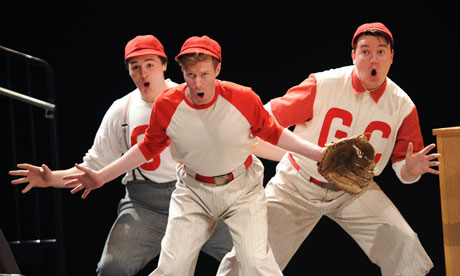
The Life We Realize

Was today important? How about tomorrow?

Our Town

EMILY: “Does anyone ever realize life while they live it…every, every minute?”

STAGE MANAGER: “No. Saints and poets maybe…they do some.”

Thornton Wilder, Our Town


“Choose the least important day in your life. It will be important enough.”

Thornton Wilder, Our Town

I never read Thornton Wilder’s play, Our Town. It seems like the type of literature that would be required high school reading. The mundane and simple nature of the play would surely be lost on most high schoolers, so it’s a good thing I didn’t discover the play until recently.

I’ve just started reading it…the first play I’ve read in at least thirty years. What a relief to know I get to read this one for the sheer pleasure of it, and not in preparation for a final exam on the subject.

There are a ton of thought provoking quotes in the play, but these two stand out for me:

Does anyone ever realize life while they live it…every, every minute?

It’s easy for us to see that fish swim in water that sustains their life, but I doubt they realize it. It’s easy for us to understand that we are “swimming” in the air that sustains our life, but I doubt we realize it. Life is all around us, every minute if we choose to notice.

How many of us realize how precious each day is while we are living them. The countless decisions and non-decisions we make each day, the people we impact (hopefully positively). The memories we accumulate along the way.

Instead of continuously looking ahead, chasing our dreams, maybe it’s good to look to the side occasionally. Slow down and check out the scenery that’s whizzing past as we barrel ahead to our futures. Taking time to appreciate the gift of our life, even as we live it.

Choose the least important day in your life. It will be important enough.

If you live to be 100 years old, that’s 36,500 days. How about 75 years? That’s 27,375. Imagine you just turned 48, like me. I’ve used 17,538 of my days, so far. Trust me, I used a calculator to check my math.

Which one was the most important? How about the least important?

What are the criteria you use to define importance? Do you have your criteria all picked out? Are you ready for the days when those things you thought were important suddenly don’t matter?

Each of us can identify important days in our past. Chances are, some of the days you see today as being most important didn’t seem so important when you were living them in real time. Hindsight is good that way.

Was today important? How about tomorrow, or the next day?

Each of them will be important enough, if we take the time to realize it.


Photo Credit:  http://www.theguardian.com


Who’s With Me?

Leadership lessons from Bluto (John Belushi) in Animal House, circa 1978…

Bluto--whos with me


Leadership lessons from Bluto (John Belushi), circa 1978…


Bluto: Hey! What’s all this laying around s***? 

Stork: What the hell are we supposed to do, ya moron? We’re all expelled. There’s nothing to fight for anymore.

D-Day: [to Bluto] Let it go. War’s over, man. Wormer dropped the big one.

Bluto: What? Over? Did you say “over”? Nothing is over until we decide it is! Was it over when the Germans bombed Pearl Harbor? Hell no!

Otter: [to Boon] Germans?

Boon: Forget it, he’s rolling.

Bluto: And it ain’t over now. ‘Cause when the goin’ gets tough…

[thinks hard of something to say]

Bluto: The tough get goin’! Who’s with me? Let’s go!

[Bluto runs out, alone…]

Other than not being in the script, why didn’t anyone follow Bluto at this point?

Simple. He didn’t outline the mission, or why it was important. He didn’t engage the early adopters, the risk takers.

He didn’t capture the imagination of any thought leaders in the group. Sure, he conveyed some intense emotion.  He may have even motivated a few of his team members to think a bit, and ignore Stork and D-Day’s surrender. But, take action? Not a chance.

[Bluto returns, looking frustrated…]

Bluto: What the f*** happened to the Delta I used to know? Where’s the spirit? Where’s the guts, huh? This could be the greatest night of our lives, but you’re gonna let it be the worst. “Ooh, we’re afraid to go with you Bluto, we might get in trouble.” Well just kiss my ass from now on! Not me! I’m not gonna take this. Wormer, he’s a dead man! Marmalard, dead! Niedermeyer…

Otter: Dead! Bluto’s right. Psychotic… but absolutely right. We gotta take these bastards. Now we could do it with conventional weapons, but that could take years and cost millions of lives. No, I think we have to go all out. I think that this situation absolutely requires a really futile and stupid gesture be done on somebody’s part!

Bluto: We’re just the guys to do it.

[Boon and D-Day stand up] 

Boon: Let’s do it.

Bluto: [shouting] “Let’s do it”!

[all of the Deltas stand up and run out with Bluto]

How did Bluto turn the tide? He challenged the team to face their fears. He outlined the (crazy) mission, and why it mattered.

Most important…he ignited a thought leader in the group.  Otter took emotional ownership of the crazy mission and vision that Bluto (sort of) outlined.  Otter gave it clarity, and made it safe for everyone to support.

Once Otter (and D-Day and Boon) stand in support of Bluto’s crazy idea, the rest of the team unites. The exact plan isn’t clear, but the thought leaders create the wave of support it needs to launch.   The rest is detail.

All Bluto has to do is add:  “We’re just the guys to do it.”

He doesn’t ask, “Who’s with me?” when he leads the team out the second time.  He already knows, and so does his team.

Who are the thought leaders in your organization?

How do you influence them? How do they influence you?

What are you doing to harness their power?

Who’s with you?  That’s up to you and your thought leaders.

http://youtu.be/q7vtWB4owdE

Do It Anyway

Very few of us will change the (entire) world. But, following the advice in these verses is a great way to change our little corner of it…

I recently came across this poem.  It was painted on the wall of Mother Teresa’s home for children in Calcutta, India.  While it’s well-known to many, it’s new to me.  I like it so much I’ve decided to share it here:

People are often unreasonable, irrational, and self-centered.

Forgive them anyway.

If you are kind, people may accuse you of selfish, ulterior motives.

Be kind anyway.

If you are successful, you will win some unfaithful friends and some genuine enemies.

Succeed anyway.

If you are honest and sincere, people may deceive you.

Be honest and sincere anyway.

What you spend years creating, others could destroy overnight.

Create anyway.

If you find serenity and happiness, some may be jealous.

Be happy anyway.

The good you do today, will often be forgotten.

Do good anyway.

Give the best you have, and it will never be enough.

Give your best anyway.

In the final analysis, it is between you and God.

It was never between you and them anyway.

Very few of us will change the (entire) world. But, following the advice in these verses is a great way to improve our little corner of it.

That’s all that matters anyway.

Questions of Talent

How much time do you spend thinking about the talent in your organization?

captain_picard

Talent is the life blood of any organization. This is easily forgotten as organizations try to remain relevant in a world characterized by nanosecond attention spans.

It doesn’t matter what product or service your organization delivers. Having the right talent in the right places at the right time is the key to your organization’s success.

With so much riding on talent, is it a top priority for you? How much time do you spend thinking about the talent in your organization?

How engaged is the talent in your organization? Do they really care about the mission, or are they just going through the motions, collecting a paycheck?

Do you know who’s ready to move up, who’s moving sideways, and who needs to move out?

What are you doing about it?

What about your own talent? Are you prepared to move up? Do you still fit in your role, or your organization?

Who are you developing to be your replacement?

Are you truly engaged in the mission, or just going through the motions?

If you aren’t fully engaged, it’s time to either move on, or re-commit. Life’s too short to live somewhere in between.


If It Makes You Happy

There’s a question in life that each of us gets to answer:

JulnJen-Blue


“If it makes you happy, then why the hell are you so sad?”  –Sheryl Crow

I was hiking this week and came across a California Conservation Corps crew. They were clearing brush near the trail. There were probably ten in the crew. I don’t know if they were volunteers, paid workers, or possibly working off community service hours. One thing was certain. None of them were enjoying the work.

I saw a lot of slouchy, half-hearted shoveling. They each looked exhausted. The brush wasn’t fighting back, but it was on the verge of beating this crew. None of the crew members embraced the joy that can come from working outside as the sun rises. I doubt if any were proud of the job they were doing, or the difference they were making.

They weren’t happy because they didn’t want to be happy.

Are you happiest at home? At work? Running trails? Sewing a quilt? Playing Call of Duty? Cooking dinner? Reviewing your finances? Gazing upon the ocean from the balcony of your stateroom? Sitting in quiet meditation? Mowing the lawn? Sipping a Mai Tai? Pulling weeds? Playing hide-and-seek with your kids? Cleaning your toilets? Watching your kids’ soccer games? Doing the dishes? Surfing? Playing guitar?

If you put this list in descending order from happiest to saddest, which activity is your happiest? Saddest?

I submit that each activity (and hundreds more) can be happy or sad, rewarding or frustrating, peaceful or angry, creative or boring. The activity and its location aren’t nearly as important as the one real determining factor:

The attitude we choose to bring.

There’s a question in life that each of us gets to answer:

What makes me happy?

The answer? The third word of the question.

Until you work on yourself, there isn’t much anyone or anything can do to make you happy.

“Most folks are as happy as they make up their minds to be.”  –Abraham Lincoln


In honor of this, my 100th blog post, I thought I’d post a picture of two readers I have in my mind as I write each post.  It’s amazing to me that this photo is nearly twenty years old!  My how time flies.


What would you do if you weren’t afraid?

Fear can motivate. Fear can paralyze. It can save your life. Unfortunately, it can also control your life.

“…let me assert my firm belief that the only thing we have to fear is…fear itself — nameless, unreasoning, unjustified terror which paralyzes needed efforts to convert retreat into advance.” –Franklin Delano Roosevelt (first inauguration address, 1933)

Fear can motivate. Fear can paralyze. It can save your life. Unfortunately, it can also control your life.

Here’s a list of fears to consider:

  • Failure
  • Embarrassment
  • Public Speaking
  • Death (I’m pretty sure a lot of people fear the first three more than death)
  • Not Being Accepted
  • Commitment
  • Flying
  • Disappointment
  • Success
  • Fame
  • Responsibility
  • the Unknown
  • the Dark
  • New Experiences
  • Being Blamed
  • Heights
  • Snakes
  • Spiders
  • Sharks
  • Geese
  • Open Spaces
  • Anywhere but Home
  • Confined Spaces

I know people who have each of these fears. I have some of them, and I’m sure you have some as well.

Fear is generated in our Lizard Brain . That primitive part of our brain that keeps us alive while we’re thinking about other stuff. Our Lizard Brain means well, and only has our best interest in mind. It’s the center of our survival instinct. It will do anything it can to help us avoid the things we fear. Unfortunately, it’s part of our brain that we barely control.

One way to gain control of our fear is to discover, and admit, that it exists. That, and admitting our fears impact the things we choose to do (or not do). It may help to discuss your fears with someone you trust, or to contemplate them on your own. Either way, understanding your fears is the first step toward controlling them.

Consider a ten-year-old, standing in right field. He knows that he’s in that position because he’s the worst player on the team. Fly balls rarely make it to right field in little league games, so he’s safe out there. What happens when the ball flies into right field? What’s the first thing on that ten-year-old’s mind? Probably something like, “Please don’t let me screw this up and drop the ball.” His first thought comes from a place of fear. Did he catch the ball? Did he make the right play once he had the ball? Maybe, but doubtful.

Imagine the same player who knows he’s in right field because he’s the only player who can make the throw all the way to third base. He has a gun for an arm, and he may be the best player on the team. What’s he thinking when the ball flies into right field? “I can’t wait to get that ball so I can make the play.   We are going to stop this rally and win the game!” Fear isn’t part of the equation. Did he catch the ball? Did he make the right play? Probably.

Fear creates completely different experiences for these ten-year-olds. The secret is that this applies at all ages, in nearly everything we do.

How many of your goals are “off limits” because you’re afraid? How many potential goals are eliminated by fear (your Lizard Brain), before you even know about them?

How often is fear your first response? How often do you talk yourself out of something that’s outside your comfort zone? It’s easy to do…avoiding fear is a powerful motivation.

Start small. Choose one thing that scares you and go after it. Embrace the negative energy of fear and turn retreat into advance. Each time you do this, your list of fears will shrink.

What would you do if you weren’t afraid?

Do it today!


Two Words

Here are two powerful words you can use every day…

How many times have you heard (or said) something like:

“I used to run until I hurt my knee”

“I remember how fun it was to cook with my kids”

“I like gardening, but I just don’t have time”

“I wish I had the energy to workout”

“I used to practice piano at least an hour a day”

“I loved traveling before the kids were born”

“I had to start working fulltime, so I didn’t have time to finish my degree”

“I’ve always wanted to learn how to play guitar”

“I wish I knew how to draw”
We all have things we used to do, things we wish we could do, or could have done. The question is what’s stopping us from doing these things? What’s stopping us from trying something new?

For the things we used to do, but don’t anymore, here are two powerful words:

Begin again.

For things we wish we could do, there’s an even more powerful version:

Begin.

The easiest failure is failing to begin.

Our greatest success can only happen when we choose to begin.

Or, begin again.


Your Life’s Mission

The awkwardly silent room’s attention shifted to me…

I don’t remember the exact year, but it was probably around 2003. My boss invited a couple of us to attend a leadership meeting that he attended monthly. Each meeting had a keynote speaker, and he thought we’d like to hear the talk.

The speaker’s topic was how our life’s mission impacts our leadership style, and ultimately what we’ll drive ourselves to accomplish professionally. He made a compelling case, and then asked each of us to state what our life’s mission was…on the spot.

I hadn’t given it much thought. I was pretty focused on the day-to-day challenges of making a living, trying to save money for our daughters’ college education, trying to find time to run and exercise, maybe finally furnish a couple of the empty rooms in our house.

Luckily I was toward the end of the line, so I got to listen to everyone else’s. There were lots of lofty and admirable missions mentioned. Most were brief. A couple of the missions took some time to explain.

A mission is a promise to yourself. A mission is a set of principles that guide your actions. We may not always fulfill our mission, but it’s always there, pointing the way.

As each person stated their missions, I faced the reality that I didn’t really have one.

My good friend and co-worker went just before me, and he said that his life’s mission could be summed up in two words. He smiled and said, “Have fun!” An awkward silence came over the group. They were probably wondering if this guy was serious, or was he just mocking the exercise.

The awkwardly silent room’s attention shifted to me.

I said something about creating opportunities for personal growth, challenging myself to push past my limits (whatever that meant), and I summed it up with, “Have fun.” Given the fact that I didn’t have a life’s mission when I arrived, it was a decent start.

Definitely not my final answer.

Over the years since that day, I’ve had this question about my life’s mission rolling around in my head. Now that I’m about halfway through life (that is, if I’m lucky enough to live until I’m 94), I think I’ve finally figured it out. I can sum it up with nine words:

Serve God.

Bring joy.

Help others.

Explore.

Have fun!

The room is looking at you now.  What’s your life’s mission?

The Truth about Ownership

Does everyone own the outcome, or no one?

“When everybody owns something, nobody owns it, and nobody has a direct interest in maintaining or improving its condition. That is why buildings in the Soviet Union—like public housing in the United States—look decrepit within a year or two of their construction…” Milton Friedman

Dr. Friedman won the Nobel Prize for Economic Science in 1976, and died in 2006 at the age of 94.

I could make this post all about his defense of capitalism, his arguments against socialism, the benefits of reducing government’s role in our lives, and a whole host of ideas that he defended throughout his career.

Instead, my focus is on ownership and how Dr. Friedman’s quote applies to leadership in a business setting.

Look around your workplace. Look at the teams. The committees. The ad hoc groups that come together to solve a problem.

Who owns the outcomes of these teams, committees, and ad hoc groups? Is everyone aligned around the same goals? Does everyone own the outcome, or no one?

Ownership is the key to success. Owners are always more dedicated to the outcome than non-owners. If this is true, wouldn’t more owners be better? As Dr. Friedman points out, when everyone owns something, nobody owns it.

True leaders step up and take ownership. Leaders then unite others around the important goals. Followers, in turn, own their support of the goals and their valued place in that effort.

Show me a team with multiple owners (which is really no owners), and I’ll show you a leaderless team that’s doomed to mediocrity and failure.

The Presence of a Toddler

Toddlers are the ultimate expression of being present…

I read an article today about the “busyness bubble” that exists in society today. The author described a world where everyone is over-worked, over-stimulated, over-committed, rushing from one place to another, distracted every two minutes by emails, texts, and Twitter and Instagram feeds on their smartphones.

This continuous busyness and distracted lifestyle hampers creativity, and prevents real human connection. There isn’t time to think beyond the next two minutes, the next errand, the next meeting.

Take a walk with a toddler. Trust me, it won’t be a long walk. Watch where they focus. Notice they aren’t worried about their smartphone (since they don’t have one). They have no destination in mind when they start their walk. They’re too busy looking at the pebbles, snail shells, and cracks in the cement to think about anything else. They have no errands to run, no meetings to attend. They aren’t worried about what they said yesterday, or what they’ll be doing tomorrow.

Toddlers are the ultimate expression of being present. Nothing interrupts their train of thought except the next shiny object in front of them. Their walk is a time of new discovery and new experiences.

Busyness is self-inflicted. It’s the result of a series of decisions that we control. Each decision makes sense at the time…or, seems like the only choice we have. We decide to pile commitments on to our schedule. We decide to worry today about next week’s deadline. We decide to dwell on injustices of the past. We decide to look at our phone every two minutes.

Don’t know any toddlers? Take that walk anyway. Leave your phone behind. Count the number of snails you see. Look for the most colorful pebbles. Take some time to smell the roses in your neighbor’s yard. Appreciate the sun’s warmth on your back.

Enjoy the clarity of being present, and enjoy the fulfillment that comes from deciding to be less busy.

The choice is yours.