
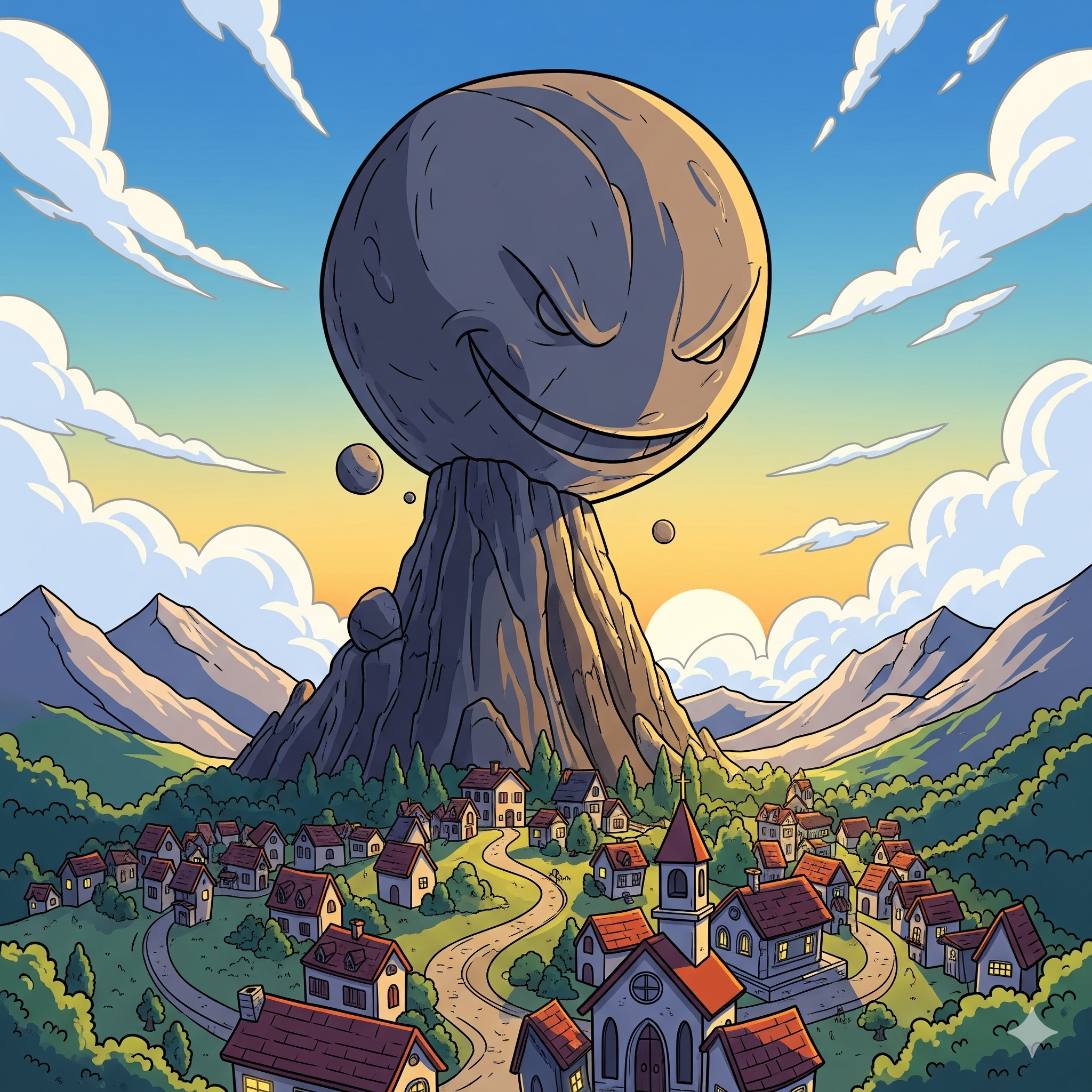
There once was a village named Smithville, tucked neatly beneath a mountain. Life was simple until the mayor spotted a massive boulder teetering on the slope. Experts confirmed the obvious. The massive boulder might fall and crush the town.
In a flash of civic urgency, the mayor declared: “We must secure the boulder!” And so they did. With ropes, pulleys, and sheer determination, ten villagers at a time held the lines to keep the boulder in place. They rotated shifts around the clock. It became routine, then tradition, then law.
Children sang, “Hold the boulder, hold the boulder, we must resolve to hold that boulder!” before school each morning. A cabin was built for the rope holders. A trail crew was hired to keep the path safe for the endless march of workers. Rope suppliers prospered since the intricate rope system required constant maintenance. Soon, nearly half the town’s budget went to “boulder security.”
Still, the village flourished. Visitors came to marvel at the rope-wrapped rock. “Come see our mighty gravity defying boulder!” proclaimed their glossy posters. A bond was passed to fund a visitor center and tour buses. Hotels filled. Restaurants boomed. Property values soared near “Boulder View Estates.”
One day, a newcomer named Brunswick questioned the logic of leaving the boulder where it was. “Why not break the boulder into smaller, harmless pieces?” The council laughed at his question.
The mayor beamed with pride, “Our boulder isn’t a threat. It’s our livelihood! Besides, we have a rope system to protect us.”
The townspeople nodded, waving their SAVE OUR BOULDER signs in support.
Who could argue with prosperity?
Brunswick left shaking his head.
Years later, despite the ropes, despite the cables, despite the slogans, the inevitable happened. That winter, the boulder grew heavier than ever with snow and ice. Villagers had trouble reaching the ropes, as storms blocked the trail. Shifts went unfilled. Fewer villagers meant fewer ropes to hold the boulder.
“The forecasters said it wouldn’t be this bad,” the mayor reassured them, as though the weather itself had broken its promise.
Workers tugged and shouted, trying to keep their grip. Fingers numbed, feet slipped, and a few gave up entirely. The remaining ropes snapped one by one. The sound echoed through the valley like rifle shots. The mountain itself seemed to groan.
Then came the moment. The final rope gave way with a thunderous crack. The boulder lurched forward, dragging what remained of the cable nets with it.
As it tumbled down the mountain, the ground shook violently. Houses rattled, dishes shattered, and children screamed.
The mighty rock careened toward the valley, smashing trees like twigs and carving deep scars into the earth. Clouds of dust rose as if the mountain were on fire. Each bounce sent shockwaves through Smithville, knocking people off their feet. The villagers ran in terror, listening to the deafening roar as the great stone rolled ever closer.
When it finally came to rest, the devastation was complete. The visitor center lay in ruins. Boulder View Estates was flattened into rubble. Streets were cracked, and smoke rose from shattered chimneys.
Yet by some miracle, no one was hurt. The thunder of the falling boulder gave everyone time to flee. Amid the destruction, whispers of a miracle could be heard all over the battered town.
As the dust cleared, townsfolk began to consider their plans for rebuilding. Some sketched designs for a grand new visitor center. This one would tell the story of The Great Fall.
A five-year plan was drafted to study rope alternatives, complete with a Rope Oversight Committee and quarterly progress reports.
Bureaucracy bloomed again, strong as ever.
Though no one mentioned the missing boulder.
Story behind the image – I used Google’s new Nano Banana image generator for this image. I asked it to produce a large and evil boulder sitting on top of a mountain, held by ropes, overlooking a nice town that it’s threatening…in a cartoonish style. This is the first image it produced. It missed the part about the ropes, but I like the over-the-top (see what I did there?) theme of this rendering. And that boulder may appear in a few more stories in the future.
© 2025 Bob Dailey. Licensed under Creative Commons BY-NC-ND 4.0.

 Grandpa Bob Encouraging Leadership
You must be logged in to post a comment.