AI Doesn’t Know Our Business. We Do.

AI can prototype our workflow. It can draft our requirements. It can generate our user stories. But it has no idea how our business actually works.

It can’t tell us where the bottlenecks in the process are. Our loan officer knows that. It can’t explain why the workaround exists. Our operations manager knows that. It doesn’t know which shortcuts blow up in an audit. Our compliance analyst knows that. It has no idea where customers rage-quit. Our customer service supervisor knows that.

Our best people, the ones who actually know how the work works, often have trouble translating what’s in their heads into something a developer can build. They know where the friction is. They know which exceptions happen every Thursday afternoon even though the procedure says they shouldn’t. They know which approval step matters, and which one is just a bureaucratic leftover from a reorg three years ago.

For the first time, the people who do the work and understand the problems they’re trying to solve can start shaping the solutions. AI gives their expertise a doorway it never had before.

These subject matter experts can sit down with an AI tool and start turning what they know into something visible. Plain language in. Workflow out. Prototype sketched. Edge cases surfaced. User stories drafted.

And when they do that, something shifts. They realize software development isn’t magic. It’s a thousand small decisions that someone has to make. That realization alone is worth the exercise.

Instead of walking into a meeting saying, “we need a dashboard” or “can we automate this?” they walk in with something tangible. Rough? Sure. Wrong in places? Probably. But it doesn’t have to be production-ready. It has to be conversation-ready.

That changes everything.

Developers, architects, and project leaders can see the idea. They ask sharper questions. They spot what already exists, what creates risk, what can ship fast. The subject matter expert starts understanding what building a solution actually involves. The dependencies. The data quality landmines. The difference between a slick mockup and something that holds up in production.

That shared understanding transforms the relationship between business and technology.

We know the old pattern. Business has a need that’s difficult to explain, the technology team tries to interpret it, weeks pass, something appears, the business says, “close but not what we meant,” the cycle repeats. Everyone gets frustrated. Nothing ships.

AI doesn’t kill that cycle. It compresses and turbo charges it. When developers start with a real prototype and a real conversation, iterations can take hours or days instead of weeks.

The AI win is getting people in the same room faster, with something real to react to.


If more people can generate ideas, workflows, and prototypes, we’ll start getting more possibilities than we can pursue. A good problem to have, but still a problem.

Bottom-up energy is powerful. It surfaces solutions from the people closest to the work. It finds problems leadership didn’t know existed.

But without focus, we’ll drown in prototypes. The bottleneck doesn’t disappear. It moves from “we don’t have enough ideas” to “we have no idea which ideas deserve investment.”

That’s on leadership.

Executives, your job isn’t to be the gatekeeper of imagination. Play that role and the old problems come back fast. Good ideas will die in departments, in notebooks, in hallway conversations that never go anywhere. You become the reason nothing changes.

Your job is to be the steward of focus. Create the channel. Invite ideas up. Encourage people to explore, prototype, get specific. Then make the call on what moves forward.

Bottom-up imagination. Technical refinement. Executive focus. That’s a model that AI tools make possible.

Subject matter experts bring better ideas because AI helps them say what they know. Technical teams sharpen those ideas because they understand what durable software is. Executives look across the whole landscape and ask the hard questions nobody else is positioned to ask.

Does this solve a real problem or just an annoying one? Does it scale? Does it duplicate something we already own? Does it create risks we can’t absorb? Is this a strategic investment or a distraction dressed up as innovation?

Not every prototype becomes a project. Not every project deserves to live in our permanent technology environment. That’s not a failure of imagination. That’s how imagination gets distilled down to create tangible business value.


The future advantage won’t go to the fastest movers or the biggest tool buyers. It won’t go to the organizations that treat AI like a cure-all and wonder why nothing changes.

It’ll go to the ones that know their business well, listen hard to the people doing the work, and never confuse creating more things with creating better things.

AI can help us build faster. That’s the easy part.

Knowing what to build and why. That’s still on us.

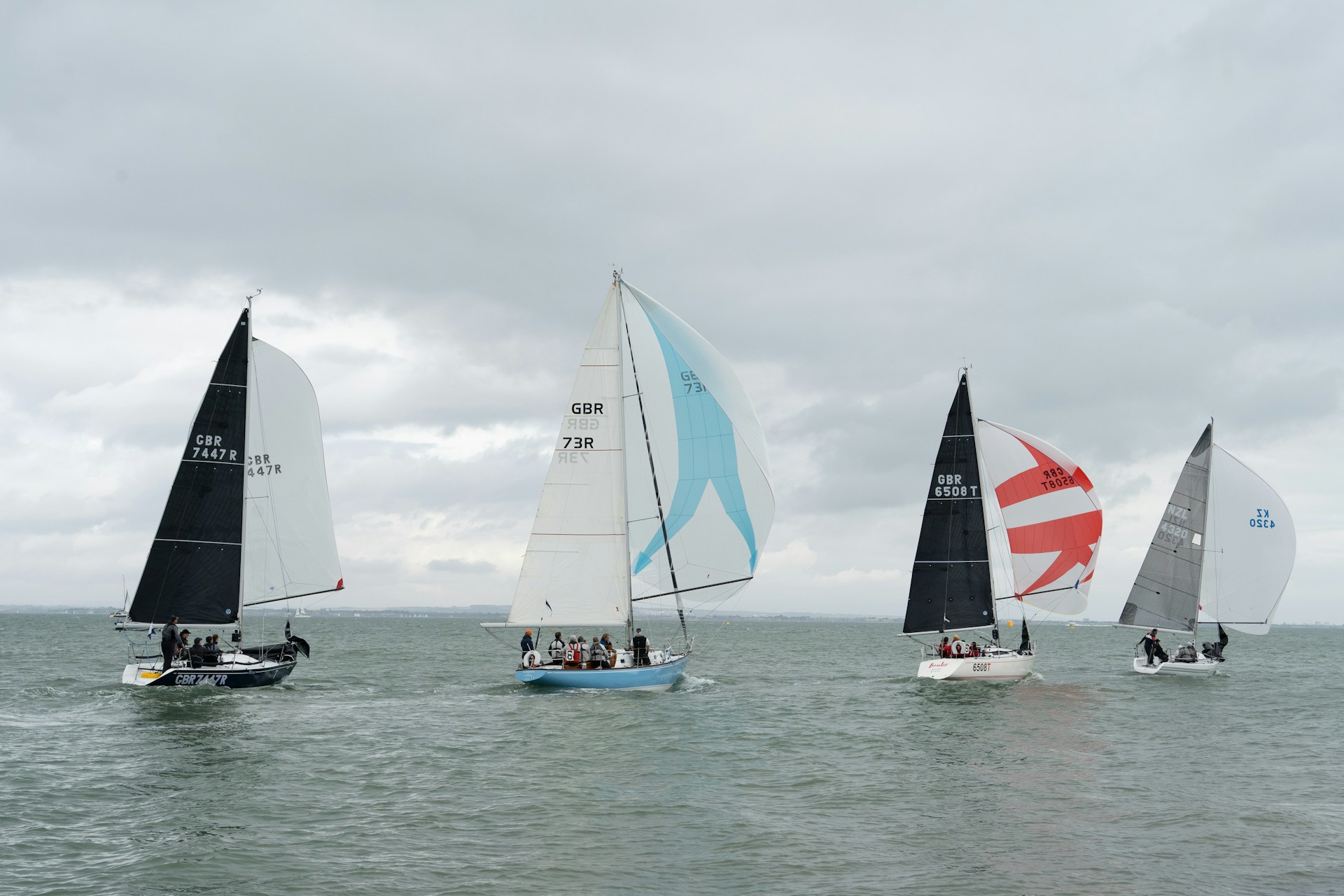
Photo by BEN ELLIOTT on Unsplash – This is a downwind leg, spinnakers out, boats grabbing everything the wind has to offer. A good metaphor for AI. It can give us remarkable speed. But we’re still in a race, there’s still a course to navigate, and the turns are still ours to make.

Measuring the AI Dividend

In the early 1990s, the term Peace Dividend appeared in headlines and boardrooms. The Cold War had ended, and nations began asking what they might gain by redirecting the resources once committed to defense.

Today the conflict is between our old ways of working and the new reality AI brings. After denial (it’s just a fad), anger (it’s taking our jobs), withdrawal (I’ll wait this one out), and finally acceptance (maybe I should learn how to use AI tools), the picture is clear. AI is here, and it’s reshaping how we think, learn, and work.

Which leads to the natural question. What is our AI Dividend?

Leaders everywhere are trying to measure it. Some ask how many people they can eliminate. Others ask how much more their existing teams can achieve. The real opportunity sits between these two questions.

Few leaders look at this across the right horizon. Every major technological shift starts out loud, then settles into a steady climb toward real value. AI will follow that same pattern.

The early dividends won’t show up on a budget line. They’ll show up in the work. Faster learning inside teams. More accurate decisions. More experiments completed in a week instead of a quarter.

When small gains compound, momentum builds. Work speeds up. Confidence rises. People will begin treating AI as a partner in thinking, not merely a shortcut for output.

At that point the important questions show themselves. Are ideas moving to action faster? Are we correcting less and creating more? Are our teams becoming more curious, more capable, and more energized?

The most valuable AI Dividend is actually the Human Dividend. As machines handle the mechanical, people reclaim their time and attention for creative work, deeper customer relationships, and more purpose-filled contributions. This dividend can’t be measured only in savings or productivity. It will be seen in what people build when they have room to imagine again.

In the years ahead, leaders who measure wisely will look beyond immediate cost savings and focus on what their organizations can create that couldn’t have existed before.

Photo by C Bischoff on Unsplash – because some of the time we gain from using AI will free us up to work on non-AI pursuits. 

The Mirage of Strategic Clarity

Strategic Planning That Can Survive Reality

It was the second day of a two-day strategic planning retreat. Revenue projections stretched across the screen. The CFO walked through all the assumptions in his spreadsheet. Customer acquisition costs will flatten, churn will improve by two points, and the new product will capture eight percent market share within six months.

Everyone nodded along, acting as if these forecasts represented knowledge rather than elaborate guesses built on dozens of assumptions, any one of which could be wrong.

Three months later, a competitor launched an unexpected feature. Customer behavior shifted. The CFO’s projections became relics of a reality that never existed. The entire strategic planning process had been built on an illusion.

What we pretend to know

In his 2022 memo The Illusion of Knowledge, Howard Marks explored how investors mistake confidence for clarity. He began with a line from historian Daniel Boorstin:

“The greatest enemy of knowledge is not ignorance, it is the illusion of knowledge.”

Leaders face a brutal paradox. Boards expect forecasts. Teams want confidence. Investors demand projections. The machinery of leadership demands certainty.

So, we build elaborate forecasts and make decisions based on assumptions we know to be fragile. We treat detailed guesses as facts.

Physicist Richard Feynman once said, “Imagine how much harder physics would be if electrons had feelings.” Electrons follow discrete laws, unlike people. People innovate, resist, panic, and occasionally do something amazing nobody saw coming. Competitors behave differently than our models assume. Markets shift for reasons we never thought possible.

Marks describes forecasting as a chain of predictions. “I predict the economy will do A. If A happens, interest rates should do B. With interest rates of B, the stock market should do C.” Even if you’re right two-thirds of the time at each step, your chance of getting all three predictions correct at once is only about thirty percent.

Leadership forecasts work in a similar way. We predict customer adoption rates. If adoption hits those numbers, we’ll need a certain operational capacity. With that capacity, we can achieve specific margins. Those margins will attract investment.

Each assumption depends on the previous one. The chain is only as strong as its weakest link.

The tools we trust

Walk into any strategic planning session and you’ll likely encounter two frameworks treated as gospel:

-SWOT analysis (strengths, weaknesses, opportunities, and threats)

-SMART goals (specific, measurable, achievable, relevant, and time-bound).

Business schools teach them. Consultants recommend them. Leaders deploy them with confidence. Each relies on assumed knowledge that may not exist.

A SWOT analysis claims to know which possible developments count as opportunities versus threats. It’s a snapshot of assumptions masquerading as strategic insight. An opportunity exists only if you can identify it, execute against it, and do so before circumstances change. The framework provides no way of acknowledging uncertainty.

SMART goals often confuse precision with accuracy. “Increase market share” becomes “increase market share in the Northeast region from 12% to 15% by Q4 2026.” It sounds specific, and therefore rigorous. It’s easy to be precise about something unpredictable.

And how do we know a goal is achievable? We make assumptions about resources, market conditions, and competitor behavior, then write a goal that treats our assumptions as facts.

Both frameworks serve a valuable purpose. They force structured thinking. But they also seduce leaders into believing they know more than they do.

What should we do instead?

To be clear, this isn’t an argument for abandoning planning. Organizations need direction, priorities, and coordinated action. The question is how to plan in ways that acknowledge what we can’t know while still making decisive progress.

A better path involves changing how we plan and how we talk about the future.

Distinguish between direction and destination. Amazon knew it wanted to be “Earth’s most customer-centric company” without knowing exactly what that would look like in year ten. “We’re moving toward increased automation” carries more truth than “we’ll reduce costs by seventeen percent by Q3 2026.” The first creates direction. The second creates false precision.

Separate what you know from what you assume. Customer complaints increased forty percent this quarter. That’s knowledge. Saying the trend will continue is extrapolation. Predicting that fixing the issue will increase retention by five points is speculation. Present plans that show what you know, what you’re inferring, what you’re assuming, and what you’ll do if you’re wrong.

Build optionality into everything. Create strategies that work across multiple futures. Hire people who can do, or think about, more than one thing. Build modular systems with flexibility in mind. Create decision points where you can change course.

Use familiar tools differently. Run a SWOT analysis, then list three ways each opportunity might fail to materialize. Write SMART goals, then document the assumptions those goals depend on and how you’ll adapt if they prove incorrect.

Here’s a concrete example. You’re deciding whether to build a new product line. The traditional approach creates a detailed business case with market projections and revenue forecasts. You present it. People debate assumptions. A decision gets made.

An alternative approach defines what success means, then identifies what must be true to achieve it. You sort those conditions into things you can validate quickly, things you can validate over time, and things you can validate only much later. Stage investments to match the timing of the validations, rather than an arbitrary quarterly schedule.

The difference in these approaches is critical. In the first, the business case pretends to represent knowledge. In the second, it becomes a set of hypotheses to test over time.

The harder path

Amos Tversky observed, “It’s frightening to think that you might lack knowledge about something, but more frightening to think that, by and large, the world is run by people who have faith that they know exactly what’s going on.”

We select leaders for their ability to project confidence about an unknowable future. We reward decisiveness over doubt. Then we wonder why strategies fail when reality diverges from our projections.

Most of us live in this system. We’ve built organizations that demand the illusion of knowledge.

Real leadership creates organizations resilient enough to find answers as circumstances unfold. It builds teams that can adapt rather than simply execute a plan written many months ago.

When did you last change a forecast because reality diverged from your assumptions?

When did you last reward someone for identifying that a plan was failing?

Start small. Pick one decision where you can be explicit about uncertainty. Structure one investment to test assumptions instead of betting on a forecast. Have one conversation where you separate what you know from what you’re guessing.

Plan in ways that acknowledge uncertainty and position your organization to learn. Lead with confidence about principles while staying adaptable around specifics. Build organizations that can adapt when reality diverges from the plan.

Because it will. The measure of leadership lies in how well your culture can face that truth.

The CFO’s spreadsheet was never the problem.

The illusion that it represented knowledge was.

Photo by Michael Shannon on Unsplash