My Friend, Paul

When I heard that my friend Paul was in the hospital and things weren’t looking good, I can’t say I was shocked. When he passed away a few days later, what stayed with me most was the loss of everything he still had ahead of him.

Paul had been in a self-destructive pattern for a while. I recognized it early, having seen something similar play out in my own family years before. Still, knowing the path doesn’t make the ending any easier.

Paul was my brother’s best friend since high school. More than that really…another brother. Like brothers often do, they didn’t agree on everything, but they agreed they were in it together, and that wasn’t going to change.

I first met Paul when he was probably a sophomore or junior in high school. I was home visiting from my freshman year in college. I remember that mullet like it was yesterday. Business up front, party in the back. He wore it with absolute confidence, as if it were the only reasonable hairstyle.

He was quick-witted and cocky, but in a good way. Sure of himself, without yet knowing what his future held. Which, in hindsight, makes him a lot like the rest of us at almost any age.

Paul had a way of knowing everyone. If he didn’t already know you, he would by the end of the day. His personality filled whatever space he walked into. He remembered names after meeting someone once, a gift I’ve always envied. He asked questions, was genuinely curious about people, and he made everyone feel seen. Paul appreciated people, and people felt that.

He was always ready to dive into big ideas and big projects. He liked to say, “I don’t have a stop sign on my chest.” While others talked about racing off-road “someday,” Paul made it real. With my brother and a group of equally committed friends, he jumped headfirst into building and racing a Class 10 buggy.

What did Paul know about off-road fabrication or racing at speed in the desert? Not much. That didn’t stop him. He’d figure it out along the way. Thursday nights in his garage turned into a ritual. Fabricating, wrenching, laughing, getting ready. Lots of Saturdays were spent in the desert testing and tuning, trying to make the car race ready.

My brother was his co-driver, mentor, and probably the unofficial crew chief. I don’t know how many races they finished, maybe one or two, but they often led the first lap and looked great until something small failed. A cheap part. A loose wire. A power steering pump. One tiny thing ending the day.

They were frustrated, but they didn’t quit. Eventually the Class 10 car gave way to a Class 8 truck. Everything got bigger. More horsepower, bigger suspension, more parts, higher speeds. More complexity. More commitment. More Thursdays. More Saturdays. More races.

Paul used to joke that the only things standing between him and winning were experience, capability, and funding. All probably true. Where most people would see that as a reason to stop, Paul saw it as part of the adventure. He believed he’d learn as he went, and he’d have fun doing it.

I was lucky to pit for Paul at a few of his races. But where I really got to see him shine was pitting for Team Honda in Baja and Team Kawasaki in Nevada. I learned that Paul knew the words to every Metallica song, and nearly every other song that came on the radio…rap, country, classic rock. He knew them all.

One Nevada race stands out. We were assigned the first pit of the day, then relocated to be the final pit later the same day. It’s always fun to be able to do two pits in the same day.

We scouted the location the day before. A desolate stretch of desert about 50 miles from the start. We rolled out early from our little motel the next morning in the dark to get set up.

We thought it would be cool to have an official Kawasaki awning over the spot where the bikes would stop for gas and service. It looked great. We forgot one detail. Securing that awning.

As the first rider, a Kawasaki (of course), came rolling in, Paul had the fuel dump can ready. We could fill a tank in about ten seconds. Everything was smooth. Then the desert wind kicked up, and the awning took off, cartwheeling across the landscape in spectacular fashion right as fueling began.

There was nothing to do but keep going. Rider one laughed as he pulled out. Did I mention there was film crew there? They laughed. We laughed. Thirty seconds later, rider two came in and out just as fast.

When we finally went to retrieve the awning that had rolled about a half mile away, we expected wreckage. Instead, it was mostly fine. Scratched, dusty, but intact. At the final pit of the day, we remembered to tie it down.

When I think of Paul, that’s what comes to mind. The sprinkling of chaos. The laughter. The way nothing ever quite went according to plan, and how little that bothered him or any of us. We were having fun together and that’s what mattered.

I’ll miss Paul’s infectious grin, his laugh, and his refusal to wait for perfect conditions. He left too early. But he left us with stories, friendships, and a reminder that life isn’t meant to be watched from the sidelines.

Rest in peace, my friend.

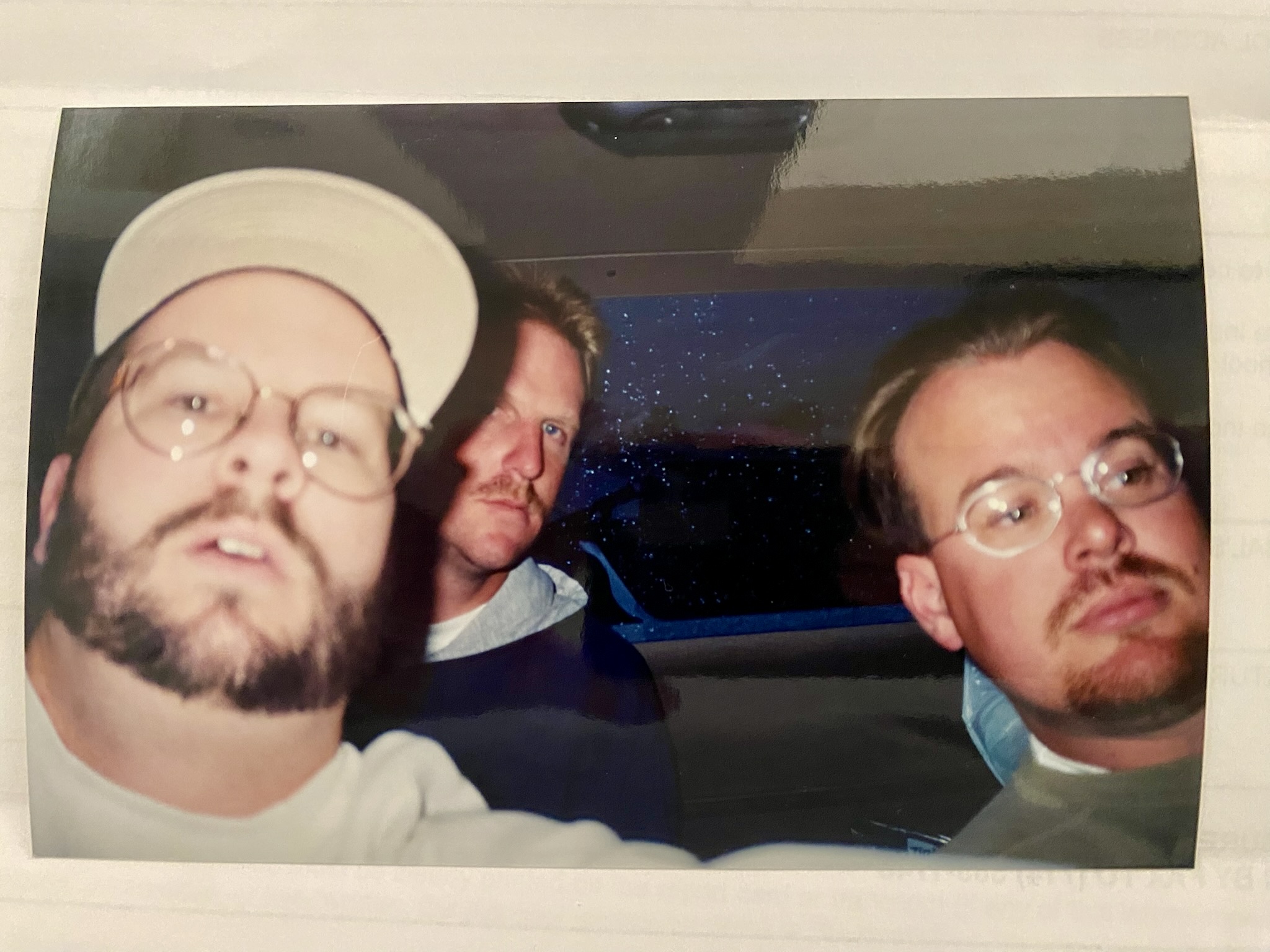
Photo – a selfie back when selfies were taken with film cameras, at least 30 years ago. Three knuckleheads driving to the desert way too early. That’s my brother and I on the left and my brother’s other brother, Paul, on the right. We’ll miss you, Paul.

I Was Just Wondering…

Are the stars just as bright from above as they are down here?

Do you get to see the ones you love? Your parents, your brothers and sisters, your old neighbors, that one special friend who always made you laugh?

Is there coffee in Heaven? Is it better than your favorite blend on a cold desert morning?

Do you remember everything now? Things once forgotten.

And now that you know, what do you know?

Do you hear us when we talk about you? When we laugh at your stories and try to retell them just right?

Do you miss us, or does love work differently there?

Can you see how much we love you still?

Are you proud of the life we’re trying to live?

Do you see how we carry your lessons forward, quietly passing your wisdom down, one small act at a time.

I wonder if you recognize your love moving through our family in the lives your grandkids and great-grandkids are creating.

And I was just wondering…

When it’s my time, when I finally get to see what you see, will you be waiting for me with open arms, and smiles, and one of your special meals that feels so much like home?

I think so.

But for now, I’ll keep wondering. 

Photo by Greg Rakozy on Unsplash

Time Does Not Heal All Wounds

“Time heals all wounds,” people say when someone we love dies. It’s a phrase offered like a Band-Aid for a broken bone. Well meaning, but inadequate for the depth of what we’re facing.

For those who have lost a daughter, a son, a spouse, a parent, a sibling, a dear friend, the truth is something different. Time doesn’t heal. It changes things, yes. It allows us to move, to function, to smile even, but it does not erase their absence. That lives inside us, a permanent resident.

When I searched for quotes and stories from others who had walked this path before me (writers, psychologists, fellow travelers through loss), I discovered that my feelings aren’t unique or abnormal.

The bereaved across time echo the same truths I’m living.

I’ve heard that grief follows a pattern of denial, anger, bargaining, withdrawal, and finally, acceptance. That may all be true. It sounds like a clean process. Just a series of steps we must go through to get to the other side.

But that path has no clean endpoint. It can stall, restart at the beginning, skip and repeat steps while never reaching a conclusion. The grieving process never ends. We merely learn to function with our grief, and we do so in our own way, as imperfectly as we do everything else in life.

Author Jamie Anderson found words for what many of us feel but struggle to express: “Grief, I’ve learned, is really just love. It’s all the love you want to give but cannot. All that unspent love gathers up in the corners of your eyes, the lump in your throat, and in that hollow part of your chest. Grief is just love with no place to go.”

This captures exactly what happens when we reach for the phone to call them or save up a story we can’t wait to tell them. Only to remember a second later that they’re gone.

Grief isn’t a single event but a series of small realizations, each one a fresh cut.

C.S. Lewis, after losing his wife Joy, wrote about the persistence of absence: “Her absence is like the sky, spread over everything.” In his book “A Grief Observed,” Lewis documented what it feels like to live inside loss. “No one ever told me that grief felt so like fear. I am not afraid, but the sensation is like being afraid. The same fluttering in the stomach, the same restlessness, the yawning. I keep on swallowing. At other times it feels like being mildly drunk, or concussed.”

This is the lived experience of a body trying to process what the mind struggles to accept.

Joan Didion echoed this truth when she lost her husband, John Gregory Dunne. In “The Year of Magical Thinking,” she wrote, “Grief turns out to be a place none of us know until we reach it. It’s a foreign country with its own customs, its own weather, its own bewildering geography.”

There is no timeline. No tidy arc where pain transforms into peace according to some predetermined set of rules.

Dr. Lois Tonkin, working as a grief counselor in the 1990s, discovered a different truth about what healing actually looks like. A client whose child had died years earlier drew her a picture showing how her grief had initially filled her entire life. A small circle almost completely consumed by loss.

But over time, something unexpected happened. The grief didn’t shrink. Instead, her life grew larger around it. There was now space for new experiences, relationships, and meaning alongside the loss. This became known as Tonkin’s Model of Grief.

Like a tree growing around a piece of metal embedded in its trunk. We don’t absorb or eliminate the foreign object. We grow around it, incorporating it into our new shape.

This model shows us that time doesn’t diminish our grief. But it expands our capacity to hold other things along with it. Some days our grief surprises us with its suddenness. A song, a scent, a birthday or anniversary, seeing a classic car they used to drive. Other days we’re living fully in the expanded space around our grief, discovering we can hold both the wound and the wonder.

We must learn to carry the sharp pain of their absence while having gratitude for the gift of having known them at all. Our capacity to feel gratitude for the life we shared can provide much needed comfort, even though we’ll never stop missing them.

Some of the most tender truths come from those who’ve lost children. Elizabeth Edwards, who lost her 16-year-old son Wade in a car accident, offered this reminder, “If you know someone who has lost a child, and you’re afraid to mention them because you think you might make them sad by reminding them that they died, you’re not reminding them. They didn’t forget they died. What you’re reminding them of is that you remembered that they lived, and that is a great gift.”

Writer Megan O’Rourke, in her memoir “The Long Goodbye” about losing her mother, captured the peculiar contrasts of grief. “You look fine. You act fine. But inside, you are not fine. And you know it will never be the same.”

This is the hard reality of grief. The simultaneous existence of functioning and not-functioning, of healing and not-healing, of being okay and not-okay. We learn to carry both states, often within the same moments.

So no, time does not heal all wounds.

Time teaches us that we can be broken and whole simultaneously. That we can miss someone terribly and still find reasons to laugh. That love doesn’t end with death. It merely changes form, expressed as the very grief we wish we could escape.

In learning to live with our wounds, we hopefully discover something about ourselves. Our capacity to grieve deeply is evidence of our capacity to love more deeply than we ever thought possible.

And maybe that’s the real truth about time and grief.

“Blessed are those who mourn, for they shall be comforted.” – Mathew 5:4

“The Lord is near to the brokenhearted and saves the crushed in spirit.” – Psalm 34:18

“Love never ends.” – 1 Corinthians 13:8

Photo by Noah Silliman on Unsplash