Finding Your Authentic Swing

What about the inevitable shanks, worm-burners, wicked slices, massive hooks, and just plain misses?

BaggerVance


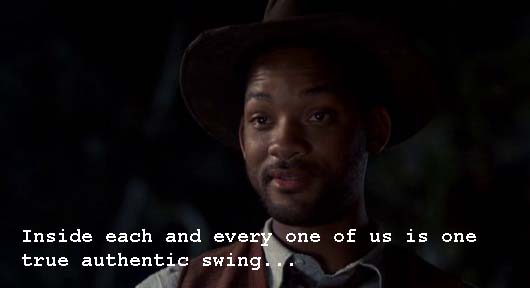
“Yep… Inside each and every one of us is one true authentic swing… Somethin’ we was born with… Somethin’ that’s ours and ours alone… Somethin’ that can’t be taught to ya or learned… Somethin’ that got to be remembered… Over time the world can, rob us of that swing… It get buried inside us under all our wouldas and couldas and shouldas… Some folk even forget what their swing was like…”

-Bagger Vance

The Legend of Bagger Vance is filled with good stuff.  It’s a movie that moseys along with a subtle, southern rhythm.  It conveys a depth of meaning without trying.  The movie challenges each viewer to look at themselves as much as the characters.

I do agree that our authentic swings can get buried under the wouldas, couldas, and shouldas of life.  They can just as easily be uncovered by the leaps, possibilities, why-not’s, and I’m-in’s.

That being said, I must disagree with Mr. Vance’s notion that we each have one true authentic swing.  I rather think we have more than one authentic swing, if we choose to search.  Not only that, we have a lot of clubs in our bag.  We have an almost infinite number of authentic-swing-and-club combinations to choose from when our time comes to stand over the ball, and deliver.

What about the inevitable shanks, worm-burners, wicked slices, massive hooks, and just plain misses?

The best among us are the ones who find a way to recover, and swing again.

Will Smith at his best…


Photo Credit

Finding the Next Higher Gear

That’s when I noticed my habit of shifting to a lower gear as the trail gets steeper ahead…

4-5-10-mountain-climbing

If you haven’t tried mountain biking, you don’t know what you’re missing.  It combines many of the best things in life:

Being outdoors, hard work, freedom, speed, some risk, and fun.

Like many sports, it’s also a great way to find your limits, and extend them a bit.

Mountain bike trails are either climbing or descending.  They may be smooth, rough, tight, rocky, rutted, or any combination of these.

Steep downhills have always scared me.  Way too fast for my taste.  That impossible battle with gravity, choosing the safest line, avoiding rocks, and leaning far enough back to avoid being pitched over the handlebars, make most steep downhills a game of survival for me.  Definitely outside my comfort zone.

I prefer climbing.  Give me a long, steep climb and I’m happy.  Tired, but happy.  Sure, gravity’s against me, but it’s not trying to throw me over the handlebars, or off the mountain side.  I get to focus on my pedaling rhythm, staying within myself, and seeing how fast I can climb the next steep hill.  It puts my mind in a quiet place.

Until someone goes around, gives a wave, and climbs out of sight!  He may be half my age, but that’s no excuse.  He’s found a way to put both himself and his bike in the next higher gear (or maybe a few higher gears).

That’s when I noticed my habit of shifting to a lower gear as the trail gets steeper ahead.  I haven’t reached the steeper section, and yet I’m already downshifting.  One could call this good preparation.

Or, fear.  Fear of being caught off-guard by the steeper trail.  Fear of actually finding my limits.  Fear that I can’t handle the next higher gear.  Fear that I’ll blow-up and have to stop, gasping for air.

Napolean Hill was right when he said, “the only limitation is that which one sets up in one’s own mind.”

As I watched that guy climb out of sight, I decided to experiment with the next higher gear.  Catching him wasn’t my goal.  That wasn’t going to happen.  Finding my limit became my new goal.  Whenever my habit said I should downshift, I purposely clicked to the next higher gear and left it there.  Suffice it to say, I found my limit a few times.

More often than not, I merely climbed faster, and clicked to even higher gears.

Since I was climbing, I had time to think.  The question that kept rolling around my head was whether I have the same habit of preemptively downshifting in other areas of my life.

Time to find out.


Photo Credit


The Next Version

The first version may dramatically change, or create new markets. But, it can’t stop there.

intro_originalipod

Just when the caterpillar thought the world was over, it became a butterfly.  ~English Proverb

There’s always a next version.  The latest update.  The new and improved model.  That is, if you sell a product (or service) and hope to remain relevant.

The first version may dramatically change, or create new markets.  But, it can’t stop there.

When Microsoft came out with its first version of MS-DOS (Microsoft disc operating system for those of you born after 1983 or so), they didn’t stop developing what they had.  There was always a new version just around the corner, and then all the versions of Windows after that.

Consider how quickly Apple’s iPod improved, shrank, morphed, and spawned new products and categories (like the iPhone).  The first iPhone was awesome and changed everything.  But, Apple didn’t stop there.  They couldn’t.

Dr. Athey (one of my favorite professors) used to talk about the “ratchet effect” in technology.  With each successive improvement in speed, features, or capability, the expectation level is ratcheted-up, at least one notch.  Each improvement creates a new floor.  A platform for the next leap.

Stop improving, stop inventing, stop pushing, stop creating, stop leaping, and guess what.  Your product begins to wither and die.  What was once amazing becomes the norm.  The markets you created start to shrink.

The same ratchet effect applies to each of us.

I will never forget a conversation I had with Grandpa Clyde.  He was about 90 years old at the time.  He had just started using email, and asked me how he could send an email to more than one recipient.  I gave him some email pointers, but I got a whole lot more in return.  His questions demonstrated a key secret to a happy life:  Continuous exploration…seeking the next version.

What are you curious about?  What scares you?  What seems impossible?  These are the first things to explore.  Choose to take your first step.  Once you take the first step, the next one is easier.

What features will be in your next version?


Photo Credit:  ARS Technica


Exceeding Your Vision

The following is not an excerpt from my new book, Leadership Starts (and Ends) in Your Head…the rest is detail.  But, I’d be remiss if I didn’t mention it here (and highly recommend it).


Vision

-What do you want to be when you grow up?

-Now that you’ve graduated, what are your plans?

-Congratulations on your marriage.  Here’s to a long and happy life!  Where are you two planning to live?

-I heard about your new job.  That’s great!  What are your prospects for career growth there?

-I heard you don’t really like your job?  What would you do if money wasn’t an object?

Each of these questions are about goals and vision.  Where do you see yourself today and in the future?  What defines success for you and how will you get there?  What path are you on and will it get you where you want to go?

But, what happens when you reach your future?  Will you know you’ve arrived?  What happens when your vision for the future comes true?

You achieve, even exceed, everything you had in mind when you started.  You exceed your vision.

Sounds like a good problem to have.

Consider the retiree who has no idea what to do with his/her time now that work doesn’t occupy their day.  The stay-at-home mom whose kids are all grown up and moved away.  The thirty-two-year-old internet entrepreneur who just sold his company for $500 million.  They have reached their goal line, that place they’ve dreamed about.

Their vision led them here, but what’s next?

I’m reminded of a quote by Walt Disney:  “All of our dreams can come true, if we have the courage to pursue them.”

For most, the courageous part is the pursuit.  For others, courage is their willingness to find new dreams when the first ones come true.

As we go through our lives, chasing goals, climbing mountains, and living the dream, it might be worthwhile to extend our vision.  Look past our first set of goals; the ones that occupy most of our time.

Look toward the greater goals, and broader definitions of our dreams.  Seek the true definition of our potential.  Our ultimate purpose.

Consult not your fears but your hopes and your dreams. Think not about your frustrations, but about your unfulfilled potential. Concern yourself not with what you tried and failed in, but with what it is still possible for you to do.  -Pope John XXIII


© 2014 Bob Dailey.  All rights reserved. 


Old Docks, New Horizons

You don’t have to be Galileo, Christopher Columbus or Marco Polo to be an explorer…

Hillsdale_Dock
Old docks capture my imagination. There’s a quiet intensity about them. A history we can feel more than see. They offer a lasting invitation to explore. To cast-off, set sail, and see what’s over the horizon.

Will you accept that invitation? How far will your explorations take you? Which way will you go? What if you can’t see the other side? Should you cast-off anyway?

We answer (or avoid) these questions every day.

Is it best to merely stand on the dock and look out at the horizon, wondering what’s just out of sight? Or, better yet, wait for someone to return and describe what’s out there? No way!

Every explorer (and innovator) in history chose to leave the safety of the dock. They couldn’t see the other side. In fact, they chose to leave the dock precisely because they needed to see over the next horizon, and the one after that.

They knew what we each know, whether we choose to admit it or not.

The answers to life’s biggest questions come to those who seek.

You don’t have to be Galileo, Christopher Columbus or Marco Polo to be an explorer. We are each explorers. All we have to do is accept the invitation.


Do It Anyway

Very few of us will change the (entire) world. But, following the advice in these verses is a great way to change our little corner of it…

I recently came across this poem.  It was painted on the wall of Mother Teresa’s home for children in Calcutta, India.  While it’s well-known to many, it’s new to me.  I like it so much I’ve decided to share it here:

People are often unreasonable, irrational, and self-centered.

Forgive them anyway.

If you are kind, people may accuse you of selfish, ulterior motives.

Be kind anyway.

If you are successful, you will win some unfaithful friends and some genuine enemies.

Succeed anyway.

If you are honest and sincere, people may deceive you.

Be honest and sincere anyway.

What you spend years creating, others could destroy overnight.

Create anyway.

If you find serenity and happiness, some may be jealous.

Be happy anyway.

The good you do today, will often be forgotten.

Do good anyway.

Give the best you have, and it will never be enough.

Give your best anyway.

In the final analysis, it is between you and God.

It was never between you and them anyway.

Very few of us will change the (entire) world. But, following the advice in these verses is a great way to improve our little corner of it.

That’s all that matters anyway.

What would you do if you weren’t afraid?

Fear can motivate. Fear can paralyze. It can save your life. Unfortunately, it can also control your life.

“…let me assert my firm belief that the only thing we have to fear is…fear itself — nameless, unreasoning, unjustified terror which paralyzes needed efforts to convert retreat into advance.” –Franklin Delano Roosevelt (first inauguration address, 1933)

Fear can motivate. Fear can paralyze. It can save your life. Unfortunately, it can also control your life.

Here’s a list of fears to consider:

  • Failure
  • Embarrassment
  • Public Speaking
  • Death (I’m pretty sure a lot of people fear the first three more than death)
  • Not Being Accepted
  • Commitment
  • Flying
  • Disappointment
  • Success
  • Fame
  • Responsibility
  • the Unknown
  • the Dark
  • New Experiences
  • Being Blamed
  • Heights
  • Snakes
  • Spiders
  • Sharks
  • Geese
  • Open Spaces
  • Anywhere but Home
  • Confined Spaces

I know people who have each of these fears. I have some of them, and I’m sure you have some as well.

Fear is generated in our Lizard Brain . That primitive part of our brain that keeps us alive while we’re thinking about other stuff. Our Lizard Brain means well, and only has our best interest in mind. It’s the center of our survival instinct. It will do anything it can to help us avoid the things we fear. Unfortunately, it’s part of our brain that we barely control.

One way to gain control of our fear is to discover, and admit, that it exists. That, and admitting our fears impact the things we choose to do (or not do). It may help to discuss your fears with someone you trust, or to contemplate them on your own. Either way, understanding your fears is the first step toward controlling them.

Consider a ten-year-old, standing in right field. He knows that he’s in that position because he’s the worst player on the team. Fly balls rarely make it to right field in little league games, so he’s safe out there. What happens when the ball flies into right field? What’s the first thing on that ten-year-old’s mind? Probably something like, “Please don’t let me screw this up and drop the ball.” His first thought comes from a place of fear. Did he catch the ball? Did he make the right play once he had the ball? Maybe, but doubtful.

Imagine the same player who knows he’s in right field because he’s the only player who can make the throw all the way to third base. He has a gun for an arm, and he may be the best player on the team. What’s he thinking when the ball flies into right field? “I can’t wait to get that ball so I can make the play.   We are going to stop this rally and win the game!” Fear isn’t part of the equation. Did he catch the ball? Did he make the right play? Probably.

Fear creates completely different experiences for these ten-year-olds. The secret is that this applies at all ages, in nearly everything we do.

How many of your goals are “off limits” because you’re afraid? How many potential goals are eliminated by fear (your Lizard Brain), before you even know about them?

How often is fear your first response? How often do you talk yourself out of something that’s outside your comfort zone? It’s easy to do…avoiding fear is a powerful motivation.

Start small. Choose one thing that scares you and go after it. Embrace the negative energy of fear and turn retreat into advance. Each time you do this, your list of fears will shrink.

What would you do if you weren’t afraid?

Do it today!


The Truth about Ownership

Does everyone own the outcome, or no one?

“When everybody owns something, nobody owns it, and nobody has a direct interest in maintaining or improving its condition. That is why buildings in the Soviet Union—like public housing in the United States—look decrepit within a year or two of their construction…” Milton Friedman

Dr. Friedman won the Nobel Prize for Economic Science in 1976, and died in 2006 at the age of 94.

I could make this post all about his defense of capitalism, his arguments against socialism, the benefits of reducing government’s role in our lives, and a whole host of ideas that he defended throughout his career.

Instead, my focus is on ownership and how Dr. Friedman’s quote applies to leadership in a business setting.

Look around your workplace. Look at the teams. The committees. The ad hoc groups that come together to solve a problem.

Who owns the outcomes of these teams, committees, and ad hoc groups? Is everyone aligned around the same goals? Does everyone own the outcome, or no one?

Ownership is the key to success. Owners are always more dedicated to the outcome than non-owners. If this is true, wouldn’t more owners be better? As Dr. Friedman points out, when everyone owns something, nobody owns it.

True leaders step up and take ownership. Leaders then unite others around the important goals. Followers, in turn, own their support of the goals and their valued place in that effort.

Show me a team with multiple owners (which is really no owners), and I’ll show you a leaderless team that’s doomed to mediocrity and failure.

Being Fazed

How many people do you know who go through life unfazed?

How many people do you know who go through life unfazed?

Nothing gets under their skin. Nothing angers them.

They don’t cry…ever. They chuckle, but rarely laugh.

They can’t be bothered with a new or revolutionary idea.

Composure is their primary goal, above all else.

There’s a degree of power that comes from being unfazed. The unfazed person appears to be in control of the situation…almost above what’s happening.

Being unfazed is appropriate, even ideal, in many situations.

But, the opposite is also true.

Consider the fun that can come from real laughter, especially when it’s shared. The emotional cleansing of a good cry, from joy or sadness. That anger and disappointment we feel when we lose can be channeled into breakthrough improvements that help us win next time.

What about being knocked over by the genius of a new idea, or the next big thing (whatever that is)? I recently saw part of a commercial showing a guy talking about a potential investment with his friend saying, “That’s nice, but what can anyone do with only 140 characters?” I don’t remember what the commercial was selling, but we all know now what can be done with only 140 characters.

As I think about the people who inspire me the most, and famous disrupters throughout history, they’re the ones who allowed themselves to be fazed. The great ones channel their fazed-ness into a passionate pursuit of excellence and innovation, helping each of us to do the same things in our own lives…if only we allow ourselves to be fazed.

The 911 Call I Never Thought I’d Make

I had an interesting start to my day last Monday. I hesitate to write about it, but here goes.

I awoke just before 5am, trying to catch my breath. I was breathing fine, but couldn’t seem to catch my breath. It was a bit like the feeling of holding your breath underwater, and racing toward the surface for the relief of fresh air…that never came. Luckily, I wasn’t drowning, but the experience was unnerving to say the least.

I figured going downstairs and starting my day would be just the ticket. As I reached downstairs, the problem wasn’t improving. Now, a wave of anxiety washed over me. I started wondering if my arms were tingling, did my chest hurt, was I having a heart attack!? I stood there in the dark for what seemed like an eternity. My mouth went dry, and still I couldn’t catch my breath.

Is this all in my head? Is this just anxiety over not being able to catch my breath? Am I going to be one of those stories of the guy who is in (almost) perfect health, and then has a heart attack?

I have a lot of other stories to live and tell. This is definitely not the one I want to have told about me today.

I decided to call 911.

After hanging up with them, I woke Janet and told her about the situation. She is awesome in these types of moments. Calm, focused. I felt comfort in not being alone. I still couldn’t catch my breath, but she was with me, and help was on the way. They’d figure this out.

I sat in my dining room, waiting for the paramedics to arrive, wondering if I’d ever catch my breath. I couldn’t help but wonder to myself how a guy who climbs stairs as a hobby, runs trails for fun, and takes long walks on my resting days could possibly be having a heart attack. Something else must be happening. I didn’t have much time to wonder, as the paramedics had arrived (probably only 3-4 minutes after my call). They hooked me up to their EKG, and started asking me a bunch of questions. Their readings all showed a perfectly beating heart, and 100% oxygen absorption. According to the monitors, I was in good shape. And yet, I couldn’t catch my breath.

They recommended I go to the Emergency Room to be checked out. Since they didn’t see any imminent danger, we decided to drive ourselves (rather than take the ambulance ride).

My anxiety subsided a bit, but still I couldn’t catch my breath. It’s a frustrating feeling. I have a new appreciation for what asthmatics, and others who have chronic breathing difficulty are going through.

ER check-in was smooth and easy, and within a couple minutes, I had seen the doctor, and was plugged into another EKG machine. A few minutes later, they took blood samples, and a chest X-ray. And still, I couldn’t catch my breath. I didn’t have any pain, just a growing irritation at not being able to breathe, and wondering where this was all going.

About a half hour later, the doctor stopped by and let us know that the blood work all came back normal. There was no trace of a heart enzyme that shows up in your blood if you’re having a heart attack. The chest X-ray showed nothing. They wanted me to stay for another two hours for observation, and then re-take the heart enzyme test.

Two hours later, I was beginning to breathe normally. Almost like a light switch, I wasn’t having trouble catching my breath. The second heart enzyme test came back negative. All good news. I was definitely not having a heart attack, and yet I clearly had something that messed up my breathing. They scheduled me to have a follow-up with my primary care doctor a couple days later.

One thing I’ve learned from being around technology all my life is that problems don’t just go away. If you don’t identify and solve the root cause, the problem will happen again at a time of its choosing. That’s exactly what happened about six hours later just as I finished eating dinner. I noticed my breathing problem came back. This time, I didn’t have the same anxiety. I “listened” more closely to what my body was telling me. It was telling me that this was somehow related to digestion. So, now I’m the guy who thought he was having a heart attack, but all he had was indigestion.

With this new theory in hand, I saw my primary care doctor and we reviewed everything that had happened. She listened, probed, checked all of the lab test results, and agreed that I’m most likely suffering from some level of acid reflux. The irritation from the acid is apparently interrupting my breathing. But, just to be certain, she scheduled me for a stress EKG test.

So, Monday I have paramedics in my house, and by Friday (Good Friday to be exact), I’m hooked up to yet another EKG machine, running on a treadmill at a twelve percent incline. Finally, something fun in this process…some exercise after having to take a week off.

The goal of a stress EKG is to put your body (specifically your heart) under an intense amount of stress and monitor how it reacts. According to the cardiology nurse who managed the test, it is about 85-90% accurate at identifying even minor cardiac issues. He told me that the electrical impulses of our heart can tell a lot about its health…especially when it’s pushed to its limits.

After about fifteen minutes, my heart rate was 175, and I was feeling great. Some water would have been nice, but that wasn’t an option. I have to admit that I enjoyed hearing one of the EKG technicians say that she’d never seen anyone run at this pace or incline for so long. Stairclimbers unite! I hope I represented us well.

The nurse asked if I was having any trouble breathing, or catching my breath. I wasn’t. We were hoping to push things hard enough to cause the problem to re-occur. No dice. I just kept running, getting thirstier, and wondering how long I should keep going. He asked me to continue at an even higher incline, as one last push to see if we could trigger the breathing problem. Nothing. Just calves that were thrashed and tired from the continuous climb. I was done, and the breathing issue never showed itself. My heart rate topped out at 180.

The good news is that my heart checked out just fine. The EKG nurse told me this provides great baselines for later in my life if an actual cardiac problem arises (something to look forward to, I guess). We’re working on the “acid” theory, so I’m on a regimen of Prilosec, and eliminating acid-causing foods from my diet.

My primary care doctor commended me on having the courage to dial 911 when I did. I hadn’t thought of it that way. She said that many people ignore warning signs that their body sends them…until it’s too late.

My decision to call 911 was a response to fear. Fear of not knowing what was happening. Fear that my life that I love so much may be ending. With the benefit of 20/20 hindsight, my life wasn’t in danger. Maybe courage is taking action in the face of fear, not merely because of it. Or, could it be that abject fear pushes us to reach out for help we never thought we’d need?

As I take yet another Prilosec and wonder if acid reflux is the root cause, I certainly have a greater appreciation for how quickly our lives can change.

Carpe Diem!