The 911 Call I Never Thought I’d Make

I had an interesting start to my day last Monday. I hesitate to write about it, but here goes.

I awoke just before 5am, trying to catch my breath. I was breathing fine, but couldn’t seem to catch my breath. It was a bit like the feeling of holding your breath underwater, and racing toward the surface for the relief of fresh air…that never came. Luckily, I wasn’t drowning, but the experience was unnerving to say the least.

I figured going downstairs and starting my day would be just the ticket. As I reached downstairs, the problem wasn’t improving. Now, a wave of anxiety washed over me. I started wondering if my arms were tingling, did my chest hurt, was I having a heart attack!? I stood there in the dark for what seemed like an eternity. My mouth went dry, and still I couldn’t catch my breath.

Is this all in my head? Is this just anxiety over not being able to catch my breath? Am I going to be one of those stories of the guy who is in (almost) perfect health, and then has a heart attack?

I have a lot of other stories to live and tell. This is definitely not the one I want to have told about me today.

I decided to call 911.

After hanging up with them, I woke Janet and told her about the situation. She is awesome in these types of moments. Calm, focused. I felt comfort in not being alone. I still couldn’t catch my breath, but she was with me, and help was on the way. They’d figure this out.

I sat in my dining room, waiting for the paramedics to arrive, wondering if I’d ever catch my breath. I couldn’t help but wonder to myself how a guy who climbs stairs as a hobby, runs trails for fun, and takes long walks on my resting days could possibly be having a heart attack. Something else must be happening. I didn’t have much time to wonder, as the paramedics had arrived (probably only 3-4 minutes after my call). They hooked me up to their EKG, and started asking me a bunch of questions. Their readings all showed a perfectly beating heart, and 100% oxygen absorption. According to the monitors, I was in good shape. And yet, I couldn’t catch my breath.

They recommended I go to the Emergency Room to be checked out. Since they didn’t see any imminent danger, we decided to drive ourselves (rather than take the ambulance ride).

My anxiety subsided a bit, but still I couldn’t catch my breath. It’s a frustrating feeling. I have a new appreciation for what asthmatics, and others who have chronic breathing difficulty are going through.

ER check-in was smooth and easy, and within a couple minutes, I had seen the doctor, and was plugged into another EKG machine. A few minutes later, they took blood samples, and a chest X-ray. And still, I couldn’t catch my breath. I didn’t have any pain, just a growing irritation at not being able to breathe, and wondering where this was all going.

About a half hour later, the doctor stopped by and let us know that the blood work all came back normal. There was no trace of a heart enzyme that shows up in your blood if you’re having a heart attack. The chest X-ray showed nothing. They wanted me to stay for another two hours for observation, and then re-take the heart enzyme test.

Two hours later, I was beginning to breathe normally. Almost like a light switch, I wasn’t having trouble catching my breath. The second heart enzyme test came back negative. All good news. I was definitely not having a heart attack, and yet I clearly had something that messed up my breathing. They scheduled me to have a follow-up with my primary care doctor a couple days later.

One thing I’ve learned from being around technology all my life is that problems don’t just go away. If you don’t identify and solve the root cause, the problem will happen again at a time of its choosing. That’s exactly what happened about six hours later just as I finished eating dinner. I noticed my breathing problem came back. This time, I didn’t have the same anxiety. I “listened” more closely to what my body was telling me. It was telling me that this was somehow related to digestion. So, now I’m the guy who thought he was having a heart attack, but all he had was indigestion.

With this new theory in hand, I saw my primary care doctor and we reviewed everything that had happened. She listened, probed, checked all of the lab test results, and agreed that I’m most likely suffering from some level of acid reflux. The irritation from the acid is apparently interrupting my breathing. But, just to be certain, she scheduled me for a stress EKG test.

So, Monday I have paramedics in my house, and by Friday (Good Friday to be exact), I’m hooked up to yet another EKG machine, running on a treadmill at a twelve percent incline. Finally, something fun in this process…some exercise after having to take a week off.

The goal of a stress EKG is to put your body (specifically your heart) under an intense amount of stress and monitor how it reacts. According to the cardiology nurse who managed the test, it is about 85-90% accurate at identifying even minor cardiac issues. He told me that the electrical impulses of our heart can tell a lot about its health…especially when it’s pushed to its limits.

After about fifteen minutes, my heart rate was 175, and I was feeling great. Some water would have been nice, but that wasn’t an option. I have to admit that I enjoyed hearing one of the EKG technicians say that she’d never seen anyone run at this pace or incline for so long. Stairclimbers unite! I hope I represented us well.

The nurse asked if I was having any trouble breathing, or catching my breath. I wasn’t. We were hoping to push things hard enough to cause the problem to re-occur. No dice. I just kept running, getting thirstier, and wondering how long I should keep going. He asked me to continue at an even higher incline, as one last push to see if we could trigger the breathing problem. Nothing. Just calves that were thrashed and tired from the continuous climb. I was done, and the breathing issue never showed itself. My heart rate topped out at 180.

The good news is that my heart checked out just fine. The EKG nurse told me this provides great baselines for later in my life if an actual cardiac problem arises (something to look forward to, I guess). We’re working on the “acid” theory, so I’m on a regimen of Prilosec, and eliminating acid-causing foods from my diet.

My primary care doctor commended me on having the courage to dial 911 when I did. I hadn’t thought of it that way. She said that many people ignore warning signs that their body sends them…until it’s too late.

My decision to call 911 was a response to fear. Fear of not knowing what was happening. Fear that my life that I love so much may be ending. With the benefit of 20/20 hindsight, my life wasn’t in danger. Maybe courage is taking action in the face of fear, not merely because of it. Or, could it be that abject fear pushes us to reach out for help we never thought we’d need?

As I take yet another Prilosec and wonder if acid reflux is the root cause, I certainly have a greater appreciation for how quickly our lives can change.

Carpe Diem!


Start Anywhere!

Nike’s Just Do It™ slogan was born in an advertising agency meeting in 1988…

According to Wikipedia, Nike’s Just Do It™ slogan was born in an advertising agency meeting in 1988.

For Nike, these words helped propel the company from $877 million in revenue in 1988 to $9.2 billion by 1998.  In 2013, Nike’s revenue was $25.3 billion.

Three simple words.

Of course, it isn’t the words alone.  It’s the call to action implied in these words:

  • Want to run a marathon?  Just do it!
  • Want to run a triathlon?  Just do it!
  • Want to play tennis?  Just do it!
  • Want to learn to oil paint?  Just do it!
  • Want to write?  Just do it!
  • Want to race motorcycles?  Just do it!
  • Want to develop an iPhone app?  Just do it!
  • Want to explore the world?  How about China (where I am this week)?  Just do it!
  • Want to hike the Appalachian Trail?  Just do it!
  • Want to own your own business?  Just do it!
  • Want to try living in New York City (in the winter!)?  Just do it!
  • Want to start a charity to help wounded veterans?  Just do it!
  • Want to build your own house?  How about a tree house?  Just do it!

Three simple words.

Not to be outdone, and to inspire not only Apple employees, but customers they didn’t yet have, Apple came up with a two-word slogan in 1997:  Think Different™.

Two words, grammar error notwithstanding.  Again, it isn’t the words, but the call to action.  If you want to create a new and interesting future, Think Different today.

Think Different.  Just Do It.

To these, I’d add two more words:

Start Anywhere!

Think Different.  Just Do It.  Start Anywhere!

How about two more:  Start today!

Seven Steps to Creating Your Goalprint

People who buy shovels don’t want shovels…

There’s a classic quote in business:

People who buy shovels don’t want shovels.  They want to make holes, or fill in holes as quickly and easily as possible.

Chances are pretty good that you’re selling shovels to someone.  Or, maybe you dig the holes?

Either way, the planning, the shovel, the digging, and the hole itself are all merely steps along the way to achieving someone’s goals.

Your goals?  Maybe…that all depends on whether you know what your goals are.

The funny thing about goals is that no one has the same goals.  They may share some, or agree on goals to pursue together.  But, no two people have the exact same goals.

Each of us has a goalprint as unique as our fingerprint.  It captures our passions, our dreams, and the specific goals we’ve laid out for our lives.  Partially-developed goalprints live in our subconscious mind, until we take the time to bring them into our conscious mind and fully define them.

Consciously defining our unique goalprint isn’t easy.  Nothing worthwhile ever is.

Here are the seven steps for creating and living your personal goalprint:

1.  Define five things you are most passionate about, and how you plan to center your life around these passions over the next five years.  Not willing to focus your life on this list of passions?  Maybe these aren’t really your passions.

2.  Define at least seven things you plan to experience over the next ten years.  A quasi-bucket list, only with a ten-year horizon.  Notice this isn’t a list of seven things you want to experience, rather a list of the seven things you plan to experience.  How many of these involve the things you are most passionate about?

3.  Money isn’t everything, but it does make the world go around.  With this in mind, write down how much money or assets you plan to have set aside for big ticket expenditures (i.e., home purchases, kids’ college, retirement, something you were passionate about in item 1, etc.) in one year, five years, ten years, and twenty years.  What income do you need to hit these targets?  Start saving now, if you haven’t already.

4.  Define what you plan to be in one year, five years, ten years, and twenty years.  This can be personal, professional, or anything else you define as what you plan to be.  Keep working until your “what” supports what you’ve listed in the first three steps.

5.  If you’re blessed with a spouse, or a soon-to-be-spouse, compare and discuss your answers in the first four steps above.  What do you have in common?  Are your goalprints compatible?  How will you each accommodate and support your spouse’s goalprint in the coming years?

6.  Hold yourself accountable for fulfilling what you’ve laid out in your goalprint as you make decisions in your life.  Enjoy defining success on your own terms.

7.  Repeat this exercise once a year.

Unlike fingerprints, our goalprint will change and grow over time.  That is, if we have the courage to let it.

____________________

If you found this or any other post on EnCurUj.com valuable, it would mean a lot to me if you would refer your friends to my site.  Thanks!

Beyond the No Wake Zone

True adventure happens out past the buoys…

nowakezonebuoy_keaalliance

I get seasick easily, especially on sailboats (and fighter jets).  I’ve been on a few sailing trips.  They all had one thing in common.  Once we’re outside the no wake zone, my nausea starts.  Things go downhill from there until my head is buried under a towel and I try to sleep until we get to dry land.  Needless to say, I avoid sailing trips.

I don’t have a problem on cruise ships, except in rough seas.  Cruise ships are engineered to deliver a smooth ride for their passengers.  Most swells go unnoticed.  Passengers wake up in a new port almost every day, and the food and entertainment are usually spectacular.

Harbor cruises work for me.  I can handle cruising around inside the no wake zone, looking at all of the boats in their slips, the nice homes on the shoreline, and passing other boats as they make their way out to sea.  Christmas time, with all the lights and decorations is the best.  It’s relaxing and safe.  There are no swells to cause nausea and seasickness.

Every sailor knows the opportunity for new discovery lies beyond the no wake zone.  True adventure happens out past the buoys, past the breakwater, and out in the wind and waves.  Riding around in the harbor, or lazily enjoying a multi-course dinner on a cruise ship are fun and sometimes exotic.  But, neither compare to the adventure of plying the seas in a forty-foot sailboat, with your hand on the tiller.

What about the risks?  Staying on shore has risks.  Cruise ships certainly carry risk (and sometimes, viruses).  We may take comfort that others are managing our risks for us, but nothing is risk free.  Storms and rough seas will hit, no matter who drives the boat.  Understanding the risks, planning and preparing for them, and facing our challenges head-on is the only consistent winning strategy…at sea, and in life.

What about seasickness?  I remember talking with a sailor in Tahiti.  We had flown in for a vacation, and met my mother-, and father-in-law, who were sailing their boat across the South Pacific.  The sailor was a friend of theirs.  I mentioned my problem with seasickness, and how it would prevent me from making such a voyage.

He laughed and said, “The seasickness usually passes after three days at sea.  After that, it’s an adventure of a lifetime.”

He was right.

The Bargains We Make

I bargained with Life for a penny…

I came across this classic poem recently:

My Wage

I bargained with Life for a penny,

And Life would pay no more,

However I begged at evening

When I counted my scanty store.

For Life is a just employer,

He gives you what you ask.

But once you have set the wages,

Why, you must bear the task.

I worked for a menial’s hire,

Only to learn dismayed,

That any wage I had asked of Life,

Life would have willingly paid.

–by Jessie Belle Rittenhouse (1869-1948)

My Question for You

What is your bargain with Life?

Are you working for a penny, or something more?

How about your end of the deal?

Are you even keeping score?

If we get out of Life,

Only what we ask,

I say go for the Moon,

And reach for the stars.

But, are you willing to bear the task?

Will This Be On The Test?!?!

I’m told that this is one of the top questions students (and parents) ask of teachers.

SanFelipeSunrise

I’m told that this is one of the top questions students (and parents) ask of teachers.

Test questions in school come in many standard forms:  true or false, multiple choice, essay…just to name a few.  Oh yeah, and word problems!  Decipher the riddle, find all the numbers that fit into formulas, and arrive at an answer (hopefully, the correct one).  And, of course, remember to show your work.

We’re taught in school that there is only one correct answer to most questions.  Columbus discovered the New World in 1492, not 1493.  It takes two hydrogens and one oxygen to make water, not two oxygens and one hydrogen.  The student’s job is to learn (memorize?) the correct answers and then “ace” their test by answering all of the questions correctly.

It’s no wonder students ask what will be on their tests.  After all, their grade is in play.  Who wouldn’t want to know what they should study, and what they can ignore?  So much is riding on the outcome.

Tests outside of school aren’t as easy.  The questions don’t come from our teachers.  Variables are often missing, and formulas rarely provide one definitive answer.  They aren’t always fair.  They don’t come with a study guide.  There’s no advice about what should be studied, or ignored.  Real life tests come from our family, friends, customers, co-workers, managers, elected officials, our children’s teachers, strangers, and ourselves…on a daily basis.  A lot more than a grade is in play with most of these tests.

Attention to detail, listening to what is said and unsaid, curiosity, creativity, openness to risk, connecting with others we trust, and a clear sense of right and wrong are the guides we have in answering the real life test questions we face.

What’ll be on your next test?  Everything you’ve experienced in life up to this point, and probably a few things you haven’t seen before.  Here’s hoping you studied well.


Test Question:  What’s the connection between this post and the sunrise photo?

Everyday is a Surprise

It all started with an earache…

 “Bobby (what anyone who knew me before I was about 13 calls me), it all started with an earache.  The doctor gave me some ear drops.  The pain didn’t stop and seemed to get worse, so he gave me stronger drops.  That still didn’t work.  He ran some tests and told me it’s cancer, and I’m gonna die.  It was an earache, and then I was dying.  He says that I will probably just die in my sleep, so each time I wake up, it’s a surprise.”

Pete_Triumph

In Pete’s case, it took about four months for the cancer specialists to identify the type of cancer that is killing him.  He told me the name, and said it is very rare, untreatable, and fast moving.  I made a mental note to look up the cancer and learn more about it.  As I type this post, I have forgotten its name.

The fact that each of us will die is no surprise.  The timing is the surprising part.  That, and the name of the thing that ultimately causes our death.  There’s always a name.

I remember a conversation I had with Grandpa Clyde (my wife’s grandfather) at least ten years ago.  He was in his late-80’s at the time, showing me how to cook ribs properly on a barbeque.  I asked him what it was like to have lived as long as he had.  I will never forget his response.  “If you live long enough, you say goodbye to a lot of friends and family.  Most of the people I grew up with are dead and gone.  I stopped going to funerals a long time ago.  I spend my time making new friends, and enjoying this time I’ve been given with my family.”

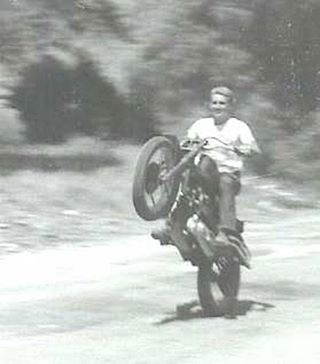
Growing up, Pete was one of my role models for a life worth living.  A firefighter, motorcycle tuner, racer, helmet painter, wheelie king, runner, water skier, speeding ticket magnet, traveler, and a Bluegrass fan.  Although I never actually saw it, he used to say that he also jumped rope, attended three world fairs, and a few other things that are probably better left unmentioned.  Pete never stopped making new friends, or appreciating his old friends.  He grabbed all that life has to offer, and then some.

Pete_Wheelie

Pete wears a patch over his right eye now.  The tumor has grown and prevents that eye from blinking.  He is in a lot of pain, and the pain medications cloud the passage of time.  This hasn’t stopped Pete from grabbing what life has left for him.  He is living each remaining day as a surprise.

In truth, each day is a surprise for all of us.  An opportunity to appreciate our family and friends.  An opportunity to make new friends, and enjoy what little time we’ve been given.

Defining Semi-Retirement

I’m definitely not retired, although I have let the term, semi-retired, roll around in my head. It seems accurate, for now.

PetersCanyonPhoto

For the first time in nearly 30 years, I’m living the life of a semi-retired person.  I’m not entirely sure what that means, but it all began about six weeks ago.  That’s when I parted company with my employer after a little over fourteen years of service.  I thoroughly enjoyed my time there.  I think we were great for each other.  I learned a lot, contributed lots of value, helped many people advance in their careers, and enjoyed the fruits of success.

I often counsel people to remember that in any organization, large or small, every day could be your last.  Many probably think I’m being a bit dramatic with this advice.  While not speaking literally (well, maybe I am), the main message is to be prepared for a sudden exit, either by your choice, or the company’s.

My departure was my choice and the process took a few months.  Heeding my own advice, my wife and I were well prepared.  We’ve saved and invested (sometimes wisely) for our entire life, lived simply, and recently wrote our last tuition check (a big milestone in any parent’s life).

My friends congratulated me on my early retirement, but I was quick to push back.

I’m definitely not retired, although I have let the term, semi-retired, roll around in my head.  It seems accurate, for now.  “Semi” opens the door to a world of options, and sets a high bar for what I’ll choose to do in the future.

What’s next?  I’m not sure, and I kinda like it like that.

Are You Asking Strategic Questions?

If your company stopped delivering its products and services, who would miss it?

It’s strategic planning season.  Companies of all shapes and sizes are dusting off their strategic plans from last year, looking into their crystal balls and determining what they’re going to do next year.  How can we extend our products or services within our marketplace?  What will it take for us to keep up (catch up) with our competition?  How can we squeeze an extra point of profitability from our existing revenue streams?  Can we raise our prices a few percentage points without losing too many customers?  Do we need this many people?

If the previous paragraph sounds familiar, your organization isn’t doing strategic planning.

Strategic planning isn’t just an annual event.  Strategic questions don’t come from a defensive posture.  They shouldn’t be about tweaking at the margin.  Strategic questions definitely shouldn’t focus on ways to play “catch up.”  These questions may be important, but they aren’t strategic.  They’re tactical.

If your company stopped delivering its products and services, who would miss it?

What do your customers, or prospective customers, really want?  What are they trying to accomplish?  Your organization’s value comes from helping customers hit their strategic targets.  Otherwise, you’re merely a commodity, a convenience to be discarded whenever possible.

Many organizations fool themselves into believing they do strategic planning.  Sadly, they’re only going through the motions, “challenging themselves” to answer the easy, tactical questions…year after year.

That is, until their customers find another way to meet their strategic goals.

Remembering to Breathe

Nearly all sports are the same (at least on one level).

Nearly all sports are the same (at least on one level).  It doesn’t matter if that sport is soccer, baseball, golf, archery, skeet shooting, curling, downhill skiing, long distance running, ice skating, motorcycle racing, or competitive yodeling.

They each start with the same fundamentals:

  • Relax and stay loose
  • Calm your mind
  • Visualize success
  • Bend your knees
  • Don’t forget to breathe.

One could make a case that each of these fundamentals are of equal importance, but my money is on the last one.  Consciously remembering to breathe puts us in the right state of mind to remember the other fundamentals.

We each face challenges on a daily basis.  Some are small, and some are huge (at least from our perspective).  Here’s a strategy for tackling each of them:

  • Relax and stay loose
  • Calm your mind
  • Visualize success
  • Bend your knees
  • Remember to breathe!