The Most Powerful Words of All

We can tell ourselves almost anything, and we will believe it. If we don’t believe at first, we can relentlessly work to convince ourselves. Remember, we’re in our head all the time…unfiltered!

“Sticks and stones may break my bones, but names will never hurt me.”

Why do parents teach this little quote to their kids?  Simple.  It’s a one-sentence philosophy that arms each of us against the words others may use to describe us, or worse, to tear us down.  We learn from this one sentence that words can’t hurt us.

As a philosophy, it works.  But, in practice, it misses a few points.

Words do matter.  They inspire, motivate, comfort, and create.  They also discourage, disappoint, frustrate, and destroy.

Certain words wield more power than all others.  The words we say to ourselves.

We can tell ourselves almost anything, and we will believe it.  If we don’t believe at first, we can relentlessly work to convince ourselves.  Remember, we’re in our head all the time…unfiltered!

We each have a personal stream of consciousness that narrates our perspective of what’s “really” happening around us, and to us.  It’s this continuous chatter of self-talk in our head that drives everything we feel, and everything we do.

The words in our self-talk carry all the power, regardless of what’s happening around us.  Imagine you’re a golfer.  A professional golfer.  Maybe the best golfer in the world.  You’ve won major tournaments this season.  You’ve outclassed the entire field.  And yet, you aren’t satisfied with your results, because they should have been better.  You finished second a few too many times this season to let yourself really celebrate your success.

Why?  Negative self-talk.  Your self-talk is telling you that you aren’t good enough.  You don’t deserve all the accolades coming your way.  You tell yourself that your short game needs to get a little better if you expect to win again.  Each mistake you make is amplified in your head as yet another reason you shouldn’t win.  So you stop winning.

Negative self-talk has nothing to do with reality.  It only robs energy and happiness.  Positive self-talk has nothing to do with reality.  It only brings energy and happiness.  The reality you perceive, the reality you create, and the way you will ultimately live your life are each dictated by your self-talk.

The words we say to ourselves can and will hurt us.  Or…they can lift us, propel us, and bring us happiness.

We get to choose.

“Whether you think you can, or think you can’t.  You’re right.”  –Henry Ford

Spare Me Your Bad PowerPoints

If we get a conversation going, don’t worry if we don’t get through all the slides you brought. The conversation is the thing, not your presentation…

I thought the days of bad PowerPoint presentations were over.  I thought the 100’s (1,000’s?) of articles and posts about avoiding Death by PowerPoint were enough to stop the madness.  I was wrong.

Recently, I’ve been on the receiving end of a steady flow of bad PowerPoints:

  • The 37-slide(!) monstrosity that doesn’t know what it’s trying to say, so it just drones on with countless photos, graphics, and three-letter-acronyms (TLA’s) in a futile attempt to baffle the audience
  • The same 37-slide deck that starts off with three or four slides telling me how I’m an awful human being because I’m a businessman, and then expects me to continue watching the remaining 30-plus slides
  • The 15-slide deck that starts with a quirky animation of the title page, and brings in sound effects on slide four, that have nothing to do with anything…other than showing-off the presenter’s awesome skills with PowerPoint
  • The 10-slide deck that had a series of graphs and charts that might be making a point, but that point is obscured by the blizzard of graphics
  • Slides that have seven bullet points with multiple sentences per bullet point.

I could go on, but I’ve probably lost you already…

Here’s some key points to remember for your PowerPoint presentation, especially if you’re selling me something like an idea, a product, or a service…in other words, anything (in no particular order):

  • Less is more. My attention span is pretty short.  You’ll start losing me by about slide five.  I’m totally checked out by slide seven, and I’m thinking about all the other things I could be doing by slide ten.
  • Slides should have no more than 4-5 bullets, and no more than 4-5 words per bullet. Want more words or bullets?  Put them in the appendix, or give me a one-two-page note that has all the words.  That way I’ll have something I can file with all the other stuff I’m not reading.
  • Statistics, photos and graphics?   I should be able to fully understand their meaning in 10 seconds.  If you get this right, you can make a huge impact.  Get it wrong, and you lost me…maybe for good.
  • Got any slides where you’ll have to show me around for a while to help me understand you and your message? Dump them.  I don’t have the patience for you to show me around your slide.  I should fully understand your slide in 10 seconds.
  • Please know why you’re showing me your presentation. What’s your point?  What do I need to know?  What action should I be taking?  Why?  Get to it quickly.  Think elevator pitch.
  • If we get a conversation going, don’t worry if we don’t get through all the slides you brought. The conversation is the thing, not your presentation.

Pique my interest, and get me asking questions.  Create a conversation, and maybe your presentation will lead us to something great.

Otherwise, I’ve already forgotten what you were presenting and why it mattered.

TEDx ChapmanU–August 20, 2015

Be curious. Open your mind. Challenge yourself to listen and learn. Respectfully explore new perspectives. Discover your own inner Icon\Genius\Maverick.

Great advice in any setting. Prerequisites for attending a TEDx event….

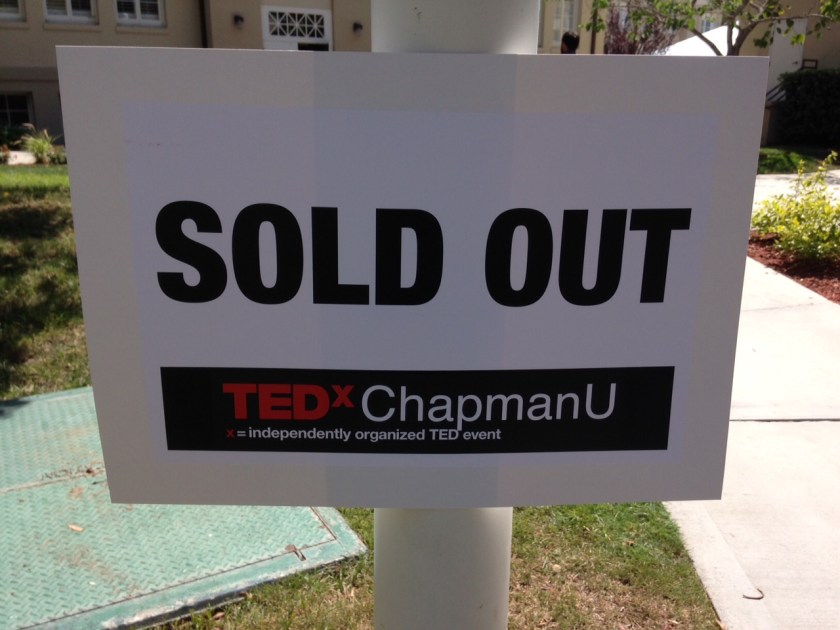
TEDxSoldOut

Be curious. Open your mind. Challenge yourself to listen and learn. Respectfully explore new perspectives. Discover your own inner Icon\Genius\Maverick.

Great advice in any setting. Prerequisites for attending a TEDx event.

Here’s a summary of this year’s talks:

Stella Young—I’m not your inspiration, thank you very much. Stella was born with a disability that limited her growth, and confines her to a wheelchair. Is it difficult being disabled? Yes. Is she special because she’s disabled? She doesn’t think so, and her goal is that you won’t either.

Stella told a story that happened when she was about thirteen. Her parents received a call from a representative of their town council saying they’d like to give Stella an award for her community achievements. That was puzzling to her parents (and her), since she hadn’t really achieved anything for the community. She was more interested in watching Buffy the Vampire Slayer, and Dawson’s Creek than actually doing anything for someone else.

The real reason for the award was that she was disabled and could be an inspiration to others. But that’s just it. She says that being disabled shouldn’t be something special, or an inspiration. After all, isn’t the inspiration we feel based upon the silent (and instant) comparison we make to that disabled person’s difficulty…and our relief that it isn’t us? By comparing ourselves to someone we think should have lowered expectations, we give ourselves permission to have our own higher expectations, at their expense.

Stella can’t wait for the day when being disabled isn’t special: the day when we take our inspiration and lessons from the good within people, whether they’re disabled or not.

Dan Pallotta—The way we think about charity is dead wrong. How much should a charity spend on fundraising? How much overhead should they have? Is it better to have a bake sale and raise $375 with no overhead, or spend $350,000 to produce an event that raises $5,000,000? If you’re an MBA graduate, should you go to work at a for-profit company, or a non-profit?

Dan says the way we approach these questions, and the ethical standards we put on charities and non-profits, is shackling them and reducing their ability to grow. We should be focused on what they are raising, how successful they are at providing their services, and not their overhead rate.

He provided a number of examples of the ways we apply different standards to for-profits, compared to non-profits. And yet, for all the advantages that for-profit organizations have in terms of access to capital, access to talent, permission to make mistakes, and their ability to focus on growth; they are not equipped or motivated to provide the type of assistance (economic and otherwise) that’s required in the lowest 10 percent of our society. Philanthropy is the marketplace for love. We need a robust and well-funded non-profit community to meet the very real needs of those less fortunate.

To get there, we need to upend the way we think about non-profits. We need to remove the shackles and give them the room they need to grow and succeed.

Mina Morita. What you value is defined by what you risk. Mina’s mom risked everything to come to America from Japan when she was 20. Mina gave up her corporate job to pursue her love of theater. Through many twists and turns, she is now the Artistic Director of Crowded Fire Theater. She’s fulfilled and happy. Not because her life is perfect. It’s fairly messy.

She gets to tell stories and create unique moments that can only happen in theater. Theater fulfills dreams. It’s a place where failure and judgment are in the flesh…every night. She has missed a lot of life’s joys, sacrificed special moments with family and friends. But, she’s happy because her life is what she wants it to be. What you value is defined by what you risk.

Brian Vellmure. Brian is a management consultant, but his talk wasn’t about that. It was about how to prepare our next generation for the challenges that lie ahead. What does he recommend? Team sports and adventure travel.

Team sports show us how to work with others, how to rise to a new challenge, how to go beyond what’s expected. Most importantly, team sports show us how to respond and bounce back from failure…and the fear of failure.

Adventure travel makes us all kindergarteners again. We don’t know anything. We don’t know the language, the customs, the food, or the geography. Outcomes are uncertain. It’s perfect practice for dealing with the challenges that our future will bring.

Why do some people succeed while others fail? Brian says successful people have three things above all else. Curiosity. Grit. Character.

Ryan Gattis. Ryan is an author, but more than that, he is an explorer of life. In 2009, his life had bottomed. He boiled it down to a series of numbers and stats, and none painted a good picture.

As a storyteller, Ryan told us that every good story has five elements:

Hooks

The Unexpected

Cause & Effect

How did it feel?

Concrete specific detail.

All of these elements are nothing if the story (and the author) lacks authenticity. Authenticity is the invisible power that makes a story matter.

Ryan weaved three stories together that contained all of the elements. We heard about the depths of his despair in 2009 and the course he charted to climb out, followed by an intense meeting with a Los Angeles area gang leader, asking permission to do research for his next book, All Involved: A Novel of the 1992 L.A. Riots. The third story, and also an unexpected element within the first two, was something that happened when he was seventeen. He wound up on the receiving end of a punch from a football player named Lump. The punch destroyed and relocated all of the cartilage in his nose to an area on his cheek, without breaking a bone. Two reconstructive surgeries later, he was fluent in pain.

It was that pain that gave his stories their authenticity, along with all the other elements. He discovered that once he opened up to his pain, his prose opened up as well.

Doug Woo. Doug is the president of the Smart Display Division at FUHU. FUHU focuses on providing digital solutions for families and kids. They have a line of tablets, aimed at the unique needs of families. Their Big Tab displays are as big as seventy inches. They resemble large flat screen TV’s, but they act like tablets.

Their innovation was to create a whole new category, based on something that everyone thought they already knew. Tablets. Innovation is practical change, driven by desperation or inspiration. FUHU went “big,” and focused on how to connect the family with their technology. Their cause was bigger than just the technology. Togetherness, collaboration, sharing. These were their motivation, and the Big Tab displays are the result.

These tablets don’t isolate family members. Instead, the entire family shares in the immersive experiences that only the Big Tab can provide.

Dotsie Bausch. In the first minute of Dotsie’s talk, we learned that she was a fashion model, a cocaine addict, bulimic, and attempted suicide twice. This was all before she entered three years of therapy. As she made progress, her therapist recommended she take on a new activity, and she chose cycling on a whim.

By 2012, she had become an Olympian track cyclist. She won a silver medal in the team pursuit event. She says that she has a voracious appetite for winning.

But, that wasn’t the subject of her talk.

Her talk focused on the benefits of a plant-based diet. It all started when she watched a documentary about factory farms, and witnessed the cruelty that animals face on their way to slaughter. She considers it an act of Olympic-level compassion to eat a plant-based diet.

She says that a person who eats only a plant-based diet is consuming 200,000 less gallons of water per year than someone who eats a meat-based diet. Athletes who eat plant-based diets recover 50% faster than their meat-based counterparts.

She asked each of us to go meatless for one day to start down the path toward a plant-based diet.

Todd Irving. Everyone is someone’s child. Todd says this should be the dominant thought in education at all levels. Parents send their most precious possession to school, and they should be treated that way. Todd is the teacher, now principal, that we hope all of our kids get. What makes the most difference to a kid? Taking time to make a connection with them. Getting to know them, their dreams, and their fears…one-on-one. Every child needs to have hope, and that’s the job of every educator, and each of us in the community.

Lesley Fightmaster. Yes, that’s her real name. Lesley is a yoga instructor. She led us in a short, guided meditation. We started by focusing on our breathing and our posture. With our eyes closed, breathing a little more deeply, she guided us through a series of peaceful thoughts that we directed out to the world and then back within ourselves.

Meditation helps us focus on the present moment. This moment is great. Be there. Namaste.

Dr. Anthony Chang. Dr. Chang started his talk with some sobering statistics about the relative happiness of physicians in the US. Nine out of ten physicians wouldn’t recommend their profession to others. Only 6% are happy with their careers. We are creating a perfect storm for reducing physician morale. They are under pressure to see high volumes of patients in a short amount of time. They are inundated with data gathering, data entry, and billing challenges.

Dr. Chang gets his inspiration from his patients. He told us about three of his patients, Hanna, Elsie, and Shirley. Hanna helped him renew his idealism for his profession. Elsie showed him how important it is to take all the data we have and somehow turn it into wisdom for patients…intelligence in medicine. Shirley reminded him about the importance of innovation in medicine.

Dr. Chang wants to integrate artificial intelligence into the practice of medicine. When we were learning to fly, we watched birds. Our first attempts tried to mimic their method, and didn’t work. Only by learning the underlying characteristics of flight, were we able to solve the riddle of flight in our own unique way.

It’s the same with artificial intelligence. Rather than attempting to mimic the way our brains function, the best approach is to extract the lessons we can learn and create our own unique methodology for bringing intelligence to various fields, like medicine.

Dr. Brenda Wiederhold. Dr. Wiederhold is a clinical psychologist and entrepreneur. She uses virtual reality to create transformative therapies for her patients. Therapies that free her patients from the bonds of fear and anxiety, and help them regain control.

Virtual reality is an excellent tool for transporting a patient into another reality. A reality that scares them, paralyzes them, or holds them hostage. Once the patient enters this reality, Dr. Wiederhold can work with them in this safe environment, showing them how to control their emotions, and ultimately their subconscious mind. This frees the patient to use what they’ve learned in the virtual reality environment, in the real world.

Phu Hoang. Build your dreams over time. Phu is the co-founder and CEO of Virtium Technology. He says there are two types of entrepreneurs. One is the “reckless abandon” type that makes a breakthrough and dives into it without really knowing which way he’s going. We’ve heard of many of them, yet there are only a few of them.

Then, there’s the rest of us.

Phu’s advice is to always have a dream, but also a belief in ourselves. He always believed that if he put time into learning about something, he could master it. By continuously improving, he could become the best. Choose a niche in something that is already growing rapidly. Look where the big guys aren’t looking and take that bite size niche. Become number one in that niche and build from there.

It’s okay to build someone else’s dream while you’re building your own. When you’re ready, make the leap and work full-time on your own dream.

Rob Seitelman. Rob is the speaker coach for Chapman’s TEDx. His talk was a letter to his daughters on the power of failure. Everything worthwhile has to cost something. Sometimes that cost is failure. Create a fall-through plan, not a fall-back plan. Sometimes you can do everything right and it still doesn’t work. The reality is that life is all about family, friends, and most importantly, love.

Never let someone else dictate your happiness. There is such a thing as best, but it’s only what’s best for YOU that matters. What’s best for someone else isn’t necessarily best for you. Think about the “why” of things. The most important “why” is: for the benefit of those who will come after us.

Ahmed Younis. Ahmed is an Assistant Professor at Chapman University. He focuses on the architecture of social change, youth employment in the Arab World, global Muslim public opinion and Islamic reform for social change. He started his talk by saying that he’s been working on terrorism for the past fifteen years. But, he hit a wall about a year ago.

He began to lose faith. A vessel can only pour what is within it, and he feared that his vessel was empty. It’s his job to articulate hope, and yet he was out of hope. He went on a search for hope and found it in a surprising place. He found hope in graphic novels and comic books. His favorite comic books? Pride, Cairo, Captain America, Black Panther, and Ms. Marvel.              

Each tells a story where hope triumphs amidst tragedy and conflict. Each is a story of heroes rising up from nothing to take on a world of ugliness and darkness.

How we engage the ugliness determines our hearts, and gives us hope.

Mandy Len Catron. Mandy published an article in the New York Times in January of this year, titled, To Fall In Love with Anyone, Do This. It highlights a study done more than twenty years ago by Dr. Arthur Aron. It’s an experiment built around the intimacy that comes from sustained, escalating, reciprocal, personalistic self disclosure.

Here’s the premise (from the article): A heterosexual man and woman enter the lab through separate doors. They sit face to face and answer a series of increasingly personal questions. Then they stare silently into each other’s eyes for four minutes. The most tantalizing detail: Six months later, two participants were married. They invited the entire lab to the ceremony.

Intrigued, Mandy tried this experiment with an acquaintance. After they had asked each other the 36 questions, they stepped outside the bar where they were for the evening, and onto a bridge. They then stared silently into each other’s eyes for four minutes.

Did they fall in love? Yes, but that’s not the whole story.Her story received over 8 million views. Suddenly, she was an international news story. Unfortunately, so was her new relationship. The most asked question she receives is, “Are you two still together?”

She doesn’t think that’s the question we should be asking.

When you admit to loving someone, you admit to having a lot to lose. What she wants from love, and probably what most people want, is a guarantee that this love will last forever. That’s why everyone asks if they’re still together.

Falling in love and staying in love are two different things. Love is terrifying, and there aren’t any guarantees. That’s part of the deal.

Are they still together? Yes.


If there was one overarching theme from all the talks, it is that hope is precious. Without it, life becomes ugly. With it, everything else becomes possible.

Past Chapman TEDx summaries:

2013

2014


It’s Only a Hundred Years

The life we build is rarely planned, and only takes shape in retrospect…

“I’m 15 for a moment
Caught in between 10 and 20
And I’m just dreaming
Counting the ways to where you are”

I’ve come to realize that life can be divided into quarters, each (hopefully) lasting 25 years.  Every quarter has its own unique challenges, and opportunities.  Some things we care deeply about in one quarter don’t matter as much in the next.  Each quarter carries mystery, and revelation.

“I’m 33 for a moment
Still the man, but you see I’m a ‘they’
A kid on the way, babe.
A family on my mind”

Experience reveals the nature of our mysteries.  A total mystery in one quarter often becomes a given in the next.  I have a good friend who likes to say, “I’m gonna be one smart mutha, just before I die.”  I suppose that’s the irony of life.  Just as you’re totally prepared to live it, it’s over.

“I’m 45 for a moment
The sea is high
And I’m heading into a crisis
Chasing the years of my life”

It may be a revelation to some that we are never totally prepared.  We never know everything (and don’t remember it even if we do).  We rarely understand all that is happening around us.  The life we build is rarely planned, and only takes shape in retrospect.

“Half time goes by
Suddenly you’re wise
Another blink of an eye
67 is gone
The sun is getting high
We’re moving on…”

This doesn’t mean that we throw all caution to the wind, ignoring what others have learned, bouncing from one experience to another.  Life carries a ton of mysteries, but we can (and should) learn from those who have gone before us.  Those who faced similar mysteries, similar challenges.

“15 there’s still time for you
22 I feel her too
33 you’re on your way
Everyday’s a new day…”

Each of us has something to share with our fellow travelers.  We can shed light on their mystery.  Show a way.  Lead by example.  Reveal truths that we can clearly see.

“I’m 99 for a moment
And dying for just another moment
And I’m just dreaming
Counting the ways to where you are”

In the process, we reveal new truths for ourselves, see with new eyes, and listen with new attention.  That’s the journey.  Enjoy every minute of it.

“When you only got a hundred years to live.”  -John Ondrasik, Five for Fighting


Discuss or Defend?

The search for alignment, a conclusion, a decision, or an all-out victory often trumps everything else…

Discussing involves active listening.  Curiosity.  Openness.  It requires genuine interest in ideas, even if they contradict your own.

Defending involves taking and holding a position.  Looking for openings to argue against another idea.  Preparing your response, while you should be listening.

Discussing takes time.  Discussing requires courtesy, respect, and patience.  Defending, not so much.

Most discussions we see on TV, or hear on the radio, aren’t discussions at all.  They’re exercises in defending.  Questions and answers are metered out in an attempt to defend one position or another.

It’s often the same in a business setting.

The search for alignment, a conclusion, a decision, or an all-out victory often trumps everything else, including a meaningful exchange of ideas.

How often do you defend, instead of discuss?  Be honest.  We’re just discussing here…no need to get all defensive.

What if you went through an entire day without defending?  Think you could do it?


The Most Powerful Feature on Your Phone

Smart phones have unbelievable power. I recently read that the Apollo 11 spacecraft that landed on the moon had…

Smart phones have unbelievable power.  I recently read that the Apollo 11 spacecraft that landed on the moon had 1,300 times less computing power than an iPhone.  And, I bet the iPhone takes better pictures than most of Apollo 11’s cameras.

Continuous connectivity, access to all the information the internet has to offer, games, and the ability to talk to family and friends from almost anywhere (it is a phone after all).  All great features.  But there’s an even more powerful feature.

Airplane mode.

It’s not just for flying.

Next time you’re asked to silence your cell phone, try airplane mode instead.

Going for a run, bike ride, or a workout at the gym?  Airplane mode.  Your music will play just fine.  Better yet, how about listening to the rhythm of your own thoughts?

Having dinner?  Airplane mode.  Enjoy the sanctity of good food and good company (that would be the people at the dinner table with you).

Watching your kid’s game?  Airplane mode.  Try out the video capture capabilities of your phone without being interrupted by some alert.

Playing Risk with your kids?  Airplane mode.  Worldwide domination demands your undivided attention.

Walking on the beach with someone you love.  Airplane mode.  Hold their hand instead of your phone.

Continuous connectivity is amazing.

Airplane mode controls the very definition of “continuous.”  That’s real power.

Use it wisely and enjoy being present.

The Mystery of the Dots

Our lives can seem like a collection of random experiences, decisions, non-decisions, near-misses, lucky chances, chance encounters, crazy ideas…

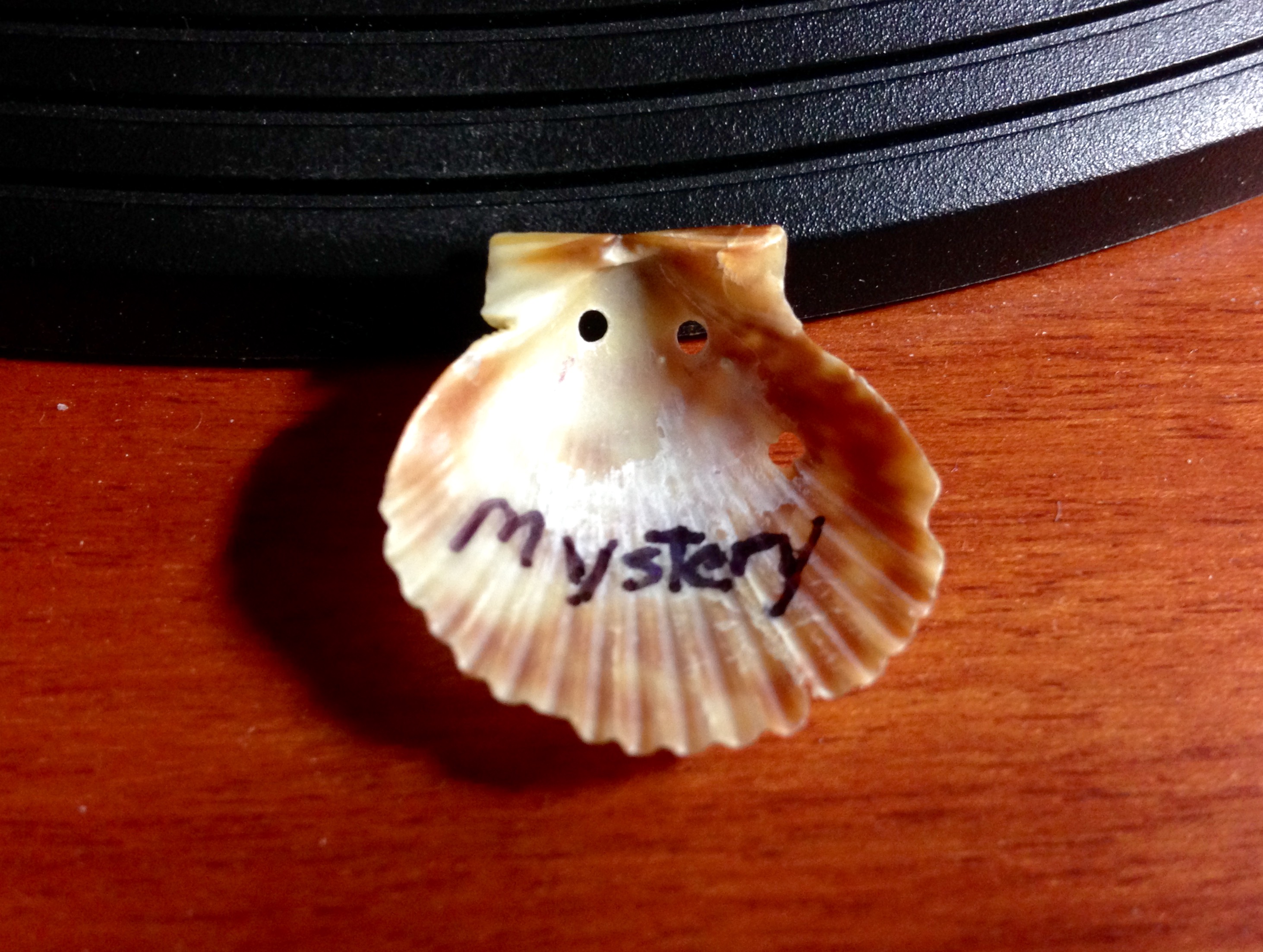
MysterySeashell

I recently participated in my first Church retreat.  It opened with an exercise where each participant drew a seashell out of a pile of seashells.  Written inside each shell was one word.  The facilitator then asked each of us to say how this one word connects with our lives.

My word was Mystery.

As I sat pondering the word, I couldn’t help thinking about all the dots in my life that have connected to bring me here.

Connect-the-dot puzzles are a great way to teach kids how to count, and see that there can be order in the apparent chaos of a bunch of dots on a page.

Our lives can seem like a collection of random experiences, decisions, non-decisions, near-misses, lucky chances, chance encounters, crazy ideas, mundane thoughts, risky ventures, explorations, challenges, victories, losses, successes, failures, limitations, beliefs, non-beliefs, triumphs, heartbreaks, new directions, people, places and things.

These are our dots.

We create some of the dots, but most of them are already there, waiting for us to connect.

Which dot comes next?  Do we choose, or is it chosen for us?  Is there a pattern, or at least some path, in all these dots?  I like to think we have something to do with deciding which dot comes next, but certainly not everything.

Nearly every major turning point in my life (good and bad, but mostly good) was unplanned.  Sure, I may have been prepared to capitalize, but the actual “dot” came out of nowhere, often by chance.

To paraphrase a quote from The Way (a movie I highly recommend, by the way), “You don’t choose a life, you live it.”  We all make plans, and try to map out where we’re headed.  The truth is, we don’t have as much control over things as we’d like to think.

Letting go of the illusion of control is a big step toward happiness.

The happiest people I know live their lives as a verb, rather than something to be controlled, or pondered in the past tense.  They are always seeking, always learning, always renewing.  They usually spend a lot of time serving others.  They don’t know which dot comes next, but they’re open to the possibilities.

I can see some big dots in my future, but I know there are a bunch I don’t see.  That’s the great mystery that makes life so awesome.

The Trouble with Gauges

Successful flying is much more than air speed…

cockpit-sopwith-1-1_2-strutter

One might argue that air speed is the most important factor in flying.  Not enough and you fall from the sky.  Too much, and your plane suffers catastrophic damage (and may fall from the sky).

I searched for at least three minutes (that’s a long time to be on a wild-Google-chase) to find an image of a simple cockpit instrument panel.  Notice anything?  Even this simple panel has a lot more than an air speed indicator.

In addition to air speed, the pilot can see engine rpm, oil temperature, water temperature, cylinder head temperature, fuel level, battery voltage, whether or not the plane is flying level, and the all-important altitude.

Successful flying is much more than air speed.  Otherwise, there’d only be one gauge.

Flying is much more than monitoring gauges.  Otherwise, what’s the point of windows?

Do you measure your life with one gauge, or a cluster of gauges?

Which gauge do you look at most?  Is it the right one?

Have you noticed where you’re heading, or are you too busy looking at your gauges?


Photo Credit: World of Aircraft Design


Taking Time to Grieve

Grieving is unavoidable, no matter how busy or tough we think we are.

When someone we love dies, we often hear about the grieving process.  We hear that we should take time to grieve.  It’s something we can’t skip.

Grieving is unavoidable, no matter how busy or tough we think we are.

I remember when my Grandma Anne died (over twenty years ago).  My cousin, Devin, told me about DAWA, the four stages of the grieving process that he’d learned as a policeman:

Denial—we deny that the person has died, or that this is really happening.  We may also deny that it’s impacting us emotionally, or deny that we even understand the mix of emotions that are welling-up inside of us.

Anger—we realize this is real.  We wonder what we could have done differently.  We wonder how something like this could have happened.  We may question the justice in the universe, or how God could allow this.  Bargaining phrases like, “if only…” come into our mind.

Withdrawal—sometimes the only way to cope with the reality of our loss, and the emotions we can’t control, is to withdraw.  This may be within ourselves, or to some place where we can be alone.  Denial is giving way to reality.  Anger is turning to sadness.  We look within ourselves for the strength to overcome our sadness.

Acceptance—we begin to get our head wrapped around what is happening.  We start to make peace with this new reality.  Acceptance doesn’t mean we’re “over it,” or that there isn’t an irreparable rip in the fabric of our soul.  It means we start to understand how to go forward with our life.

It’s easy to list these stages and assume grief is a simple process with a beginning, middle, and end.  It doesn’t work that way.  Some people never get through all the stages, or, they may cycle through one or more of the stages numerous times.  It’s a process without a true endpoint…only the hope of eventual acceptance.

The grieving process applies to more than our loved ones passing away.  It can apply to losing just about anything else we love (whether we realize it or not).

Maybe it’s a friend who we don’t get to see anymore, a hobby we can no longer participate in, moving into a new house (and leaving the old one behind), graduating from college and saying goodbye to our friends, losing that job we thought we’d have for many years to come.

It doesn’t matter if we’re the ones driving the change in our life, or if the change is thrust upon us without warning.  It doesn’t matter if our loss is a stepping stone that leads us to something even greater (which is often the case).

The loss is real.

And, so is the grieving process.

Your Employees Don’t Work for You

Who works for whom?

The following is an excerpt from my book, Leadership Starts (and Ends) in Your Head…the rest is detail.

Chapter 3.  Employees Don’t Work for You

Ask employees to list the things they “work for.” I guarantee managers will not be at the top of that list, if they make the list at all. The following is generally what employees are working for:

  • To earn a paycheck
  • To make a living for myself and/or my family
  • To experience the challenge
  • To grow
  • To have fun with my coworkers
  • To create something bigger than myself
  • To be a part of an organization that shares my values

Ironically, if you ask a lot of managers to describe their organizations, they will often tell you how many people they have working for them. Really? How is it that employees are working for a whole list of things other than managers, yet managers list how many people are working for them? How can this basic premise of the relationship between management and employees be so disconnected?

Is it just semantics to say that employees don’t work for their managers; they report to their managers? Quite the contrary. It’s critical for managers to realize that their employees merely report to them. Employees take direction, seek motivation, look for clarity, look for support, and often look for permission or forgiveness from their managers. But they don’t work for their managers.

Great managers actually work for their employees. The managers’ focus should be creating environments where their employees, and by extension, their businesses can be successful. This means that managers are, first and foremost, service providers to their employees. Managers are responsible for ensuring that any obstacles to great performance are removed from their employees’ paths. These obstacles may come from outside the organization, or, as is often the case, the biggest obstacles will come from within.

What are some obstacles to great performance? It can be as simple as the climate control in the office. It may be too cold or too hot for employees to concentrate on their work. Employees may be struggling to get their jobs done with faulty or worn-out tools. How about the work environment that has an employee who disrupts the rest of the team or isn’t pulling his or her weight? All of these are examples of issues managers need to be aware of. Not only that, managers need to take swift action to eliminate these barriers to performance, in service to their employees.

And that’s just it, if managers are paying attention to the needs of their employees, they will be able to move quickly to help their employees succeed. After all, an employee’s success is the key to the organization’s success, and, in turn, the manager’s success.


Book_Order_Snap


© 2014 Bob Dailey.  All rights reserved.