There’s a quiet moment in meaningful work when your idea begins to live in someone else. You see it in the way they talk about it. You hear it in their enthusiasm. You notice how they add their experience and their language to it until the idea carries their imprint as much as yours.
It can feel strange the first time it happens. You know the origin, but they suddenly feel the spark of the idea for themselves. That’s the moment you know your idea has begun to grow.
Real success often arrives like this, but we don’t always notice it. People begin to adopt your idea, reshape it, and eventually believe in it with a conviction that can be surprising. They explain it to others in their own voice. They defend it. They improve it. If the idea spreads far enough, some will forget where it began. Your name may fade from the origin story. That loss of attribution can sting if you hold the idea too tightly. It should feel like success instead.
Leaders have a responsibility here. Ideas rarely spread through logic alone. They spread through emotional ownership that grows when people discover a piece of themselves in the idea. When that happens, they carry the idea farther than you ever could by insisting on authorship.
A leader’s task is to create the conditions for this transfer. You offer the early shape of the idea, then invite others to step inside and help build the next version. You ask for their insight, their experience, and their concerns. You let their fingerprints gather on the surface until the idea becomes a shared creation. People support what they help to shape.
As others begin to adopt your idea, they’ll need to feel safety in their new enthusiasm. They need to know they’re not the only ones who believe in this direction. A wise leader pays attention to this. They take the people who have embraced their idea and introduce them to others who have done the same. They form new connections, helping to create a small community where confidence strengthens and courage grows. When people see others adopting the same idea, they feel validated, understood, and ready to act.
This is how ideas gain momentum inside organizations. One person sees the promise. Another begins to shape it. A third begins to feel inspired. Before long, it becomes a shared narrative. It starts with your imagination, but it continues through their belief and conviction.
Once people begin to adopt your idea, you must release it. You may or may not receive credit for it. Either outcome is acceptable.
The goal was never to build a monument to your creativity. The goal was to move the organization forward. When others bring your idea into new conversations without you, your contribution has done its job.
Your attention can return to the horizon. There’s always another idea waiting for you, another possibility that needs your curiosity, another problem that needs new framing.
Good leaders plant seeds. Great leaders celebrate when those seeds take root across the organization.
Inspired by Dr. Michael Levin’s post, h/t – Tim Ferriss
Photo by Alex Beauchamp on Unsplash – a new idea taking root and growing beyond its beginning.
There are certain destinations in the world that feel larger than life. The Taj Mahal is one of those places. For many travelers, seeing it with their own eyes is a once-in-a-lifetime moment.
We were finally there. We had made it to Agra. All that remained was to step inside the gates and witness the iconic white marble glowing in the sun.
Only one problem.
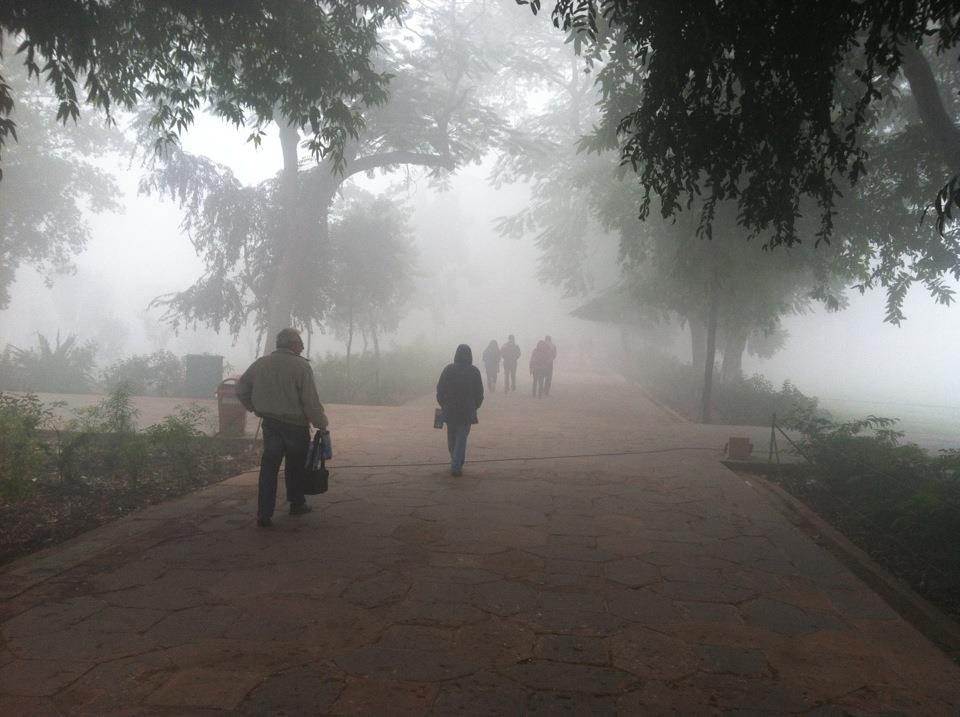
There was no sun. There was no white marble. There was no Taj Mahal.
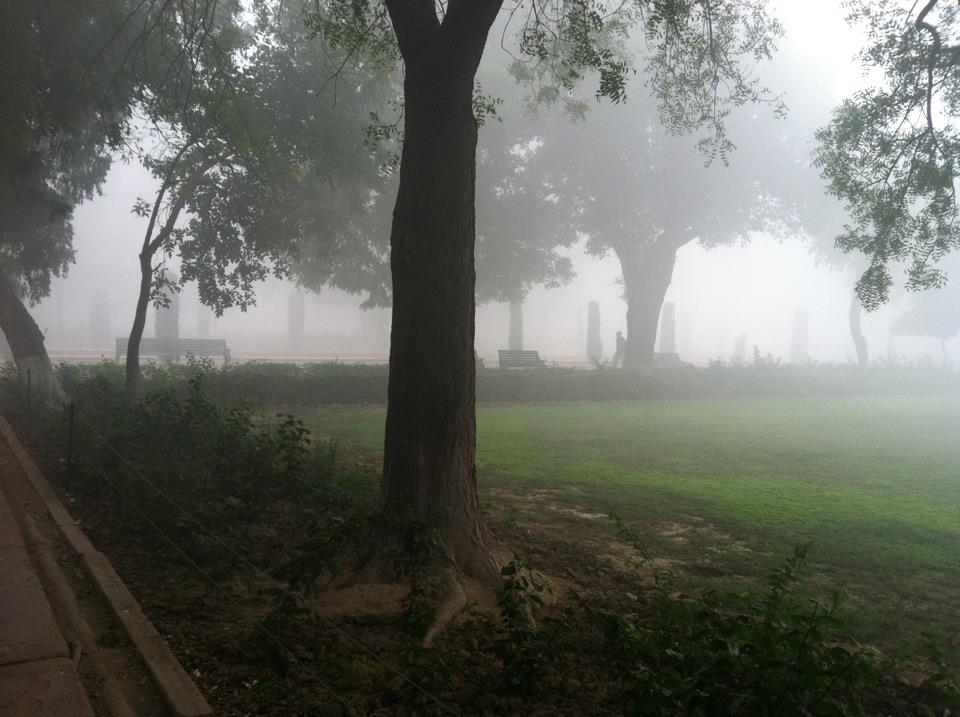
There was only fog.
We woke that morning filled with hope. The rooftop restaurant gave us a commanding view of… absolutely nothing. We stared into a wall of haze, sipping coffee and laughing at the absurdity of our timing. Surely the fog would lift. Surely the Taj Mahal would reveal itself.
Our guide, Kuldeep, assured us everything would be fine. He had led more than 500 tours of the Taj Mahal. He knew everything there was to know about its history and its beauty. We boarded our bus, grabbing our special cloth bags with a picture of the Taj printed on them. These were designed to hold the single water bottle we were allowed to bring inside the property. And we set off with excitement.
Fog. All the way there. Fog in the parking lot. Fog at the security lines. Fog as we walked the long approach toward the main viewing area. Each time Kuldeep stopped to point out an “excellent vantage point,” we nodded with wide eyes, imagining the magnificent structure hidden somewhere in the mist.
We took photos pointing at the picture on our water bottle bags. That was the only Taj Mahal available to us from any vantage point.
As we walked toward the building, we eventually reached the outer wall and finally saw something. White marble appeared just a few feet above our heads. Then the stone vanished again into the haze. The grand dome. The sweeping arches. The delicate inlays. All shrouded in fog.
We were standing beside one of the wonders of the world and could only see a sliver of it.
Our group laughed so much that day. Not because we had traveled halfway around the world only to miss the view. We laughed because we were sharing something unforgettable and slightly ridiculous. We were experiencing a story that would last much longer than a postcard-perfect photograph.
Kuldeep shook his head with disbelief. In all his tours, he had never experienced this. He told us we were a very select group of visitors who could claim something few on Earth could say. We visited the Taj Mahal, but we have never actually seen it.
He was right. I still have never seen the Taj Mahal in person.
The destination was never the prize
You might think this would be a disappointment. But when I look back on that trip, the fog made everything richer.
The destination was never the prize. The people were.
We shared meals and conversations and inside jokes. We tried foods that were new to us. We navigated chaos and beauty side by side. We saw India’s contrasts and colors and kindness. We saw devotion expressed in temples and marketplaces. We saw how history and modern life can exist on top of each other without barriers.
The Taj Mahal is extraordinary. I would love to see it someday with clear skies and a rising sun. Yet I already have what I came for.
When I think about all the amazing places I have been blessed to visit, a pattern appears. I never say, “Remember when we saw that famous landmark.” I say things like:
– Remember how we got lost trying to find it? – Remember the tiny restaurant we discovered afterward? – Remember the guide who became a friend? – Remember that amazing gelato place in the middle of nowhere?
I have my memory of that rooftop breakfast. I have the echo of laughter on the bus. I have the photos of my family and friends pointing to a water bottle bag as if it were the crown jewel of Indian architecture.
The world is full of wonders. But relationships are the wonders that stay with us.
The real bucket list
If someday I return to the Taj Mahal and finally see it, I’ll smile and take it in. But I know the picture etched into my heart is already complete. It’s filled with faces and voices and laughter. It has the beauty of our shared experience.
Checklists are fine for airplanes. But our lives deserve something better.
The best adventures can’t be captured by a camera or a perfect view. What lasts are the relationships made stronger by shared surprises, setbacks, and moments of wonder.
This story, fog and all, remains one of my favorites.
Photo by Mark Harpur on Unsplash showing the majestic beauty of the Taj without fog.
The photos below are mine showing what we actually saw. Unfortunately, the amazing water bottle bag photos are stored on a drive I can’t see…a little bit like that morning in Agra more than a decade ago.
There it is!Can you see the Taj in the background?Can you see the Taj on the right?
It was the second day of a two-day strategic planning retreat. Revenue projections stretched across the screen. The CFO walked through all the assumptions in his spreadsheet. Customer acquisition costs will flatten, churn will improve by two points, and the new product will capture eight percent market share within six months.
Everyone nodded along, acting as if these forecasts represented knowledge rather than elaborate guesses built on dozens of assumptions, any one of which could be wrong.
Three months later, a competitor launched an unexpected feature. Customer behavior shifted. The CFO’s projections became relics of a reality that never existed. The entire strategic planning process had been built on an illusion.
What we pretend to know
In his 2022 memo The Illusion of Knowledge, Howard Marks explored how investors mistake confidence for clarity. He began with a line from historian Daniel Boorstin:
“The greatest enemy of knowledge is not ignorance, it is the illusion of knowledge.”
Leaders face a brutal paradox. Boards expect forecasts. Teams want confidence. Investors demand projections. The machinery of leadership demands certainty.
So, we build elaborate forecasts and make decisions based on assumptions we know to be fragile. We treat detailed guesses as facts.
Physicist Richard Feynman once said, “Imagine how much harder physics would be if electrons had feelings.” Electrons follow discrete laws, unlike people. People innovate, resist, panic, and occasionally do something amazing nobody saw coming. Competitors behave differently than our models assume. Markets shift for reasons we never thought possible.
Marks describes forecasting as a chain of predictions. “I predict the economy will do A. If A happens, interest rates should do B. With interest rates of B, the stock market should do C.” Even if you’re right two-thirds of the time at each step, your chance of getting all three predictions correct at once is only about thirty percent.
Leadership forecasts work in a similar way. We predict customer adoption rates. If adoption hits those numbers, we’ll need a certain operational capacity. With that capacity, we can achieve specific margins. Those margins will attract investment.
Each assumption depends on the previous one. The chain is only as strong as its weakest link.
The tools we trust
Walk into any strategic planning session and you’ll likely encounter two frameworks treated as gospel:
-SWOT analysis (strengths, weaknesses, opportunities, and threats)
-SMART goals (specific, measurable, achievable, relevant, and time-bound).
Business schools teach them. Consultants recommend them. Leaders deploy them with confidence. Each relies on assumed knowledge that may not exist.
A SWOT analysis claims to know which possible developments count as opportunities versus threats. It’s a snapshot of assumptions masquerading as strategic insight. An opportunity exists only if you can identify it, execute against it, and do so before circumstances change. The framework provides no way of acknowledging uncertainty.
SMART goals often confuse precision with accuracy. “Increase market share” becomes “increase market share in the Northeast region from 12% to 15% by Q4 2026.” It sounds specific, and therefore rigorous. It’s easy to be precise about something unpredictable.
And how do we know a goal is achievable? We make assumptions about resources, market conditions, and competitor behavior, then write a goal that treats our assumptions as facts.
Both frameworks serve a valuable purpose. They force structured thinking. But they also seduce leaders into believing they know more than they do.
What should we do instead?
To be clear, this isn’t an argument for abandoning planning. Organizations need direction, priorities, and coordinated action. The question is how to plan in ways that acknowledge what we can’t know while still making decisive progress.
A better path involves changing how we plan and how we talk about the future.
Distinguish between direction and destination. Amazon knew it wanted to be “Earth’s most customer-centric company” without knowing exactly what that would look like in year ten. “We’re moving toward increased automation” carries more truth than “we’ll reduce costs by seventeen percent by Q3 2026.” The first creates direction. The second creates false precision.
Separate what you know from what you assume. Customer complaints increased forty percent this quarter. That’s knowledge. Saying the trend will continue is extrapolation. Predicting that fixing the issue will increase retention by five points is speculation. Present plans that show what you know, what you’re inferring, what you’re assuming, and what you’ll do if you’re wrong.
Build optionality into everything. Create strategies that work across multiple futures. Hire people who can do, or think about, more than one thing. Build modular systems with flexibility in mind. Create decision points where you can change course.
Use familiar tools differently. Run a SWOT analysis, then list three ways each opportunity might fail to materialize. Write SMART goals, then document the assumptions those goals depend on and how you’ll adapt if they prove incorrect.
Here’s a concrete example. You’re deciding whether to build a new product line. The traditional approach creates a detailed business case with market projections and revenue forecasts. You present it. People debate assumptions. A decision gets made.
An alternative approach defines what success means, then identifies what must be true to achieve it. You sort those conditions into things you can validate quickly, things you can validate over time, and things you can validate only much later. Stage investments to match the timing of the validations, rather than an arbitrary quarterly schedule.
The difference in these approaches is critical. In the first, the business case pretends to represent knowledge. In the second, it becomes a set of hypotheses to test over time.
The harder path
Amos Tversky observed, “It’s frightening to think that you might lack knowledge about something, but more frightening to think that, by and large, the world is run by people who have faith that they know exactly what’s going on.”
We select leaders for their ability to project confidence about an unknowable future. We reward decisiveness over doubt. Then we wonder why strategies fail when reality diverges from our projections.
Most of us live in this system. We’ve built organizations that demand the illusion of knowledge.
Real leadership creates organizations resilient enough to find answers as circumstances unfold. It builds teams that can adapt rather than simply execute a plan written many months ago.
When did you last change a forecast because reality diverged from your assumptions?
When did you last reward someone for identifying that a plan was failing?
Start small. Pick one decision where you can be explicit about uncertainty. Structure one investment to test assumptions instead of betting on a forecast. Have one conversation where you separate what you know from what you’re guessing.
Plan in ways that acknowledge uncertainty and position your organization to learn. Lead with confidence about principles while staying adaptable around specifics. Build organizations that can adapt when reality diverges from the plan.
Because it will. The measure of leadership lies in how well your culture can face that truth.





 Grandpa Bob Encouraging Leadership
You must be logged in to post a comment.