Speed bumps and walls…

…have a few things in common. Both force us to pay attention, slow down, and (sometimes) change course…

speed-bump-warning-sign

…have a few things in common.  Both force us to pay attention, slow down, and (sometimes) change course.  In many ways, speed bumps are merely walls that are short enough to get over with minimal effort.

Unlike speed bumps, walls are there to stop us, contain us, to protect something we’re not supposed to see, or maybe provide protection to something we don’t want others to see.

Is that nasty cold you have a speed bump or a wall?

How about the job you had until last week?  Is losing that job a speed bump or a wall?

Is the macro-economic forecast for 2% or less in U.S. Gross Domestic Product growth a speed bump or a wall?

Is bad weather (however you define the term bad) a speed bump or wall?

The death of a loved one?  Speed bump or wall?

The diagnosis you received from your doctor that has you wondering how long you have to live this life you love.  Speed bump?  Wall?

Meeting the person of your dreams and falling in love.  Speed bump or wall?  Surprise!  Good news introduces speed bumps and walls, just like bad news.  Of course, good news can also knock down walls.

When the news first hits, it almost always looks like a wall.  Only after further reflection, maybe some quiet meditation, a hard workout(s), discussions with our friends and family, enjoying a bowl of our favorite ice cream, watching some sunrises and sunsets, or all of these, do the walls start to look shorter.

As the walls lose their height, they may disappear from sight, or take the shape of speed bumps that we can handle.

Some walls are high and stay that way.  If we can’t climb over, we learn to change direction and find a way around.

What if we can’t climb over, can’t change direction, and the high walls continue to surround us?  Should we give up?

No way!

We build our expansive life inside the new walls and never drop our quest to escape…even if we have to dismantle the walls one brick (or chisel strike) at a time.

Do you remember that guy who gave up?  Neither can anyone else.  –Author Forgotten

There’s a crack in the gutter where a flower grows…

They’re not supposed to be there. It should be impossible for them to grow…

Pandora is awesome.  I was listening to my Happy Radio channel the other day when this song called Hey, Hey, Hey came on.  It had a catchy tune, and some of the words seemed nice when I chose to listen closely.  It was my first time hearing it, but I knew it had been around a while.

Somewhere in the middle of the song I hear:

There’s a crack in the gutter where a flower grows

Reminding me that everything is possible
Yeah, reminding me that nothing is impossible
You gotta live for the one that you love you know
You gotta love for the life that you live you know

Singing hey, hey, hey
No matter how life is today
There’s just one thing that I got to say
I won’t let another moment slip away

That got my attention.

How many times have you seen a plant (sometimes a weed, but that’s really in the eye of the beholder) growing out of a crack in the sidewalk, or the gutter?  How about the tree that figures out how to grow from within a cracked boulder?

They’re not supposed to be there.  It should be impossible for them to grow.  Yet, there they are.  Thriving in the most inhospitable of environments.

Each of us have the same ability to overcome adversity.  To be the flower growing in the crack in the gutter.  To grow and thrive in our little corner of the world, making a small but important difference to those around us.

Life is a journey, and it can be a struggle.  But, it’s also a triumph, and an opportunity to make our mark in places nobody (including ourselves) would ever expect.


Here’s the whole song…and, yeah, it’s been around since 2010.  Only took me five years to notice it (not good for my hipster cred):  Hey, Hey, Hey


TEDx ChapmanU–August 20, 2015

Be curious. Open your mind. Challenge yourself to listen and learn. Respectfully explore new perspectives. Discover your own inner Icon\Genius\Maverick.

Great advice in any setting. Prerequisites for attending a TEDx event….

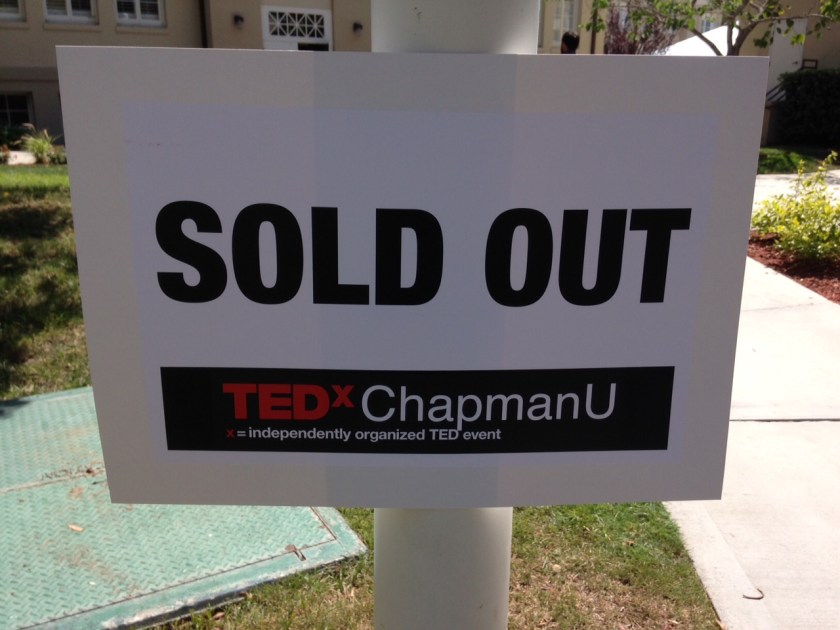
TEDxSoldOut

Be curious. Open your mind. Challenge yourself to listen and learn. Respectfully explore new perspectives. Discover your own inner Icon\Genius\Maverick.

Great advice in any setting. Prerequisites for attending a TEDx event.

Here’s a summary of this year’s talks:

Stella Young—I’m not your inspiration, thank you very much. Stella was born with a disability that limited her growth, and confines her to a wheelchair. Is it difficult being disabled? Yes. Is she special because she’s disabled? She doesn’t think so, and her goal is that you won’t either.

Stella told a story that happened when she was about thirteen. Her parents received a call from a representative of their town council saying they’d like to give Stella an award for her community achievements. That was puzzling to her parents (and her), since she hadn’t really achieved anything for the community. She was more interested in watching Buffy the Vampire Slayer, and Dawson’s Creek than actually doing anything for someone else.

The real reason for the award was that she was disabled and could be an inspiration to others. But that’s just it. She says that being disabled shouldn’t be something special, or an inspiration. After all, isn’t the inspiration we feel based upon the silent (and instant) comparison we make to that disabled person’s difficulty…and our relief that it isn’t us? By comparing ourselves to someone we think should have lowered expectations, we give ourselves permission to have our own higher expectations, at their expense.

Stella can’t wait for the day when being disabled isn’t special: the day when we take our inspiration and lessons from the good within people, whether they’re disabled or not.

Dan Pallotta—The way we think about charity is dead wrong. How much should a charity spend on fundraising? How much overhead should they have? Is it better to have a bake sale and raise $375 with no overhead, or spend $350,000 to produce an event that raises $5,000,000? If you’re an MBA graduate, should you go to work at a for-profit company, or a non-profit?

Dan says the way we approach these questions, and the ethical standards we put on charities and non-profits, is shackling them and reducing their ability to grow. We should be focused on what they are raising, how successful they are at providing their services, and not their overhead rate.

He provided a number of examples of the ways we apply different standards to for-profits, compared to non-profits. And yet, for all the advantages that for-profit organizations have in terms of access to capital, access to talent, permission to make mistakes, and their ability to focus on growth; they are not equipped or motivated to provide the type of assistance (economic and otherwise) that’s required in the lowest 10 percent of our society. Philanthropy is the marketplace for love. We need a robust and well-funded non-profit community to meet the very real needs of those less fortunate.

To get there, we need to upend the way we think about non-profits. We need to remove the shackles and give them the room they need to grow and succeed.

Mina Morita. What you value is defined by what you risk. Mina’s mom risked everything to come to America from Japan when she was 20. Mina gave up her corporate job to pursue her love of theater. Through many twists and turns, she is now the Artistic Director of Crowded Fire Theater. She’s fulfilled and happy. Not because her life is perfect. It’s fairly messy.

She gets to tell stories and create unique moments that can only happen in theater. Theater fulfills dreams. It’s a place where failure and judgment are in the flesh…every night. She has missed a lot of life’s joys, sacrificed special moments with family and friends. But, she’s happy because her life is what she wants it to be. What you value is defined by what you risk.

Brian Vellmure. Brian is a management consultant, but his talk wasn’t about that. It was about how to prepare our next generation for the challenges that lie ahead. What does he recommend? Team sports and adventure travel.

Team sports show us how to work with others, how to rise to a new challenge, how to go beyond what’s expected. Most importantly, team sports show us how to respond and bounce back from failure…and the fear of failure.

Adventure travel makes us all kindergarteners again. We don’t know anything. We don’t know the language, the customs, the food, or the geography. Outcomes are uncertain. It’s perfect practice for dealing with the challenges that our future will bring.

Why do some people succeed while others fail? Brian says successful people have three things above all else. Curiosity. Grit. Character.

Ryan Gattis. Ryan is an author, but more than that, he is an explorer of life. In 2009, his life had bottomed. He boiled it down to a series of numbers and stats, and none painted a good picture.

As a storyteller, Ryan told us that every good story has five elements:

Hooks

The Unexpected

Cause & Effect

How did it feel?

Concrete specific detail.

All of these elements are nothing if the story (and the author) lacks authenticity. Authenticity is the invisible power that makes a story matter.

Ryan weaved three stories together that contained all of the elements. We heard about the depths of his despair in 2009 and the course he charted to climb out, followed by an intense meeting with a Los Angeles area gang leader, asking permission to do research for his next book, All Involved: A Novel of the 1992 L.A. Riots. The third story, and also an unexpected element within the first two, was something that happened when he was seventeen. He wound up on the receiving end of a punch from a football player named Lump. The punch destroyed and relocated all of the cartilage in his nose to an area on his cheek, without breaking a bone. Two reconstructive surgeries later, he was fluent in pain.

It was that pain that gave his stories their authenticity, along with all the other elements. He discovered that once he opened up to his pain, his prose opened up as well.

Doug Woo. Doug is the president of the Smart Display Division at FUHU. FUHU focuses on providing digital solutions for families and kids. They have a line of tablets, aimed at the unique needs of families. Their Big Tab displays are as big as seventy inches. They resemble large flat screen TV’s, but they act like tablets.

Their innovation was to create a whole new category, based on something that everyone thought they already knew. Tablets. Innovation is practical change, driven by desperation or inspiration. FUHU went “big,” and focused on how to connect the family with their technology. Their cause was bigger than just the technology. Togetherness, collaboration, sharing. These were their motivation, and the Big Tab displays are the result.

These tablets don’t isolate family members. Instead, the entire family shares in the immersive experiences that only the Big Tab can provide.

Dotsie Bausch. In the first minute of Dotsie’s talk, we learned that she was a fashion model, a cocaine addict, bulimic, and attempted suicide twice. This was all before she entered three years of therapy. As she made progress, her therapist recommended she take on a new activity, and she chose cycling on a whim.

By 2012, she had become an Olympian track cyclist. She won a silver medal in the team pursuit event. She says that she has a voracious appetite for winning.

But, that wasn’t the subject of her talk.

Her talk focused on the benefits of a plant-based diet. It all started when she watched a documentary about factory farms, and witnessed the cruelty that animals face on their way to slaughter. She considers it an act of Olympic-level compassion to eat a plant-based diet.

She says that a person who eats only a plant-based diet is consuming 200,000 less gallons of water per year than someone who eats a meat-based diet. Athletes who eat plant-based diets recover 50% faster than their meat-based counterparts.

She asked each of us to go meatless for one day to start down the path toward a plant-based diet.

Todd Irving. Everyone is someone’s child. Todd says this should be the dominant thought in education at all levels. Parents send their most precious possession to school, and they should be treated that way. Todd is the teacher, now principal, that we hope all of our kids get. What makes the most difference to a kid? Taking time to make a connection with them. Getting to know them, their dreams, and their fears…one-on-one. Every child needs to have hope, and that’s the job of every educator, and each of us in the community.

Lesley Fightmaster. Yes, that’s her real name. Lesley is a yoga instructor. She led us in a short, guided meditation. We started by focusing on our breathing and our posture. With our eyes closed, breathing a little more deeply, she guided us through a series of peaceful thoughts that we directed out to the world and then back within ourselves.

Meditation helps us focus on the present moment. This moment is great. Be there. Namaste.

Dr. Anthony Chang. Dr. Chang started his talk with some sobering statistics about the relative happiness of physicians in the US. Nine out of ten physicians wouldn’t recommend their profession to others. Only 6% are happy with their careers. We are creating a perfect storm for reducing physician morale. They are under pressure to see high volumes of patients in a short amount of time. They are inundated with data gathering, data entry, and billing challenges.

Dr. Chang gets his inspiration from his patients. He told us about three of his patients, Hanna, Elsie, and Shirley. Hanna helped him renew his idealism for his profession. Elsie showed him how important it is to take all the data we have and somehow turn it into wisdom for patients…intelligence in medicine. Shirley reminded him about the importance of innovation in medicine.

Dr. Chang wants to integrate artificial intelligence into the practice of medicine. When we were learning to fly, we watched birds. Our first attempts tried to mimic their method, and didn’t work. Only by learning the underlying characteristics of flight, were we able to solve the riddle of flight in our own unique way.

It’s the same with artificial intelligence. Rather than attempting to mimic the way our brains function, the best approach is to extract the lessons we can learn and create our own unique methodology for bringing intelligence to various fields, like medicine.

Dr. Brenda Wiederhold. Dr. Wiederhold is a clinical psychologist and entrepreneur. She uses virtual reality to create transformative therapies for her patients. Therapies that free her patients from the bonds of fear and anxiety, and help them regain control.

Virtual reality is an excellent tool for transporting a patient into another reality. A reality that scares them, paralyzes them, or holds them hostage. Once the patient enters this reality, Dr. Wiederhold can work with them in this safe environment, showing them how to control their emotions, and ultimately their subconscious mind. This frees the patient to use what they’ve learned in the virtual reality environment, in the real world.

Phu Hoang. Build your dreams over time. Phu is the co-founder and CEO of Virtium Technology. He says there are two types of entrepreneurs. One is the “reckless abandon” type that makes a breakthrough and dives into it without really knowing which way he’s going. We’ve heard of many of them, yet there are only a few of them.

Then, there’s the rest of us.

Phu’s advice is to always have a dream, but also a belief in ourselves. He always believed that if he put time into learning about something, he could master it. By continuously improving, he could become the best. Choose a niche in something that is already growing rapidly. Look where the big guys aren’t looking and take that bite size niche. Become number one in that niche and build from there.

It’s okay to build someone else’s dream while you’re building your own. When you’re ready, make the leap and work full-time on your own dream.

Rob Seitelman. Rob is the speaker coach for Chapman’s TEDx. His talk was a letter to his daughters on the power of failure. Everything worthwhile has to cost something. Sometimes that cost is failure. Create a fall-through plan, not a fall-back plan. Sometimes you can do everything right and it still doesn’t work. The reality is that life is all about family, friends, and most importantly, love.

Never let someone else dictate your happiness. There is such a thing as best, but it’s only what’s best for YOU that matters. What’s best for someone else isn’t necessarily best for you. Think about the “why” of things. The most important “why” is: for the benefit of those who will come after us.

Ahmed Younis. Ahmed is an Assistant Professor at Chapman University. He focuses on the architecture of social change, youth employment in the Arab World, global Muslim public opinion and Islamic reform for social change. He started his talk by saying that he’s been working on terrorism for the past fifteen years. But, he hit a wall about a year ago.

He began to lose faith. A vessel can only pour what is within it, and he feared that his vessel was empty. It’s his job to articulate hope, and yet he was out of hope. He went on a search for hope and found it in a surprising place. He found hope in graphic novels and comic books. His favorite comic books? Pride, Cairo, Captain America, Black Panther, and Ms. Marvel.              

Each tells a story where hope triumphs amidst tragedy and conflict. Each is a story of heroes rising up from nothing to take on a world of ugliness and darkness.

How we engage the ugliness determines our hearts, and gives us hope.

Mandy Len Catron. Mandy published an article in the New York Times in January of this year, titled, To Fall In Love with Anyone, Do This. It highlights a study done more than twenty years ago by Dr. Arthur Aron. It’s an experiment built around the intimacy that comes from sustained, escalating, reciprocal, personalistic self disclosure.

Here’s the premise (from the article): A heterosexual man and woman enter the lab through separate doors. They sit face to face and answer a series of increasingly personal questions. Then they stare silently into each other’s eyes for four minutes. The most tantalizing detail: Six months later, two participants were married. They invited the entire lab to the ceremony.

Intrigued, Mandy tried this experiment with an acquaintance. After they had asked each other the 36 questions, they stepped outside the bar where they were for the evening, and onto a bridge. They then stared silently into each other’s eyes for four minutes.

Did they fall in love? Yes, but that’s not the whole story.Her story received over 8 million views. Suddenly, she was an international news story. Unfortunately, so was her new relationship. The most asked question she receives is, “Are you two still together?”

She doesn’t think that’s the question we should be asking.

When you admit to loving someone, you admit to having a lot to lose. What she wants from love, and probably what most people want, is a guarantee that this love will last forever. That’s why everyone asks if they’re still together.

Falling in love and staying in love are two different things. Love is terrifying, and there aren’t any guarantees. That’s part of the deal.

Are they still together? Yes.


If there was one overarching theme from all the talks, it is that hope is precious. Without it, life becomes ugly. With it, everything else becomes possible.

Past Chapman TEDx summaries:

2013

2014


Be the Candle

There’s a place in Baja, on the Sea of Cortez side, about 100 miles south of San Felipe…

“It is better to light a candle than to curse the darkness.”  – Confucius (Kung Fu Tzu)

There’s a place in Baja, on the Sea of Cortez side, about 100 miles south of San Felipe called Gonzaga Bay.  You can drive there pretty easily (by Baja standards) nowadays.  But, 30 years ago, it was quite an adventure to get there.  Your reward for all that off road adventure (other than the journey itself)?  An off-the-grid community of small “houses” on a beautiful bay with whatever supplies you were able to bring with you.

Beyond the stark beauty of the bay, the warm water, fresh ocean breezes, and perfect cocktail conditions, the thing I remember most was the darkness.  The stars were so close you could almost touch them.  On a moonless night, you couldn’t see your hand in front of your face.

But, light one candle and the scene changed.  The light from that one candle would penetrate the darkness.  The terrain glowed in the light.  Bushes and rocks cast shadows in the night.  The darkness was no match for the light from just one candle.

Darkness is all around us.  That darkness may even come from within.  We can choose to let the darkness consume us and everything we do.

Or, we can be the candle.

Finding Your Authentic Swing

What about the inevitable shanks, worm-burners, wicked slices, massive hooks, and just plain misses?

BaggerVance


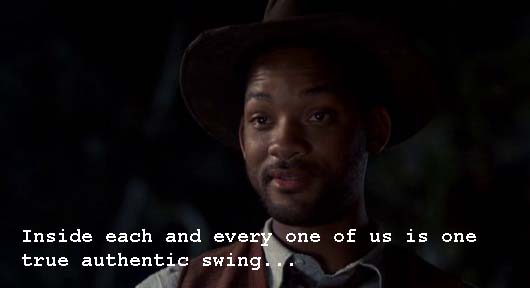
“Yep… Inside each and every one of us is one true authentic swing… Somethin’ we was born with… Somethin’ that’s ours and ours alone… Somethin’ that can’t be taught to ya or learned… Somethin’ that got to be remembered… Over time the world can, rob us of that swing… It get buried inside us under all our wouldas and couldas and shouldas… Some folk even forget what their swing was like…”

-Bagger Vance

The Legend of Bagger Vance is filled with good stuff.  It’s a movie that moseys along with a subtle, southern rhythm.  It conveys a depth of meaning without trying.  The movie challenges each viewer to look at themselves as much as the characters.

I do agree that our authentic swings can get buried under the wouldas, couldas, and shouldas of life.  They can just as easily be uncovered by the leaps, possibilities, why-not’s, and I’m-in’s.

That being said, I must disagree with Mr. Vance’s notion that we each have one true authentic swing.  I rather think we have more than one authentic swing, if we choose to search.  Not only that, we have a lot of clubs in our bag.  We have an almost infinite number of authentic-swing-and-club combinations to choose from when our time comes to stand over the ball, and deliver.

What about the inevitable shanks, worm-burners, wicked slices, massive hooks, and just plain misses?

The best among us are the ones who find a way to recover, and swing again.

Will Smith at his best…


Photo Credit

Two Stories for Lent

As Lent begins, I thought I’d share these two stories…

As Lent begins, I thought I’d share these two stories.  Both are classics, and worthy of contemplation:

The Doctor and the Father

A doctor entered the hospital in a hurry after being called in for an urgent surgery.  He had answered the call, dropped what he was doing, and went directly to the surgery ward.  He found the boy’s father pacing in the hall waiting for the doctor.

On seeing him, the father yelled, “Why did you take all this time to come?  Don’t you know that my son’s life is in danger?  Don’t you have any sense of responsibility?”

The doctor smiled and said, “I am sorry.  I wasn’t in the hospital and I came as fast as I could after receiving the call.  And now, I wish you’d calm down so that I can do my work.”

“Calm down?!  If that was your son in that room, would you calm down?” asked the father angrily.

The doctor smiled again and replied, “I will say what Job said in the Holy Book: ‘From dust we came and to dust we return, blessed be the name of God.’  Doctors cannot prolong lives.  Go and pray for your son, and we will do our best by God’s grace.”

“Giving such advice is easy when you’re not concerned,” murmured the father.

The surgery took many hours, after which the doctor went out happily to greet the father.  “Thank goodness, the surgery was successful, and your son is saved!”  And without waiting for the father’s reply, he carried on his way running down the hall toward the exit, as he yelled, “If you have any further questions, please ask the nurse!”

“Why is he so arrogant?  He couldn’t wait a few minutes so that I could ask about my son’s state?” asked the father when he saw the nurse minutes after the doctor had left.

The nurse answered, tears coming down her face, “His son died yesterday in a car accident.  He was at the funeral when we called him for your son’s surgery.  And now that he saved your son’s life, he left running to attend what’s left of his son’s funeral.”

We go through life, never truly knowing what burdens others are carrying.

Which are you?  The doctor, or the father?


Lunch with God

A little boy wanted to meet God.  He packed his suitcase with dress clothes, and some packets of cakes for his journey.  He walked a long way and felt tired.

As he sat in a park to rest, he opened a packet of cake to eat.  Then he noticed an old woman sitting sadly with hunger nearby, so he offered her a piece of cake.

She gratefully accepted it with a wide look and smiled at him.  Her smile was so pretty that the boy longed to see it again.  After some time, he offered another piece of cake.  Again, she accepted it and smiled at him.

The boy was delighted!  They sat there all afternoon eating and smiling, but they never said a word.

When it grew dark, the boy was frightened and he got up to leave but before he had gone more than a few steps, he ran back and gave her a hug and she kissed him with her prettiest smile.

When the boy got home and opened the door, his mother was surprised by the look of joy on his face.  She asked him, “What did you do today that made you look so happy?”

He replied, “I had lunch with God.”  Before his mother could respond, he added, “You know what?  She’s got the most beautiful smile I’ve ever seen in my life!”

Meanwhile, the old woman, also radiant with joy, returned to her home.  Her son was stunned by the look of peace on her face and asked, “Mom, what did you do today that made you so happy?”

She replied, “I ate cakes in the park with God.”  Before her son responded, she added, “You know, he’s much younger than I expected.”

Too often we underestimate the power of a touch, a smile, a kind word, a listening ear, an honest compliment, or the smallest act of caring.  Each has the potential to turn a life around.

People come into our lives for a reason, for a season, or for a lifetime.  Accept each of them equally, and let them see God in you.


The Obstacles You Think You Know…Don’t Matter

Polynomials suck, but they aren’t the obstacle that matters most…

Polynomial Function

I used to hear one question a lot when I was a kid.

Whether an adult was asking me, or another kid my age, it was always the same:

What are you going to be when you grow up?

In second grade, I knew I wanted to be a doctor.  My friend wanted to be a fireman.  Another friend wanted to be a professional skateboarder.

By high school, I was still thinking doctor, or maybe veterinarian.  One of my friends planned to be an engineer, another wanted to teach, and one planned to go to the Air Force Academy and become a fighter pilot (he just retired from the Air Force a few years ago).

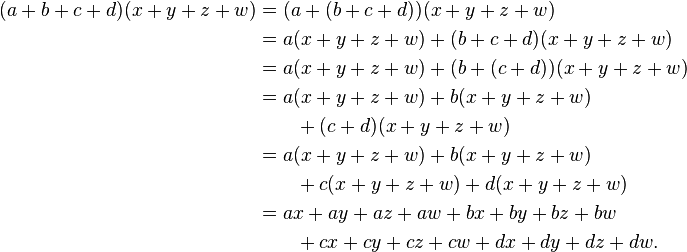
In my senior year in high school I ran into Algebra 2.  More specifically, factoring polynomials.  FOIL method.  Up to that point, math had made sense.  Plug the numbers into the formulas, and get your answer.  X equals 11, Y equals 9.  Pythagorean Theorem?  Piece of cake.  Word problems?  Easy.

But, polynomials made no sense.  The magic of the FOIL method didn’t help.  First, Outside, Inside, Last?  Solving for multiple variables that cancel each other out in some mysterious way?  Arriving at an answer that looks as cryptic as the original question?  What does a polynomial look like if you draw one?  When will we ever use this in real life?  I’d say it was all Greek to me, but I didn’t know Greek either, or Latin.

I hadn’t even reached Calculus (the math all the other brainiacs were taking in their senior year), and I’d hit a wall.

Polynomial Example

I could see the handwriting on the chalkboard (teachers used to write on them before whiteboards were invented).  To become a doctor would require a science degree of some kind.  That science degree would require a ton of math well beyond polynomials…maybe even Calculus.  What comes after Calculus?!  And, what about Latin?  Doctors all seemed to use Latin.  How would I learn that?  It wasn’t even offered at my high school.  And, what about getting into medical school?  Did I have eight years to give up?  How would I pay for all of it?  This was going to be hard!

We each have a strategic thinking instinct.  The ability to prioritize, make deductions, create connections, and map out a direction.  Or, multiple directions.

Unfortunately, more often than not, we either ignore our strategic thinking capability, or we use it to map out why something is impossible.  We visualize all the obstacles while ignoring the path around, over, or through them.  We neatly stack all the obstacles into an impenetrable wall, rather than a series of hurdles to be taken one-at-a-time.

My doctor plans went down in flames…but, I was the one pointing the metaphorical plane into the ground.

Could I have found a way to understand polynomials?  Yes.  Could I have dealt with Calculus?  Yes.  What about Latin?  Yes.  What about getting into medical school?  Yes.  Did I have what it took to become a doctor?  Probably (we will never know).

Did I allow myself to realize any of this at the time?  No.  I was too busy jumping toward another goal that had fewer obstacles, or so I thought.  One that didn’t require Calculus.  One that I could get my head around, and see more clearly.

I now understand something I didn’t back when I was a high school senior.  I’m not sure I understood it by the time I was a college senior either.  Our biggest obstacle, the one that matters more than any of the obstacles we can see, the obstacle that trumps all others, is staring back at us in the mirror.  Find your way around, over, or through yourself, and you are well on your way to overcoming almost any other obstacle in your path…maybe even polynomials.

Want the answer to the crazy equation?  This might (or might not) be it


Photo Credits:  Here and Here


Life is…

Life is a celebration…

As we end one year and prepare to begin another, it’s a great time to reflect.

What have I completed, and what will I begin?

How did I fail, and how will I succeed?

Who did I help, and who will I help?

What is my true mission?

I found this great reminder (as I often do) in a quote from Mother Teresa:

“Life is an opportunity, benefit from it.

Life is beauty, admire it.

Life is a dream, realize it.

Life is a challenge, meet it.

Life is a duty, complete it.

Life is a game, play it.

Life is a promise, fulfill it.

Life is sorrow, overcome it.

Life is a song, sing it.

Life is a struggle, accept it.

Life is a tragedy, confront it.

Life is an adventure, dare it.

Life is luck, make it.

Life is too precious, do not destroy it.

Life is life, fight for it.”

 To this list, I’d add:

Life is a journey, explore it.

Life is failure, learn from it.

Life is service, give it.

Life is a gift, share it.

Life is a celebration, enjoy it!

© 2014 Bob Dailey.  All rights reserved.

Inspiration is great, but…

????????????????????????????????????????

When was the last time you were truly inspired?

Maybe you saw an inspirational movie, an awesome TED talk, or read an inspiring book. Maybe you had a great meeting with your boss. Maybe you have a brilliant idea that will change the world.

Inspiration can come from just about anywhere.

Inspiration is great, but is it enough? Does inspiration alone drive us to take action, to move toward our new future? Maybe, but probably not.

Inspiring thoughts quickly fade. Without action, inspiration is just another passing thought…soon forgotten.

Remaining in the status quo usually seems safer than taking action.

It’s almost a cliché: The journey of a thousand miles begins with the first step. Inspiration is nothing until it’s coupled with your willingness to take action. To take the first step, and then the next.

Action is the fulfillment of inspiration, and often inspires others in the process.

What action are you taking today to pursue the things that inspire you?

Do It Anyway

Very few of us will change the (entire) world. But, following the advice in these verses is a great way to change our little corner of it…

I recently came across this poem.  It was painted on the wall of Mother Teresa’s home for children in Calcutta, India.  While it’s well-known to many, it’s new to me.  I like it so much I’ve decided to share it here:

People are often unreasonable, irrational, and self-centered.

Forgive them anyway.

If you are kind, people may accuse you of selfish, ulterior motives.

Be kind anyway.

If you are successful, you will win some unfaithful friends and some genuine enemies.

Succeed anyway.

If you are honest and sincere, people may deceive you.

Be honest and sincere anyway.

What you spend years creating, others could destroy overnight.

Create anyway.

If you find serenity and happiness, some may be jealous.

Be happy anyway.

The good you do today, will often be forgotten.

Do good anyway.

Give the best you have, and it will never be enough.

Give your best anyway.

In the final analysis, it is between you and God.

It was never between you and them anyway.

Very few of us will change the (entire) world. But, following the advice in these verses is a great way to improve our little corner of it.

That’s all that matters anyway.