There are no self-driving…

Auto-pilot and self-driving systems have one thing in common: they know where they’re going…

Airplanes have auto-pilot.  Cars are getting closer to self-driving.  In fact, I just saw a headline about a police officer pulling over a self-driving Google car (not sure who gets the ticket in that situation).

As Aldous Huxley said in his 1931 book, it’s a brave new world.

Auto-pilot and self-driving systems have one thing in common:  they know where they’re going.  Actually, the systems don’t know.  The operator who is (ostensibly) in control knows the starting point, and the destination.

Real life doesn’t work that way.

There are no self-driving:

Friendships.  We don’t know when a new friendship will start, we surely don’t know where it’s going, and we hope it never ends.  The journey is what makes it so good.  Have you put any of your friendships in self-drive mode?  It’s a conscious decision, even when you act like you didn’t notice.  Here’s the good news.  In most friendships, you can switch out of self-drive mode and restart the journey.  Your only decision is when to flip that switch.

Projects.  We usually know when a project starts, and when it’s supposed to end.  We have plans, resources, and our schedules.  We (should) know what defines success in a project, and what the end result needs to be.  That’s all the ingredients a project needs to switch to auto-pilot.  Right?  Not so fast!  Show me a project that’s out of control, off schedule, costing more than expected, and I’ll show you a project that went on auto-pilot while nobody was looking.

Parenting.  We know when parenting starts, and that’s about it.  Parents understand that every day with their kids is an adventure.  It’s an adventure they hope never ends.  There are days when they’d like to go on auto-pilot, but those are the days when they should be most engaged.

Companies.  It doesn’t matter what size they are, or how long they’ve been around.  If people inside a company start to “mail it in,” stop caring, assume someone else is asking the tough questions, assume someone else is making the hard choices; that’s the beginning of the end.  It may take some time, but the end is baked-in the moment self-drive mode is engaged.  It’s just a question of when, and it’s never pretty when the end arrives.

Marriages.  We certainly know when marriages begin.  Sadly, some marriages have ended, yet the people involved don’t even realize it.  Why?  Self-drive.  One or both have engaged the self-drive button and decided that they’re just along for the ride.  Only together can a married couple steer, accelerate, hit the brakes, seek out new routes, find shortcuts, or just enjoy the scenery.  It takes constant work, endless attention, and unending love to share this most important steering wheel.  There’s no room for self-drive in the front seat of a marriage.

Self-drive may seem easier, but its sole focus is the start and the end.  These are only two points on the journey.

The part in the middle is the real reward.  Engage self-drive and you will miss it.


Yo Ho, Yo Ho, A Pirate’s Life for Me!

What makes this ride so popular? Definitely not the speed. Is it the “escape” into another world? Maybe. But, is it really an escape?

Disneyland-POTC_sign

If you’re like me, you know the only way to turn at the end of Main Street USA is left.  Left, toward Adventureland, and New Orleans Square.  Sure, you could go for one of the “speed” rides like Space Mountain over in Tomorrowland.  Buzz Lightyear (Astro Blasters) is a good one.  Or, maybe Thunder Mountain.  The Matterhorn is re-opened, if you like to have your spine compressed (not sure why they didn’t fix that problem during the most recent refresh).

But, the best rides are definitely in Adventureland.  The Jungle Cruise, Indiana Jones, Pirates of the Caribbean, and the Haunted Mansion.  Don’t even get me started on how awesome Tom Sawyer’s Island is.

The Jungle Cruise is all about the puns.  Indiana Jones is (mild) sensory overload and a neat cave walk to and from the ride.  The Haunted Mansion is a cross between Tim Burton’s vision of the world, and old school special effects that are still cool.

The best of all is Pirates!

First you’re in a New Orleans bayou.  Crickets are chirping, a few frogs are croaking quietly, and fireflies dart about.  It’s dark, quiet, and lazy.  The swamp guy sits on his porch, smoking a corn cob pipe.  The sound of slow banjo picking comes from his house.  Do swamp guys have CD’s?  Electricity?  Does he have a banjo-playing friend in the house?  Then, total darkness, a quick drop, and we enter a pirate’s lair.  It’s clearly seen better days.  Tons of treasure gather dust and cob webs.

I’ve never known what a New Orleans bayou has to do with being in a pirate’s lair, but over the years, I’ve learned it doesn’t matter.  “Dead men tell no tales!”  Just as you figure out that all the riches and treasures in the world didn’t do these dead pirates any favors, a foggy curtain projects an apparition of Davy Jones, warning us about the cursed lives of pirates.  Our boat ignores the warning and carries us into this cursed world.

We enter a pitched battle between a pirate ship with cannons blazing, and the shore defenses firing back.  It’s a desperate battle with explosions and lots of yelling.  Somehow the shots never hit anything vital, or do they?  The battle rages on, but we pass safely under the line of fire.

The harbor comes into view.  Not just any harbor, but a “Yo Ho, Yo Ho, a pirate’s life for me,” harbor from long ago.  Pirates are drinking and singing.  Some of the less fortunate are dunked endlessly in a well.  A vain search for Captain Jack Sparrow.  Others are sold as brides.  We see drunk pirates singing to themselves and no one in particular, scheming ways to find more treasure.

The scene shifts again to a prison where the only hope of escape lies in convincing a dog to give up the keys.  The dog never budges, but always looks like he might.  Hopefulness mixed with despair.  If only the prisoners would realize that their only salvation is to find a new strategy, a new direction.  Of course, they never make this connection.  We slowly pass under a collapsing ceiling, and back into the harbor.

The town is ablaze, but nobody cares.  We know the flames spell disaster, but that’s lost on everyone in the scene.  They continue to drink, sing, and chase each other in a search for the next moment.  Some fire randomly across the water at their friends.  “Yo Ho, Yo Ho, a pirate’s life for me!”

The dichotomy of the celebratory singing and the evil that humans do to one another isn’t the point…or, maybe it is.  All the while, our boat floats lazily through the scene.

We begin our slow climb out of this cursed world as Jack Sparrow tell us to, “Drink up you laddies!  Yo Ho!”

What makes this ride so popular?  Definitely not the speed.  Is it the “escape” into another world?  Maybe.  But, is it really an escape?

Each of us can relate to being the pirate.  We’ve been dunked in the proverbial well…sometimes we do the dunking.  We’ve fired aimlessly at our enemies (and our friends) at one time or another.  Oblivious to the pain we may cause.  We’ve focused solely on the now.  Ignored the future.  We’ve looked for treasure.  Maybe we’ve found it…and yet, our search continues.

Are we nothing more than passengers on the boat, passing lazily through the scenes of life, yet never connecting to any of it?  Hopefully not.

A pirate’s life, indeed.  Time to get in line for the next ride!


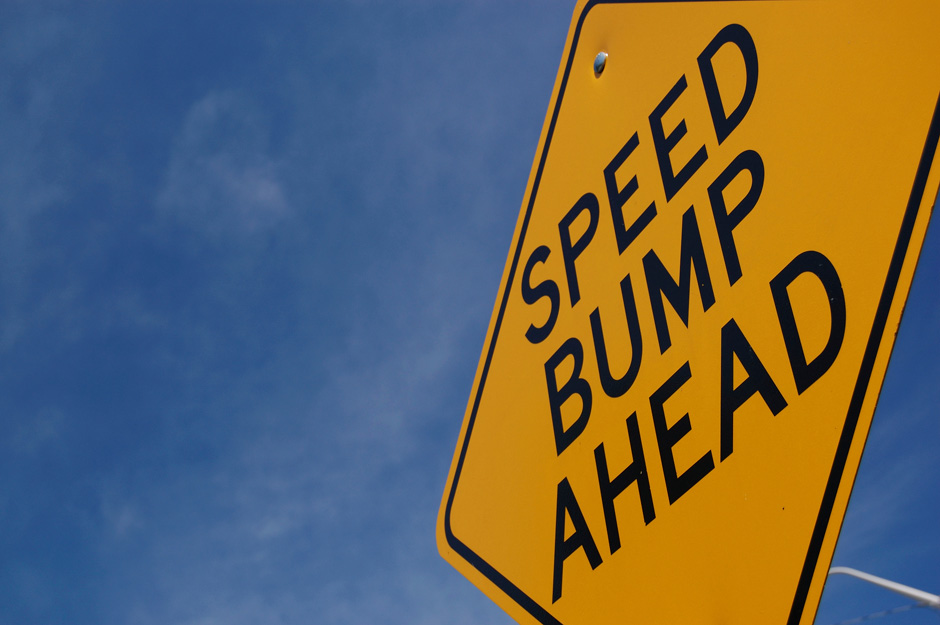
Speed bumps and walls…

…have a few things in common. Both force us to pay attention, slow down, and (sometimes) change course…

speed-bump-warning-sign

…have a few things in common.  Both force us to pay attention, slow down, and (sometimes) change course.  In many ways, speed bumps are merely walls that are short enough to get over with minimal effort.

Unlike speed bumps, walls are there to stop us, contain us, to protect something we’re not supposed to see, or maybe provide protection to something we don’t want others to see.

Is that nasty cold you have a speed bump or a wall?

How about the job you had until last week?  Is losing that job a speed bump or a wall?

Is the macro-economic forecast for 2% or less in U.S. Gross Domestic Product growth a speed bump or a wall?

Is bad weather (however you define the term bad) a speed bump or wall?

The death of a loved one?  Speed bump or wall?

The diagnosis you received from your doctor that has you wondering how long you have to live this life you love.  Speed bump?  Wall?

Meeting the person of your dreams and falling in love.  Speed bump or wall?  Surprise!  Good news introduces speed bumps and walls, just like bad news.  Of course, good news can also knock down walls.

When the news first hits, it almost always looks like a wall.  Only after further reflection, maybe some quiet meditation, a hard workout(s), discussions with our friends and family, enjoying a bowl of our favorite ice cream, watching some sunrises and sunsets, or all of these, do the walls start to look shorter.

As the walls lose their height, they may disappear from sight, or take the shape of speed bumps that we can handle.

Some walls are high and stay that way.  If we can’t climb over, we learn to change direction and find a way around.

What if we can’t climb over, can’t change direction, and the high walls continue to surround us?  Should we give up?

No way!

We build our expansive life inside the new walls and never drop our quest to escape…even if we have to dismantle the walls one brick (or chisel strike) at a time.

Do you remember that guy who gave up?  Neither can anyone else.  –Author Forgotten

Keeping the Wonder

Expertise means knowing. Knowing usually repels wonder…

In the beginning, before we’re experts, the following are easy questions to ask:

  • I wonder if this will work.
  • I wonder how this works.
  • I wonder who can help me if this doesn’t work.
  • I wonder what’ll happen when this works.

Once we become the expert, our expertise means:

  • This will work.
  • I know how it works.
  • I’m the one that people come to when it doesn’t work.
  • I’ve seen this work a million times, so I know exactly what’ll happen when it does work.

In the beginner’s mind there are many possibilities, in the expert’s mind there are few. –Shunryu Suzuki

Expertise means knowing.  Knowing usually repels wonder.

But, powerful things can happen when expertise is mixed with wonder, instead of being separated from it:

  • I wonder if there’s a better way to make this work.
  • I wonder if I can eliminate this entire step and get the same result another way.
  • I wonder who I can help learn more about how this works.
  • I wonder how my customer views the way this works.

The expert who keeps their wonder is willing to search for new ways, new answers, and even new questions, in a quest for continuous improvement.

That same expert might even wonder (pun intended) if their expertise can solve an entirely new set of problems.

True innovation is almost always impossible without its main ingredient:  wonder.

The more you know, the more you know you don’t know.  –Aristotle


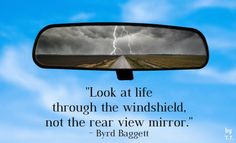
The Rear-View Mirror

Rear-view mirrors are nice, but the real action is in the opposite direction…

For years, I seemed to pick cars that were too short.  The rear-view mirrors were always right at my eye level.  At first, that sounds about right.  But, the mirrors actually blocked my view out the front windshield.

I had two choices:

Duck down and look under the mirror to see the road ahead,

or,

Remove the mirror.

Not wanting to scrunch down, or have to remember that what I could see was actually the view out the back window, I decided to remove the mirror from my view.

A bit drastic, but I was okay with it.  I could always use the side mirrors to see behind me.  Besides, I mostly used the rear-view mirror to scan for cops (it’s easier to spot their profile, or their lights, using the rear-view mirror).  Since I wasn’t in the habit of breaking laws, it wasn’t a big sacrifice to lose that wide-angle backward view.

Most of what I was interested in was in front of me anyway.  Removing the mirror let me stay focused on what was coming, rather than where I’d been.  Occasionally, I’d glance to the empty spot where the mirror used to be, mostly out of habit.

A habit born of the desire to glean value from where I’d been, but mostly to know if something was about to catch me.  It didn’t matter that I wasn’t doing anything worthy of being caught.  But, still, it was there.  The unknown pursuer.  The quick glance to the rear-view would help me see when it was coming.  It never was.

Fast-forward twenty years or so, and my car (actually a truck) is bigger.  The rear-view mirror doesn’t block my view out the front.  It provides a nice panorama out the back.  I don’t use it much (the side mirrors are still my go-to).  When I do use it, I’m not interested in seeing my pursuer.  I’m not as concerned about who may be back there (unless it’s a knucklehead weaving through traffic, ignoring everyone’s safety).

My rear-view mirror lets me quickly see where I’ve been, and that’s enough.  The real action is still in front of me, so I’m glad my mirror doesn’t block that view.

Otherwise, it would have to go.

Rear_View

There’s a crack in the gutter where a flower grows…

They’re not supposed to be there. It should be impossible for them to grow…

Pandora is awesome.  I was listening to my Happy Radio channel the other day when this song called Hey, Hey, Hey came on.  It had a catchy tune, and some of the words seemed nice when I chose to listen closely.  It was my first time hearing it, but I knew it had been around a while.

Somewhere in the middle of the song I hear:

There’s a crack in the gutter where a flower grows

Reminding me that everything is possible
Yeah, reminding me that nothing is impossible
You gotta live for the one that you love you know
You gotta love for the life that you live you know

Singing hey, hey, hey
No matter how life is today
There’s just one thing that I got to say
I won’t let another moment slip away

That got my attention.

How many times have you seen a plant (sometimes a weed, but that’s really in the eye of the beholder) growing out of a crack in the sidewalk, or the gutter?  How about the tree that figures out how to grow from within a cracked boulder?

They’re not supposed to be there.  It should be impossible for them to grow.  Yet, there they are.  Thriving in the most inhospitable of environments.

Each of us have the same ability to overcome adversity.  To be the flower growing in the crack in the gutter.  To grow and thrive in our little corner of the world, making a small but important difference to those around us.

Life is a journey, and it can be a struggle.  But, it’s also a triumph, and an opportunity to make our mark in places nobody (including ourselves) would ever expect.


Here’s the whole song…and, yeah, it’s been around since 2010.  Only took me five years to notice it (not good for my hipster cred):  Hey, Hey, Hey


Closing Your Eyes to See More Clearly

Have you ever tried brushing your teeth with your eyes closed, or in total darkness? I’m sure you’re asking, “How hard can that be?”

Have you ever tried brushing your teeth with your eyes closed, or in total darkness?  I’m sure you’re asking, “How hard can that be?”

Give it a shot and you’ll find out.

Would you be able to find the toothpaste?  How about your toothbrush?  The sink?  Now for the tough part.  Can you put the right amount of toothpaste on the toothbrush?

Maybe you mastered all of that, and even brushed the proper amount of time.  Are you sure you’re spitting in the sink?  Did you put the toothbrush back where it belongs?  How about the toothpaste?

You (should) brush at least twice a day.  Multiply that by your lifetime of days, and that’s a lot of practice.  Your brain should do it automatically…and it does until you eliminate one sense (sight in this case).  Then it gets a lot harder.

So hard that you may find all your attention focused on that one simple task.  For that moment, you will be fully present.  No distractions.  Only a laser focus on trying to figure out how to get the right amount of toothpaste on the toothbrush without making a mess.

Our brains are amazing.  The biggest consumer of calories within our bodies.  So, over millions of years of development, our brains have found ways to disengage (in the interest of energy conservation).  Once our brain establishes a pattern for an activity, it flips the “auto-pilot” switch and rests.

Think about all things you do in a day without thinking.  Or, maybe all the things you do while thinking too much.  What if you approached each one a little differently?

Commute to work a completely different way.  Shop in the opposite direction (admit it, when you go to “your” grocery store, you usually go in the same direction).  Put your shoes on starting with the other foot.

Put a penny next to your smart phone.  Pick it up instead of your phone when you get that urge to check your messages.  A penny for your thought.  Maybe you can give those pennies to a charity.  Since this is for your favorite charity, what if you put a $20 bill there instead?  That habit of yours may actually help someone else.

Which brings us back to the original premise.  Brushing your teeth in the dark.  Try it.  You just might see things a bit more clearly.


Here’s the kicker.  If you brush in the dark for about a week, it will become second nature to you, and (you guessed it) your brain will once again go on auto-pilot.  Time to switch it up again!


The Most Powerful Words of All

We can tell ourselves almost anything, and we will believe it. If we don’t believe at first, we can relentlessly work to convince ourselves. Remember, we’re in our head all the time…unfiltered!

“Sticks and stones may break my bones, but names will never hurt me.”

Why do parents teach this little quote to their kids?  Simple.  It’s a one-sentence philosophy that arms each of us against the words others may use to describe us, or worse, to tear us down.  We learn from this one sentence that words can’t hurt us.

As a philosophy, it works.  But, in practice, it misses a few points.

Words do matter.  They inspire, motivate, comfort, and create.  They also discourage, disappoint, frustrate, and destroy.

Certain words wield more power than all others.  The words we say to ourselves.

We can tell ourselves almost anything, and we will believe it.  If we don’t believe at first, we can relentlessly work to convince ourselves.  Remember, we’re in our head all the time…unfiltered!

We each have a personal stream of consciousness that narrates our perspective of what’s “really” happening around us, and to us.  It’s this continuous chatter of self-talk in our head that drives everything we feel, and everything we do.

The words in our self-talk carry all the power, regardless of what’s happening around us.  Imagine you’re a golfer.  A professional golfer.  Maybe the best golfer in the world.  You’ve won major tournaments this season.  You’ve outclassed the entire field.  And yet, you aren’t satisfied with your results, because they should have been better.  You finished second a few too many times this season to let yourself really celebrate your success.

Why?  Negative self-talk.  Your self-talk is telling you that you aren’t good enough.  You don’t deserve all the accolades coming your way.  You tell yourself that your short game needs to get a little better if you expect to win again.  Each mistake you make is amplified in your head as yet another reason you shouldn’t win.  So you stop winning.

Negative self-talk has nothing to do with reality.  It only robs energy and happiness.  Positive self-talk has nothing to do with reality.  It only brings energy and happiness.  The reality you perceive, the reality you create, and the way you will ultimately live your life are each dictated by your self-talk.

The words we say to ourselves can and will hurt us.  Or…they can lift us, propel us, and bring us happiness.

We get to choose.

“Whether you think you can, or think you can’t.  You’re right.”  –Henry Ford

Spare Me Your Bad PowerPoints

If we get a conversation going, don’t worry if we don’t get through all the slides you brought. The conversation is the thing, not your presentation…

I thought the days of bad PowerPoint presentations were over.  I thought the 100’s (1,000’s?) of articles and posts about avoiding Death by PowerPoint were enough to stop the madness.  I was wrong.

Recently, I’ve been on the receiving end of a steady flow of bad PowerPoints:

  • The 37-slide(!) monstrosity that doesn’t know what it’s trying to say, so it just drones on with countless photos, graphics, and three-letter-acronyms (TLA’s) in a futile attempt to baffle the audience
  • The same 37-slide deck that starts off with three or four slides telling me how I’m an awful human being because I’m a businessman, and then expects me to continue watching the remaining 30-plus slides
  • The 15-slide deck that starts with a quirky animation of the title page, and brings in sound effects on slide four, that have nothing to do with anything…other than showing-off the presenter’s awesome skills with PowerPoint
  • The 10-slide deck that had a series of graphs and charts that might be making a point, but that point is obscured by the blizzard of graphics
  • Slides that have seven bullet points with multiple sentences per bullet point.

I could go on, but I’ve probably lost you already…

Here’s some key points to remember for your PowerPoint presentation, especially if you’re selling me something like an idea, a product, or a service…in other words, anything (in no particular order):

  • Less is more. My attention span is pretty short.  You’ll start losing me by about slide five.  I’m totally checked out by slide seven, and I’m thinking about all the other things I could be doing by slide ten.
  • Slides should have no more than 4-5 bullets, and no more than 4-5 words per bullet. Want more words or bullets?  Put them in the appendix, or give me a one-two-page note that has all the words.  That way I’ll have something I can file with all the other stuff I’m not reading.
  • Statistics, photos and graphics?   I should be able to fully understand their meaning in 10 seconds.  If you get this right, you can make a huge impact.  Get it wrong, and you lost me…maybe for good.
  • Got any slides where you’ll have to show me around for a while to help me understand you and your message? Dump them.  I don’t have the patience for you to show me around your slide.  I should fully understand your slide in 10 seconds.
  • Please know why you’re showing me your presentation. What’s your point?  What do I need to know?  What action should I be taking?  Why?  Get to it quickly.  Think elevator pitch.
  • If we get a conversation going, don’t worry if we don’t get through all the slides you brought. The conversation is the thing, not your presentation.

Pique my interest, and get me asking questions.  Create a conversation, and maybe your presentation will lead us to something great.

Otherwise, I’ve already forgotten what you were presenting and why it mattered.

What’s Not to Love about Carrot Cake?

They called it carrot cake, but this cake was a lot more than carrots, and it was awesome!

I had my first piece of carrot cake in 1974, or maybe it was 1973.  We were at my uncle Denby’s wedding, and the cake they served was this oddly wonderful concoction of flavors I had never tasted.  Being one of the munchkins in the crowd, I did what smart munchkins did back then:  I eavesdropped on the adults who were talking about the cake.

They called it carrot cake, but this cake was a lot more than carrots, and it was awesome!

I don’t remember having carrot cake again until college.  I may have had it before then, but those memories are lost in a din of other information like the capital of North Dakota, the difference between an adverb and an adjective, why the earth rotates around the sun and not the other way around, and who shot J.R (we watched that episode with a huge crowd of Hilltoppers in a hotel bar in Rosarito Beach, but that’s another story).

Whenever I see carrot cake as a dessert option at a restaurant, I order it.  Carrot cake muffin?  Gotta have it.  I’ve sampled carrot cake recipes across the US, and even a couple in foreign countries.  Some are decent.  Claim Jumper’s is probably the best, especially with a scoop of vanilla ice cream (everything is good with a scoop of ice cream).

When the time came to choose our wedding cake, Janet and I chose carrot cake.  Actually, I think Janet knew I’d love it, and it was her small wedding gift to me.  The only bite of that cake I got that day was in the cake-cutting ceremony.  We were too busy with all the other wedding stuff to actually eat any of the awesome cake we’d chosen.

As good as everyone else’s carrot cake is, none come close to mom’s.  Mom’s is the only carrot cake that captures the awesomeness of my first carrot cake experience in the ‘70s.  It’s simply the best.

Unfortunately, my love affair with all things carrot cake came to a screeching halt a little over a year ago when I was diagnosed with gluten intolerance.  Someone asked me recently what I miss the most now that I basically can’t eat anything made with wheat, or containing gluten as an additive (it’s hidden in tons of sauces, dressings, and of course, beer).

The first thing that popped into my head was carrot cake.  It’s not that I miss the taste of carrot cake so much (but, really I do).  It’s the freedom to try everyone’s attempt at carrot cake…knowing that none will compare to mom’s.  I miss getting to have a huge slice of carrot cake at mom’s, and then getting to take about half of the cake home (since it’s not everyone else’s favorite) to enjoy every night for a week.  There’s nothing like a slice of carrot cake and a tall glass of milk after a hard day of whatever I did that day.

Thanks to gluten intolerance, I thought those days were gone.  Not so fast!

Turns out there’s an excellent gluten-free “all-purpose flour” available at Trader Joe’s.  What’s the first thing I thought of when I saw it?  You guessed it!  I need to get mom a couple pounds of this stuff so she can make some of her carrot cake with it, just in time for my 49th birthday!

We are about t-minus one hour from heading over to mom and dad’s to celebrate the September birthdays in our family (there are a bunch of them).  We’ll eat some barbecued steaks with all the trimmings.  But, more importantly, we’ll be trying the gluten-free carrot cake that she and my niece baked.  I’ve heard that it’s pretty good.

I know it will be awesome.  Why?  Mom (and my niece) made it, and that’s all that matters.