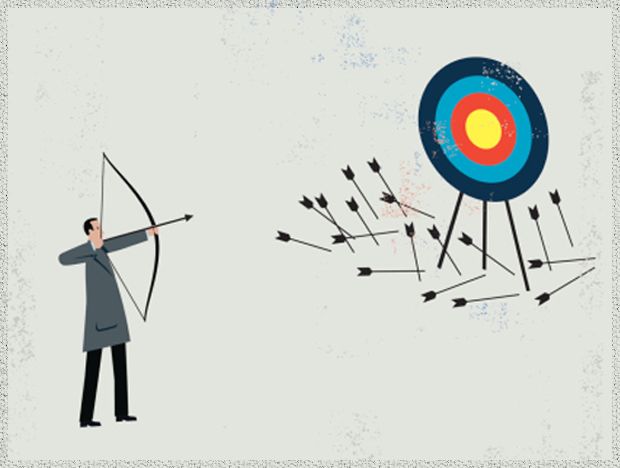
Are You Really Outside Your Comfort Zone?

When you find yourself outside your comfort zone, what’s your goal?

ComfortZone

In the 80’s, the message was, “Dress for Success.”  Dress at least one level up, make a great impression, get promoted.  The concept focused on impressing the gatekeeper (your boss, or your boss’s boss), moving up, achieving success.  “Upwardly mobile” was a phrase people used to describe themselves.  Inherent in this approach was the thought that your success was dictated by how far up you climbed in one organization.

In the 90’s, the message was, “Be nimble, move fast, deliver quality.”  Tom Peters really came into focus in the 90’s with his thoughts on the “nanosecond” 90’s.  Big companies needed to find ways to “bob and weave,” to adjust to the ever-changing market dynamics.  We all searched for ways to shift paradigms, boost quality, and invent new ways of streamlining processes.

One by-product of this nimble and fast-moving behavior was rapid employee movement.  Corporate downsizing, upsizing, and reorganizations, along with an even faster corporate merger and acquisition pace, made remaining in one organization for a lifetime as remote as winning the lottery.

Dress for Success was out.  Upward mobility was out.  The era of the entrepreneur was upon us (even though it had been with us since the dawn of civilization).  The corporate version, the “intrapreneur,” became a big thing.  This was the person in the meeting who was slightly quirky, a bit edgy and imaginative, and didn’t mind “poking the bear” a bit.  He or she operated with a flair that the corporate mindset both embraced and slightly feared.  This was the person that would help the corporation remain relevant in the face of fast-moving competition, but might upset the apple cart along the way.

Somewhere in the late 90’s or early 2,000’s I started hearing that we should “think outside the box.”  “Think Different” became Apple’s calling card.  It was only that type of thinking that would yield meaningful results.  Anything else was just window dressing, or “lipstick on a pig.”  Look at the top 10 companies in terms of market value (both public and private) and it’s hard to argue with this sentiment.

But, even those “renegade” companies struggle to stay “different” over the long term.  What once seemed new, even revolutionary, becomes the new norm.  Soon, there’s a clamor for the next version, the new invention, the new product, the next “thing.”

What’s the answer to all of this?  Organizations and entrepreneurs try to operate “outside of their comfort zone.”  Yeah!  That’s the ticket.  If we can get everyone pushing outside their comfort zone, maybe that will result in something different, and cajole some new ideas into fruition.

But, the truth is that none of us like it outside our comfort zone.  Most companies and shareholders prefer their comfort zone as well.

We constantly seek our comfort zone, even as we talk about pushing ourselves outside of it.  If we happen to venture out and actually operate for a while in the hinterlands, our deep subconscious goal is to regain our footing, by seeking approval or acceptance of our crazy ideas back in the comfort zone.

We may get used to operating in a new zone and call that our new comfort zone…but, it’s still our (new) comfort zone.  This is one definition of progress.

People have varying perspectives on what’s comfortable.  The free climber is happiest and most “alive” when climbing a 3,000-foot rock face without ropes.  Another person’s comfort zone is speaking in front of a large audience.  Still another person’s idea of comfort is analyzing reams of financial data about the performance of their company.

What is your comfort zone?  When are you the most at ease?

What are you doing to operate outside that zone?

When you find yourself outside your comfort zone, what’s your goal?  To return to the safety of the comfort zone, or to extend your reach to an even more uncomfortable spot?

Look closely and be honest with yourself.  You’re probably spending most of your time inside your comfort zone or trying to find your way back there.

It’s up to you to determine whether this is okay, or not.


The Questions We Ask When Someone Dies Are the Wrong Ones!

The questions we ask when someone dies miss what really matters…

  • How old was he?
  • How did he die?
  • Did he suffer at the end?
  • Was his family with him?
  • Various versions of:  Who is he leaving behind?  How are they doing?

These are all worthwhile questions.  They show how much we care.

They also provide a small glimpse into our future, and the future of the people we love and care about.  We will each take our final breath someday.  It’s just a question of when and how.

These questions do more to quench the morbid curiosity we have about our own future than to learn about the life of the person who just died.

We used to receive a local monthly newspaper.  I was always fascinated by the stories in the obituary section.  Each person had a story.  An arc through time.  Milestones.  Achievements.  Lives they touched.  But, these were merely stories someone else had written to encapsulate an entire lifetime into a few paragraphs of highlights.

It’s impossible to capture someone’s life in a few paragraphs or even an entire book.

Our lives aren’t just a series of events and milestones.  They’re an almost infinite collection of moments.

Moments that often seem trivial when they happen, but are anything but trivial.  These moments would probably never make the “highlight reel.”  These are the moments that (with the benefit of hindsight) are turning points in our life, and the lives of the people we touch.

Our lives are also a feeling.  An energy.  An impression we leave behind.  It’s not tangible, and it can’t be seen or touched.  But, it touches everyone around us.  It’s something they can only describe with a far-away look in their eyes when we’re gone.

The questions we ask when someone dies miss what really matters.

I’d like to add some new ones:

  • What are the moments you shared with him that you remember most?
  • What stories did he tell you?
  • Which stories had the most impact on you?
  • How did he make you feel when you were around him?
  • How did he impact the direction your life is going?
  • What did you learn from him and the way he lived his life?
  • What type of energy did he bring to your life?
  • What impression did he make on you?
  • What comes to your mind whenever you think about him, now that he’s gone?

And, one final question to consider while we’re still here:

How will those that you love and care about answer these questions after you’re gone?


“I’m bored!”

Our little crew had a solid plan every day…

“Thems was fightin’ words” in our house when I was a kid.  If mom ever heard us utter those two words, she had a list of things for us to do.  We learned quickly to find things to do for ourselves, since mom’s list was definitely not a fun list (toilets, folding clothes, raking leaves, etc.).

I remember one summer, probably the one between 7th and 8th grade.  Our little crew had a solid plan every day.  It usually involved taking a mid-day “break” to watch Get Smart at Denis’ house.  I’m pretty sure they ran two episodes, back-to-back.  So, that took care of about an hour of entertainment.  The rest is a blur of football games, hide-and-seek, swimming at Marty’s, riding bikes, and just about anything else that would keep us from having to say, “I’m bored.”

I suppose it’s all those years of training, followed by “advanced” training in college, and then even more in the work environment.

Stay busy.

Keep moving.

There’s always something to be done.

Don’t be lazy.

If you aren’t busy, you better at least look busy.

Where’s your work ethic?

Aren’t you dedicated to this cause?

Focus on the task at hand!

Don’t be boring (even worse than being bored)!

Somewhere along the way, a lack of movement, or a completed task list, started to equate with the dreaded “b” word.  Somehow, a lack of movement turned into an example of laziness.

Is it even possible to do nothing and be at peace with it?  Or, do we have to tell ourselves that this momentary lack of movement is just a quick break before returning to another of life’s endless tasks?

When did doing nothing go from being a peaceful state to one of guilty boredom…or worse, an example of our laziness?  When did life become a task list?

The next time I’m faced with the challenge of doing absolutely nothing, I hereby promise myself that I won’t be bored (or guilty about my laziness).

I will enjoy the peace of that moment with gratitude.

What’s next? (just kidding)


Self-Talk

Consider the amazing power that something quieter than a whisper (the silence of our own thoughts) has over each of us.

It’s not what you say out of your mouth that determines your life.  It’s what you whisper to yourself that has the most power. –Robert T. Kiyosaki

The first person to give you feedback is yourself…in the form of self-talk.  You have 24/7 access to your internal talk track.  Your messaging is unfiltered and brutally honest.

Does unfiltered and honest mean accurate?  Does it mean valuable?  Not necessarily.

The truth is that no matter how incorrect your self-talk is, or how much you try to ignore it, you are your most trusted advisor.  You have the most power over yourself (for better or worse).

Negative self-talk is easy.  Bad news travels fast, especially when it doesn’t have to travel.

Positive self-talk is harder, and sometimes difficult to believe.  Our positive self-talk can sound a bit crazy, which makes it easier to discount.

Status quo is powered by doubt in our positive self-talk.

The most successful people I know face challenges with self-talk.  They happen to believe their positive self-talk just a little more than the negative.

The negative is right there, trying to hold them back.  Somehow they’ve found a way to focus on the positive, finding ways to push past their wave of doubt.

They’ve usually found kindred spirits who can help strengthen their positive self-talk.  A support network that reinforces their crazy ideas.  The best support network doesn’t fully buy-in to the crazy.  They merely create an environment where it’s okay to explore the crazy.  To bring it out in the open and let it breathe a little.

And, that’s the real secret of self-talk.  We all have negative and positive self-talk rolling around in our heads.  But, if we can allow the positive to get a little breathing room, that’s usually all it takes to win the internal battle against the negative.

Here’s the challenge:  The war between negative and positive is never over.  You have to win it one battle at a time.

Note to Self

I will do these things as a promise to myself…

Maybe it’s all the close calls, existential threats, newly-invented liabilities, newly-minted regulations, new competitors, old competitors, angry customers, happy customers, former customers, new customers, potential opportunities, new ideas, new methods, better mouse traps, and everything else that comes our way in business (no matter the size).

Maybe it’s the fight-or-flight instinct that gets honed to a fine edge through years of experience.  Knowing when to hold ‘em, and when to fold ‘em…but always allowing room for doubt.  Knowing when the silent customer is more important than the loudest one.  Knowing that the employee you don’t see is just as important as the one you do see.  Knowing we always have a competitor, whether we realize it or not.

Maybe it’s that standard defensive posture that every business assumes at times, even when it knows that only a strong offense will win the day.  Understanding that this isn’t a game we get to win every day.

Maybe it’s just fear of failure, or more likely, fear of success.

Whatever it is that stops me from getting the most enjoyment from this business…now is the time to let it go.

Life is way too short to let the small stuff get in the way.

Here’s my promise to myself:

  • I will go on offense, every day
  • I will acknowledge my fears, but only if it helps create a stronger offense
  • I will focus on the next step forward, and let the past remain there
  • I will create opportunities for those around me
  • I will love and serve
  • I will let go
  • I will enjoy each day as the gift that it is.

I will do these things as a promise to myself, knowing that I’m not the One who is in control.

The Puzzles We Build

In our house, whenever we started a puzzle, it was an “all-hands-on-deck” affair…


jigsaw-puzzle_pieces

When was the last time you assembled a puzzle?

Did you do it yourself, or did you have help?

How long did it take to assemble?  Minutes?  Hours?  Days?

In our house, whenever we started a puzzle, it was an “all-hands-on-deck” affair.  We’d all start working it.  Some of us would focus on organizing the pieces to make them visible.  Others would dive right in and start putting pieces together.

I worked the edges.  It’s the only thing that helped me get my bearings on the puzzle.  Start with the flat sides and establish a border…then work into the middle.  Working from the middle, out, was way too random for me.

“Hey, does anyone want some hot chocolate?” always seemed like a good question for me to ask after about a half-hour of diligent work.  With marshmallows.  Without looking up, I’d get some slow yesses and a few grunts.  By the time I came back with the hot chocolate, I was always amazed at the progress.

I’d get back to working the edges.

Each of us had our specialty and our own pace.  Some of us were easily distracted (me).  My wife would stay focused for hours…one piece at a time.

“Hey, who’s up for a break from the puzzle?  Maybe we can hit it again in a couple of hours with fresh eyes.”  I was always a proponent of fresh eyes.

But, then we’d get most of the edges completed.  I’d get my own personal rhythm, and I could start to see the patterns.  The puzzle started to take shape.  First, in my mind and then on the table.  My perspective on the puzzle and my ability to add value to it changed as the image emerged from all the pieces.

I don’t know if my wife and daughters (or anyone else who’d stop by and get sucked into the assembly project) went through the same evolution in their perspective as I did.

Our latest puzzle is a new business (actually, an existing business that we recently purchased).  Once again, our family is building a puzzle together.  This time, it’s not at the dining room table with a clear picture of the final product.  In fact, new pieces are being added to this puzzle all the time.

Once again, we’re each approaching the puzzle in our own way.  Center-out.  Edges-in.

Distractions?  Definitely.

Is an image beginning to emerge?  Yes.

The best (and most challenging) aspect of this puzzle is that it’s never finished.  It grows and evolves.  It occasionally leaves us feeling a bit perplexed.  But, it also takes beautiful shape before our eyes as we continue to build, one piece at a time.

Anyone up for some hot chocolate?  We’re gonna be here a while!


Speedometers Steal Speed

“The cheetah is the fastest animal on earth.  It can reach speeds of up to 65 miles per hour as it pursues its prey.  Just look at its awesome speed, as it chases down that gazelle!” – Every Nature Program about Cheetahs

Do you think the cheetah has any idea how fast he’s going?

What about an eagle as it dives through the air to reach its prey?

Does the pelican think about his speed as he dives into the water to catch dinner?

Does the pole vaulter know how fast she’s running just before her jump?

What about the downhill mountain bike racer?

The answers to these questions are obvious.  For each to be effective, none are looking at a speedometer to determine their next move.  They aren’t referring to some magical heads-up-display to tell them how they’re doing.

In their critical moment, no measurements or brilliant strategic insights will impact the outcome.  They will succeed or fail based solely on how they perform, in the next moment.

The moment is all that matters.

Speedometers don’t make speed.  They provide external feedback and nothing else.

How often are you slowing down to check your speedometer, instead of focusing on your next critical moment?

Truth is, your moment is all that matters.  There’s plenty of time for feedback later when it’s not stealing your speed.

Microwaves and Slow Cookers

Ever burn popcorn in the microwave? If so, you know how quickly it can happen…

I recently heard someone make reference to their art not being microwaved.  Their art is the kind that comes from a slow-cooker.

An interesting concept.

The food (or drink) that we place in a microwave is already mostly prepared.  We aren’t interested in the process.  We just want it to be hot, and we’ve relied on someone else to handle the actual work of preparation.

With the slow cooker, it’s up to us.  We choose the ingredients.  We do the preparation.  Separately, the ingredients just sit there…waiting to be part of something.  But, blended properly, with the right amount of time and heat (energy), those separate ingredients (hopefully) combine to create something unique and tasty.

The microwave measures its cooking time in 30-second increments.  Hot dogs wrapped in a damp napkin take about a minute.  Popcorn takes three to four minutes.  Organic brown rice from Trader Joe’s takes four minutes.

Slow-cooking time is measured in hours.  Six hours is usually too short.  Eight to ten hours gets it right.

And, what about the accompaniments?  With a microwave cooking cycle, there’s only time to get your plate ready, find a clean fork, and maybe pour a glass of your favorite beverage.  Linear and task-focused.

Slow-cooking provides time for the cook to consider what goes best with the main dish.  What shall we have for dessert?  Would a loaf of fresh French bread go well with this stew?  The fullness of the dining experience is in play.

Neither method is perfect.

Ever burn popcorn in the microwave?  If so, you know how quickly it can happen.  Something so simple becomes a lump of smoking charcoal.

Slow-cooking disasters are equally possible.  Your reward for that ten-hour wait may be something that’s not even edible (at least for anyone who has taste buds).

Both methods have their place.  Both carry risk.

The question is how are you deciding which parts of your life to microwave, and which parts to slow-cook?

A tougher question might be:  Are you making the choice, or allowing someone else to make the choice for you?

Relax, You’re Doing Fine

Enjoy your time. Let someone else worry about all that other…

I saw this on a license plate frame.  When I first saw it, I didn’t give it much attention.  Then, as I sat at the red light, staring at those four simple words, I realized how freeing they are.

Relax, you’re doing fine.

You aren’t as far behind as you thought in the “race” of life.  In fact, life isn’t a race at all.  There’s no prize at the end for getting to the finish line faster than the other people.

You’re living in a great time.  Why is it so great?  Because it’s your time.  It doesn’t matter what else is happening.  The fact that things are actually happening, and you are here to see, participate, and have an impact is all that matters.  What impact?  That’s up to you.

What you do, how you do it, and the pace you choose are up to you.  I recommend you take advantage of your limited time on the planet.  Start moving, stay moving, always learn, and never stop teaching.  But, that’s just me.  It’s up to you and no one else.

Not as happy as you’d like to be?  Not as fulfilled as you’d like to be?  Worried that life is passing you by?  Worried that you aren’t as rich, pretty, strong, tall, smart, stylish, successful, or any other measure society places on us, as you’d like to be?

We all have the same seconds, minutes, and hours every day.  Our ability to define our time by the people we help, and the smiles we coax into the world are the only things we control.  The rest is going to happen with or without our involvement.

Enjoy your time.  Let someone else worry about all that other comparison stuff.

And, never forget:  Relax, you’re doing fine.

Failures have excuses…Successes have stories

The unfortunate truth is that some of us start making excuses long before the failure is complete…

unsplash_Samuel_Clara

The excuse:  “We were in trouble right from the start.  We started in the dark and two of our headlamps wouldn’t work.  It started raining as we approached the halfway mark.  The mud really slowed us down.  Then, Jeremy slipped and fell and muddied up all his gear.  We knew we couldn’t make it to the summit and back before sunset, so we decided to turn back.”

The story: “That hike was epic!  We started in the dark.  We had to share John’s headlamp because ours stopped working for some reason.  When the sun finally came up, it started raining.  Hard.  The mud made for slow going.  When Jeremy fell in that massive mud puddle, we just cracked up, wondering what else this hike would throw at us.  It took about ten minutes to get him cleaned up.  Once the storm passed, we had to double-time it to make it to the summit before dark.  We got there with plenty of time to spare.  It was awesome!”

The excuse:  “There was no way we could have made the goal.  The economy turned sour on us in the second quarter.  Some bozo from IT botched the server install, and it took nearly two months to get everything configured properly.  That didn’t leave enough time for the developers to deliver on schedule.  All in all, it’s amazing we’re still in business.”

The story:  “Can you believe it?  We were pulling all-nighters for weeks because some bozo from IT botched our server install.  But, we made the release date.  Customers loved it, and we hit our sales target.  Nobody thought that could happen in this economy.”

Have you ever noticed that failures have excuses, and successes have stories?

The unfortunate truth is that some of us start making excuses long before the failure is complete.  We run into a hurdle, lose our belief in the goal, or simply lose hope that we can achieve success.

So, we get busy preparing excuses.

Our failure must be justified.  First to ourselves, and then to everyone else.  It’s even better if we can find allies to help us create better excuses.  Excuse making often replaces the work that just might deliver success.

Are successes perfect?  Far from it.

Success rarely comes without adversity.  Success usually requires new tactics, mid-course corrections, and tons of hard work.  Overcoming the odds, leaping over the hurdles, finding creative solutions…these give power to the stories we tell about our success.

Imagine a world where adversity strengthens our success stories, rather than bolstering the excuses we make for our failures.

“If it is important to you, you will find a way.  If not, you will find an excuse.”  -Author Unknown

p/c: Unsplash.com, Samuel Clara