Note to Self

I will do these things as a promise to myself…

Maybe it’s all the close calls, existential threats, newly-invented liabilities, newly-minted regulations, new competitors, old competitors, angry customers, happy customers, former customers, new customers, potential opportunities, new ideas, new methods, better mouse traps, and everything else that comes our way in business (no matter the size).

Maybe it’s the fight-or-flight instinct that gets honed to a fine edge through years of experience.  Knowing when to hold ‘em, and when to fold ‘em…but always allowing room for doubt.  Knowing when the silent customer is more important than the loudest one.  Knowing that the employee you don’t see is just as important as the one you do see.  Knowing we always have a competitor, whether we realize it or not.

Maybe it’s that standard defensive posture that every business assumes at times, even when it knows that only a strong offense will win the day.  Understanding that this isn’t a game we get to win every day.

Maybe it’s just fear of failure, or more likely, fear of success.

Whatever it is that stops me from getting the most enjoyment from this business…now is the time to let it go.

Life is way too short to let the small stuff get in the way.

Here’s my promise to myself:

  • I will go on offense, every day
  • I will acknowledge my fears, but only if it helps create a stronger offense
  • I will focus on the next step forward, and let the past remain there
  • I will create opportunities for those around me
  • I will love and serve
  • I will let go
  • I will enjoy each day as the gift that it is.

I will do these things as a promise to myself, knowing that I’m not the One who is in control.

The Puzzles We Build

In our house, whenever we started a puzzle, it was an “all-hands-on-deck” affair…


jigsaw-puzzle_pieces

When was the last time you assembled a puzzle?

Did you do it yourself, or did you have help?

How long did it take to assemble?  Minutes?  Hours?  Days?

In our house, whenever we started a puzzle, it was an “all-hands-on-deck” affair.  We’d all start working it.  Some of us would focus on organizing the pieces to make them visible.  Others would dive right in and start putting pieces together.

I worked the edges.  It’s the only thing that helped me get my bearings on the puzzle.  Start with the flat sides and establish a border…then work into the middle.  Working from the middle, out, was way too random for me.

“Hey, does anyone want some hot chocolate?” always seemed like a good question for me to ask after about a half-hour of diligent work.  With marshmallows.  Without looking up, I’d get some slow yesses and a few grunts.  By the time I came back with the hot chocolate, I was always amazed at the progress.

I’d get back to working the edges.

Each of us had our specialty and our own pace.  Some of us were easily distracted (me).  My wife would stay focused for hours…one piece at a time.

“Hey, who’s up for a break from the puzzle?  Maybe we can hit it again in a couple of hours with fresh eyes.”  I was always a proponent of fresh eyes.

But, then we’d get most of the edges completed.  I’d get my own personal rhythm, and I could start to see the patterns.  The puzzle started to take shape.  First, in my mind and then on the table.  My perspective on the puzzle and my ability to add value to it changed as the image emerged from all the pieces.

I don’t know if my wife and daughters (or anyone else who’d stop by and get sucked into the assembly project) went through the same evolution in their perspective as I did.

Our latest puzzle is a new business (actually, an existing business that we recently purchased).  Once again, our family is building a puzzle together.  This time, it’s not at the dining room table with a clear picture of the final product.  In fact, new pieces are being added to this puzzle all the time.

Once again, we’re each approaching the puzzle in our own way.  Center-out.  Edges-in.

Distractions?  Definitely.

Is an image beginning to emerge?  Yes.

The best (and most challenging) aspect of this puzzle is that it’s never finished.  It grows and evolves.  It occasionally leaves us feeling a bit perplexed.  But, it also takes beautiful shape before our eyes as we continue to build, one piece at a time.

Anyone up for some hot chocolate?  We’re gonna be here a while!


Relax, You’re Doing Fine

Enjoy your time. Let someone else worry about all that other…

I saw this on a license plate frame.  When I first saw it, I didn’t give it much attention.  Then, as I sat at the red light, staring at those four simple words, I realized how freeing they are.

Relax, you’re doing fine.

You aren’t as far behind as you thought in the “race” of life.  In fact, life isn’t a race at all.  There’s no prize at the end for getting to the finish line faster than the other people.

You’re living in a great time.  Why is it so great?  Because it’s your time.  It doesn’t matter what else is happening.  The fact that things are actually happening, and you are here to see, participate, and have an impact is all that matters.  What impact?  That’s up to you.

What you do, how you do it, and the pace you choose are up to you.  I recommend you take advantage of your limited time on the planet.  Start moving, stay moving, always learn, and never stop teaching.  But, that’s just me.  It’s up to you and no one else.

Not as happy as you’d like to be?  Not as fulfilled as you’d like to be?  Worried that life is passing you by?  Worried that you aren’t as rich, pretty, strong, tall, smart, stylish, successful, or any other measure society places on us, as you’d like to be?

We all have the same seconds, minutes, and hours every day.  Our ability to define our time by the people we help, and the smiles we coax into the world are the only things we control.  The rest is going to happen with or without our involvement.

Enjoy your time.  Let someone else worry about all that other comparison stuff.

And, never forget:  Relax, you’re doing fine.

The Vocabulary of Christmas

MerryChristmas

I’m fascinated with the way our vocabulary morphs as we approach Christmas.  Consider how often you hear these words other than this time of year:

Jingle Bells

Rudolph

Reindeer

Santa

Elves

Cinnamon Sticks

Tidings

Nutcracker

Jack Frost

Mulling Spice

Christmas Island

Jolly

Jack Frost

Snowman

Stockings

Baking

Chestnuts

Trimmings

Joy

Twinkles

Tinsel

Sugarplums

Merry

Noel

Caroling

Village

Christmas Tree Lot

Chimney

Crèche

Gingerbread

Frankincense

Welch Cakes

Wishes

Myrrh

Fruitcake

Holly

Manger

Nativity

Goodies

Home (as in “for the holidays”)

Frightful (as in the weather outside)

North Pole

Workshop

Ornaments

Traditions

Partridge

Cornish Pasties

Poinsettias

Rejoice

Scrooge

Sleigh

Wise Men

Yuletide

These words trigger great memories, but none would matter without family and friends to make them special.

May we each create wonderful new memories with our family and friends this Christmas season.

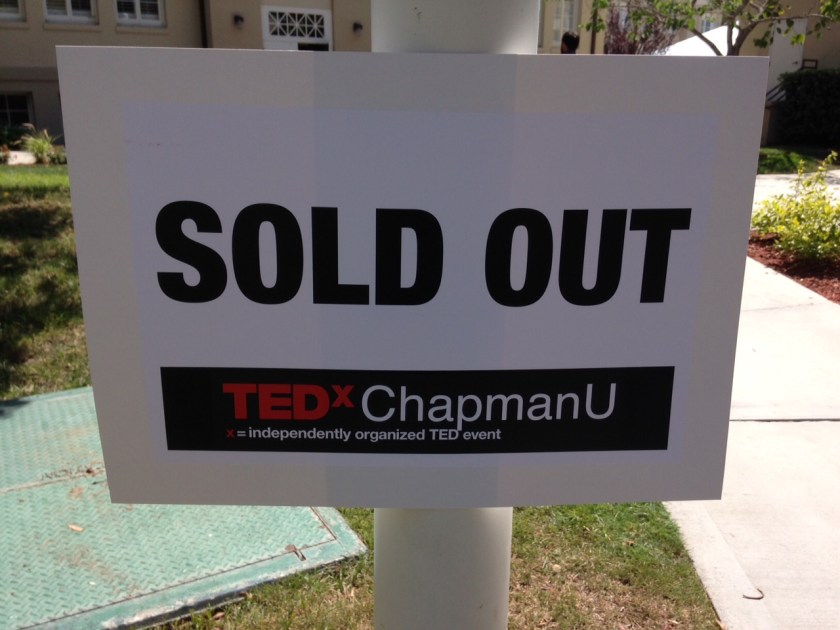
TEDx ChapmanU–August 20, 2015

Be curious. Open your mind. Challenge yourself to listen and learn. Respectfully explore new perspectives. Discover your own inner Icon\Genius\Maverick.

Great advice in any setting. Prerequisites for attending a TEDx event….

TEDxSoldOut

Be curious. Open your mind. Challenge yourself to listen and learn. Respectfully explore new perspectives. Discover your own inner Icon\Genius\Maverick.

Great advice in any setting. Prerequisites for attending a TEDx event.

Here’s a summary of this year’s talks:

Stella Young—I’m not your inspiration, thank you very much. Stella was born with a disability that limited her growth, and confines her to a wheelchair. Is it difficult being disabled? Yes. Is she special because she’s disabled? She doesn’t think so, and her goal is that you won’t either.

Stella told a story that happened when she was about thirteen. Her parents received a call from a representative of their town council saying they’d like to give Stella an award for her community achievements. That was puzzling to her parents (and her), since she hadn’t really achieved anything for the community. She was more interested in watching Buffy the Vampire Slayer, and Dawson’s Creek than actually doing anything for someone else.

The real reason for the award was that she was disabled and could be an inspiration to others. But that’s just it. She says that being disabled shouldn’t be something special, or an inspiration. After all, isn’t the inspiration we feel based upon the silent (and instant) comparison we make to that disabled person’s difficulty…and our relief that it isn’t us? By comparing ourselves to someone we think should have lowered expectations, we give ourselves permission to have our own higher expectations, at their expense.

Stella can’t wait for the day when being disabled isn’t special: the day when we take our inspiration and lessons from the good within people, whether they’re disabled or not.

Dan Pallotta—The way we think about charity is dead wrong. How much should a charity spend on fundraising? How much overhead should they have? Is it better to have a bake sale and raise $375 with no overhead, or spend $350,000 to produce an event that raises $5,000,000? If you’re an MBA graduate, should you go to work at a for-profit company, or a non-profit?

Dan says the way we approach these questions, and the ethical standards we put on charities and non-profits, is shackling them and reducing their ability to grow. We should be focused on what they are raising, how successful they are at providing their services, and not their overhead rate.

He provided a number of examples of the ways we apply different standards to for-profits, compared to non-profits. And yet, for all the advantages that for-profit organizations have in terms of access to capital, access to talent, permission to make mistakes, and their ability to focus on growth; they are not equipped or motivated to provide the type of assistance (economic and otherwise) that’s required in the lowest 10 percent of our society. Philanthropy is the marketplace for love. We need a robust and well-funded non-profit community to meet the very real needs of those less fortunate.

To get there, we need to upend the way we think about non-profits. We need to remove the shackles and give them the room they need to grow and succeed.

Mina Morita. What you value is defined by what you risk. Mina’s mom risked everything to come to America from Japan when she was 20. Mina gave up her corporate job to pursue her love of theater. Through many twists and turns, she is now the Artistic Director of Crowded Fire Theater. She’s fulfilled and happy. Not because her life is perfect. It’s fairly messy.

She gets to tell stories and create unique moments that can only happen in theater. Theater fulfills dreams. It’s a place where failure and judgment are in the flesh…every night. She has missed a lot of life’s joys, sacrificed special moments with family and friends. But, she’s happy because her life is what she wants it to be. What you value is defined by what you risk.

Brian Vellmure. Brian is a management consultant, but his talk wasn’t about that. It was about how to prepare our next generation for the challenges that lie ahead. What does he recommend? Team sports and adventure travel.

Team sports show us how to work with others, how to rise to a new challenge, how to go beyond what’s expected. Most importantly, team sports show us how to respond and bounce back from failure…and the fear of failure.

Adventure travel makes us all kindergarteners again. We don’t know anything. We don’t know the language, the customs, the food, or the geography. Outcomes are uncertain. It’s perfect practice for dealing with the challenges that our future will bring.

Why do some people succeed while others fail? Brian says successful people have three things above all else. Curiosity. Grit. Character.

Ryan Gattis. Ryan is an author, but more than that, he is an explorer of life. In 2009, his life had bottomed. He boiled it down to a series of numbers and stats, and none painted a good picture.

As a storyteller, Ryan told us that every good story has five elements:

Hooks

The Unexpected

Cause & Effect

How did it feel?

Concrete specific detail.

All of these elements are nothing if the story (and the author) lacks authenticity. Authenticity is the invisible power that makes a story matter.

Ryan weaved three stories together that contained all of the elements. We heard about the depths of his despair in 2009 and the course he charted to climb out, followed by an intense meeting with a Los Angeles area gang leader, asking permission to do research for his next book, All Involved: A Novel of the 1992 L.A. Riots. The third story, and also an unexpected element within the first two, was something that happened when he was seventeen. He wound up on the receiving end of a punch from a football player named Lump. The punch destroyed and relocated all of the cartilage in his nose to an area on his cheek, without breaking a bone. Two reconstructive surgeries later, he was fluent in pain.

It was that pain that gave his stories their authenticity, along with all the other elements. He discovered that once he opened up to his pain, his prose opened up as well.

Doug Woo. Doug is the president of the Smart Display Division at FUHU. FUHU focuses on providing digital solutions for families and kids. They have a line of tablets, aimed at the unique needs of families. Their Big Tab displays are as big as seventy inches. They resemble large flat screen TV’s, but they act like tablets.

Their innovation was to create a whole new category, based on something that everyone thought they already knew. Tablets. Innovation is practical change, driven by desperation or inspiration. FUHU went “big,” and focused on how to connect the family with their technology. Their cause was bigger than just the technology. Togetherness, collaboration, sharing. These were their motivation, and the Big Tab displays are the result.

These tablets don’t isolate family members. Instead, the entire family shares in the immersive experiences that only the Big Tab can provide.

Dotsie Bausch. In the first minute of Dotsie’s talk, we learned that she was a fashion model, a cocaine addict, bulimic, and attempted suicide twice. This was all before she entered three years of therapy. As she made progress, her therapist recommended she take on a new activity, and she chose cycling on a whim.

By 2012, she had become an Olympian track cyclist. She won a silver medal in the team pursuit event. She says that she has a voracious appetite for winning.

But, that wasn’t the subject of her talk.

Her talk focused on the benefits of a plant-based diet. It all started when she watched a documentary about factory farms, and witnessed the cruelty that animals face on their way to slaughter. She considers it an act of Olympic-level compassion to eat a plant-based diet.

She says that a person who eats only a plant-based diet is consuming 200,000 less gallons of water per year than someone who eats a meat-based diet. Athletes who eat plant-based diets recover 50% faster than their meat-based counterparts.

She asked each of us to go meatless for one day to start down the path toward a plant-based diet.

Todd Irving. Everyone is someone’s child. Todd says this should be the dominant thought in education at all levels. Parents send their most precious possession to school, and they should be treated that way. Todd is the teacher, now principal, that we hope all of our kids get. What makes the most difference to a kid? Taking time to make a connection with them. Getting to know them, their dreams, and their fears…one-on-one. Every child needs to have hope, and that’s the job of every educator, and each of us in the community.

Lesley Fightmaster. Yes, that’s her real name. Lesley is a yoga instructor. She led us in a short, guided meditation. We started by focusing on our breathing and our posture. With our eyes closed, breathing a little more deeply, she guided us through a series of peaceful thoughts that we directed out to the world and then back within ourselves.

Meditation helps us focus on the present moment. This moment is great. Be there. Namaste.

Dr. Anthony Chang. Dr. Chang started his talk with some sobering statistics about the relative happiness of physicians in the US. Nine out of ten physicians wouldn’t recommend their profession to others. Only 6% are happy with their careers. We are creating a perfect storm for reducing physician morale. They are under pressure to see high volumes of patients in a short amount of time. They are inundated with data gathering, data entry, and billing challenges.

Dr. Chang gets his inspiration from his patients. He told us about three of his patients, Hanna, Elsie, and Shirley. Hanna helped him renew his idealism for his profession. Elsie showed him how important it is to take all the data we have and somehow turn it into wisdom for patients…intelligence in medicine. Shirley reminded him about the importance of innovation in medicine.

Dr. Chang wants to integrate artificial intelligence into the practice of medicine. When we were learning to fly, we watched birds. Our first attempts tried to mimic their method, and didn’t work. Only by learning the underlying characteristics of flight, were we able to solve the riddle of flight in our own unique way.

It’s the same with artificial intelligence. Rather than attempting to mimic the way our brains function, the best approach is to extract the lessons we can learn and create our own unique methodology for bringing intelligence to various fields, like medicine.

Dr. Brenda Wiederhold. Dr. Wiederhold is a clinical psychologist and entrepreneur. She uses virtual reality to create transformative therapies for her patients. Therapies that free her patients from the bonds of fear and anxiety, and help them regain control.

Virtual reality is an excellent tool for transporting a patient into another reality. A reality that scares them, paralyzes them, or holds them hostage. Once the patient enters this reality, Dr. Wiederhold can work with them in this safe environment, showing them how to control their emotions, and ultimately their subconscious mind. This frees the patient to use what they’ve learned in the virtual reality environment, in the real world.

Phu Hoang. Build your dreams over time. Phu is the co-founder and CEO of Virtium Technology. He says there are two types of entrepreneurs. One is the “reckless abandon” type that makes a breakthrough and dives into it without really knowing which way he’s going. We’ve heard of many of them, yet there are only a few of them.

Then, there’s the rest of us.

Phu’s advice is to always have a dream, but also a belief in ourselves. He always believed that if he put time into learning about something, he could master it. By continuously improving, he could become the best. Choose a niche in something that is already growing rapidly. Look where the big guys aren’t looking and take that bite size niche. Become number one in that niche and build from there.

It’s okay to build someone else’s dream while you’re building your own. When you’re ready, make the leap and work full-time on your own dream.

Rob Seitelman. Rob is the speaker coach for Chapman’s TEDx. His talk was a letter to his daughters on the power of failure. Everything worthwhile has to cost something. Sometimes that cost is failure. Create a fall-through plan, not a fall-back plan. Sometimes you can do everything right and it still doesn’t work. The reality is that life is all about family, friends, and most importantly, love.

Never let someone else dictate your happiness. There is such a thing as best, but it’s only what’s best for YOU that matters. What’s best for someone else isn’t necessarily best for you. Think about the “why” of things. The most important “why” is: for the benefit of those who will come after us.

Ahmed Younis. Ahmed is an Assistant Professor at Chapman University. He focuses on the architecture of social change, youth employment in the Arab World, global Muslim public opinion and Islamic reform for social change. He started his talk by saying that he’s been working on terrorism for the past fifteen years. But, he hit a wall about a year ago.

He began to lose faith. A vessel can only pour what is within it, and he feared that his vessel was empty. It’s his job to articulate hope, and yet he was out of hope. He went on a search for hope and found it in a surprising place. He found hope in graphic novels and comic books. His favorite comic books? Pride, Cairo, Captain America, Black Panther, and Ms. Marvel.              

Each tells a story where hope triumphs amidst tragedy and conflict. Each is a story of heroes rising up from nothing to take on a world of ugliness and darkness.

How we engage the ugliness determines our hearts, and gives us hope.

Mandy Len Catron. Mandy published an article in the New York Times in January of this year, titled, To Fall In Love with Anyone, Do This. It highlights a study done more than twenty years ago by Dr. Arthur Aron. It’s an experiment built around the intimacy that comes from sustained, escalating, reciprocal, personalistic self disclosure.

Here’s the premise (from the article): A heterosexual man and woman enter the lab through separate doors. They sit face to face and answer a series of increasingly personal questions. Then they stare silently into each other’s eyes for four minutes. The most tantalizing detail: Six months later, two participants were married. They invited the entire lab to the ceremony.

Intrigued, Mandy tried this experiment with an acquaintance. After they had asked each other the 36 questions, they stepped outside the bar where they were for the evening, and onto a bridge. They then stared silently into each other’s eyes for four minutes.

Did they fall in love? Yes, but that’s not the whole story.Her story received over 8 million views. Suddenly, she was an international news story. Unfortunately, so was her new relationship. The most asked question she receives is, “Are you two still together?”

She doesn’t think that’s the question we should be asking.

When you admit to loving someone, you admit to having a lot to lose. What she wants from love, and probably what most people want, is a guarantee that this love will last forever. That’s why everyone asks if they’re still together.

Falling in love and staying in love are two different things. Love is terrifying, and there aren’t any guarantees. That’s part of the deal.

Are they still together? Yes.


If there was one overarching theme from all the talks, it is that hope is precious. Without it, life becomes ugly. With it, everything else becomes possible.

Past Chapman TEDx summaries:

2013

2014


Real People. Not Actors.

Are real people supposed to be more honest than actors…

There I was at the gym, climbing the StairMaster (it’s what competitive stair climbers do for fun), and I noticed a commercial on one of the TV’s.  I don’t know what the commercial was trying to sell.  I only know that the people who looked so excited were Real People. Not Actors. That’s what it said on the screen.

I wonder if actors like being thought of as not real people.

Are real people supposed to be more honest than actors?

Don’t we all act just a little bit everyday?  If that’s true, who’s the real person, and who’s the actor?

Real people choose to act in a certain way, everyday.  They may choose to act unhappy, irritated, belligerent, impatient, frustrated.  Or, they may choose to act happy, supportive, patient, welcoming.

We’re all actors…and real people.  We choose how we act.

When we choose, it’s real for everyone, including ourselves.

It’s Only a Hundred Years

The life we build is rarely planned, and only takes shape in retrospect…

“I’m 15 for a moment
Caught in between 10 and 20
And I’m just dreaming
Counting the ways to where you are”

I’ve come to realize that life can be divided into quarters, each (hopefully) lasting 25 years.  Every quarter has its own unique challenges, and opportunities.  Some things we care deeply about in one quarter don’t matter as much in the next.  Each quarter carries mystery, and revelation.

“I’m 33 for a moment
Still the man, but you see I’m a ‘they’
A kid on the way, babe.
A family on my mind”

Experience reveals the nature of our mysteries.  A total mystery in one quarter often becomes a given in the next.  I have a good friend who likes to say, “I’m gonna be one smart mutha, just before I die.”  I suppose that’s the irony of life.  Just as you’re totally prepared to live it, it’s over.

“I’m 45 for a moment
The sea is high
And I’m heading into a crisis
Chasing the years of my life”

It may be a revelation to some that we are never totally prepared.  We never know everything (and don’t remember it even if we do).  We rarely understand all that is happening around us.  The life we build is rarely planned, and only takes shape in retrospect.

“Half time goes by
Suddenly you’re wise
Another blink of an eye
67 is gone
The sun is getting high
We’re moving on…”

This doesn’t mean that we throw all caution to the wind, ignoring what others have learned, bouncing from one experience to another.  Life carries a ton of mysteries, but we can (and should) learn from those who have gone before us.  Those who faced similar mysteries, similar challenges.

“15 there’s still time for you
22 I feel her too
33 you’re on your way
Everyday’s a new day…”

Each of us has something to share with our fellow travelers.  We can shed light on their mystery.  Show a way.  Lead by example.  Reveal truths that we can clearly see.

“I’m 99 for a moment
And dying for just another moment
And I’m just dreaming
Counting the ways to where you are”

In the process, we reveal new truths for ourselves, see with new eyes, and listen with new attention.  That’s the journey.  Enjoy every minute of it.

“When you only got a hundred years to live.”  -John Ondrasik, Five for Fighting


One Syllable Words

The assignment: Describe the most dramatic moment in your life. Easy. But, there were two rules…

The assignment:  Describe the most dramatic moment in your life.  Easy.  But, there were two rules:

1) You have 15 minutes.

2) Only use one-syllable words.

That’s a little tougher.

Here was my entry:

“The rate is gone!”

“Turn her!”

“Code blue!” yelled the nurse.

All of the white coats on the floor were there fast.  Jan’s eyes showed her fear.  I was no help.  I froze and watched in awe.

One nurse pushed some drug in her arm.  One nurse held her hand.  Two docs barked new plans and the group worked their plan.

“Crash cart!” yelled one doc.

“We must go in.  The child may be lost!”

This was our first child.  We had been there for a day and a half, and now this.  What did it all mean?  Would our child make it out to see the world?

They ran down the hall on her bed with wheels.  There I stood.  The clock read five. The mess showed what was left from my child’s fight for life.  Where did they go?  I did not know so I stood there in the dark for at least three ticks of the clock.

“Sir, your wife is fine,” the nurse said.  She had found me and showed me to the room.  “Your child is fine.  Come in and see.  Would you like to hold her?”

Our girl was born!  From out of the dark, the world turned bright for us all that day.

***

Twenty-five years later, yet it seems like only a few minutes have passed.  Julianne made her dramatic entrance, and our lives have never been the same.

Happy (slightly early) Birthday, Julianne!


Some Things I Know to Be True

  1. Airplanes generally don’t crash due to one failure, or unexpected event. They rarely crash when a second failure happens.  It’s usually the third unexpected event that brings it down.  This tragic truism in real-life plane travel can be applied to life.  Consider your own “plane crashes.”  Were they preceded by just one failure, or unexpected event?    It was probably the second and third failure that actually brought things down.  We learn more from failures than successes.  Even better are the lessons that come when we honestly and thoroughly investigate our own plane crashes, and the series of failures that caused them.
  1. Speaking of success. Success is all about definition.  The only definition that matters is the one you create for yourself.  Success, by any definition, won’t bring truly transcendent happiness.
  1. Transcendent happiness comes from within.  Its foundation is a belief in something greater than yourself.  Something that you can’t touch, taste, see, smell, or hear.
  1. Speaking of something greater than yourself.  Love is the most powerful force in the universe.  It transcends all time and space.  Love can’t be stopped by death.  Being loved, and loving others, fills your soul.  Love is free, and yet it has infinite value.
  1. Teaching your son to cook blueberry muffins for his dad is one of the best gifts a mom can give to her son (and husband). Texting a photo of that cooking lesson to his grandpa is a great way to demonstrate truth number four.

James_Cooking_Muffins

The Mystery of the Dots

Our lives can seem like a collection of random experiences, decisions, non-decisions, near-misses, lucky chances, chance encounters, crazy ideas…

MysterySeashell

I recently participated in my first Church retreat.  It opened with an exercise where each participant drew a seashell out of a pile of seashells.  Written inside each shell was one word.  The facilitator then asked each of us to say how this one word connects with our lives.

My word was Mystery.

As I sat pondering the word, I couldn’t help thinking about all the dots in my life that have connected to bring me here.

Connect-the-dot puzzles are a great way to teach kids how to count, and see that there can be order in the apparent chaos of a bunch of dots on a page.

Our lives can seem like a collection of random experiences, decisions, non-decisions, near-misses, lucky chances, chance encounters, crazy ideas, mundane thoughts, risky ventures, explorations, challenges, victories, losses, successes, failures, limitations, beliefs, non-beliefs, triumphs, heartbreaks, new directions, people, places and things.

These are our dots.

We create some of the dots, but most of them are already there, waiting for us to connect.

Which dot comes next?  Do we choose, or is it chosen for us?  Is there a pattern, or at least some path, in all these dots?  I like to think we have something to do with deciding which dot comes next, but certainly not everything.

Nearly every major turning point in my life (good and bad, but mostly good) was unplanned.  Sure, I may have been prepared to capitalize, but the actual “dot” came out of nowhere, often by chance.

To paraphrase a quote from The Way (a movie I highly recommend, by the way), “You don’t choose a life, you live it.”  We all make plans, and try to map out where we’re headed.  The truth is, we don’t have as much control over things as we’d like to think.

Letting go of the illusion of control is a big step toward happiness.

The happiest people I know live their lives as a verb, rather than something to be controlled, or pondered in the past tense.  They are always seeking, always learning, always renewing.  They usually spend a lot of time serving others.  They don’t know which dot comes next, but they’re open to the possibilities.

I can see some big dots in my future, but I know there are a bunch I don’t see.  That’s the great mystery that makes life so awesome.