Anyone But Me

It’s easiest to let someone else.

  • unsplash-benjamin-child“Who wants to start?”
  • “Any volunteers?”
  • “We need to think outside the box.  Do you have any ideas we can pursue?”
  • “Who’s gonna drive innovation for our company?”
  • “Did you see what they just did?  Who’s heading up our response?”
  • “I’m sure glad he’s running with that project.  I wouldn’t get anywhere near that thing!”
  • “Who’s next?”
  • “You’re kidding me!  She’s leading our brainstorming session?”
  • “I sure hope they figure this thing out.  We need answers and we need them fast!”
  • “I can’t believe we’re doing this.  Who came up with this idea?”
  • “They’re idiots to think this will matter.”

It’s easy to hide.  Easy to complain.  Easy to snipe from a distance.

It’s easiest to let someone else.

The hard thing is stepping up.

Volunteering.

Risking failure.

Taking charge.

Risking embarrassment.

Choosing to lead.

Risking success.

Turning “anyone but me” into “why not me” is the first step…and the hardest one of all.


Photo Credit:  Unsplash–Benjamin Child

Solving Interesting Problems and Finding Failure Along the Way

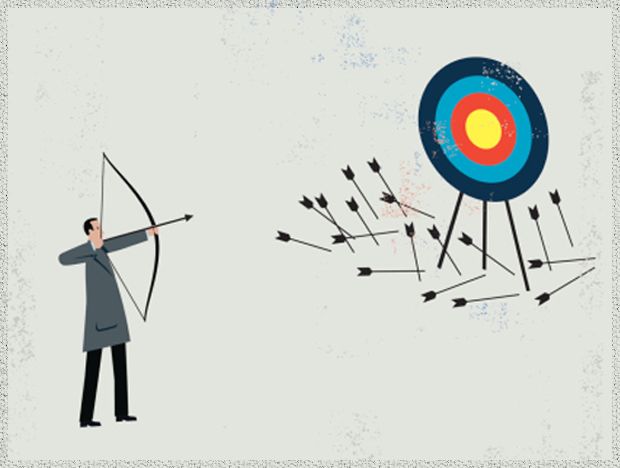
What’s the easiest way to avoid failure?

Failure_Target

There I was, listening to a Tim Ferris podcast, featuring Seth Godin (a great combination, by the way).

Seth said a lot.  When it came to our education system, he said it’s geared toward making compliant workers to serve the industrial complex.  I can’t help but agree with that assessment.

He said our education system should instead focus on two things:

  1. Teaching our children how to solve interesting problems (where the answers can’t be Googled),

and,

  1. Teaching our children how to lead.

As I listened, I completely agreed.

And then, only one day later, I was presented with an interesting problem.

Kip was telling me about a problem he likes to ask his programming candidates.  He gave me the problem with a look that said, “Surely you’ll be interested in this problem, and you’ll be able to figure it out.”

Wrongo!

As he explained the problem, my mind wasn’t looking for a solution.  Instead, I started wondering why I’d spend time on this problem, could I Google it (you can), how long would I have to struggle with it before he’d give me the answer, and what would an HR person say about asking this particular question (ever focused on compliance).

Meanwhile, he stood there expecting me to attack the problem, to ask follow-up questions, to start searching for a solution.  I gave him nothing.

Disappointed, he realized I wasn’t working the problem.  He gave me a hint, trying to get me to engage.  No dice.  I wasn’t tackling the problem.  I wasn’t even curious.  I waited for the answer.  In fact, I noticed I was thinking about something else (probably having to do with where we’d be eating lunch).  I hadn’t even tried.

Here’s the problem (it’s called the three light bulb question):

A windowless room has 3 light bulbs. You are outside the room with 3 switches, each controlling one of the lightbulbs. If you can only enter the room one time, how can you determine which switch controls which light bulb?

An interesting problem.  One I had chosen to not solve.

A problem that a younger version of myself would have loved.  It requires logic, imagination, a willingness to fail, and enough confidence to know, really know, that I can find the solution.

Here’s a small hint.  You’ll need to use all of your senses to find the answer.

For me, the question that’s more interesting than the light bulb problem is why I chose (almost automatically) to give up before trying to solve it.

I can tell myself it’s because I’m not a programming candidate, or that I don’t have to prove myself by solving the puzzle.  But, these aren’t the reasons.

Could be a lack of confidence.  Somewhere, deep in my subconscious (or maybe right on the surface), I didn’t know that I could solve the problem.  Queue the white flag.

That’s not the root cause.  In that same subconscious place, my mind saw an opportunity to fail.

Failure is not an option.

Failure is embarrassing.

Failure exposes our weaknesses.

How could it be that the younger version of myself would have tackled this problem with gusto, but the more experienced version sees an opportunity for failure and runs the other way?

I’ve purposely faced failure countless times in my life.  I remember being the guy who “poked the bear.”  I loved the unsolvable problem.  My job often involved turning around “unsolvable” situations.  Failure lurked around every corner, but it seemed normal to me.

There must be something else happening.

The narrative.  That’s the message we tell ourselves (and others) about our core beliefs.  It describes what makes us tick, our mission, why we do all the crazy things we choose to do.  It doesn’t matter if the narrative is always true.  It’s our narrative, and it drives the way we perceive our place in the world.

Years of status meetings, monthly reports, strategy reviews, and all the rest taught me to avoid failure.  Don’t miss the goal.  Give yourself some wiggle room.  Make sure you have buy-in from everyone before launching that new idea.  Don’t take any unnecessary risks.  Don’t go out on a limb…you might fall.  We have shareholders who expect a return.

Without realizing it, I allowed my narrative to morph.  Failure avoidance found its way in.

What’s the easiest way to avoid failure?

Don’t take up the challenge.  Avoid the risks.  Don’t poke that bear.  Let someone else try.  Say “No.”

But, failures teach us the most valuable lessons in life.  The quickest way to stop learning is to avoid failures.

The truth is, avoiding failure is the biggest failure of all.

Something I’ll remember the next time I’m faced with an interesting problem, or an opportunity to fail (which are often the same things).

Want the answer to the three light bulb question?

Here’s one more hint.  Your sense of touch will come into play.

By now, I’m sure you’ve figured it out.  If not, here it is:

Turn on two switches (call them A and B) on and leave them on for a few minutes.  Then turn one of them off (switch B) and enter the room.

I’ll let you figure out the rest.

The Questions We Ask When Someone Dies Are the Wrong Ones!

The questions we ask when someone dies miss what really matters…

  • How old was he?
  • How did he die?
  • Did he suffer at the end?
  • Was his family with him?
  • Various versions of:  Who is he leaving behind?  How are they doing?

These are all worthwhile questions.  They show how much we care.

They also provide a small glimpse into our future, and the future of the people we love and care about.  We will each take our final breath someday.  It’s just a question of when and how.

These questions do more to quench the morbid curiosity we have about our own future than to learn about the life of the person who just died.

We used to receive a local monthly newspaper.  I was always fascinated by the stories in the obituary section.  Each person had a story.  An arc through time.  Milestones.  Achievements.  Lives they touched.  But, these were merely stories someone else had written to encapsulate an entire lifetime into a few paragraphs of highlights.

It’s impossible to capture someone’s life in a few paragraphs or even an entire book.

Our lives aren’t just a series of events and milestones.  They’re an almost infinite collection of moments.

Moments that often seem trivial when they happen, but are anything but trivial.  These moments would probably never make the “highlight reel.”  These are the moments that (with the benefit of hindsight) are turning points in our life, and the lives of the people we touch.

Our lives are also a feeling.  An energy.  An impression we leave behind.  It’s not tangible, and it can’t be seen or touched.  But, it touches everyone around us.  It’s something they can only describe with a far-away look in their eyes when we’re gone.

The questions we ask when someone dies miss what really matters.

I’d like to add some new ones:

  • What are the moments you shared with him that you remember most?
  • What stories did he tell you?
  • Which stories had the most impact on you?
  • How did he make you feel when you were around him?
  • How did he impact the direction your life is going?
  • What did you learn from him and the way he lived his life?
  • What type of energy did he bring to your life?
  • What impression did he make on you?
  • What comes to your mind whenever you think about him, now that he’s gone?

And, one final question to consider while we’re still here:

How will those that you love and care about answer these questions after you’re gone?


Later…

Later only matters in the present.

Later creates room for compromises.

Later lives for tomorrow.

Later keeps lists.

Later allows us to avoid.

Later tells us why we’re preparing.

Later delays forgiveness.

Later is born from hope.

Later connects without really connecting.

Later captures what we imagine.

We often try to create what happens later by our actions today.

Later provides direction.

Later reduces today’s expectations.

Later can hijack the present.

Later is the carrier of our dreams.

Later gains power when it remains vague.

Later simplifies execution.

Later is where many careers will find their stride.

Later is where the craziest ideas go to die.

Later tells us it’s okay to delay.

Later is where big ideas find their future.

Later makes it okay to add complexity.

Later drags us reluctantly forward.

Later makes today easier.

Later makes today harder.

Later isn’t guaranteed.  It can easily turn into never if we allow it.

Later only matters in the present. By the time we get to later, there’s a new later that will once again seem more important than our new present.

There’s more to say on this subject.  I’ll probably get to it later…

Self-Talk

Consider the amazing power that something quieter than a whisper (the silence of our own thoughts) has over each of us.

It’s not what you say out of your mouth that determines your life.  It’s what you whisper to yourself that has the most power. –Robert T. Kiyosaki

The first person to give you feedback is yourself…in the form of self-talk.  You have 24/7 access to your internal talk track.  Your messaging is unfiltered and brutally honest.

Does unfiltered and honest mean accurate?  Does it mean valuable?  Not necessarily.

The truth is that no matter how incorrect your self-talk is, or how much you try to ignore it, you are your most trusted advisor.  You have the most power over yourself (for better or worse).

Negative self-talk is easy.  Bad news travels fast, especially when it doesn’t have to travel.

Positive self-talk is harder, and sometimes difficult to believe.  Our positive self-talk can sound a bit crazy, which makes it easier to discount.

Status quo is powered by doubt in our positive self-talk.

The most successful people I know face challenges with self-talk.  They happen to believe their positive self-talk just a little more than the negative.

The negative is right there, trying to hold them back.  Somehow they’ve found a way to focus on the positive, finding ways to push past their wave of doubt.

They’ve usually found kindred spirits who can help strengthen their positive self-talk.  A support network that reinforces their crazy ideas.  The best support network doesn’t fully buy-in to the crazy.  They merely create an environment where it’s okay to explore the crazy.  To bring it out in the open and let it breathe a little.

And, that’s the real secret of self-talk.  We all have negative and positive self-talk rolling around in our heads.  But, if we can allow the positive to get a little breathing room, that’s usually all it takes to win the internal battle against the negative.

Here’s the challenge:  The war between negative and positive is never over.  You have to win it one battle at a time.

Note to Self

I will do these things as a promise to myself…

Maybe it’s all the close calls, existential threats, newly-invented liabilities, newly-minted regulations, new competitors, old competitors, angry customers, happy customers, former customers, new customers, potential opportunities, new ideas, new methods, better mouse traps, and everything else that comes our way in business (no matter the size).

Maybe it’s the fight-or-flight instinct that gets honed to a fine edge through years of experience.  Knowing when to hold ‘em, and when to fold ‘em…but always allowing room for doubt.  Knowing when the silent customer is more important than the loudest one.  Knowing that the employee you don’t see is just as important as the one you do see.  Knowing we always have a competitor, whether we realize it or not.

Maybe it’s that standard defensive posture that every business assumes at times, even when it knows that only a strong offense will win the day.  Understanding that this isn’t a game we get to win every day.

Maybe it’s just fear of failure, or more likely, fear of success.

Whatever it is that stops me from getting the most enjoyment from this business…now is the time to let it go.

Life is way too short to let the small stuff get in the way.

Here’s my promise to myself:

  • I will go on offense, every day
  • I will acknowledge my fears, but only if it helps create a stronger offense
  • I will focus on the next step forward, and let the past remain there
  • I will create opportunities for those around me
  • I will love and serve
  • I will let go
  • I will enjoy each day as the gift that it is.

I will do these things as a promise to myself, knowing that I’m not the One who is in control.

Beware of the Edge

The edge is like the proverbial flame that draws the moth…

sitting-at-the-edge-of-a-cliff

I recently heard about a sign at the top of Mount Vesuvius.  It reads, “Beware of the edge.”

That’s the only safety precaution in the area.  No guardrails.  Just a sign.

I can hear it now:

“Your honor, I submit that my client had no idea he could plummet to his death by stepping over the edge of that volcano.  If only there’d been a guardrail to prevent his untimely death.”

Or,

“Your honor, we acknowledge that there was a sign that said, “Beware of the edge,” but my client must have thought he was safe as long as he stayed inside the guardrails.  Since there were no guardrails on the mountain, he was clearly misled into a false sense of safety and security…just before his fall.”

How many of us really need a sign, or a guardrail, to tell us to stay away from the edge?  Can’t we see the danger on our own, without the sign?

The truth is, probably not.

Why not?

Simple.  The edge is where the action is.  We know it’s dangerous.  We know our mind will play an imaginary leap that only our subconscious sees when we look over the edge.  We secretly like the butterflies we get in our stomach.

The edge brings sharp focus.  It’s where our imagination is most alive!

Sometimes, the edge represents the end of a long journey.  A challenging climb.  Our view over the edge reminds us of the distance we’ve traveled.  The work we’ve put in to get there.

The edge is like the proverbial flame that draws the moth.  The edge reminds us of how fragile our life is.  One step away from real danger.

How do we approach the edge, and take in its energy, while avoiding the danger that lurks just one step beyond?

It’s a question we each have to answer for ourselves.

But, here’s hoping we don’t discover the answer as we tumble over the edge.

Are You Willing?

All that matters is learning what you believe in…

“I know this now.  Every man gives his life for what he believes.  Every woman gives her life for what she believes.  Sometimes people believe in little or nothing, and yet they give their lives to that little or nothing.  One life is all we have and we live it as we believe in living it and then it’s gone.  But to surrender what you are and to live without belief is more terrible than dying—even more terrible than dying young.”  –Joan of Arc

Joan of Arc lived less than twenty years.  Yet she fought for her beliefs and made a huge impact on history.  She died for her beliefs at an age when many are just beginning their life’s journey.

She knew what she believed in.  She knew what it meant to sacrifice for her beliefs.  Ask anyone who serves or served in the military, a first responder who runs into a burning building to save others, or a newly formed priest who has answered God’s call.  These are just a few examples.  Each of them know what it means to sacrifice for their beliefs.

Sometimes our beliefs emerge quietly without our knowledge.  We go through life, making seemingly inconsequential decisions about what we will and won’t do.  We decide who our friends are, and how much we will let them into our lives.  We decide when to listen.  We decide how honest we will be with the world around us.

We establish habits for living our life, and we go on our merry way.

Do you know what you believe in?  Really?  Do you know what you believe to be true?  Do you know what is important in your life?

Have you made the quiet time in your life that’s necessary to consider these questions?

What if it turns out that the things you believe in aren’t manifested in the way you live?  Are you willing to change your habits?  Are you willing to eliminate the things that don’t support your beliefs?  Will you support your beliefs in the way you live, and the way you work with others?  Are you willing to make your beliefs the centerpiece of your actions in everything you do?

Joan of Arc was right.  One life is all we have, and then it’s gone.

Where are you in that one life?  Is it too late to examine your beliefs and change the way you live?

The answer is clear  But, it won’t become obvious until we make quiet time in our lives to reflect.  When we do, we find it’s never too late to examine our beliefs and change our life.

Every day is a new beginning if we choose to make it so.  It doesn’t matter what happened in the past.  It doesn’t matter who wronged you.  It doesn’t matter if you had a terrible childhood.  It doesn’t matter if you’ve missed opportunities in the past.  It certainly doesn’t matter if you failed in the past.

All that matters is learning what you believe in.  Then, deciding what to do with that new knowledge, starting today.

The only question is:  Are you willing to find out?


Beliefs and Values

h/t:  Matthew Kelly

One Syllable Words

The assignment: Describe the most dramatic moment in your life. Easy. But, there were two rules…

The assignment:  Describe the most dramatic moment in your life.  Easy.  But, there were two rules:

1) You have 15 minutes.

2) Only use one-syllable words.

That’s a little tougher.

Here was my entry:

“The rate is gone!”

“Turn her!”

“Code blue!” yelled the nurse.

All of the white coats on the floor were there fast.  Jan’s eyes showed her fear.  I was no help.  I froze and watched in awe.

One nurse pushed some drug in her arm.  One nurse held her hand.  Two docs barked new plans and the group worked their plan.

“Crash cart!” yelled one doc.

“We must go in.  The child may be lost!”

This was our first child.  We had been there for a day and a half, and now this.  What did it all mean?  Would our child make it out to see the world?

They ran down the hall on her bed with wheels.  There I stood.  The clock read five. The mess showed what was left from my child’s fight for life.  Where did they go?  I did not know so I stood there in the dark for at least three ticks of the clock.

“Sir, your wife is fine,” the nurse said.  She had found me and showed me to the room.  “Your child is fine.  Come in and see.  Would you like to hold her?”

Our girl was born!  From out of the dark, the world turned bright for us all that day.

***

Twenty-five years later, yet it seems like only a few minutes have passed.  Julianne made her dramatic entrance, and our lives have never been the same.

Happy (slightly early) Birthday, Julianne!


The Truth about Grudges

The easy thing to do is turn each injustice into a grudge…

It doesn’t take long in life for injustice to come your way.

Your mommy takes your toy away before you’re finished with it.  Injustice!  How do you deal with it?  Maybe you cry, or throw a hissy fit.  Chances are, since your attention span at 18 months is pretty short, you’ll forget about the injustice and get another toy.

Life isn’t fair, and neither are some people.  Things go wrong.  Plans get up-ended.  Promises aren’t always kept.  A friend or family member may offend us.  Someone we love may destroy themselves with addiction.  We might be the victim of a heinous crime.

Live long enough, and the injustices (both real and imaginary) will pile up.  What to do?  Crying may be appropriate.  And there’s nothing like the emotional release of a good hissy fit every now and then.  But, after that, then what?

The easy thing to do is turn each injustice into a grudge.  That way, you can stack the latest grudge on top of the others you’re carrying.  If your grudges become disorganized, you can spend some quality time dwelling on them and get them reorganized.  If they get too heavy, enlisting the help of others to carry some of your grudges is always helpful.

The burden of a grudge is carried by the victim.  The perpetrator, whether real or not, carries no such burden.  The perpetrator may carry regret, but they feel none of the weight of your grudge.

In our quest to never forget the lessons of an injustice, we wrap these lessons inside the grudge.  It’s a package deal.

For this reason, letting go, forgiving, can seem impossible.  Forgiveness runs counter to our natural instincts.  But forgiveness is about much more than survival.  It’s about finding a way to thrive with a clear focus on the things in life that really matter.

Letting go of a grudge doesn’t mean ignoring the lesson.  It means freeing yourself from the weight that only you are carrying.