Nothing You Love is Lost

“Nothing you love is lost.  Not really.  Things, people – they always go away, sooner or later. 

You can’t hold them any more than you can hold moonlight.  But, if they’ve touched you, if they’re inside you, then they’re still yours. 

The only things you ever really have are the ones you hold inside your heart.”

– Bruce Coville (h/t James Clear for sharing)

I’m working on a project for my kids and grandkids that has me writing answers to a series of about 75 questions.  It’ll be an autobiography of sorts…a collection of memories and stories about life from my perspective.

While answering a question that asked me to describe a typical school day, I eventually got to my life in high school. 

I found myself thinking about the first person who I’d known well that died. 

Mr. McNally, my freshman pre-algebra and senior year chemistry teacher, was killed by a drunk driver who ran a red light and broadsided his vehicle.

I hadn’t thought about Mr. McNally for many years, but the moment I thought about my time in high school, all the wonderful memories about him came flooding back.  I could see his witty smile; the lab coat he always wore in the chemistry lab. I remembered where I sat in the chem lab and the goofy glasses we had to wear when conducting experiments.     

His untimely death was devastating news for our school and all of us who knew him.  Mr. McNally was loved by his students.  He was one of the special teachers in my life.  The kind that not only teaches their subjects extremely well but had a profound impact on my growth as a person.

The unfortunate truth about life is that as the years go by, you’ll have to say goodbye to countless special people.  Family members. Friends.  Teachers. 

Some will die, some will move away.  In each case, we will lament that it was too soon.  Their departure leaves a shadow on our soul where once they belonged.    

I think the most powerful part of Coville’s quote is the way it highlights the transience of love and our relationships.  We can’t grasp or possess the moonlight, but we can admire it and the feeling it gives us.  Similarly, we can’t possess the people or experiences we love.  We can only cherish the memories and the impact they’ve had on us, and hope that we were able to return a positive impact to them.

Coville’s quote encourages us to appreciate the moments and connections we have while we have them.  Knowing that if they end, the love we shared with them and their significance endures, enriching our lives. 

May the memories you have of your loved ones remain with you always, and may those memories be a source of light and inspiration even as your journey continues without them. 

I have one favor to ask. If you enjoyed this post, please forward it to others.

p/c – Mike Labrum – Unsplash.com

Navigating Fear…A Personal Guide to Freedom and Growth

Fear is like that well-meaning friend who occasionally oversteps boundaries. It’s a survival instinct, a leftover trait from our ancestors who needed it to avoid becoming someone else’s lunch. It can guide us toward wise choices and help us steer clear of danger.

Our imagination, on the other hand, is a bit of a storyteller, especially when it comes to tales that can hold us back. With all our experiences and secrets tucked away in our minds, our imagination can whip up some remarkably dreadful future scenarios. And our lizard brains? They thrive on responding to fear.

Fear is undoubtedly real. The fear of failure, loss, embarrassment, injury, loneliness, helplessness, and death can have profound impacts on our thoughts and actions. However, if we recognize, understand, and confront these fears head-on, it will be like flicking on the lights in a dark room – suddenly, the monsters lose their scariness.

By acknowledging that fear is a living part of us, we can take steps toward asserting our control over it. Fear shouldn’t be in the driver’s seat. 

“Yea, though I walk through the valley of the shadow of death, I will fear no evil: for thou art with me; thy rod and thy staff they comfort me.” – Psalm 23

We aren’t alone in this journey of conquering fear. We have a loving God, supportive family, and caring friends to help us face our fears. They can offer a broader perspective and lend a hand when we need it most.

Life is a rollercoaster of unknowns, and fear hates rollercoasters. Instead of fearing the unknown, befriend it. New ideas, experiences, and relationships? Embrace them as opportunities, be curious, and let the adventure unfold.

Life is rarely easy, and sometimes truly terrible things happen to us. But, fear should be the backseat driver, not our navigator.

“I must not fear. Fear is the mind-killer.

Fear is the little-death that brings total obliteration.

I will face my fear. I will permit it to pass over me and through me.

And, when it has gone past, I will turn the inner eye to see its path.

Where the fear has gone there will be nothing. Only I will remain.”

–Paul Atreides in the novel Dune, by Frank Herbert

Photo: Why hot air balloons? Well, taking a ride in a hot air balloon would not be possible if we let fear make the decision. I’m happy to report the balloon ride was amazing!

I have one favor to ask:  If you find this information useful, please forward and recommend it to someone else.  Thanks! 

The Dance of Light and Dark

I originally wrote this poem eight or nine years ago.  It was an exercise in using contrasting words, contrasting rhythms, active and passive voices, sensory symbolism, and a few other style toys that I thought would be fun to try (for a hobbyist writing nerd).

As often happens when I write, the theme I had in mind when I started was quickly overtaken by other ideas.  The words and symbolism began pointing the way.  A new theme slowly emerged.

Then, just as I was gaining momentum, some shiny objects interrupted, and I set this poem aside.  A whole bunch of amazing life events started happening and years (eight or nine to be exact) came and went.

This poem sat on the hard drive of what would become my “old” computer.  When I moved over to the new computer, somehow all the data didn’t get transferred properly to the new computer (or to any of the cloud storage locations I use today).

I forgot about the poem until a couple of weeks ago when I was looking for a fictional story I’d written.  After some searching, I realized the only place it could be was on that old computer that we hadn’t turned on in years (and that we kept for some reason).  Imagine my surprise when I was able to boot it up and look around on the hard drive for some of my old (nearly lost) work.

I found that fictional story I was looking for (maybe I’ll publish it in some form in the future), along with a bunch of other work I had forgotten…including this poem.  Again, shiny objects intervened, and I didn’t get around to re-reading this poem until today.  The toys I’d been playing with so many years ago were just lying about where this big kid had left them.

I picked up my writing toys and continued playing with the words, the styles, and the symbols.  The theme that was there so many years ago was showing itself but in a new way that I hadn’t quite seen in the past.  Again, the words and symbols pointed the way (just like Mr. Cox told us in eleventh grade English class).

I hope you enjoy it.  Let me know what you think in the comments.


The Dance of Light and Dark

Lengthening shadows descend across the forest floor.

The perpetual dance as day gives way to night.

Glorious palettes of color and light,

Surrendering to shadows in the growing darkness.


The air grows cold with the smell of decay.

Death wins a battle in its forever war on life.


Your heartbeat echoes behind your ears.

A quiet rhythm of life.

You hear the mournful wail of a distant companion, howling for a moon not yet risen.


Stars shine like pinholes through a curtain.

The moon rises in the distance, casting new light in the dark.


While creatures of the night toil in the shadows,

Hunting and evading, hiding and pouncing, dying and surviving.

They don’t know what their future holds.

Pain or comfort.

Life or death.


Trees moan quietly as they sway against the wind’s unending assault.

Each is alone in the crowd to persevere as they must.

These trees know without knowing that morning will come.

A distant dream in the long cold night that’s just beginning.


Morning brings new light.

An eternity of hope.

Wistful breezes carry the freshness of this glorious day.

The sun lends its brilliant glow to all that it touches.


A new day, with promises to make.

Promises to fulfill.

Promises of life, of love, of laughter, and joy.


This dance of light and dark,

Of hope and despair,

Of life and death.

An eternity before,

An eternity after.

This dance is our journey.

This dance is each of us.


Photo by Casey Horner on Unsplash


DAWA, Coronavirus, and Normal

I remember thinking how simple it all sounded, and I was relieved to know I had a model to follow. What I didn’t know at the time is that this simple model is anything but simple…

 

Denial.

Anger.

Withdrawal.

Acceptance.

I first learned about these stages of grief when Grandma Anne died (over 30 years ago).  My cousin, who was a newly minted police officer at the time, described how he received training on this model in the police academy.

I remember thinking how simple it all sounded, and I was relieved to know I had a model to follow.  What I didn’t know at the time is that this simple model is anything but simple.

Models provide a basis for understanding a concept or an idea…and that’s helpful.  Models make the complex seem simple.  But models rarely capture the layers of detail or the often-gut-wrenching processes they describe.

Today, the DAWA model is a bit outdated.  Additional “stages” have been added over the years to the original model.  Stages like shock, bargaining, depression, and testing are layered into discussions of the grieving process nowadays.

How does all of this relate to the Coronavirus?

Thanks to Coronavirus, we are suddenly sharing a grief experience with every person on the planet, at the same time.  Every single one of us has lost something extremely important because of Coronavirus.

The normal that we knew, the normal that we understood, the normal that we took for granted…died over the last 30-60 days.  If you could ask all 6 billion-plus people on Earth when, exactly, normal died, their answers would vary by a few days or few weeks.  But nobody would deny that their normal is gone.

When we grieve or face a major crisis in our lives, we come together with others, we gather closer to the people we love, we comfort each other with hugs and shared laughter.  We cry together.  We cook together.  We share meals.  We share stories about what we’ve lost.  We might go to an inspirational concert and hold hands while we sway and sing along with tears streaming down our faces.

We love to be with people, even if we describe ourselves as introverts or “not a people person.”

Unfortunately, that part of normal has also died (at least for a while).

While it doesn’t look like it (because our beloved normal is gone), we are all grieving.  Every one of us.

Make no mistake about it.  Something we loved, something we treasure, and something we counted on has died.  We are grieving our loss, even as events unfold in front of us that may make things worse before they get better.

We probably don’t think we have time right now to grieve.  But, we’re each somewhere on the DAWA continuum of denial, anger, withdrawal, or acceptance.  In fact, we’re bouncing around on that continuum today.

We’ve lost our normal, and we’re being forced to live in a new normal.  This new normal will probably give way to yet another new normal a few months from now.  None of us know what any of this will look like.  That mystery is an unfortunate part of our new normal (as crazy as it may sound).

It’s normal to be in denial.  It’s normal to be angry.  It’s normal to withdraw or try to escape.  It’s also normal, and necessary, to find acceptance.

Acceptance doesn’t mean giving up.  It means that the energy we’ve been using to fight the new normal can be channeled toward making the best of what’s in front of us.

Sure, we all miss our beloved normal from the past.  We’d prefer to have our old normal back in our lives.  But we must find a way to accept, to allow ourselves to rest, and let go of our longing.

The good news is that we’ve each had normal die before.  We’ve had to adjust to new normals throughout our life and we’re generally pretty good at it:

  • Moving from one school to another and making new friends
  • Graduating high school or college
  • Starting our first “real” job
  • Leaving our first job
  • Starting our second job
  • Meeting the person of our dreams that we plan to spend the rest of our life with
  • Divorcing that person
  • Experiencing the death of a loved one
  • Becoming a parent (or a grandparent)
  • Starting your own business
  • Selling that business
  • Losing a house and everything we own in a fire
  • The knee injury that forced you to stop playing your favorite game
  • Having your house destroyed in a tornado

These are all examples of events in our lives that require us to let go of the old normal and embrace the new normal.  Sometimes the new normal is because of something amazingly good, and other times it’s caused by something amazingly bad.

I’m not sure I’ve reached the acceptance stage in my own grieving process.  I tell myself that I’m there, but I know it’s not always true.  As I work through the process and prepare myself for what lies ahead, I like to keep this list of ideas in mind:

  • Take things one day at a time
  • Prayer is your instant connection to someone who loves you completely
  • Celebrate your victories, no matter how small
  • Give yourself a break
  • Be grateful and enjoy what you have
  • Forgive yourself for not knowing exactly what to do (none of us know, which is true a lot more than we’d like to admit)
  • Only allow yourself to worry about the future for a few minutes each day and move on. I’d say to stop worrying completely since worrying is a non-productive use of energy, but I know it’s not possible to eliminate it completely.
  • Check-in once each day for the news on Coronavirus, and what the latest government directions are (social distancing, masks or no masks, etc.). By now, you know the symptoms, what you’re supposed to be doing to prevent the spread, and what you’re supposed to do if you or someone close to you become symptomatic.  The rest is probably not super useful, and you can catch-up on all of it during your once-a-day check in.
  • Be kind to others. Your kindness will go a long way and may lead to more kindness in your “downstream.”  Even a smile to a stranger letting them know we’re all in this together is helpful.  By the way, your eyes show your smile, even if your mask doesn’t.
  • Realize that you are grieving, and so is everyone else. We will each have good days and bad days in our grief journey.
  • Take time to gather with your friends and family members by phone, video conference, or even a nice email note.  These are your people.  Embrace them remotely.

We are living through future history.  The events happening around us and to us today will be discussed, debated, and written about for decades to come.  Our lives are forever changed, and the changes are continuing to unfold.

We can use our energy to reach back to the past with all that we have, searching for the normal that’s gone.

Or, we can channel our energy to reach toward the future, creating the best possible new normal for ourselves and our loved ones.

While I grieve for the past, I choose to reach for the future.

Photo by Mike Labrum on Unsplash

What a Wonderful World

Sadness can find us with little or no effort…

Sadness can find us with little or no effort…sometimes on a daily basis.

I see trees of green,
red roses too.
I see them bloom,
for me and you.
And I think to myself,
what a wonderful world.

Sadness, defined as anything that’s the opposite of joy:

Emotional pain

Feelings of disadvantage

Loss

Despair

Grief

Anger

Helplessness

Disappointment

Sorrow

Frustration

Guilt

I see skies of blue,
And clouds of white.
The bright blessed day,
The dark sacred night.
And I think to myself,
What a wonderful world

Oddly, we sometimes seek out sadness for our own purposes.  Maybe we need an excuse for not being the person we know we can be.  Maybe we find comfort in burdening others with our pain.

The colors of the rainbow,
So pretty in the sky.
Are also on the faces,
Of people going by,
I see friends shaking hands.
Saying, “How do you do?”
They’re really saying,
“I love you”.

When sadness in its many forms pays a visit, we have two fundamental questions to ask ourselves:

  • What will we allow inside?
  • How long will we allow it to stay?

It’s easy to say that we get to decide.  That doesn’t mean it’s easy to kick sadness out once it arrives for a visit.

I hear babies cry,
I watch them grow,
They’ll learn much more,
Than I’ll ever know.

What to do?  Here’s a list that I have to remind myself of from time to time:

  • Tune your mind to find joy in the simple things
  • Seek out and cherish love in your life
  • Offer forgiveness to yourself and others
  • Share your time and attention with others
  • Seek opportunities to serve others first
  • Observe life with a sense of awe and gratitude.

Joy won’t find us the way sadness can.  Joy only shows itself when we take action to greet it warmly with open arms and outstretched hands.

And I think to myself,
What a wonderful world.

Yes, I think to myself,
What a wonderful world.

Oh Yeah.

Photo by Clay Banks on Unsplash

Time For a Reboot?

Reboots aren’t only applicable to technology problems…

I learned a truism about computers back in the late-80’s:

More than 50% of the time, a computer problem can be overcome by merely rebooting the machine

Sometimes this means pressing a specific keystroke combination.  Other times it means simply unplugging the machine from the wall, and then plugging it in again.

Fast-forward nearly forty years, and the old “reboot method” is still effective at least 50% of the time.

Reboots aren’t only applicable to technology problems.

Unplugging from a problem or challenge, even for a short period of time, can shed light on a new set of perspectives.  And, guess what…about 50% of the time, one of those new perspectives will hold the key to overcoming your “unsolvable” problem.

Rebooting doesn’t only mean disconnecting.  It can also mean purposely switching up your approach, assigning new team members, changing up the words you use to describe the problem, or putting the issue into a “timeout,” so you can work on something else for a while.

Rebooting may mean taking that vacation you’ve been promising yourself and your family.  You tell yourself there’s no time for a vacation.  No time to disconnect.

Wrongo!

Denying yourself the opportunity to temporarily disconnect is denying yourself access to your most creative idea flow.  The flow that comes from freeing your mind, even briefly, from your day-to-day tasks.

There’s a ton of power in the reboot, the restart, and the disconnect.

The answers to your most unsolvable problems lie on the other side of that reboot you’ve been avoiding (at least 50% of the time, of course).

Photo by Nadine Shaabana on Unsplash

Happiness and Butterflies

How are they related? Read on to find out…

“Happiness is like a butterfly: the more you chase it, the more it will evade you, but if you notice the other things around you, it will gently come and sit on your shoulder.” -Henry David Thoreau

I saw a butterfly today while working outside.  I didn’t pay much attention and continued doing my work.

For the next 2-3 minutes, that butterfly kept flitting by and finally landed on my shoulder (only for a few seconds before taking off and flying away).

Then, tonight I randomly saw this quote about happiness and butterflies from Thoreau.

I remember thinking how grateful I was to have that little butterfly land on me earlier today. I’m pretty sure everything else on my mind drifted away for that one quiet moment.

Happiness had gently come to sit on my shoulder.

Happiness is always within reach.  If only we take the time to notice it with gratitude.

Today, I needed a reminder and I’m grateful that little butterfly was there to oblige.

Photo by Stefany Andrade on Unsplash


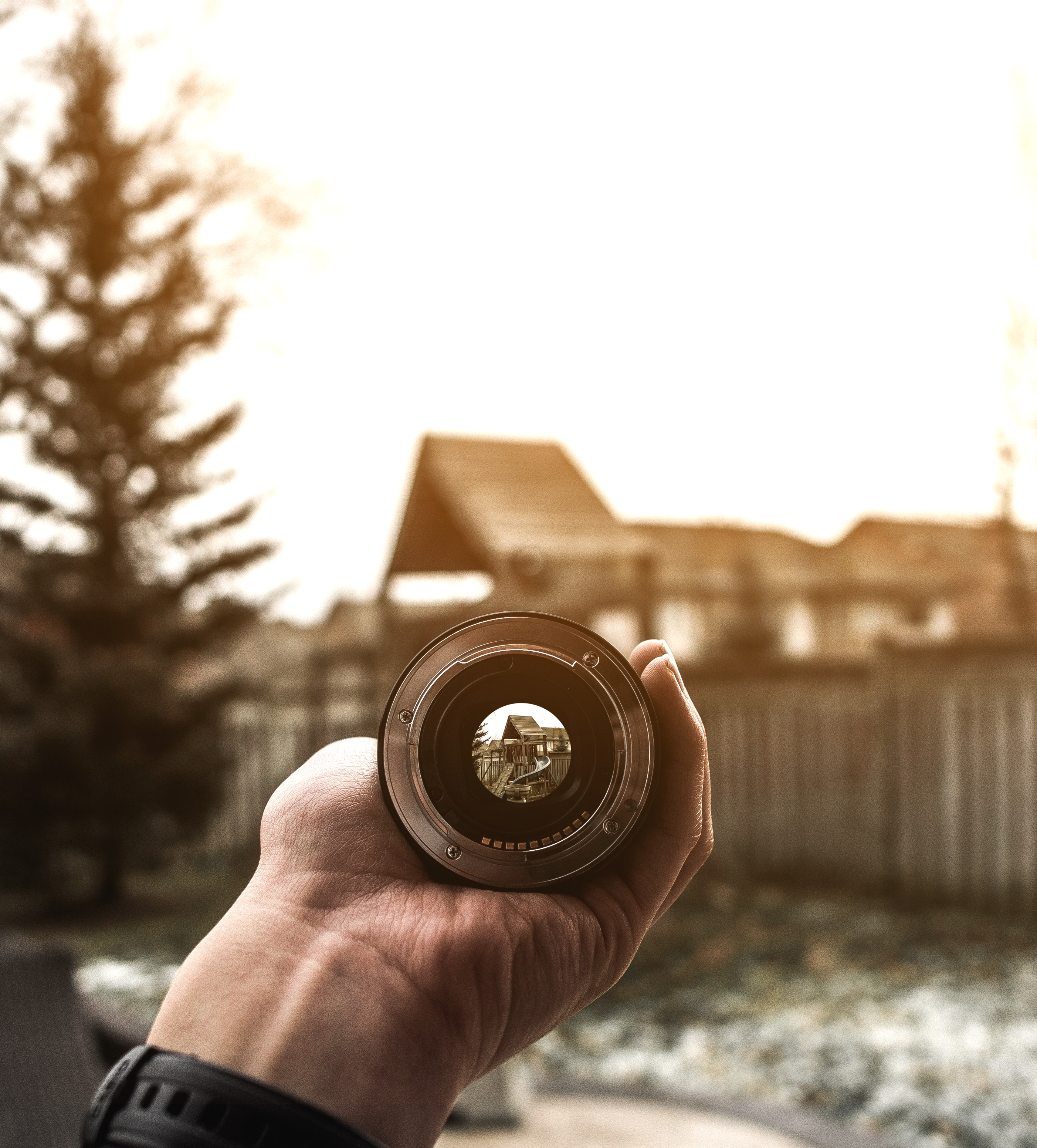
Time for a Lens Change?

We control our settings.  We control our lenses…

Way back in junior high (in the last century), I learned about photography with 35mm SLR cameras.  These were the “real thing.”  They were a far cry from the cheap Instamatics that everyone I knew used at the time.

We learned about shutter speeds, f-stops, light meters, focus points, passive and active lighting, shadows, framing, composition, film types, and lenses.

Did we want to capture the action close-up, or in the distance?  Blur the action, or stop it?  Shadow the subject, or light it?  Black and white, or color?  Grainy or smooth?  Focus on the foreground or the background?  Capture the subject from the left, or right?

It didn’t matter if we were photographing a mountain, a flower, a person, or a can of tomatoes.  Using all the tools at our disposal, we controlled what happened in each photo.

Don’t even get me started on developing film in a darkroom.  We learned about that too.  More ways to control the image that appears in the photo.  For younger readers, darkrooms are the place where the exposed film was transformed into photos.  Using various methods, we could edit an image like you can today in your phone’s photo editor or Photoshop.

The main lesson about all this wasn’t the tools and techniques of photography. It was the realization that the camera was only a tool to capture a moment.  That moment, with all its beauty, drama, imperfections, and emotions.

More specifically, the camera captures a feeling that comes from the image and our memory of that feeling.  The image is merely a pathway to our feelings about the subject.

We capture moments and feelings every day.  Usually without a camera.  We control how these moments and feelings appear on the canvas that matters the most.  In our heart and in our mind.

If the world seems to be against you, and all you see is ugliness and despair, that’s probably because of the way you’re choosing to see the world.

If everything is amazing and perfect, that’s also a result of the way you’re choosing to see the world.

Neither view is 100% accurate.  Reality has its ups and downs.  We face challenges and triumphs, victories and defeats, every day.

The key is to understand that we have way more to do with the way these moments are captured and interpreted than anyone or anything in our world.

We control our settings.  We control our lenses.  We choose where we focus.

Ultimately, we choose how to frame our moments.  Not the other way around.

Photo by Warren Wong on Unsplash

Why the 90-Day Rule is So Powerful

With the advent of the internet, and then smartphones, we’re able to access the outside world on-demand from just about anywhere.  The flipside is that the outside world can access each of us just as easily.

Friends and colleagues can send us an email or text at any time.  They can use a selection of apps to “ping” us from across the world with information, photos, articles, or project status updates.

And, although rare these days, people can even call us on our smartphone…trust me, it still happens.

In all these instances, the expectation is that we’ll be fully accessible, and ready to respond immediately to any and all issues, questions, or opportunities that come our way.

An immediate-response, immediate-judgment, immediate-decision-making model of interaction is the new norm.  We train our brains to quickly scan complex situations with the goal of rendering snap decisions that we can provide as part of our response(s).

There’s just one problem:  creating this speedy-response capability eliminates the one thing that many decisions (especially complex and long-term decisions) require:  TIME

Time and space are exactly what we need to make our most effective decisions.

Time to absorb information at our own pace.

Time to immerse ourselves in a new situation before being forced to judge it or make decisions about it.

Consider the person who gets a new job.  This new job is going to be amazing.  It’s what they want to do, and it pays a lot more than their last job.

It’s normal to visualize all the ways to be successful in the new job.  It’s normal to think of how to spend the new-found money.

It’s also normal that once the work starts, the new job won’t be as amazing as it seemed.  After the first week, the job and the people at the new job may seem like a nightmare.

Or, the new job is as amazing as it appeared and the people are awesome.  But the work is highly technical and challenging.  Doubts can creep in about whether it’s a good skill set fit.

The truth is, in the first week (even the first month) of new things like jobs, relationships, or workout routines, we don’t know enough to judge.  We may think we know.  We don’t.

This is where the power of the “90-Day Rule” shows itself.  What is the 90-Day Rule?  It’s something I made up that says for the next 90 days, I’ll immerse myself in the new thing (job, workout routine, etc.) without any preconceived judgment, without any pressure to decide, and without any thoughts about alternatives.

If I’ve decided to do this new thing (after days, weeks, months, sometimes years of contemplation), I’m going to give it at least 90 days before judging it.

In the new job example, consider how freeing a 90-day moratorium on judgment will be.  You’re not judging the new people.  You’re not judging the new company.  You’re not judging your ability to perform in the new job.  You’re not even judging the commute.

No judgments means you can focus on what it takes to be as successful as possible in the new job.  All the energy you would have focused on making judgments and other distracting decisions is channeled fully into the most valuable tasks.

What about all that new money you’re earning at this new job?  What if you give yourself 90 days before spending it on all that new stuff?  Have a nice dinner to celebrate the start, and then wait 90 days.  You’ll have plenty of time to spend all this new money on the 91st day.  What’s your hurry?

When was the last time you gave anything 90 minutes before passing judgment?  It’s time to give important decisions at least 90 days before passing judgment.

You’ve decided on this course of action.  Let it play out.  Give it room.  Let it breathe.  See where it goes.

Give yourself the power of time.

Photo by Ümit Bulut on Unsplash


Letting Go

You are not what has happened to you…

“If there are pieces of your past that are weighing you down, it’s time to leave them behind.  You are not what has happened to you.  You are someone unimaginably greater than you have ever considered, and maybe it’s time to consider all the possibilities that are within you.”  –Matthew Kelly

How much baggage are you carrying from your past?

The mistakes you’ve made.  The opportunities you missed.  The disappointments.  The tragedies.  The could’ve beens and the should’ve beens.  The people you still won’t forgive.

Letting go doesn’t mean forgetting your past.  It doesn’t mean ignoring the lessons you’ve learned.

It means forgiving yourself and forgiving others.  It means loving the amazing person you’ve become and letting go of the person you or anyone else thought you should have become.

Each of us is a work-in-progress.  We have an opportunity every day to define our future.  But, it’s impossible to choose our future while burdened with all the weight of our past.

It’s time to let go.  Drop the weight.  Drop the guilt.  Drop the anger.  Drop the regrets that quietly gnaw at your core.

Let go and prepare yourself for the awesome future that you choose.

As Matthew Kelly says, “You are someone unimaginably greater than you have ever considered.”

Photo by Gianandrea Villa on Unsplash