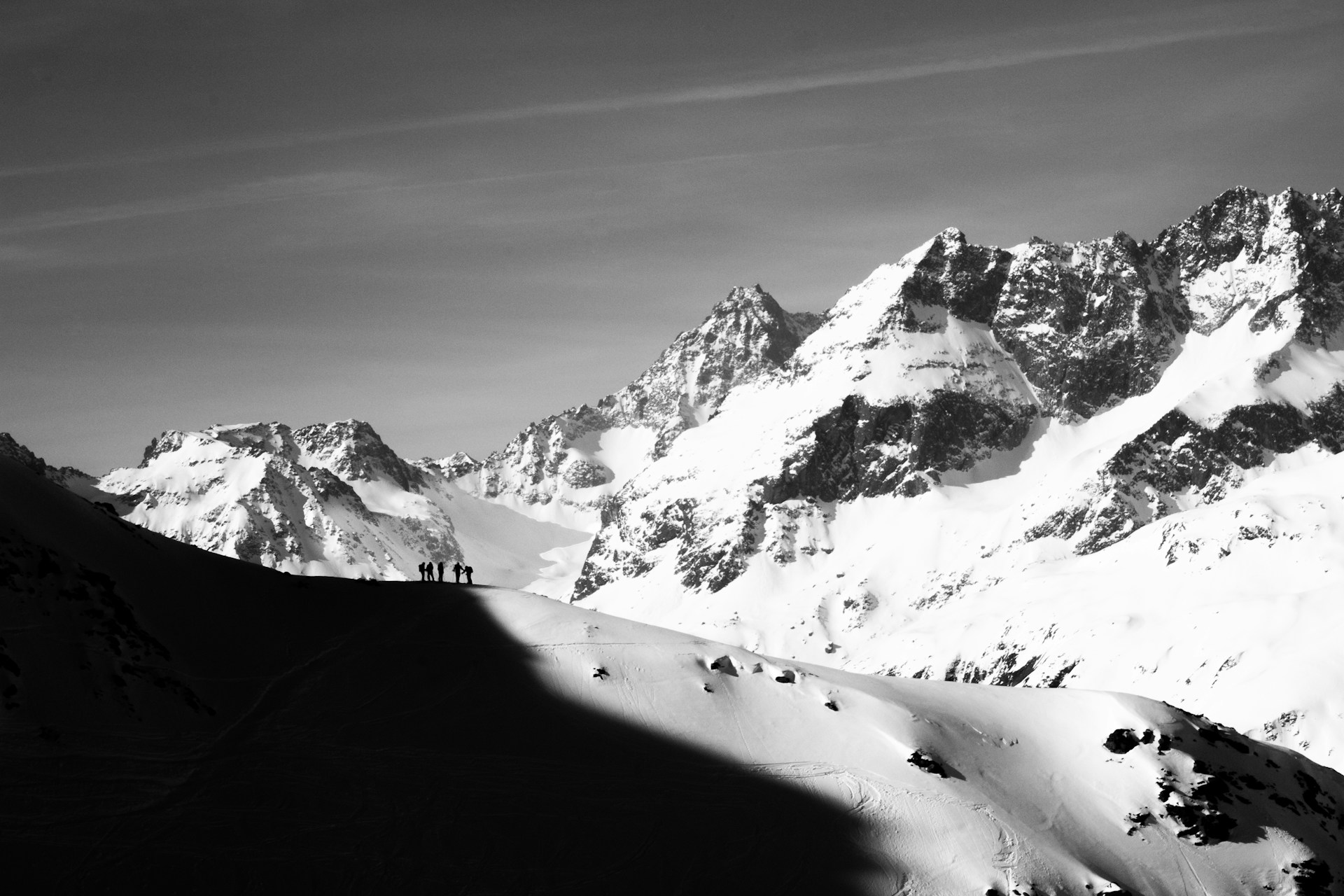
Climbing in Times of Change

René Daumal titled his unfinished novel, Mount Analogue. It describes a peak, “whose summit is inaccessible by ordinary means.” The mountain can only be reached through inner transformation, making it both a place and an analogy for our journey of struggle toward resilience and clarity in the fog.

Leadership in upheaval can feel similar. Our map runs out. The ground shifts. We carry only our memories. Some sharp with regret, others shining with joy. Yet even scars can become footholds for our climb.

Daumal wrote, “You cannot stay on the summit forever; you have to come down again. So why bother in the first place? Just this: what is above knows what is below, but what is below does not know what is above.”

The summit gives leaders perspective. From above, we see connections hidden from the valley floor. The shape of the landscape, how the streams converge, where the shadows fall and light breaks through. We descend changed by what we’ve seen, and those who walk beside us are steadied by our vision.

History shows us that change always reshapes our climb. The printing press, the steam engine, electricity, space travel, and global connectivity to name a few. Artificial intelligence is the latest steep slope, bringing fear, excitement, and possibility all at once.

Leaders can steady others by naming the change clearly, framing the opportunities, modeling ways to adapt, and keeping purpose at the center of the change.

Daumal died before finishing his book. It breaks off mid-sentence. A fitting metaphor for leadership. Unfinished, unresolved, always in motion.

Leadership is the willingness to prepare others for the climb, walking faithfully with them, and offering perspective so they can see what’s possible…and dare to tackle the climb themselves.

h/t – James Clear for showing a quote from this book that sent me down the path to learn more about Mount Analogue. 

Photo by Caleb Lumingkit on Unsplash

Climbing 10% of the Mountain

“…climbing 10% of the mountain ten times is not as useful as climbing to the top once.” – Adam Mastroianni

This quote reminds me of the old adage about project resourcing: sometimes projects can’t be completed faster merely by adding more people to it.  After all, the story goes, nine women can’t make a baby in a month.

Does this climbing quote ignore our preparation?  Route scouting, equipment testing, and countless workouts that make the summit climb possible.  Not to mention the like-minded team we built to support the climb.

Maybe it’s not about preparation.  Maybe it’s about the false-starts, the simulated progress, the big talk and no action that we engage in to make it seem like we’re climbing when we’re not.  We think we’re fooling everyone, but we’re only fooling ourselves as we take the comfortable way out and choose not to climb at all.

It’s easy to climb 10% of the mountain or achieve 10% of the goal.  It’s easy to get 50%.  60%.  Even 75%.  But as the challenges compound near the top, we let doubts creep in.  The grinding effort becomes exhausting.  We lose sight of the summit or forget why we’re climbing in the first place. 

We make excuses.  We can come back another day and try again.  The summit will always be there, and maybe next time… 

That’s just it.  We’re rarely “ready” for the climbs that matter, whether in business, fitness, or life’s hardships.  Waiting for the perfect time often means waiting forever. 

You have the power to choose the summit run every time.  Committing 100% effort, even when you feel 60% ready.  Trusting that you’ll figure out the rest along the way. 

Life’s summits rarely wait for us to feel ready. The question is: will you take the first step…and then push beyond 10%, all the way to the top?

Photo by Paolo Feser on Unsplash

Writing the Check – the best piece of advice I’ve ever received

I’ve received (and read) lots of advice in my lifetime.  I’ve even had an opportunity to give advice to others. 

The most valuable piece of advice I’ve received was from my dear friend, Jay Scott, around 1991 or 1992 (paraphrasing):

“Mr. Dailey (we refer to each other formally, of course), everything in life comes down to writing a check.  You want a new car?  Write a check.  You want to learn a new skill?  Write a check.  You want to add something nice to your house?  Write a check.  You’re either going to write the check or not.  All the rest is just detail.” 

When he said it, I didn’t think much of it.  It sounded like a flippant observation that oversimplified life’s choices. 

As I’ve lived my life and encountered tons of situations, opportunities, and decisions, I’ve come to realize the genius in his observation. 

The check may be money…the literal meaning of the word “check.”  Sometimes the check is the decision to invest something of your own personal value into an idea, an object, or a cause.  The check becomes a commitment of your finite time and energy…and maybe your money. 

The idea that all the rest is just detail reinforces the notion that while we may elaborate on our decisions with lengthy justifications or stories, at the core, it’s about that decisive moment of commitment.

I’ve found that most of the time I have my decision made about something within a minute of considering my alternatives (whatever they may be).  Whether I act immediately on that decision (write the check) or wait some undetermined time period (sometimes years) is another matter.

I’ve applied this fundamental knowledge about humans and their check-writing decisions many times.  If my boss says that he supports an idea or strategy, I try to get him to “write the check” about that support as quickly as possible.  It’s easy to support an idea in the abstract or tell your employee that you support him or her.  It’s something entirely different to then act on that support by “writing the check.” 

If the boss (or anyone for that matter) talks about how they believe in something or they support something, if they’re not willing to write the check for it, you know they’re just telling a story.  Only when they commit their check (money, time, reputation, etc.) to something are they truly supporting it.  Another phrase, “having skin in the game” applies here.   No skin in the game, no commitment.

It all comes down to writing the check.  

p/c – Tommy Lisbin – Unsplash Why? This climber has written the check(s) and is fully committed to this task. And, the goal is in sight.

I’m not afraid of heights…

The real question isn’t about fear of heights or fear of ladders.  It’s about your definition of the higher ground…

…but I am afraid of ladders.

When I heard someone at the gym saying this to his workout buddy, he was referring to the reason he doesn’t put up Christmas lights.  He hates climbing on ladders.

For the record, I’m not too keen on climbing ladders either.

My immediate thought was how easy it is to dream of and visualize reaching the heights of our chosen field.  The hard part is the ladder.

Choosing the right ladder, or series of ladders.

Our ladder needs to be sturdy enough to take our weight and the weight of everyone else making the same climb.

It’s easy to pick the nearest ladder or the one where we can see the top.  But that’s not always the right one.

And, once we choose, how long should we climb before jumping to another ladder?

The real question isn’t about fear of heights or fear of ladders.  It’s about your definition of the higher ground.  Your definition of success.  The “why” for your climb.

Are these easy questions to answer?  Definitely, not.

Here’s the tricky part:  your answers to these fundamental questions of why will morph over time.  Something you thought was important in high school isn’t important when you’re 25, or 30.  Similarly, something that’s important when you’re 30 isn’t so important when you’re 50, or 65.

Our answers also adapt to our surroundings, to the people we see the most.  It’s human nature.  We adapt to survive.  We compromise to fit with those around us.  Our perceptions are shaped by what’s closest.

The good news is that with the internet, blog sites, news sites, books, videos, and podcasts, the definition of “closest” has changed.  While it’s true that we still work closely with the ten people that are near us, we have access to a universe of ideas and perspectives far beyond our “local” reach.  All we have to do is choose to look.

What about heights and climbing ladders?  They matter.  But not as much as why you’re climbing in the first place.

“Management is efficiency in climbing the ladder of success; leadership determines whether the ladder is leaning against the right wall.”  –Stephen Covey

Photo by Samuel Zeller on Unsplash

Finding the Next Higher Gear

That’s when I noticed my habit of shifting to a lower gear as the trail gets steeper ahead…

4-5-10-mountain-climbing

If you haven’t tried mountain biking, you don’t know what you’re missing.  It combines many of the best things in life:

Being outdoors, hard work, freedom, speed, some risk, and fun.

Like many sports, it’s also a great way to find your limits, and extend them a bit.

Mountain bike trails are either climbing or descending.  They may be smooth, rough, tight, rocky, rutted, or any combination of these.

Steep downhills have always scared me.  Way too fast for my taste.  That impossible battle with gravity, choosing the safest line, avoiding rocks, and leaning far enough back to avoid being pitched over the handlebars, make most steep downhills a game of survival for me.  Definitely outside my comfort zone.

I prefer climbing.  Give me a long, steep climb and I’m happy.  Tired, but happy.  Sure, gravity’s against me, but it’s not trying to throw me over the handlebars, or off the mountain side.  I get to focus on my pedaling rhythm, staying within myself, and seeing how fast I can climb the next steep hill.  It puts my mind in a quiet place.

Until someone goes around, gives a wave, and climbs out of sight!  He may be half my age, but that’s no excuse.  He’s found a way to put both himself and his bike in the next higher gear (or maybe a few higher gears).

That’s when I noticed my habit of shifting to a lower gear as the trail gets steeper ahead.  I haven’t reached the steeper section, and yet I’m already downshifting.  One could call this good preparation.

Or, fear.  Fear of being caught off-guard by the steeper trail.  Fear of actually finding my limits.  Fear that I can’t handle the next higher gear.  Fear that I’ll blow-up and have to stop, gasping for air.

Napolean Hill was right when he said, “the only limitation is that which one sets up in one’s own mind.”

As I watched that guy climb out of sight, I decided to experiment with the next higher gear.  Catching him wasn’t my goal.  That wasn’t going to happen.  Finding my limit became my new goal.  Whenever my habit said I should downshift, I purposely clicked to the next higher gear and left it there.  Suffice it to say, I found my limit a few times.

More often than not, I merely climbed faster, and clicked to even higher gears.

Since I was climbing, I had time to think.  The question that kept rolling around my head was whether I have the same habit of preemptively downshifting in other areas of my life.

Time to find out.


Photo Credit