As we enter 2026, it’s tempting to look for a new system, a better plan, or the perfect moment to begin.
Most of the time, the real answer is simpler.
Just show up.
The secret to progress isn’t brilliance or motivation. It isn’t certainty or confidence. It’s presence.
Show up every day. Show up when it’s easy. Show up when it’s uncomfortable. Show up when you don’t know what comes next.
Show up and be present. Show up and handle your business. Show up and figure it out as you go. Show up for the people you love. Show up for the work that matters. Show up for yourself.
When you’re unsure what to do next, don’t overthink it. Show up and take the next step. Clarity usually follows movement.
The alternative is standing down. Waiting. Drifting. Quietly giving up ground you were meant to claim.
You’re stronger than that.
Progress is rarely dramatic. It’s built through consistency. Through ordinary days stacked on top of each other. Choosing to show up when no one is watching.
The hard things happen because you showed up. The meaningful things happen because you stayed. The impossible things only happen when you refuse to disappear.
There’s another truth hidden in showing up.
When you show up, you give others permission to do the same. Your presence becomes proof. Your consistency becomes encouragement. People notice. They realize they can take the next step too.
So how do you crush your goals in 2026?
You don’t wait for the perfect plan. You don’t wait to feel ready.
You show up. You make it happen.
Because that’s what you do. And this is how things get done.
A friend called recently. He’s been running his own business successfully for over a decade. Things are going well, really well. That’s why he reached out.
He wanted to talk through some ideas. Usually when I get these calls, it’s because a business owner is thinking about making a major change. Maybe selling, maybe acquiring another business, maybe just trying to get unstuck from a rut. But this wasn’t that kind of conversation.
He explained that his team is doing great work. His own role had evolved into mostly business development and handling occasional fire drills. Lately, there haven’t been many fires. The business is running so smoothly that, for the first time in years, he has time on his hands. Unexpected free time.
That’s usually a good thing, right?
He thought so too at first. He ramped up his business development efforts (always wise to add growth fuel to a business), and then he did something else. He stepped back and watched. Observed. Assessed.
For the first time in a while, he was able to look at the processes and tools his company uses with a fresh set of eyes. The eyes of an outsider.
That’s when he saw the gaps.
Not because things were falling apart. But because, with a little perspective, he realized how much better things could be. He saw inefficiencies, opportunities for automation, outdated systems, and new tools that could transform how they operate.
His brain lit up. Ideas started flowing. He made lists. And more lists. He started thinking through what needed to change, planning what to build, what to retire, and how to bring the team into the improvement process.
That’s when he called me. Not for help solving the problems, but because he suddenly had too many ideas and plans.
He’d become overwhelmed by the possibilities.
So, I asked him: What would it take to give yourself permission to conclude the brainstorming, the planning…and begin?
He paused.
As the boss, no one else was going to tell him to stop generating ideas and to start work on executing them. There’s no urgent deadline forcing a decision. No one asking for a status update. The machine is humming along, profitably. But he can see how much more potential is just sitting there waiting to be tapped.
We didn’t talk about his ideas or operations at all. We talked about how to decide. How to identify the vital few initiatives that would make the biggest difference. How to involve his team. How to get moving.
We talked about starting, and how starting builds momentum.
Our brains love ideation. There are no limits, no constraints. It’s energizing to imagine improvements, design new systems, and sketch out possibilities. We feel smart. We feel alive.
But our minds? They get restless. We lie awake at night, spinning. We second-guess ourselves. We get caught in the loop of “what if” and “maybe later.”
That’s where permission to conclude enters the picture.
It’s the quiet decision that says: “I’ve thought enough. I’ve explored enough. I may not have a perfect plan, but I have enough to begin.”
It’s the green light we must give ourselves. To start, to build, to test, to course-correct.
It’s a commitment. Not to perfection, but to movement.
To gain clarity through execution. To action that reveals what thinking alone cannot.
If you find yourself spinning with ideas, take a deep breath.
Give yourself permission to conclude.
And start.
Photo by Isaac Mugwe on Unsplash – the rider has no idea what lies ahead…only guesses, maybe some visualization of what could be lurking around that dark corner. The only way to find out is to start and figure it out along the way.
h/t – I learned about the concept of the “vital few” over 20 years ago from MAP Consulting. A simple yet powerful realization that we can only work on a few things at any one time. Choose the vital few, work on them, then move to the next set of vital few items after that.
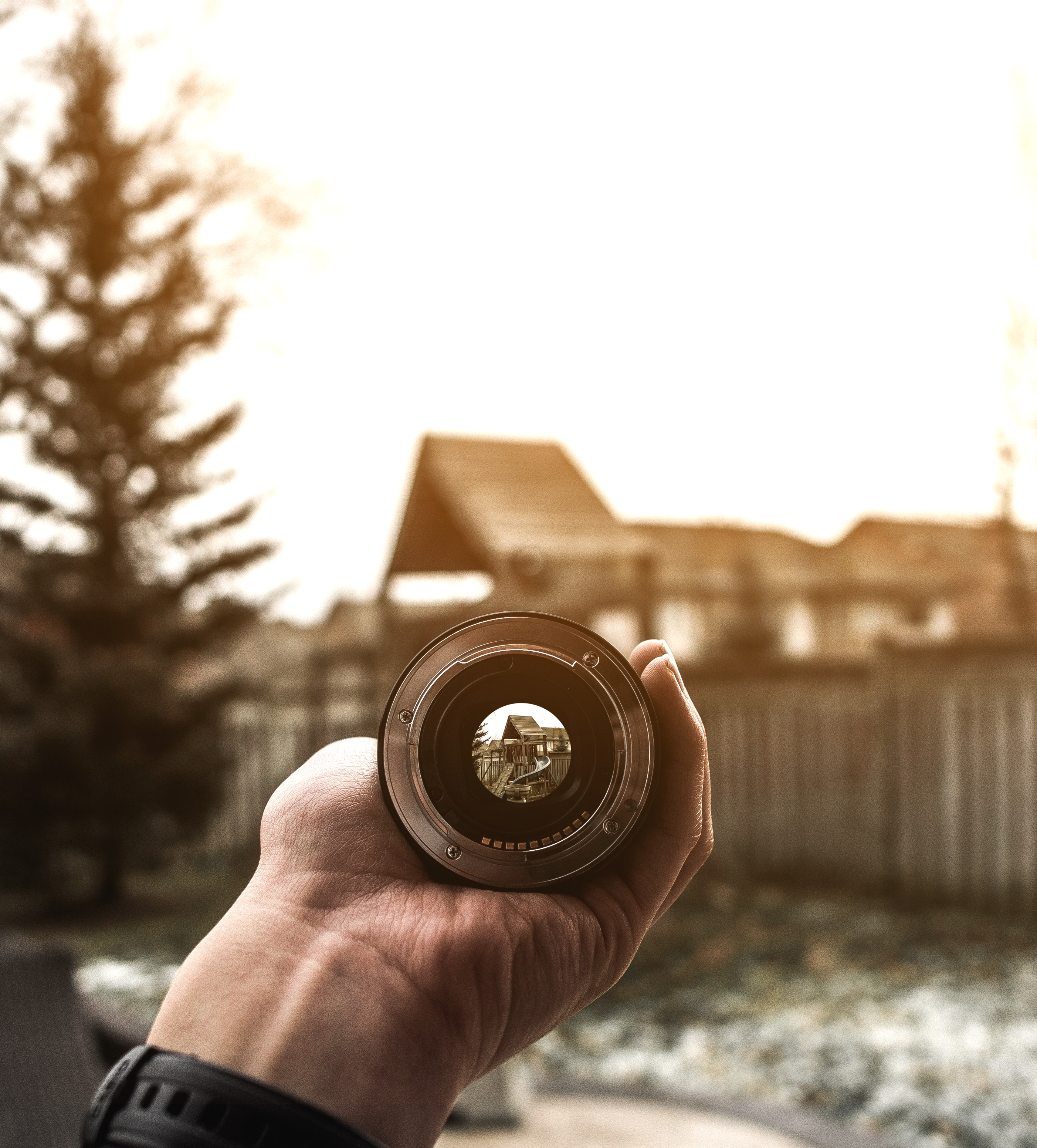
Way back in junior high (in the last century), I learned about photography with 35mm SLR cameras. These were the “real thing.” They were a far cry from the cheap Instamatics that everyone I knew used at the time.
We learned about shutter speeds, f-stops, light meters, focus points, passive and active lighting, shadows, framing, composition, film types, and lenses.
Did we want to capture the action close-up, or in the distance? Blur the action, or stop it? Shadow the subject, or light it? Black and white, or color? Grainy or smooth? Focus on the foreground or the background? Capture the subject from the left, or right?
It didn’t matter if we were photographing a mountain, a flower, a person, or a can of tomatoes. Using all the tools at our disposal, we controlled what happened in each photo.
Don’t even get me started on developing film in a darkroom. We learned about that too. More ways to control the image that appears in the photo. For younger readers, darkrooms are the place where the exposed film was transformed into photos. Using various methods, we could edit an image like you can today in your phone’s photo editor or Photoshop.
The main lesson about all this wasn’t the tools and techniques of photography. It was the realization that the camera was only a tool to capture a moment. That moment, with all its beauty, drama, imperfections, and emotions.
More specifically, the camera captures a feeling that comes from the image and our memory of that feeling. The image is merely a pathway to our feelings about the subject.
We capture moments and feelings every day. Usually without a camera. We control how these moments and feelings appear on the canvas that matters the most. In our heart and in our mind.
If the world seems to be against you, and all you see is ugliness and despair, that’s probably because of the way you’re choosing to see the world.
If everything is amazing and perfect, that’s also a result of the way you’re choosing to see the world.
Neither view is 100% accurate. Reality has its ups and downs. We face challenges and triumphs, victories and defeats, every day.
The key is to understand that we have way more to do with the way these moments are captured and interpreted than anyone or anything in our world.
We control our settings. We control our lenses. We choose where we focus.
Ultimately, we choose how to frame our moments. Not the other way around.
Attention is the currency we use for spending time…
I’ve read countless articles and blog posts about work/life balance. They generally focus on the rigors of managing a business in a 24-hour-a-day cycle. Some are from the manager’s perspective, and others are from the worker’s point-of-view.
Most articles mention sacrifices. How families, spouses, kids, friends, and even our own health and welfare, are forced into the back seat while our hero focuses on the challenges of his/her career path. There’s usually some kernel of wisdom…justification for the decisions being made by all involved.
Achievement rarely happens without hard work, focus, determination, sacrifice, and making the (hopefully) right choices. What are the right choices? That varies for each person.
One thing that doesn’t vary for each person is the value of their time. Time is the most precious and fleeting commodity in our lives. We can’t control time. We only control how we spend it.
Attention is the currency we use for spending time. Like time, our attention is limited. Unlike time, we control our attention. We decide what deserves it, and what doesn’t.
Work/life balance isn’t really about the demands of the job. It’s not about the oppressive boss who demands our continuous availability, or employees who need input and direction at all hours. It’s definitely not about checking our email or social feed every fifteen minutes.
Regardless of its details, if there is such a thing as work/life balance, it comes down to two things:
Realizing that we decide where to focus our attention.
Whether we decide consciously or not, our actions make our attention decisions a reality.
Photo credit: Diane Anderson (my wonderful mother-in-law), who focuses (pun intended) a lot of her attention on making beautiful art with her camera.
Our phone, internet and cable TV stopped working. We used my cell phone to notify our provider and schedule a technician to visit this morning.
Janet had an early morning appointment, so she was up and out of the house early. Rather than eat my breakfast while watching some Sunday morning show, or something I had previously recorded, I sat out on the patio and enjoyed my Coach’s Oats with a cut up banana…and a hot chocolate.
Far from silence, I was sitting in the middle of a chorus of bird songs. The flutter of wings, and the squeaks of hummingbirds greeted me as I sat there. Everything else was quiet, and while I sat motionless, a flock of quail strolled in to sample the seeds I had put out on the hill behind our house. They didn’t even notice me as they milled about, chirping at each other and eating.
After finishing breakfast, I didn’t check my email. I didn’t check my news feed in FaceBook. I didn’t check out my Twitter feed. I didn’t pop-up Zite. I didn’t fire up my favorite Pandora channel.
I grabbed my Kindle and read. This is something usually reserved for the final sleepy minutes of my day, around bedtime. A big reading session at that time is about fifteen minutes. This morning, I read for about two hours. It’s amazing how fast I can read when I’m actually awake and not distracted.
Of course, there were times when the bird action around me was so intense that I couldn’t help but stop reading and enjoy the show. I also heard an argument going on up the hill from our house between a mom and her twenty-something daughter. It’s sad that they were spending their early Sunday time arguing. Seems like a waste of a glorious morning.
I hear the technician arriving out front. I wonder if I should answer the door when he knocks.
P.S. Since you’re seeing this post, you guessed it…I answered the door. We may be back on the grid, but we plan to make this house a grid-free zone on a regular basis going forward.





 Grandpa Bob Encouraging Leadership
You must be logged in to post a comment.