The Questions We Ask When Someone Dies Are the Wrong Ones!

The questions we ask when someone dies miss what really matters…

  • How old was he?
  • How did he die?
  • Did he suffer at the end?
  • Was his family with him?
  • Various versions of:  Who is he leaving behind?  How are they doing?

These are all worthwhile questions.  They show how much we care.

They also provide a small glimpse into our future, and the future of the people we love and care about.  We will each take our final breath someday.  It’s just a question of when and how.

These questions do more to quench the morbid curiosity we have about our own future than to learn about the life of the person who just died.

We used to receive a local monthly newspaper.  I was always fascinated by the stories in the obituary section.  Each person had a story.  An arc through time.  Milestones.  Achievements.  Lives they touched.  But, these were merely stories someone else had written to encapsulate an entire lifetime into a few paragraphs of highlights.

It’s impossible to capture someone’s life in a few paragraphs or even an entire book.

Our lives aren’t just a series of events and milestones.  They’re an almost infinite collection of moments.

Moments that often seem trivial when they happen, but are anything but trivial.  These moments would probably never make the “highlight reel.”  These are the moments that (with the benefit of hindsight) are turning points in our life, and the lives of the people we touch.

Our lives are also a feeling.  An energy.  An impression we leave behind.  It’s not tangible, and it can’t be seen or touched.  But, it touches everyone around us.  It’s something they can only describe with a far-away look in their eyes when we’re gone.

The questions we ask when someone dies miss what really matters.

I’d like to add some new ones:

  • What are the moments you shared with him that you remember most?
  • What stories did he tell you?
  • Which stories had the most impact on you?
  • How did he make you feel when you were around him?
  • How did he impact the direction your life is going?
  • What did you learn from him and the way he lived his life?
  • What type of energy did he bring to your life?
  • What impression did he make on you?
  • What comes to your mind whenever you think about him, now that he’s gone?

And, one final question to consider while we’re still here:

How will those that you love and care about answer these questions after you’re gone?


Later…

Later only matters in the present.

Later creates room for compromises.

Later lives for tomorrow.

Later keeps lists.

Later allows us to avoid.

Later tells us why we’re preparing.

Later delays forgiveness.

Later is born from hope.

Later connects without really connecting.

Later captures what we imagine.

We often try to create what happens later by our actions today.

Later provides direction.

Later reduces today’s expectations.

Later can hijack the present.

Later is the carrier of our dreams.

Later gains power when it remains vague.

Later simplifies execution.

Later is where many careers will find their stride.

Later is where the craziest ideas go to die.

Later tells us it’s okay to delay.

Later is where big ideas find their future.

Later makes it okay to add complexity.

Later drags us reluctantly forward.

Later makes today easier.

Later makes today harder.

Later isn’t guaranteed.  It can easily turn into never if we allow it.

Later only matters in the present. By the time we get to later, there’s a new later that will once again seem more important than our new present.

There’s more to say on this subject.  I’ll probably get to it later…

Self-Talk

Consider the amazing power that something quieter than a whisper (the silence of our own thoughts) has over each of us.

It’s not what you say out of your mouth that determines your life.  It’s what you whisper to yourself that has the most power. –Robert T. Kiyosaki

The first person to give you feedback is yourself…in the form of self-talk.  You have 24/7 access to your internal talk track.  Your messaging is unfiltered and brutally honest.

Does unfiltered and honest mean accurate?  Does it mean valuable?  Not necessarily.

The truth is that no matter how incorrect your self-talk is, or how much you try to ignore it, you are your most trusted advisor.  You have the most power over yourself (for better or worse).

Negative self-talk is easy.  Bad news travels fast, especially when it doesn’t have to travel.

Positive self-talk is harder, and sometimes difficult to believe.  Our positive self-talk can sound a bit crazy, which makes it easier to discount.

Status quo is powered by doubt in our positive self-talk.

The most successful people I know face challenges with self-talk.  They happen to believe their positive self-talk just a little more than the negative.

The negative is right there, trying to hold them back.  Somehow they’ve found a way to focus on the positive, finding ways to push past their wave of doubt.

They’ve usually found kindred spirits who can help strengthen their positive self-talk.  A support network that reinforces their crazy ideas.  The best support network doesn’t fully buy-in to the crazy.  They merely create an environment where it’s okay to explore the crazy.  To bring it out in the open and let it breathe a little.

And, that’s the real secret of self-talk.  We all have negative and positive self-talk rolling around in our heads.  But, if we can allow the positive to get a little breathing room, that’s usually all it takes to win the internal battle against the negative.

Here’s the challenge:  The war between negative and positive is never over.  You have to win it one battle at a time.

The Puzzles We Build

In our house, whenever we started a puzzle, it was an “all-hands-on-deck” affair…


jigsaw-puzzle_pieces

When was the last time you assembled a puzzle?

Did you do it yourself, or did you have help?

How long did it take to assemble?  Minutes?  Hours?  Days?

In our house, whenever we started a puzzle, it was an “all-hands-on-deck” affair.  We’d all start working it.  Some of us would focus on organizing the pieces to make them visible.  Others would dive right in and start putting pieces together.

I worked the edges.  It’s the only thing that helped me get my bearings on the puzzle.  Start with the flat sides and establish a border…then work into the middle.  Working from the middle, out, was way too random for me.

“Hey, does anyone want some hot chocolate?” always seemed like a good question for me to ask after about a half-hour of diligent work.  With marshmallows.  Without looking up, I’d get some slow yesses and a few grunts.  By the time I came back with the hot chocolate, I was always amazed at the progress.

I’d get back to working the edges.

Each of us had our specialty and our own pace.  Some of us were easily distracted (me).  My wife would stay focused for hours…one piece at a time.

“Hey, who’s up for a break from the puzzle?  Maybe we can hit it again in a couple of hours with fresh eyes.”  I was always a proponent of fresh eyes.

But, then we’d get most of the edges completed.  I’d get my own personal rhythm, and I could start to see the patterns.  The puzzle started to take shape.  First, in my mind and then on the table.  My perspective on the puzzle and my ability to add value to it changed as the image emerged from all the pieces.

I don’t know if my wife and daughters (or anyone else who’d stop by and get sucked into the assembly project) went through the same evolution in their perspective as I did.

Our latest puzzle is a new business (actually, an existing business that we recently purchased).  Once again, our family is building a puzzle together.  This time, it’s not at the dining room table with a clear picture of the final product.  In fact, new pieces are being added to this puzzle all the time.

Once again, we’re each approaching the puzzle in our own way.  Center-out.  Edges-in.

Distractions?  Definitely.

Is an image beginning to emerge?  Yes.

The best (and most challenging) aspect of this puzzle is that it’s never finished.  It grows and evolves.  It occasionally leaves us feeling a bit perplexed.  But, it also takes beautiful shape before our eyes as we continue to build, one piece at a time.

Anyone up for some hot chocolate?  We’re gonna be here a while!


Speedometers Steal Speed

“The cheetah is the fastest animal on earth.  It can reach speeds of up to 65 miles per hour as it pursues its prey.  Just look at its awesome speed, as it chases down that gazelle!” – Every Nature Program about Cheetahs

Do you think the cheetah has any idea how fast he’s going?

What about an eagle as it dives through the air to reach its prey?

Does the pelican think about his speed as he dives into the water to catch dinner?

Does the pole vaulter know how fast she’s running just before her jump?

What about the downhill mountain bike racer?

The answers to these questions are obvious.  For each to be effective, none are looking at a speedometer to determine their next move.  They aren’t referring to some magical heads-up-display to tell them how they’re doing.

In their critical moment, no measurements or brilliant strategic insights will impact the outcome.  They will succeed or fail based solely on how they perform, in the next moment.

The moment is all that matters.

Speedometers don’t make speed.  They provide external feedback and nothing else.

How often are you slowing down to check your speedometer, instead of focusing on your next critical moment?

Truth is, your moment is all that matters.  There’s plenty of time for feedback later when it’s not stealing your speed.

Are You Willing?

All that matters is learning what you believe in…

“I know this now.  Every man gives his life for what he believes.  Every woman gives her life for what she believes.  Sometimes people believe in little or nothing, and yet they give their lives to that little or nothing.  One life is all we have and we live it as we believe in living it and then it’s gone.  But to surrender what you are and to live without belief is more terrible than dying—even more terrible than dying young.”  –Joan of Arc

Joan of Arc lived less than twenty years.  Yet she fought for her beliefs and made a huge impact on history.  She died for her beliefs at an age when many are just beginning their life’s journey.

She knew what she believed in.  She knew what it meant to sacrifice for her beliefs.  Ask anyone who serves or served in the military, a first responder who runs into a burning building to save others, or a newly formed priest who has answered God’s call.  These are just a few examples.  Each of them know what it means to sacrifice for their beliefs.

Sometimes our beliefs emerge quietly without our knowledge.  We go through life, making seemingly inconsequential decisions about what we will and won’t do.  We decide who our friends are, and how much we will let them into our lives.  We decide when to listen.  We decide how honest we will be with the world around us.

We establish habits for living our life, and we go on our merry way.

Do you know what you believe in?  Really?  Do you know what you believe to be true?  Do you know what is important in your life?

Have you made the quiet time in your life that’s necessary to consider these questions?

What if it turns out that the things you believe in aren’t manifested in the way you live?  Are you willing to change your habits?  Are you willing to eliminate the things that don’t support your beliefs?  Will you support your beliefs in the way you live, and the way you work with others?  Are you willing to make your beliefs the centerpiece of your actions in everything you do?

Joan of Arc was right.  One life is all we have, and then it’s gone.

Where are you in that one life?  Is it too late to examine your beliefs and change the way you live?

The answer is clear  But, it won’t become obvious until we make quiet time in our lives to reflect.  When we do, we find it’s never too late to examine our beliefs and change our life.

Every day is a new beginning if we choose to make it so.  It doesn’t matter what happened in the past.  It doesn’t matter who wronged you.  It doesn’t matter if you had a terrible childhood.  It doesn’t matter if you’ve missed opportunities in the past.  It certainly doesn’t matter if you failed in the past.

All that matters is learning what you believe in.  Then, deciding what to do with that new knowledge, starting today.

The only question is:  Are you willing to find out?


Beliefs and Values

h/t:  Matthew Kelly

Keeping the Wonder

Expertise means knowing. Knowing usually repels wonder…

In the beginning, before we’re experts, the following are easy questions to ask:

  • I wonder if this will work.
  • I wonder how this works.
  • I wonder who can help me if this doesn’t work.
  • I wonder what’ll happen when this works.

Once we become the expert, our expertise means:

  • This will work.
  • I know how it works.
  • I’m the one that people come to when it doesn’t work.
  • I’ve seen this work a million times, so I know exactly what’ll happen when it does work.

In the beginner’s mind there are many possibilities, in the expert’s mind there are few. –Shunryu Suzuki

Expertise means knowing.  Knowing usually repels wonder.

But, powerful things can happen when expertise is mixed with wonder, instead of being separated from it:

  • I wonder if there’s a better way to make this work.
  • I wonder if I can eliminate this entire step and get the same result another way.
  • I wonder who I can help learn more about how this works.
  • I wonder how my customer views the way this works.

The expert who keeps their wonder is willing to search for new ways, new answers, and even new questions, in a quest for continuous improvement.

That same expert might even wonder (pun intended) if their expertise can solve an entirely new set of problems.

True innovation is almost always impossible without its main ingredient:  wonder.

The more you know, the more you know you don’t know.  –Aristotle


Discuss or Defend?

The search for alignment, a conclusion, a decision, or an all-out victory often trumps everything else…

Discussing involves active listening.  Curiosity.  Openness.  It requires genuine interest in ideas, even if they contradict your own.

Defending involves taking and holding a position.  Looking for openings to argue against another idea.  Preparing your response, while you should be listening.

Discussing takes time.  Discussing requires courtesy, respect, and patience.  Defending, not so much.

Most discussions we see on TV, or hear on the radio, aren’t discussions at all.  They’re exercises in defending.  Questions and answers are metered out in an attempt to defend one position or another.

It’s often the same in a business setting.

The search for alignment, a conclusion, a decision, or an all-out victory often trumps everything else, including a meaningful exchange of ideas.

How often do you defend, instead of discuss?  Be honest.  We’re just discussing here…no need to get all defensive.

What if you went through an entire day without defending?  Think you could do it?


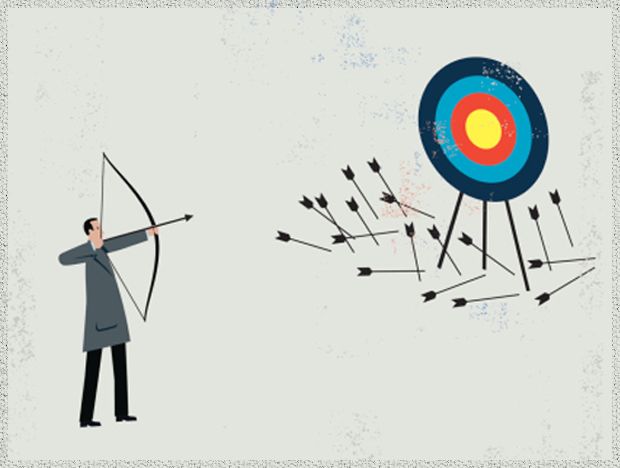
Where are You Aiming?

What if getting ready isn’t the first step?

“If you aim at nothing, you will hit it every time.”  -Zig Ziglar

Ready.  Aim.  Fire.

That’s the standard way to shoot at a target.  How many people actually follow these steps?

How many have you seen following other sequences:

Ready.  Fire.  Aim.

Fire.  Fire.  Fire.

Aim.  Aim.  Aim.  Aim.

Ready…  Ready…  Ready… (now what?)

Ready.  Aim.  Aim.  Aim.  Aim.  Aim.  Fire?  Fire?

Life is a series of choices.  A series of challenges.  A series of what if’s.

It’s impossible to know the true definition of “ready” in a life of endless possibility.  One can spend a lifetime “getting ready” for an outcome that may, or may not, happen.  The truth is, we are never fully ready.

What if getting ready isn’t the first step?  What if pursuing excellence is?

Excellence in whatever we do.  Excellence in the way we look at life.  Excellence in our contribution.  Excellence in the way we treat others.  Excellence in our expectations of ourselves and others.  When excellence is the target, the other steps become clear.

Pursue excellence.  Ready.  Aim.  Fire.  Adjust.  Pursue excellence.  Repeat.

Does excellence mean perfection?  No.  Pursuing perfection is a fool’s errand.  The good news is that by pursuing excellence we get a glimpse of perfection from time to time.

The target isn’t the real reward anyway.  That comes from the pursuit itself.


Finding the Next Higher Gear

That’s when I noticed my habit of shifting to a lower gear as the trail gets steeper ahead…

4-5-10-mountain-climbing

If you haven’t tried mountain biking, you don’t know what you’re missing.  It combines many of the best things in life:

Being outdoors, hard work, freedom, speed, some risk, and fun.

Like many sports, it’s also a great way to find your limits, and extend them a bit.

Mountain bike trails are either climbing or descending.  They may be smooth, rough, tight, rocky, rutted, or any combination of these.

Steep downhills have always scared me.  Way too fast for my taste.  That impossible battle with gravity, choosing the safest line, avoiding rocks, and leaning far enough back to avoid being pitched over the handlebars, make most steep downhills a game of survival for me.  Definitely outside my comfort zone.

I prefer climbing.  Give me a long, steep climb and I’m happy.  Tired, but happy.  Sure, gravity’s against me, but it’s not trying to throw me over the handlebars, or off the mountain side.  I get to focus on my pedaling rhythm, staying within myself, and seeing how fast I can climb the next steep hill.  It puts my mind in a quiet place.

Until someone goes around, gives a wave, and climbs out of sight!  He may be half my age, but that’s no excuse.  He’s found a way to put both himself and his bike in the next higher gear (or maybe a few higher gears).

That’s when I noticed my habit of shifting to a lower gear as the trail gets steeper ahead.  I haven’t reached the steeper section, and yet I’m already downshifting.  One could call this good preparation.

Or, fear.  Fear of being caught off-guard by the steeper trail.  Fear of actually finding my limits.  Fear that I can’t handle the next higher gear.  Fear that I’ll blow-up and have to stop, gasping for air.

Napolean Hill was right when he said, “the only limitation is that which one sets up in one’s own mind.”

As I watched that guy climb out of sight, I decided to experiment with the next higher gear.  Catching him wasn’t my goal.  That wasn’t going to happen.  Finding my limit became my new goal.  Whenever my habit said I should downshift, I purposely clicked to the next higher gear and left it there.  Suffice it to say, I found my limit a few times.

More often than not, I merely climbed faster, and clicked to even higher gears.

Since I was climbing, I had time to think.  The question that kept rolling around my head was whether I have the same habit of preemptively downshifting in other areas of my life.

Time to find out.


Photo Credit