Providing Room to Fail

Organizational culture, not technology, is the hardest part of innovation

How many of your projects are truly innovative? If you have any, what’s your success rate? Would you consider your success rate to be all-star caliber?

This baseball analogy is almost a cliché, but it holds up. A professional hitter with a .300 average is considered excellent (all-star?). That means they fail seven times out of ten.

Now imagine applying this to innovation. What if only 30% of your projects succeed? At first glance, that sounds like a losing record. But if the successful projects provide 10x productivity increases, transform your customer’s experience, or massively boost profitability…30% success would yield incredible results for your organization.

This is the kind of opportunity in front of us today with AI. Tools are maturing quickly. The potential is staggering. Every company, large or small, is beginning to experiment.

Some will tiptoe. Others will dive headfirst. All will face a mix of breakthroughs and busts.

There will be tools that don’t deliver on promises, pilots that fizzle, and teams that struggle with adoption. But there will also be amazing homeruns. Projects that reshape the business and redefine what’s possible.

Many leaders today are focusing on which AI tools to purchase and how to train their teams. That’s the easy part.

The harder part is creating space for both the hits and the strikeouts. If people feel they must succeed every time, they probably won’t swing at all. They’ll play it safe and stick with what they know.

Innovation will grind to a halt.

Providing room to fail doesn’t mean celebrating mistakes. It means making sure your team knows that experiments, even the ones that fall short, are part of making progress. Leaders who demand perfection get compliance. Leaders who make room for failure get innovation.

As you lead your organization into AI and beyond, remember that your job isn’t to guarantee every swing is a hit.

Your job is building a culture where people are willing to keep taking swings.

Photo by Chris Chow on Unsplash

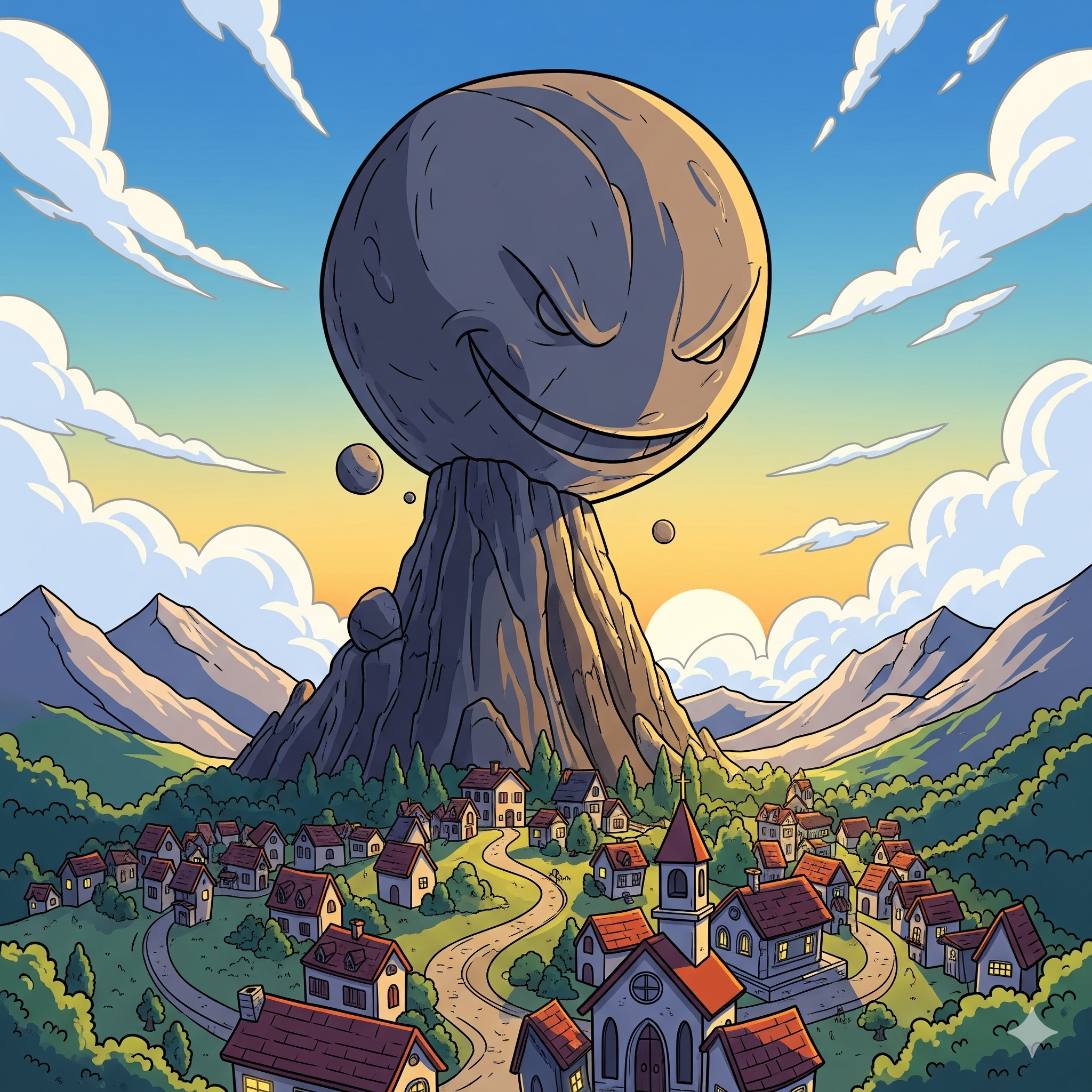
Who Will Hold the Boulder? (a short parable)

There once was a village named Smithville, tucked neatly beneath a mountain. Life was simple until the mayor spotted a massive boulder teetering on the slope. Experts confirmed the obvious. The massive boulder might fall and crush the town.

In a flash of civic urgency, the mayor declared: “We must secure the boulder!” And so they did. With ropes, pulleys, and sheer determination, ten villagers at a time held the lines to keep the boulder in place. They rotated shifts around the clock. It became routine, then tradition, then law.

Children sang, “Hold the boulder, hold the boulder, we must resolve to hold that boulder!” before school each morning. A cabin was built for the rope holders. A trail crew was hired to keep the path safe for the endless march of workers. Rope suppliers prospered since the intricate rope system required constant maintenance. Soon, nearly half the town’s budget went to “boulder security.”

Still, the village flourished. Visitors came to marvel at the rope-wrapped rock. “Come see our mighty gravity defying boulder!” proclaimed their glossy posters. A bond was passed to fund a visitor center and tour buses. Hotels filled. Restaurants boomed. Property values soared near “Boulder View Estates.”

One day, a newcomer named Brunswick questioned the logic of leaving the boulder where it was. “Why not break the boulder into smaller, harmless pieces?” The council laughed at his question.

The mayor beamed with pride, “Our boulder isn’t a threat. It’s our livelihood! Besides, we have a rope system to protect us.”

The townspeople nodded, waving their SAVE OUR BOULDER signs in support.

Who could argue with prosperity?

Brunswick left shaking his head.

Years later, despite the ropes, despite the cables, despite the slogans, the inevitable happened. That winter, the boulder grew heavier than ever with snow and ice. Villagers had trouble reaching the ropes, as storms blocked the trail. Shifts went unfilled. Fewer villagers meant fewer ropes to hold the boulder.

“The forecasters said it wouldn’t be this bad,” the mayor reassured them, as though the weather itself had broken its promise.

Workers tugged and shouted, trying to keep their grip. Fingers numbed, feet slipped, and a few gave up entirely.  The remaining ropes snapped one by one. The sound echoed through the valley like rifle shots. The mountain itself seemed to groan.

Then came the moment. The final rope gave way with a thunderous crack. The boulder lurched forward, dragging what remained of the cable nets with it.

As it tumbled down the mountain, the ground shook violently. Houses rattled, dishes shattered, and children screamed.

The mighty rock careened toward the valley, smashing trees like twigs and carving deep scars into the earth. Clouds of dust rose as if the mountain were on fire. Each bounce sent shockwaves through Smithville, knocking people off their feet. The villagers ran in terror, listening to the deafening roar as the great stone rolled ever closer.

When it finally came to rest, the devastation was complete. The visitor center lay in ruins. Boulder View Estates was flattened into rubble. Streets were cracked, and smoke rose from shattered chimneys.

Yet by some miracle, no one was hurt. The thunder of the falling boulder gave everyone time to flee. Amid the destruction, whispers of a miracle could be heard all over the battered town. 

As the dust cleared, townsfolk began to consider their plans for rebuilding. Some sketched designs for a grand new visitor center. This one would tell the story of The Great Fall.

A five-year plan was drafted to study rope alternatives, complete with a Rope Oversight Committee and quarterly progress reports.

Bureaucracy bloomed again, strong as ever.

Though no one mentioned the missing boulder.

Story behind the image – I used Google’s new Nano Banana image generator for this image. I asked it to produce a large and evil boulder sitting on top of a mountain, held by ropes, overlooking a nice town that it’s threatening…in a cartoonish style. This is the first image it produced. It missed the part about the ropes, but I like the over-the-top (see what I did there?) theme of this rendering. And that boulder may appear in a few more stories in the future.

© 2025 Bob Dailey. Licensed under Creative Commons BY-NC-ND 4.0.

I’m Not That — What You’re Not Might Be Holding You Back

Sometimes the hardest limits aren’t what we believe we are…but what we’ve decided we’re not.


Leader: I’m hitting a wall. No matter how hard I try, something’s stuck.
Coach: Where?
Leader: Connecting with my direct reports. The one-on-one meetings. All the details. I’m just not wired for any of it.
Coach: You sure?
Leader: I’ve never been good at connection. I’m not super technical. I’m not touchy-feely. I’m not a detail person.
Coach: Sounds like you’ve got your “not” list down cold.
Leader: Isn’t that just self-awareness?
Coach: Could be. Or maybe you’re protecting yourself with that list.
Leader: I’m not trying to be someone I’m not.
Coach: Are you avoiding someone you could become? What if the growth you’ve been chasing is on the other side of “I’m not”?
Leader: What if I do all that work and don’t like what I find?
Coach: Then you’ll learn something real. But what if you find a strength you didn’t know you had?
Leader: That feels like a stretch.
Coach: Growth usually does.


“Ego is as much what you don’t think you are as what you think you are.”
Joe Hudson

We usually spot ego in people who overestimate themselves. Their arrogance and swagger enter the room before they do.

But ego has a quieter side. It hides in the limits we quietly accept. Not in who we think we are, but in who we’ve decided we’re not.

“I’m not technical.”
“I’m not good at details.”
“I hate public speaking.”

These negations, the things we distance ourselves from, might feel like declarations of strength and clarity.

But often they are boundaries we’ve unconsciously placed around our identity. Once we’ve drawn these lines, we stop growing beyond them. They protect us from challenges, discomfort, and the hard work we know will be required.

Leaders who define themselves by what they aren’t often:

-Avoid feedback that challenges their identity.

-Miss chances to adapt or grow.

-Choose the path of least resistance.

-Struggle to connect with different types of people.

-Dismiss skills they haven’t developed (yet).

If you’re feeling stuck, ask yourself:

-What am I avoiding by saying, “I’m not that”?

-What am I protecting by holding on to that story?

-What might open up if I let it go?

Sometimes the next chapter of growth begins not with a new strength, but with a willingness to loosen our grip on the stories we tell ourselves.

If you want to grow as a leader—or help others grow—it’s not enough to ask, “Who am I?”

You also have to ask, “What am I willing to become?”

Photo by Amir Mortezaie on Unsplash

When Fires Become the Work

Ask someone how their day went, and odds are, they’ll say, “Busy.”

Dig a little deeper, and you’ll hear about the fires they had to put out, the urgent requests from their boss, or the upset customers they had to talk in off the ledge. Everyone’s racing from task to task, reacting to whatever pops up next.

What you don’t hear—at least not often—is someone saying, “Today I worked on our 30-day goals,” or, “I spent the afternoon exploring how AI might streamline our operations,” or, “I studied what our competitors are doing better than we are.”

Most people are caught in an infinite response loop. The big questions get pushed to tomorrow, especially if the boss isn’t asking about them anyway. And often, he’s just as busy reacting to his own list of urgent problems.

Response mode is easy. You don’t have to choose what matters most. Just deal with what’s in front of you. There’s no time for stepping back, rethinking the process, or preventing tomorrow’s fires today. You stay busy. That way, you can tell yourself you’re still needed.

And when the day ends, you can point to everything you handled and feel like you earned your paycheck.

But the real questions are:
Did you move any of your monthly, quarterly, or annual goals forward?
Do you even know what they are?

For many, the answers are no and definitely no.

Working in the business is the default. It’s safe and familiar. It keeps your hands full.

Working on the business is different. It takes time, thought, and courage. It means facing questions without clear answers. It means exploring new tools, unlearning old habits, and imagining better ways to serve your customers.

No fires today? Is your boss on vacation? Sounds like an easy day.

But if no one thinks about what’s next, if no one is asking what should change or improve, and if no one is steering the ship, that ship will eventually drift. Maybe into a storm. Maybe into the rocks.

And no one will notice until it’s too late.

So, ask yourself:
Are you steering, or just responding?

Side note: These questions apply outside of work. If we’re not actively steering in our personal lives, we can just as easily find ourselves in a storm we could have avoided, running aground on some rocks, or drifting aimlessly out to sea.

Photo by Amir Saeid Dehghan Tarzejani on Unsplash

Garbage In, Garbage Out: Your Focus Defines Your Success

“Garbage In, Garbage Out” doesn’t just apply to computers—it applies to your life. The people you spend time with, the content you consume, and the habits you build shape your future. Want better results? Choose better inputs.

“You are the average of the five people you spend the most time with.” – Jim Rohn

“You are what you repeatedly do.” – Aristotle

“Show me your friends, and I’ll show you your future.” – John Kuebler

“Your life is controlled by what you focus on.” – Tony Robbins

The old phrase, “garbage in, garbage out” doesn’t only apply to computers and databases. It applies to how we live our lives.

Our inputs—the people we surround ourselves with, the information we consume, and the habits we cultivate—shape our outcomes.

If you spend time with amazing, imaginative, productive, and adventurous people, chances are you’ll start adopting some of those same qualities. At a minimum, you’ll develop personal goals that push you to emulate those qualities in your own way.

On the other hand, if you surround yourself with negative, self-destructive, bitter, or complacent people, their mindset and behaviors will slowly seep into your own life. Even if you think you’re immune, habits and attitudes are contagious.

Small Choices Compound Over Time

Consider this simple example.

If you exercise at least three days per week, you’ll see progress. Do it five days per week, and your results will be even better.

But if you instead have the habit of drinking a large chocolate shake for lunch every day, the impact won’t be immediate, but with time you’ll notice a negative shift in your health and energy levels.

Neither of these changes happen overnight.  But over months and years, they define who you become.

Our small choices create big results.

The Status Quo Trap—It’s Hard to Change

It’s obvious that if you run toward a cliff, ignoring all the warning signs, you’re in for a big fall. But in real life, it’s rarely that clear.

Like the boiling frog who doesn’t realize the water is heating up until it’s too late, many people stay in toxic environments, bad habits, or unproductive routines because the declining results are slow and gradual. It doesn’t feel urgent—until suddenly, it is.

Our Inputs Dictate Our Outputs—So Choose Wisely

Our mind works like an algorithm.  What we feed it shapes what it returns to us.

If we constantly consume negative news, gossip, or toxic social media, our mindset will reflect it.

If we surround ourselves with people who challenge us to grow, read books that inspire us, and engage in meaningful conversations, our perspective will shift toward productivity and fulfillment.

The good news? We choose. And by making intentional choices, we set the trajectory for our future.

Challenge: Take an Inventory of Your Inputs

For the next week, pay attention to what’s influencing you.  Your environment, the content you consume, and the habits you engage in.

Who are the five people you spend the most time with? Are they making you better?

What are you reading, watching, and listening to? Is it fueling growth or draining your potential?

What small habit could you start today that would improve your future?

The inputs you choose today will shape who you become tomorrow, next year, and a decade from now.

Your choices matter.  Make them count.

Photo by William Topa on Unsplash

Breaking the Rhythm of Mediocrity

Each of us has a natural speed.  A rhythm that feels comfortable. Some of us move fast, always pushing, never stopping. Others take a slow, methodical approach. And some avoid movement altogether.

Occasionally, we can shift gears and speed up for a short-term need. But the comfort of our standard speed usually draws us back.

Dialing up is hard. It’s difficult to imagine doing more than we’re doing now. It’s harder still to visualize the better outcomes that could come from pushing ourselves and our organizations beyond the status quo.

Even worse is when we deliberately slow our pace to fit in.  To blindly match our rhythm to those around us, in our workplace, our social circles, our environment. The groups we allow to shape us.

The slow, almost imperceptible tick-tock of our internal metronome feels safe, especially if it’s set to someone else’s rhythm. It’s predictable. It gives us a (false) sense of control when we have no control at all.

We tell ourselves that changing our settings would bring chaos.  Better to stay safe and avoid the challenge. 

If we’re willing to turn our settings down to accommodate others, why not turn them up to pursue our own goals?

Why not push beyond our comfort zone to improve, to evolve?  Why not try to inspire those around us to ramp up? 

The things we don’t change are the things we’re actively choosing. Doing nothing is a choice.

Life moves at a relentless pace, largely outside our control. What we can control is our response.  We can set our internal rhythm to match what’s happening or set it to create what we want to happen.

Here’s a brutal truth: The outside world doesn’t grant or deny us anything. It keeps moving, with or without us.

It’s up to us to set our own tempo—not for the group, not for the organization, but for ourselves and the people who matter most.

Photo by Lance Anderson on Unsplash

Embrace Newton’s Motion: Breaking Free from Inertia

Newton’s first law of motion (also called the law of inertia), states that an object at rest will stay at rest, and an object in motion will stay in motion unless acted upon by an external force. While this principle is foundational in physics, it can be applied to the way we live our lives. 

In our daily lives, it’s easy to remain at rest. We experience moments of doubt and confusion, low motivation, and a natural tendency to avoid change. This mental and emotional inertia can keep us stuck, making it difficult to take action or move forward. Organizations often reinforce this inertia with incentives that promote the perceived “safety” of maintaining the status quo.

As we age, this resistance to movement can become even stronger. We rely on past experiences, often using them as justifications for inaction. “It didn’t work before, so why would it work this time?” This mindset is a barrier to personal growth and fulfillment.

Unfortunately, a life at rest, devoid of risk and new experiences, can become empty and unfulfilling.

Our goal should be to actively push against the inertia holding us in place. This involves taking risks, trying new things, and offering our time and energy to others. Overcoming inertia requires a conscious effort to break free from the comfort of staying still.

The second part of Newton’s law of inertia emphasizes that an object in motion tends to stay in motion. This should be a powerful motivator. Once we start moving in a direction, it’s likely that we’ll continue to do so unless something actively stops us.

Turns out that those around us are battling their own inertia and may not have the energy to impede our progress.

By choosing to move, we can capitalize on opportunities that arise. While others remain stuck in their self-imposed rest, we can explore new paths, achieve our goals, and live our most fulfilling life long before they even notice what we’re doing.

Embrace the motion. Take action. Push past the barriers, especially self-imposed barriers.   The world is full of opportunities for those who dare to tap into the Newtonian motion that’s available to each of us…all we have to do is move. 

p/c – Benjamin Voros, Unsplash.com

The What If Game

Powering your day...

I recently saw this advice:

Asking what if about your past is a waste of time.  Asking what if about your future is tremendously productive. – Kevin Kelly

It’s easy to focus on what could have been, what you should have done, what someone did or didn’t do to you (or for you), and all the mistakes you’ve made.

It’s even easier to let all that stuff in the past dictate what you’ll do in the future.  Our past has tons of built-in excuses.  Excuses that help us stick with the status quo, protect us against taking new risks, prevent us from trying something new, or exploring where we’ve never been. 

Our lizard brains love the barriers that the past can provide.  Like a protective cocoon…one we never have to leave.

What if you choose your future without the limitations or excuses of your past? 

That’s the harder and much more rewarding path.  You might fail.  You might be embarrassed.  You’ll surely make new mistakes. 

But you might succeed, and you’ll probably discover something you never knew you were seeking.

You can accept the lessons of your past as you drop the past from your thinking. 

When was the last time you did something for the first time? 

Did you take more than 30 seconds to answer that question? 

What if you purposely pursue the surprises that come from diving headfirst into new experiences and adventures?

It’s time to find out.    

Photo: My grandson, Charlie, boogie boarding for the first time (about 5 years ago). May we each experience the same joy when we’re trying something for the first time.

Premature Judging

The easiest approach is to prematurely judge, declare failure and decide who to blame…

Should a new home construction project be judged when only its blueprint exists?  How about when the site has been prepared?  What about when the materials like wood, rebar, and electrical conduit are delivered?

Should we wait to judge the home build until the framing is complete?  Should we wait until the walls and roof are added?  Or, wait until all the windows are installed?  What about the paint and other finishing touches on the house?  Should you wait for those to be completed?

Can you judge the success of the home build before it’s finished?

When making chocolate chip cookies, do you judge the success of the cookies while mixing the ingredients?  How about when the chocolate chips are poured into the batter?

What if the recipe called for real butter, but you only have that non-diary butter substitute that’s supposed to be healthier than butter?  Are your cookies doomed at that point?  Should you call-off the project and declare it a failure?

Assuming you’ve made it past the butter/non-dairy butter issue, is it right to judge the cookies after they’re spooned out onto the cookie sheet, but not yet baked?

Just before placing those filled cookie sheets into the preheated oven, is that the time to re-evaluate the entire cookie-making process to determine if it’s failing?  Should you call a meeting to discuss whether the cooking temperature listed in the recipe is the correct one for your cookies?

Houses and cookies are obvious examples of “projects” that have a lot of moving parts.  They build from a set of raw ingredients, mixed with time and effort, into a completed item.

What about less obvious events in our lives?  When’s the right time to judge these for success or failure (using whatever measures you’ve chosen)?

  • new job
  • new business
  • new business strategy
  • new information system
  • new software development project
  • new friends
  • new marriage
  • new workout regimen
  • new hobby
  • new home

The easiest approach is to prematurely judge, declare failure and decide who to blame.  Failure is comforting.  The status quo is easy.

The new thing is never easy.  Creating something new is almost always uncomfortable.

When we judge too early, failure soon follows.

By the way, the cookies were amazing, but not until they came out of the oven.

Photo by NeONBRAND on Unsplash

Blame and Our Ego

Why do we play the blame game?

“If you get your ego in your way, you will only look to other people and circumstances to blame.” –Jocko Willink

Here’s a thought experiment…

Looking back over the past few weeks (or months, or years), how many times did you blame:

  • someone
  • some thing
  • traffic
  • an injury
  • a disability
  • the weather
  • the economy
  • the government
  • your boss
  • your employee
  • social media
  • a company
  • a bad memory
  • anything but yourself?

No matter the subject, there are plenty of candidates for our blame…as long as we can aim it outward.

Our ego prefers blaming “the other” rather than accepting responsibility.  Life’s easier that way.

Blame doesn’t just apply to things that happened in the past.  Blame is most powerful (and crippling) when it prevents something from happening in the future:

  • I won’t be able to make it out there tomorrow. The traffic is just too crazy at that time.
  • I hate this job, but I don’t have time to learn a new trade.
  • I’d love to help you move, but with my bad back, I wouldn’t be very helpful.
  • There’s no way I’d ever start my own business in this economy. Besides, who needs all the government regulations and hassle?
  • It’s way too cold out there to go for a walk today.
  • I’d love to travel more, but there’s no way my boss would ever give me the time off.

How many times have you used blame to avoid doing something new, or something that could fail?

Blame is useful when it establishes a foundation for improvement.  When it represents a first step toward identifying root causes that can be solved.

Beyond that, blame has very little value, except stroking our ego (and keeping us nice and warm in our cacoon of status quo).

Photo by Casey Horner on Unsplash