Always Improve Your Position

A few days ago, I was listening to Jocko Willink speak about the quiet discipline behind Brazilian jiu-jitsu. I’m not a jiu-jitsu person, but one idea landed for me. It’s a truth I already knew but had never heard spoken so simply:

Always improve your position.

In jiu-jitsu, nothing happens all at once. A submission arrives like lightning, but only to the untrained eye. What looks like a sudden victory is really the final expression of dozens of subtle movements that came before it. A hip shifts. A grip tightens. An elbow gains an inch of space. Most of these moves go unnoticed. Each small adjustment creates a little more room, a little more leverage, a little more advantage.

I’ve always believed real progress works this way. It’s rarely dramatic. It’s quiet and patient. The accumulated effect of showing up, learning something new, adding a bit more care, and preparing a little more than required.

Breakthroughs rarely come from a single moment of inspiration. They come from the quiet work no one sees. The thoughtful practice that sharpens your skills, the trust built over months of ordinary conversations, the time spent learning before making a decision. When opportunity arrives, it looks sudden to others. To you, it feels like the next logical step.

This truth showed up clearly for me after a derecho tore through our property on Father’s Day weekend a few years ago. Ninety-mile-per-hour winds knocked down at least thirty trees across multiple acres. When I walked our land the next morning, everything felt broken and overwhelming. The cleanup looked like a project that would take months. I didn’t have months to devote to it.

But I did have mornings. So, I decided to work for an hour and a half every day before work. I cleared a small section each morning. It was incredibly slow. I dragged branches, cut trunks, chipped debris, split firewood, and made countless trips to our local dump. Small steps, small progress, one morning at a time.

Over the course of a year (maybe more), I worked my way across our entire property. Along the way, I cut in new hiking trails and removed a number of unhealthy trees. What started as a mess became a healthier stand of trees and a network of paths that look like they’ve been here forever.

Out of destruction came a daily habit that changed my life. I still work outside every morning. Clearing brush, trimming trees, expanding trails, building chicken coops, restoring a rustic barn. All in small ninety-minute bites. It’s like a time-lapse video created through countless quiet mornings of small improvements.

The pattern I saw on my land is exactly what Jocko described on the mat. I didn’t need a grand plan or a burst of superhuman effort. I needed to improve my position every day, just by a little.

Improve your position today, even by an inch, and tomorrow becomes easier. Improve it again tomorrow, and the day after that reveals options that didn’t exist before. You don’t need surges of motivation or dramatic reinvention. You only need the willingness to keep moving, always improving.

Careers grow this way. Trust grows this way. Faith deepens this way. Families strengthen this way.

Progress won’t always be linear. Some days distractions will pull us off course, or setbacks will undo work we thought was finished. All of this is part of the journey. Even then, the way forward still comes through small steps. Imperfect, uneven, but the work of always improving our position remains the same.

We improve our position slowly, almost without noticing. That’s enough. Tomorrow, we’ll improve again. Then one day, we’ll find ourselves able to take a step that would have felt impossible a year ago.

Focus on the next inch. The miles will take care of themselves.

Photo by Walter Martin on Unsplash – a great rendition of my early morning work environment for at least a year.


Teachers, Mentors, and the Grace That Carries Us

“There is no Frigate like a Book / To take us Lands away.”

Emily Dickinson wrote these words in her quiet room, understanding something I didn’t grasp for decades. The greatest journeys begin within.

I know her poem only because of my 11th grade AP English teacher, Mr. Cox. As a rambunctious and cocky 11th grader, would I have taken any of my “super valuable” time to read poems, sonnets, short stories, even books? No way.

But because of his work (and the work of countless other teachers along the way), I did read. A lot. I learned tons of material and information that didn’t matter to me at the time…but matter a lot today.

My focus back then was simple. Be the best student, get the highest test scores, pass as many AP tests as possible, and earn varsity letters in multiple sports. Mostly, I wanted to beat everyone else, pure and simple. It helped that I was blessed with an almost photographic memory and could recall facts and formulas with ease (sadly, not so much nowadays).

I carried that mindset into college. I loved being the student who defined the grading curve for the class. I was annoyed if I didn’t get every single point on an assignment, midterm, or final. I had an almost uncontrollable drive to outshine everyone…as if that was all that mattered.

I was completely wrong.

On the bright side, that drive and motivation made me a successful student and propelled me into my early career.

On the other hand, seeing everyone as my competition, and less as people, meant I probably missed out on a lot of fun. And lots of friendships that never happened. I was so focused on the destination that I forgot to notice who was traveling with me.

That realization connects me back to Dickinson’s frigate in ways I never expected. She saw the book as a vessel capable of carrying anyone, anywhere, without cost or permission. But what I’ve learned over nearly fifty years since high school is that I was asking the wrong question. It was never “How far can I go?” It was “Who am I becoming, and who’s helping me understand?”

My journey from that hyper-competitive teenager to what I hope is a much more caring, thoughtful, empathetic, nuanced, and life-giving person has been propelled by those same teachers I mentioned earlier, and a longer line of guides who keep showing up at the right time in my life.

I didn’t realize it then, but those books, poems, and teachers were all part of my fleet of frigates. Each one quietly helped me close the distance between knowledge and understanding, between my ambition and wisdom.

My mentors, family, and friends have all been vessels that carried me through changing seas. Some taught me to sail straight into the wind. Others reminded me that drifting for a while can be part of my journey as well. Each lesson mattered, even the ones that didn’t make sense at the time…especially those.

Over time, life has a way of sanding down our sharper edges, revealing something deeper underneath. My focus slowly shifted from being the best at something to becoming the best version of myself.

Now, when I think about Emily Dickinson’s frigate, I picture something far greater than a book. I picture a lifetime of learning, carried by the people who invested their time, wisdom, and patience in me. Mr. Cox, and others who gave freely of their time and wisdom, helped me see that the destination isn’t solely becoming the top of the class. It’s finding a profound depth of understanding, the expansion of empathy, and the ability to see beauty and meaning in small, unexpected places.

If I could go back and talk to that 16-year-old version of myself, I’d tell him the real tests aren’t scored on paper. They’re graded every day in how we treat people, how we listen, and how we show grace.

I’d tell him that the frigate he thinks he’s steering alone has always been guided by grace. The true measure of his voyage will be how much space he makes for others to come aboard.

We’re all learning to sail, carried by the steady hand of God.

We never really travel alone.

Photo by Rafael Garcin on Unsplash

Process Over Outcome — The True Value of Life’s Challenges

The year spent training for a triathlon isn’t just about race day.  It’s about the discipline, endurance, and self-discovery that come with each mile ran, every beach swim, and each grueling mile logged on the bike.  The race is the goal, but the transformation to triathlete happens during the journey to the starting line. 

What about Basic Training for the Marine Corps (something I haven’t personally experienced)?  Recruits aren’t merely learning the basic skills they’ll need to be successful.  They are becoming something entirely new…a Marine. The recruit is transformed into a Marine by the training process.   

Consider a four-year college degree.  It’s been said (not sure who said it first) that the main thing a recruiter learns about a college graduate is that they had to apply themselves adequately over a four (or five, or six) year period to get enough class credits to graduate in their chosen major. Each college graduates’ journey is different, and that journey is often as valuable as the classes they had to take to get their degree.  

Even smaller experiences like a short hike, a long drive to visit family, or a phone call with a friend can offer more than just their immediate outcomes. They can provide moments of reflection, connection, and growth.

Life’s experiences are not just a series of goals to be checked off or memories to be cherished.

When we learn to enjoy the process and the lessons along the way, we gain something far more valuable: growth, understanding, and the ability to appreciate the transforming power of our journey.

 Photo by Matt Howard on Unsplash

A Season for Renewal

True renewal is a deliberate act of self-reclamation…

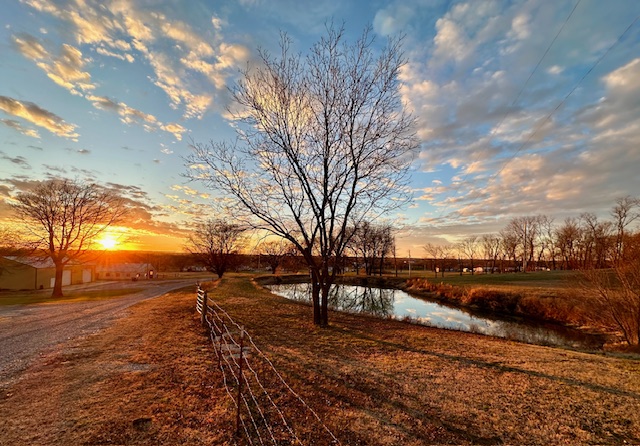
p/c: a recent sunset at our little homestead

Prayer to Saint Joseph the Worker

O Glorious Saint Joseph, model of all those who are devoted to labor,

obtain for me the grace to work in a spirit of penance for the expiation of my many sins;

to work conscientiously, putting the call of duty above my natural inclinations;

to work with thankfulness and joy, considering it an honor to employ and develop by means of labor the gifts received from God;

to work with order, peace, moderation, and patience, never shrinking from weariness and trials;

to work above all with purity of intention and detachment from self, keeping unceasingly before my eyes death and the account that I must give of time lost, talents unused, good omitted, and vain complacency in success, so fatal to the work of God.

All for Jesus, all through Mary, all after thy example, O Patriarch, Saint Joseph. Such shall be my watch-word in life and in death. Amen.  – Pope St. Pius X

In life’s journey, we may find ourselves off course or losing track of our original path. We may even fail ourselves or those we love. It is in these moments that we are being called to profound self-discovery and renewal. 

Renewal is not a passive occurrence.  As the prayer to Saint Joseph states, it requires us “to work conscientiously, putting the call of duty above [our] natural inclinations.”  True renewal is a deliberate act of self-reclamation.  We have a duty to ourselves and those we love to put in the work that leads to our self-transformation. 

It isn’t easy (nothing worthwhile ever is).  It involves adapting, finding new ways, and being intentional about embracing change. 

When we realize that ours is always a season of renewal, that we can “work in a spirit of penance for the expiation of [our] many sins,” then we will be able “to work with order, peace, moderation, and patience, never shrinking from [the] weariness and trials” of our self-improvement. 

May the spirit of renewal be our guide, not diverting us from our journey but enhancing it.  May we find the resilience within us to adapt, renew, and move forward with a fresh sense of purpose and determination.