The Day We Visited the Taj Mahal and Never Saw It

There are certain destinations in the world that feel larger than life. The Taj Mahal is one of those places. For many travelers, seeing it with their own eyes is a once-in-a-lifetime moment.

We were finally there. We had made it to Agra. All that remained was to step inside the gates and witness the iconic white marble glowing in the sun.

Only one problem.

There was no sun. There was no white marble. There was no Taj Mahal.

There was only fog.

We woke that morning filled with hope. The rooftop restaurant gave us a commanding view of… absolutely nothing. We stared into a wall of haze, sipping coffee and laughing at the absurdity of our timing. Surely the fog would lift. Surely the Taj Mahal would reveal itself.

Our guide, Kuldeep, assured us everything would be fine. He had led more than 500 tours of the Taj Mahal. He knew everything there was to know about its history and its beauty. We boarded our bus, grabbing our special cloth bags with a picture of the Taj printed on them. These were designed to hold the single water bottle we were allowed to bring inside the property. And we set off with excitement.

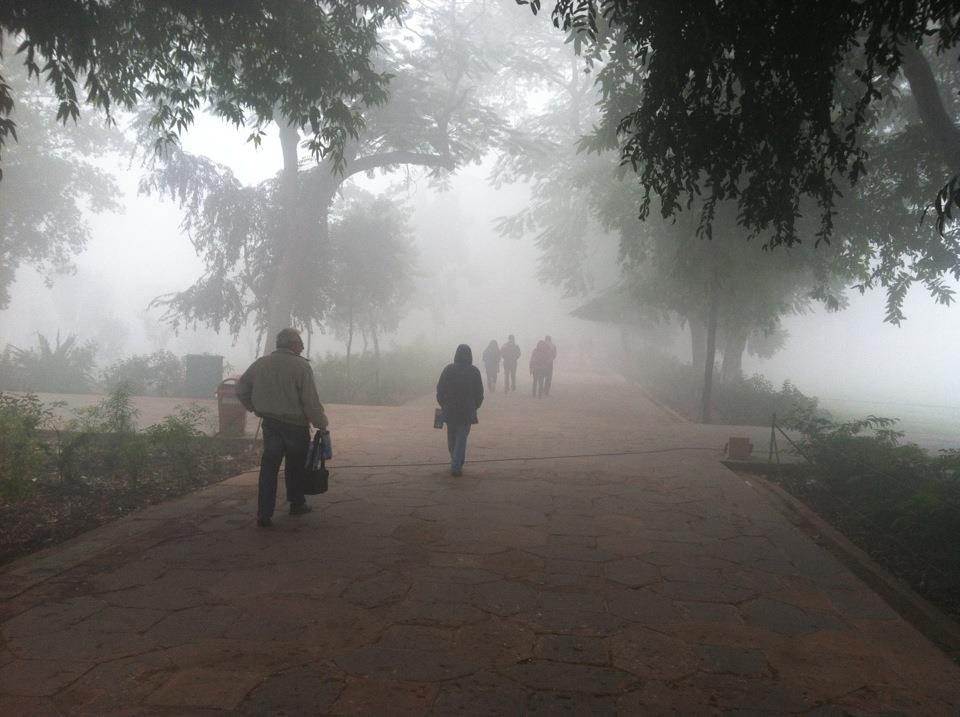
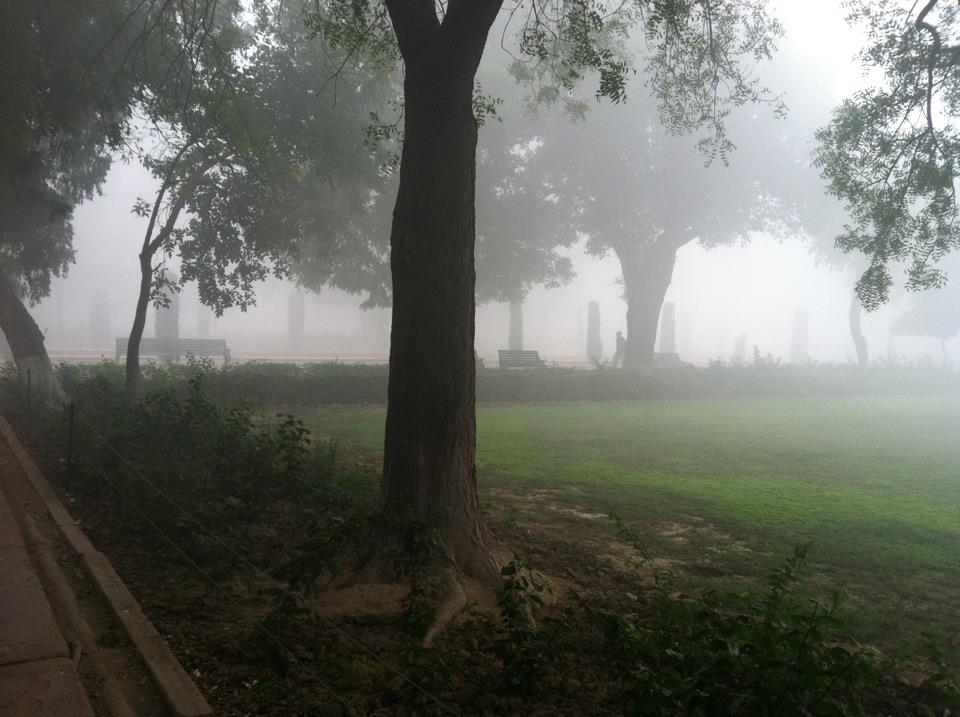
Fog. All the way there. Fog in the parking lot. Fog at the security lines. Fog as we walked the long approach toward the main viewing area. Each time Kuldeep stopped to point out an “excellent vantage point,” we nodded with wide eyes, imagining the magnificent structure hidden somewhere in the mist.

We took photos pointing at the picture on our water bottle bags. That was the only Taj Mahal available to us from any vantage point.

As we walked toward the building, we eventually reached the outer wall and finally saw something. White marble appeared just a few feet above our heads. Then the stone vanished again into the haze. The grand dome. The sweeping arches. The delicate inlays. All shrouded in fog.

We were standing beside one of the wonders of the world and could only see a sliver of it.

Our group laughed so much that day. Not because we had traveled halfway around the world only to miss the view. We laughed because we were sharing something unforgettable and slightly ridiculous. We were experiencing a story that would last much longer than a postcard-perfect photograph.

Kuldeep shook his head with disbelief. In all his tours, he had never experienced this. He told us we were a very select group of visitors who could claim something few on Earth could say. We visited the Taj Mahal, but we have never actually seen it.

He was right. I still have never seen the Taj Mahal in person.

The destination was never the prize

You might think this would be a disappointment. But when I look back on that trip, the fog made everything richer.

The destination was never the prize. The people were.

We shared meals and conversations and inside jokes. We tried foods that were new to us. We navigated chaos and beauty side by side. We saw India’s contrasts and colors and kindness. We saw devotion expressed in temples and marketplaces. We saw how history and modern life can exist on top of each other without barriers.

The Taj Mahal is extraordinary. I would love to see it someday with clear skies and a rising sun. Yet I already have what I came for.

When I think about all the amazing places I have been blessed to visit, a pattern appears. I never say, “Remember when we saw that famous landmark.” I say things like:

– Remember how we got lost trying to find it?
– Remember the tiny restaurant we discovered afterward?
– Remember the guide who became a friend?
– Remember that amazing gelato place in the middle of nowhere?

I have my memory of that rooftop breakfast. I have the echo of laughter on the bus. I have the photos of my family and friends pointing to a water bottle bag as if it were the crown jewel of Indian architecture.

The world is full of wonders. But relationships are the wonders that stay with us.

The real bucket list

If someday I return to the Taj Mahal and finally see it, I’ll smile and take it in. But I know the picture etched into my heart is already complete. It’s filled with faces and voices and laughter. It has the beauty of our shared experience.

Checklists are fine for airplanes. But our lives deserve something better.

The best adventures can’t be captured by a camera or a perfect view. What lasts are the relationships made stronger by shared surprises, setbacks, and moments of wonder.

This story, fog and all, remains one of my favorites.

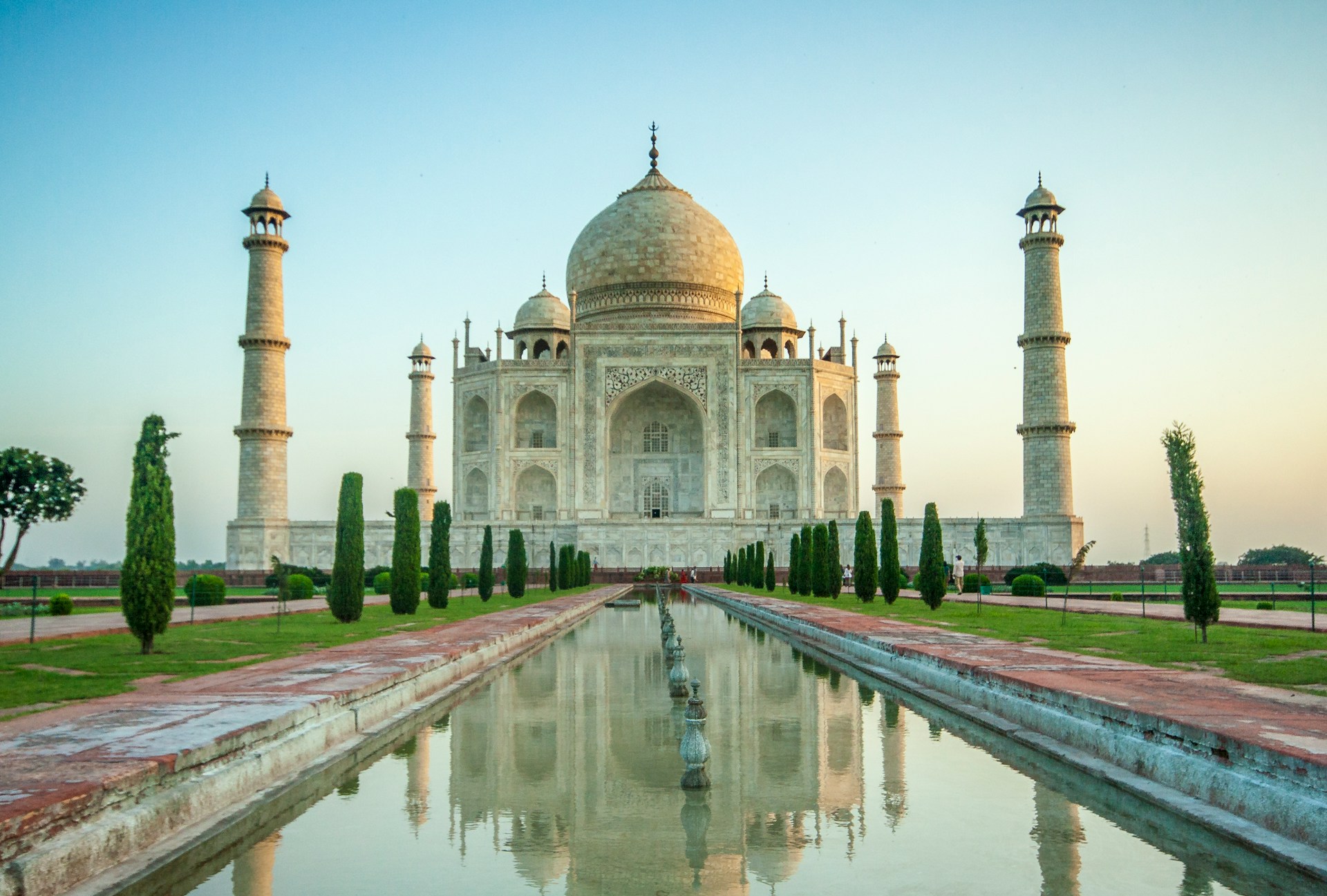
Photo by Mark Harpur on Unsplash showing the majestic beauty of the Taj without fog. 

The photos below are mine showing what we actually saw.  Unfortunately, the amazing water bottle bag photos are stored on a drive I can’t see…a little bit like that morning in Agra more than a decade ago.    

What Your 70-Year-Old Self Knows That You Don’t

We know about Maslow’s Hierarchy of Needs and how our wants and desires are like a pyramid that goes from our basic needs up to our desire for self-actualization. The Pareto Principle reminds us that 80% of our results come from 20% of our efforts, helping us focus on what truly moves the needle. Saint Ignatius’s Spiritual Exercises guide us through discernment, teaching us to distinguish between what brings life and what drains it.

But there’s another framework worth considering: the evolution of what we consider important throughout our lives.

As kids, we know what’s most important. It usually revolves around attention, followed by winning at whatever we are doing, which we think will get us more of that attention we crave. Everything feels urgent. Every disappointment feels permanent. The world revolves around us, and that’s exactly as it should be for a child learning to navigate life.

Teenagers start to focus on freedom, independence, and figuring out what they’re going to do when they grow up (whatever that means). They often reject what their parents value. Sometimes for good reasons, sometimes solely because rebellion feels necessary for finding their own path. What matters most is breaking free from the constraints that feel suffocating, even when those constraints were designed to protect them.

As young adults, we’re getting started, establishing our independent life, our financial foundations, our career foundations…at least we’re trying to get these things established. We’re in acquisition mode: getting the job, the apartment (maybe a house), the relationship, the respect (something we crave more than attention at this stage). We often dismiss advice from older generations, convinced they don’t understand how different the world is now.

Then something interesting happens.

As the decades flow by, what was important a few years ago, isn’t. We start to think about how to serve others, help our kids flourish, help their kids flourish. The shift is gradual but profound. From getting to giving, from proving ourselves to improving the lives of others.

Major life events accelerate this evolution. A health scare makes us realize that all the success in the world doesn’t matter if we’re not here to enjoy the fruits of our labor. The birth of a child or grandchild suddenly makes legacy more important than achievement. The loss of a parent reminds us that time is finite, and relationships are irreplaceable.

Sometimes the shift happens more quietly. Earlier this week, two co-workers were discussing the NBA finals and asked me what I thought of Game 2.  I had to admit that I haven’t followed basketball since the Magic Johnson era of the Lakers. As we talked, it became clear to me that I haven’t followed any sports—except for the Savannah Bananas baseball team’s shenanigans—in many years.

What captures my attention now? I’m drawn to watching people live their best lives in rural settings, building homesteads for themselves and their families. I find myself rooting for others to succeed in their chosen vocations, nothing more, nothing less. It’s not that sports became unimportant because they were bad. They just became less important than something else that feeds my soul more deeply.

As we get older, preserving our health, and the freedom that comes with it, moves toward the top of our priority list. Interesting how the freedom we sought as teenagers is still important to us in our senior years, but for different reasons. Then, we wanted freedom and thought we were ready for responsibility.

Now, we want freedom to focus on what truly matters. Freedom to be present for the people we love, freedom to contribute in meaningful ways, freedom from the noise that once seemed so important.

There’s a beautiful irony in how we often spend the first half of our lives accumulating things, achievements, and accolades, only to spend the second half learning to let go of what doesn’t serve us. We chase complexity when we’re young and value simplicity as we mature.

Questions worth considering:

– What would happen if we could skip ahead and see what our 70-year-old self considers important? What about our 80-year-old self? Would we make different choices today knowing what they know?

– Why do we have to learn the hard way that some of the things we chase don’t matter? Is there wisdom in the struggle, or are we just stubborn?

– How can we be more intentional about evolving our priorities on our terms instead of waiting for time to do it?

– What if we could honor the lessons each life stage provides without completely losing face and dismissing what came before?

The evolution of importance isn’t about getting it right or wrong at any particular stage. It’s recognizing that growth means what we value will shift.

That’s not a bug in the system. It’s a feature. The teenager’s desire for freedom isn’t foolish. It’s necessary for their development. The young adult’s focus on building a foundation isn’t shallow. It’s essential for future stability.

Perhaps the real wisdom comes in staying curious about what matters most. Knowing that the answer will keep evolving. And maybe, just maybe, we can learn to trust that each stage of life has something valuable to teach us about what’s truly important.

The key is staying awake to the lessons, even when they challenge what we thought we knew for certain.

Photo by Filip Kominik on Unsplash

Through His Eyes: A Lifetime of Wisdom Captured on Canvas

There are some paintings that do more than just depict a subject.  They capture an entire story, an entire lifetime, in a single moment. This piece is one of those rare works that demands to be seen. It grips its viewer, pulling them into a world of experience, emotion, and wisdom.

I see far more than just an old man with a pipe. I see the passage of time written across his face.  Lines carved by laughter, sorrow, resilience, and acceptance.

His piercing gaze holds stories of joy, regret, belief, triumph, failure, love, admiration, and appreciation. His expression speaks of a man who has not just existed but has truly lived, embracing all that life has offered, both the good and the bad.

Beyond his gaze, I see a hand that tells a story all its own.  His hands have endured hard work.  They’ve held the people he loves. These hands have fought, and they’ve also comforted. They are worn, yet steady.  A testament to a life of resilience, labor, and tenderness.

His grip on the pipe isn’t just a habit.  It’s a ritual.  A moment of reflection held between calloused fingers that have stood the test of time.

I didn’t know Richard Hatch personally before his recent passing.  But I can see through his painting that he had a remarkable ability to portray humanity on canvas. He wasn’t just painting a face.  He was capturing the soul of this man for each of us to see. 

Every brushstroke tells a story.  Every shade of color conveys emotion, and every detail reflects a life filled with lessons. His is the kind of art that doesn’t just sit on a wall.  It reaches out, starts a conversation, and lingers in your mind long after you’ve looked away.

Our days become years, our years become decades, and before we know it, our decades are a lifetime. This painting reminds me of that stark reality.  Not in a sad way, but in a way that urges me to embrace every moment while I can. To live fully, to love deeply, and to accept this journey for the adventure that it is.

Mr. Hatch’s painting reminds us of the beauty in aging, the dignity in experience, and the wisdom of acceptance.

p/c – Painting by Richard Hatch 

Letting Go

You are not what has happened to you…

“If there are pieces of your past that are weighing you down, it’s time to leave them behind.  You are not what has happened to you.  You are someone unimaginably greater than you have ever considered, and maybe it’s time to consider all the possibilities that are within you.”  –Matthew Kelly

How much baggage are you carrying from your past?

The mistakes you’ve made.  The opportunities you missed.  The disappointments.  The tragedies.  The could’ve beens and the should’ve beens.  The people you still won’t forgive.

Letting go doesn’t mean forgetting your past.  It doesn’t mean ignoring the lessons you’ve learned.

It means forgiving yourself and forgiving others.  It means loving the amazing person you’ve become and letting go of the person you or anyone else thought you should have become.

Each of us is a work-in-progress.  We have an opportunity every day to define our future.  But, it’s impossible to choose our future while burdened with all the weight of our past.

It’s time to let go.  Drop the weight.  Drop the guilt.  Drop the anger.  Drop the regrets that quietly gnaw at your core.

Let go and prepare yourself for the awesome future that you choose.

As Matthew Kelly says, “You are someone unimaginably greater than you have ever considered.”

Photo by Gianandrea Villa on Unsplash


Are You a Time Billionaire?

If you live to the end of your 90th year, you will have lived 2,838,240,000 seconds…

I heard the term, Time Billionaire, a few weeks ago on the Tim Ferris Podcast (which I highly recommend, by the way).

There are 31,500,000 seconds in a year.

If you live to the end of your 90th year, you will have lived 2,838,240,000 seconds.

Each of us is a time billionaire.  We have billions of seconds at our disposal.

To date, I’ve used about 1.67 billion of my seconds.  If I’ve slept for a third of my life (wouldn’t 8 hours per night be nice?), I’ve been awake and actively (?) living for 1.1 billion seconds.  I have roughly 770 million more active seconds remaining (if I live to be 90).

How many billions of seconds have you used?  How many do you have left?

It’s easy to answer the first question, impossible to answer the second one.

One thing is certain.  If you’re reading this post, you’ve already used billions of your seconds, and you probably have millions more.

The most important question is:  What do you want to do with your remaining seconds?

Love.  Work.  Play.  Explore.  Rest.  Watch.  Avoid.  Climb.  Run.  Accumulate.  Distract.  Hate.  Support.  Waste.  Invest.  Achieve.  Overcome.  Reach.  Reduce.  Enhance.  Ignore.  Engage.  Imagine.  Share.  Write.  Read.  Produce.  Consume.  Hide.  Encourage.  Recover.  Experiment.  Challenge.  Destroy.  Create.  Build.  Live!

We decide how we use our seconds (even when we choose not to decide, or let someone else decide for us).

None of us gets a second helping of seconds.  It’s worth investing some valuable seconds to consider what to do with the rest of our seconds before they’re gone.


Photo by Aron Visuals on Unsplash

Yahtzee Lessons

I was probably seven when Grandma Anne taught me to play Yahtzee.  I’d spend the night at her house with my cousin, Devin, and invariably, we’d be at her kitchen table, playing Yahtzee all afternoon.

It’s a simple game…on the surface.

Each player gets thirteen turns to complete their score card.

The top section of the score card consists of numbers 1 thru 6.  You need to roll three ones, three twos, three threes, etc. to get your “minimums.”  You could also roll four fives (or four of anything), which comes in handy if you were only able to roll two threes on a previous turn.  The idea on the top section is to score at least 63 total points, so you can get the 35-point bonus.

Yahtzee! scores 50 points.  That’s when you get all five dice to be the same during your turn.  Some players focus solely on getting Yahtzee at the expense of everything else.  The theory being that 50 points is huge, and if you get a second Yahtzee that one’s worth 100.  Of course, the odds of getting a Yahtzee are against you, but the payoff is big when it happens.

Grandma was always clear that while a Yahtzee is nice, the most consistent winning strategy is to get your bonus on the top section.  Rely on those 35 points as your foundation.  A Yahtzee, or a big four-of-a-kind on the bottom section of the score card would be icing on the cake.

Relying on the foundational 35 and less on the Yahtzee probably explains many of the best decisions I’ve made in life.

Each turn, you roll five dice to start.  You get two more rolls in your turn.  Depending on what the dice show after your first roll, you may not need to take those additional rolls.  Life is good when you roll a complete large straight or a Yahtzee on your first roll!

The bottom section of the score card has three-of-a-kind, four-of-a-kind, full house, small straight, large straight, Yahtzee! and Chance.

Chance comes into play when you’re rolling for something that doesn’t happen.  Like, you already have your small straight, and now you’re rolling to complete a large straight.  Unfortunately, that last number doesn’t come up.  You count-up the total of all the dice and enter that number into Chance.

Chance is a lot like a mulligan in golf.  A do-over.  In this case, you get to capture some points even though the rolls failed to produce.  They say there are no do-over’s in life, but I disagree.  There are plenty of second chances, if you’re willing to ask for forgiveness (mostly from yourself), learn from your mistake(s) (hopefully), and try again.

How often do three sixes come up in a roll?  How likely is it that you’ll be able to roll that one specific number you need to complete your straight or full house?  When you’ve used up your Chance spot, and your rolls have led to nothing, which slot are you willing to sacrifice to end this turn?  Odds and decisions.

Yahtzee seems like a game of chance.  It’s much more.  It’s a game of decisions and imperfect trade-offs.

After a while, we graduated to playing Triple Yahtzee, which entails playing three games simultaneously.  You get 39 turns.  One column is worth triple points, one is double points, and the last column is regular points.

The decisions and trade-offs from the “Single Yahtzee” game are in play, but now you want to maximize the point values in your triple column and consider sacrificing some of the slots in the regular column.

Don’t be fooled.  Mastering Triple Yahtzee isn’t just triple the challenge.  As in real life, something that should be only triple the challenge is often exponentially more challenging than it first appears.

What is the answer to all this exponential chaos?  Methodical effort and focused strategy.  The priorities and the strategy are defined.  The decisions that follow from these priorities become clear.  Maybe even simple.

There’s a certain genius in showing a seven-year-old the game of Yahtzee.  They haven’t fully formed their approach to decision making.  Success, failure, decisions, and sacrifices are in play with every turn.  Excellent practice for the real thing.

Yahtzee illustrates how something completely random and driven by chance can be managed within a solid set of priorities and strategies.

I didn’t just get to learn about rolling dice, counting numbers, and making decisions.  Grandma gave me the gift of lasting memories that I cherish to this day, playing Yahtzee at her kitchen table.

Now that I have six (!) grandkids of my own, I can’t wait to teach them the game of Yahtzee…and then, Triple Yahtzee!

Photo by Lea Böhm on Unsplash


More Than a Few Lessons…

unsplash-massimo-mancini

I turned 50 a while back.  Although it’s just a number, it’s a big milestone.  Hopefully, it’s a halfway point.  During my first 50 years, I’ve learned some things and here they are in no particular order:

  • The quest for the Holy Grail is all about the quest, and less about the Grail.
  • Soft tissue injuries are much harder to get over than you think.
  • Execution is all about preparation. Prepare well, and you’ll be able to execute when called upon.  Wing it and your execution will be a crap shoot.
  • Preparation is difficult and requires discipline. Building and maintaining discipline is one of the greatest challenges in life.
  • No matter how smart, strong, tough, fast, or independent you think you are. You aren’t.
  • Nearly everything is easier said than done.
  • Just because you can watch someone do something doesn’t mean you know anything about what it takes to actually do that thing.
  • Doing is the key to enjoying. Stop talking about it.  Stop thinking about it.  Stop procrastinating.  Stop making excuses.  As Nike said so well, Just Do It!  You’ll probably suck at it at first, but so does everyone else.
  • The real “99% and 1%?” Ninety-nine percent of people will try something, suck at it, and quit.  One percent will continue the struggle (see discipline above), and incrementally improve.  They may even continue long enough to become a master at it.  Another variant:  only one percent will try something, and the other ninety-nine percent will focus on explaining why they can’t or won’t.
  • Whenever I’ve become the most anxious in life, I usually realize that I’ve skipped exercise or going outside to play for more than a week (it happens more often than I care to admit!). Exercising and playing are the best ways to build a foundation of clarity and calm.
  • Another thing I’ve noticed when I’m most anxious is that I’ve probably pushed gratitude out of my mind. When your mind is filled with gratitude, it doesn’t leave a lot of room for other things like anger, frustration, or negativity (this also happens more often than I’d like).
  • Vacations are nice. Travel is nice.  Seeing exotic places is nice.  But, there’s nothing like creating a life at home that doesn’t require a vacation for happiness.  Vacations should be icing on the cake.
  • Every person who lives in the US should spend at least two weeks in a foreign country…preferably when they’re young. That way, the lessons they take away from the experience can be applied early in their life.  Something I’ve found from traveling to at least 10 (maybe more) foreign countries is that the US is like Disneyland.  Even compared to modern and thriving countries, the standard of living in the US is noticeably higher.  It is easy to take all these differences for granted, or to be truly ignorant of them…until you spend time in a foreign country.
  • Tom Petty had it right: The waiting is the hardest part.  Everything in life takes longer than you plan in your head.  That’s probably because we plan and think in our head for a long time before we spring our thoughts on the “world.”  Or, things just really do take a lot longer than we think they should.
  • Jobs become obsolete (and so do certain companies). People don’t (and neither do companies) unless they allow it.
  • The best way to avoid obsolescence?  Continuous learning.  Continuous exploration.  Saying yes more.
  • Save early and often in your life. Those savings will yield a huge amount of freedom later in your life.
  • In the struggle between service and earnings, choose service every time.
  • The most beautiful sound in Nature is uncontrolled laughter.
  • The most beautiful sight in Nature is the smiling eyes of someone you love.


Photo Credit:  Unsplash–Massimo Mancini


Later…

Later only matters in the present.

Later creates room for compromises.

Later lives for tomorrow.

Later keeps lists.

Later allows us to avoid.

Later tells us why we’re preparing.

Later delays forgiveness.

Later is born from hope.

Later connects without really connecting.

Later captures what we imagine.

We often try to create what happens later by our actions today.

Later provides direction.

Later reduces today’s expectations.

Later can hijack the present.

Later is the carrier of our dreams.

Later gains power when it remains vague.

Later simplifies execution.

Later is where many careers will find their stride.

Later is where the craziest ideas go to die.

Later tells us it’s okay to delay.

Later is where big ideas find their future.

Later makes it okay to add complexity.

Later drags us reluctantly forward.

Later makes today easier.

Later makes today harder.

Later isn’t guaranteed.  It can easily turn into never if we allow it.

Later only matters in the present. By the time we get to later, there’s a new later that will once again seem more important than our new present.

There’s more to say on this subject.  I’ll probably get to it later…

Yo Ho, Yo Ho, A Pirate’s Life for Me!

What makes this ride so popular? Definitely not the speed. Is it the “escape” into another world? Maybe. But, is it really an escape?

Disneyland-POTC_sign

If you’re like me, you know the only way to turn at the end of Main Street USA is left.  Left, toward Adventureland, and New Orleans Square.  Sure, you could go for one of the “speed” rides like Space Mountain over in Tomorrowland.  Buzz Lightyear (Astro Blasters) is a good one.  Or, maybe Thunder Mountain.  The Matterhorn is re-opened, if you like to have your spine compressed (not sure why they didn’t fix that problem during the most recent refresh).

But, the best rides are definitely in Adventureland.  The Jungle Cruise, Indiana Jones, Pirates of the Caribbean, and the Haunted Mansion.  Don’t even get me started on how awesome Tom Sawyer’s Island is.

The Jungle Cruise is all about the puns.  Indiana Jones is (mild) sensory overload and a neat cave walk to and from the ride.  The Haunted Mansion is a cross between Tim Burton’s vision of the world, and old school special effects that are still cool.

The best of all is Pirates!

First you’re in a New Orleans bayou.  Crickets are chirping, a few frogs are croaking quietly, and fireflies dart about.  It’s dark, quiet, and lazy.  The swamp guy sits on his porch, smoking a corn cob pipe.  The sound of slow banjo picking comes from his house.  Do swamp guys have CD’s?  Electricity?  Does he have a banjo-playing friend in the house?  Then, total darkness, a quick drop, and we enter a pirate’s lair.  It’s clearly seen better days.  Tons of treasure gather dust and cob webs.

I’ve never known what a New Orleans bayou has to do with being in a pirate’s lair, but over the years, I’ve learned it doesn’t matter.  “Dead men tell no tales!”  Just as you figure out that all the riches and treasures in the world didn’t do these dead pirates any favors, a foggy curtain projects an apparition of Davy Jones, warning us about the cursed lives of pirates.  Our boat ignores the warning and carries us into this cursed world.

We enter a pitched battle between a pirate ship with cannons blazing, and the shore defenses firing back.  It’s a desperate battle with explosions and lots of yelling.  Somehow the shots never hit anything vital, or do they?  The battle rages on, but we pass safely under the line of fire.

The harbor comes into view.  Not just any harbor, but a “Yo Ho, Yo Ho, a pirate’s life for me,” harbor from long ago.  Pirates are drinking and singing.  Some of the less fortunate are dunked endlessly in a well.  A vain search for Captain Jack Sparrow.  Others are sold as brides.  We see drunk pirates singing to themselves and no one in particular, scheming ways to find more treasure.

The scene shifts again to a prison where the only hope of escape lies in convincing a dog to give up the keys.  The dog never budges, but always looks like he might.  Hopefulness mixed with despair.  If only the prisoners would realize that their only salvation is to find a new strategy, a new direction.  Of course, they never make this connection.  We slowly pass under a collapsing ceiling, and back into the harbor.

The town is ablaze, but nobody cares.  We know the flames spell disaster, but that’s lost on everyone in the scene.  They continue to drink, sing, and chase each other in a search for the next moment.  Some fire randomly across the water at their friends.  “Yo Ho, Yo Ho, a pirate’s life for me!”

The dichotomy of the celebratory singing and the evil that humans do to one another isn’t the point…or, maybe it is.  All the while, our boat floats lazily through the scene.

We begin our slow climb out of this cursed world as Jack Sparrow tell us to, “Drink up you laddies!  Yo Ho!”

What makes this ride so popular?  Definitely not the speed.  Is it the “escape” into another world?  Maybe.  But, is it really an escape?

Each of us can relate to being the pirate.  We’ve been dunked in the proverbial well…sometimes we do the dunking.  We’ve fired aimlessly at our enemies (and our friends) at one time or another.  Oblivious to the pain we may cause.  We’ve focused solely on the now.  Ignored the future.  We’ve looked for treasure.  Maybe we’ve found it…and yet, our search continues.

Are we nothing more than passengers on the boat, passing lazily through the scenes of life, yet never connecting to any of it?  Hopefully not.

A pirate’s life, indeed.  Time to get in line for the next ride!


Life is…

Life is a celebration…

As we end one year and prepare to begin another, it’s a great time to reflect.

What have I completed, and what will I begin?

How did I fail, and how will I succeed?

Who did I help, and who will I help?

What is my true mission?

I found this great reminder (as I often do) in a quote from Mother Teresa:

“Life is an opportunity, benefit from it.

Life is beauty, admire it.

Life is a dream, realize it.

Life is a challenge, meet it.

Life is a duty, complete it.

Life is a game, play it.

Life is a promise, fulfill it.

Life is sorrow, overcome it.

Life is a song, sing it.

Life is a struggle, accept it.

Life is a tragedy, confront it.

Life is an adventure, dare it.

Life is luck, make it.

Life is too precious, do not destroy it.

Life is life, fight for it.”

 To this list, I’d add:

Life is a journey, explore it.

Life is failure, learn from it.

Life is service, give it.

Life is a gift, share it.

Life is a celebration, enjoy it!

© 2014 Bob Dailey.  All rights reserved.