“If you could erase one memory, what would it be?”
We all have memories that sting. Failures. Regrets. Accidents. Loss. Moments we wish had gone differently. It’s easy to imagine how much lighter life might feel if certain days had never happened.
I wouldn’t erase any of them.
Every memory, good and bad, shapes who I am today. The hard ones give me resilience, humility, and perspective. The joyful ones give me hope and fuel. Together, they’ve woven the story that brought me to this moment.
If I erased regret, I’d lose the lessons.
If I erased pain, I’d lose the growth.
If I erased loss, I’d lose the clarity it gave me about the value of life and love.
I carry each memory with gratitude. Gratitude that even the hardest chapters are part of a larger story. Gratitude that none of it was wasted.
Gratitude that grace has been big enough to redeem even the parts I once wished to forget.
Photo by Jason Thompson on Unsplash – because grace brings life out of the hardest places.
Ideas and wisdom often arrive with familiar roots.
My views on leadership come from my lived experiences and lessons I’ve learned from great builders and thinkers like Andrew Carnegie, Peter Drucker, Tom Peters, Ken Blanchard, Marshall Goldsmith, Zig Ziglar, Stephen Covey, Jack Welch, Seth Godin, Jeff Bezos, Gary Vaynerchuk, Tim Ferriss, Jocko Willink, James Clear, and countless others.
I’ve also worked with amazing managers and mentors over many decades, including a few who taught me what not to do.
Since I find myself often returning to these lessons, I thought it would be useful to write them down in a list for easier reference.
Leadership Foundations
1. Leadership begins in your mind long before it shows up in your actions.
2. Self-awareness is a leader’s first and most enduring responsibility. Know how your actions land, then lead on purpose.
3. Character outweighs credentials over the long haul.
4. Integrity compounds like interest. The longer you hold on to it, the more it grows.
5. Values are the compass that keep you on course when circumstances shift.
6. Humility is the strength to put others first.
7. Influence comes from trust, not job descriptions.
Vision and Direction
8. A leader’s vision must be big enough to inspire, but clear enough to act on today.
9. Clarity reduces fear. Ambiguity fuels it.
10. Momentum builds when people see the destination and believe they can reach it.
11. Vision is not just what you see. It’s what you help others see.
12. The clearer you are about the goal, the less room there is for fear to grow.
13. Purpose is the map. Storms are just temporary detours.
14. Belief in the destination turns small steps into powerful strides.
15. Every action should feel like part of the same bigger story.
16. Sometimes waiting is the boldest move you can make. Strategic patience is powerful (and extremely difficult).
People and Relationships
17. The right people in the right roles multiply results beyond what you can imagine.
18. A culture of respect will outlast a culture of urgency.
19. Listen like the person speaking might hand you the missing puzzle piece.
20. Pass the applause to others but keep the accountability close to your chest.
21. Trust is invisible, but when it’s gone, everything feels heavier.
22. Relationships need regular deposits of attention, not just withdrawals of effort.
23. Helping someone else win creates a tailwind for your own success.
Decision-Making
24. Good decisions blend facts, values, and the courage to act.
25. The first idea is often just the trailhead. Walk farther.
26. Energy without wisdom burns out. Wisdom without energy gathers dust.
27. Choose the option you can defend in the daylight and live with in the dark.
28. A quick, small decision can open doors a perfect plan never reaches.
29. It’s easier to fix a wrong turn early than to build a new road later.
30. Never cash in tomorrow’s credibility for today’s convenience.
Resilience and Adaptability
31. A setback is a classroom, not a graveyard.
32. Flexibility is a skill, not a personality trait. Practice it.
33. Change is the proving ground where talk becomes action. Priorities sharpen, assumptions get tested, and leadership shows up in decisions, owners, and dates. If nothing changes (no decision, no owner, no date) it was only talk.
34. Adapt your tactics, but never your core.
35. The best views are earned with effort you once thought impossible.
36. Challenges test your limits so you can discover you’re stronger than you ever imagined.
37. Sticking with it usually turns “almost” into “done.”
Growth and Learning
38. The best questions are the ones you don’t yet know how to answer.
39. The moment you stop learning, you stop leading. Sometimes before you notice.
40. Pride blocks the front door to growth. Curiosity leaves it wide open.
41. Ask for feedback before circumstances force it on you.
42. Teach your knowledge, always remembering that your actions teach your values.
43. Every conversation nudges someone closer to, or further from, their best self.
44. Failure carries lessons that success hides. Corollary: High water covers a lot of stumps.
Impact and Legacy
45. Success without significance is empty.
46. The influence you have on people’s lives will outlast your achievements.
47. Your legacy is written in the lives you touch, not in the titles you hold.
48. Leadership is something you borrow from the future. It must be returned in good condition.
49. The most meaningful titles are the ones people give you, not the ones on your nameplate.
50. Think in decades when deciding what to plant today.
51. Your success is multiplied when others stand taller because of you.
52. The best proof of leadership is when growth continues without your hand on the wheel.
53. Leave every place and every person better than they were when you arrived.
Communication & Culture
54. Say the quiet part kindly and clearly. Clarity without kindness bruises. Kindness without clarity confuses.
55. Stories travel farther (and faster) than memos. Stories move people. Memos inform them. Stories turn intention into action.
56. Consistency in small signals (tone, timing, follow-through) builds culture faster than slogans.
57. Meetings should create movement. Reserve live time for decisions and collaboration. End with owners and dates. If it’s just a podcast, send an email. If only two people need to talk, make it a call and give everyone else their time back.
58. Celebrate progress out loud so people know what “right” looks like.
59. Honesty scales when leaders go first. Name the hard thing and show how to address it.
60. Culture forms around what you tolerate as much as what you teach.
Execution & Accountability
61. Strategy stalls without a calendar. Put names and dates on intentions.
62. Start now. Ship one useful thing today. Ride the wave of momentum that follows.
63. Priorities aren’t what you say first. They’re what you do first.
64. When everything is urgent, nothing is important. Choose the one thing that unlocks the next three.
65. Inspect what you expect. Review, refine, and recommit in frequent loops.
66. Own the miss publicly and fix it quickly. Speed heals trust.
67. Scoreboards matter. People work smarter when progress (or lack thereof) is visible.
Faith, Purpose & Centering
68. Quiet time isn’t empty time. It’s where courage and wisdom refuel.
69. Purpose steadies the hands when the work gets heavy.
70. Gratitude turns pressure into perspective.
71. Servant leadership begins by asking, “Who needs strength from me today?”
72. Hope is a discipline. Practice it especially when results lag.
Leading Through Change & Uncertainty
73. Name the uncertainty. People handle the unknown better when it has boundaries.
74. Trade predictions for scenarios. Prepare for several futures, not just your favorite one.
75. Replan without blame. The map changes when the terrain does.
76. Communicate more than feels necessary. The vacuum of silence fills quickly with speculation.
77. Keep experiments small and reversible, so learning is fast and affordable.
78. Endurance is contagious. Your calm can be the team’s shelter in a hard storm.
Coaching & Talent Development
79. Grow people on purpose. Make development a standing agenda item.
80. Coach with questions that build judgment and ownership.
81. When you delegate the result, delegate the authority to achieve it. Authority and responsibility should be in balance.
82. Set intent and boundaries. Agree on check-ins. Then step back so the team can step up.
83. Size stretch work to the person’s readiness. Provide the right challenge, real help, and visible sponsorship. It’s okay if they reach the result by a different route than yours.
84. Build a bench before you need one. Succession begins on day one.
Supportive Organizational Behavior
85. Make it safe to disagree. Invite the view that challenges yours.
86. Credit ideas to their source. Recognition fuels contribution.
87. Write agendas as outcomes, not topics.
Systems Thinking & Process
88. Correct the mistake and improve the system that allowed it.
89. Turn recurring work into checklists and rhythms so excellence is repeatable. Then automate it.
90. Map the flow of work end to end. Prune any step that adds no value. Unblock the rest.
91. Measure what matters. Review it at a pace that improves the work.
Stakeholders & Customer Focus
92. Start with the customer and work back to today’s priorities.
93. Define success in customer outcomes, then align processes, metrics, and rewards.
94. Close the loop by telling people what changed and why.
Conflict & Courageous Conversations
95. Address tension early while the knot is small.
96. Separate the person from the problem. Aim at the issue, not the identity.
97. Put the real issue (the skunk) on the table. Agree on facts before you debate fixes.
Energy & Well-Being
98. Protect time for deep work and recovery so decisions are sharp.
99. Model healthy boundaries. Your example sets the team’s norms.
100. Choose a sustainable pace over heroic sprints. Consistency wins the long game.
Leadership is a skill to be learned and practiced over a lifetime. It grows through steady reflection, small improvements, course corrections, and new discoveries. These reminders pull us back to what matters when life and work get noisy.
Whether you lead a company, a classroom, a project, or a family, your influence reaches far beyond the moment.
The truest measure of leadership is the people we serve and the leaders they become.
Photo by Marcus Woodbridge on Unsplash – I love the idea of a lighthouse showing the way, standing firm and steady especially when the waves are their scariest.
I don’t remember a lot from Mrs. Olsen’s first grade class. One event that stands out is the day we planted a bunch of seeds in a garden. First grade Bob enjoyed digging in the dirt, making small seed holes, dropping each seed into its place, and writing the plant names on popsicle sticks that we plunged into the dirt next to the seeds.
Then came the bad news.
We wouldn’t be able to see the plants we’d planted until weeks later, and they wouldn’t reach maturity (whatever that meant) for at least a year.
To a first grader, weeks (and especially a year) meant forever. First grade Bob was extremely disappointed. I never saw the plants that came from the seeds we planted that day. It would be decades before adult Bob would go to the trouble of planting seeds or transplanting potted plants into a garden.
Recently, I watched an Essential Craftsman video where he planted 25 new trees. He worked the soil, designed a hand-made watering system, dug 25 holes with exactly the right spacing, brought in a truckload of special soil, mixed it with his existing soil, and then carefully placed each tree in the ground.
At various points in this multi-week project, he worked alongside his grandsons, his wife, and one of his good friends. He said that working with them over the years, especially his wife, had made him a better person.
The finished line of trees looked amazing and will look even better over the next 10 – 20 years.
He reflected that it’s easy to take for granted the shade we enjoy from trees planted decades before. The journey from seed to shade provider is a long one, but it always begins with the person (or Nature) planting that seed.
So, what kind of “shade” are we planting today? Is it the kind that shelters others through encouragement, love, wisdom, opportunity, or sacrifice?
The things we do now may not seem significant in the moment. They may never fully bloom while we’re around to enjoy them. A kind word to a child. A story passed down. A habit of generosity. A newly taught skill. A quiet act of integrity. These are the seeds we plant for the future.
Sometimes, like first grade Bob, it’s easy to get frustrated when we don’t see results right away. We live in a world that loves fast feedback and instant gratification. But shade trees don’t grow overnight. Neither do strong families, good character, or traditions worth passing on.
What if our job, the most important job of all, is to plant and build for a future we’ll never see? To create a little more shelter for the people coming after us?
Few will notice what we’re planting. But that’s okay. We do it anyway. And someone else will get to rest in that shade.
That’s the kind of impact I hope to make. Something that lasts beyond my lifetime, even if no one remembers exactly which trees I planted.
So I’ll keep planting. I’ll keep building. I’ll keep encouraging…investing in the people I know will grow far beyond me.
Because someday, someone will enjoy the shade I may never see.
Adult Bob loves that.
“If your plan is for one year, plant rice. If your plan is for ten years, plant trees. If your plan is for one hundred years, educate children.” – Confucius
Are the stars just as bright from above as they are down here?
Do you get to see the ones you love? Your parents, your brothers and sisters, your old neighbors, that one special friend who always made you laugh?
Is there coffee in Heaven? Is it better than your favorite blend on a cold desert morning?
Do you remember everything now? Things once forgotten.
And now that you know, what do you know?
Do you hear us when we talk about you? When we laugh at your stories and try to retell them just right?
Do you miss us, or does love work differently there?
Can you see how much we love you still?
Are you proud of the life we’re trying to live?
Do you see how we carry your lessons forward, quietly passing your wisdom down, one small act at a time.
I wonder if you recognize your love moving through our family in the lives your grandkids and great-grandkids are creating.
And I was just wondering…
When it’s my time, when I finally get to see what you see, will you be waiting for me with open arms, and smiles, and one of your special meals that feels so much like home?
“Time heals all wounds,” people say when someone we love dies. It’s a phrase offered like a Band-Aid for a broken bone. Well meaning, but inadequate for the depth of what we’re facing.
For those who have lost a daughter, a son, a spouse, a parent, a sibling, a dear friend, the truth is something different. Time doesn’t heal. It changes things, yes. It allows us to move, to function, to smile even, but it does not erase their absence. That lives inside us, a permanent resident.
When I searched for quotes and stories from others who had walked this path before me (writers, psychologists, fellow travelers through loss), I discovered that my feelings aren’t unique or abnormal.
The bereaved across time echo the same truths I’m living.
I’ve heard that grief follows a pattern of denial, anger, bargaining, withdrawal, and finally, acceptance. That may all be true. It sounds like a clean process. Just a series of steps we must go through to get to the other side.
But that path has no clean endpoint. It can stall, restart at the beginning, skip and repeat steps while never reaching a conclusion. The grieving process never ends. We merely learn to function with our grief, and we do so in our own way, as imperfectly as we do everything else in life.
Author Jamie Anderson found words for what many of us feel but struggle to express: “Grief, I’ve learned, is really just love. It’s all the love you want to give but cannot. All that unspent love gathers up in the corners of your eyes, the lump in your throat, and in that hollow part of your chest. Grief is just love with no place to go.”
This captures exactly what happens when we reach for the phone to call them or save up a story we can’t wait to tell them. Only to remember a second later that they’re gone.
Grief isn’t a single event but a series of small realizations, each one a fresh cut.
C.S. Lewis, after losing his wife Joy, wrote about the persistence of absence: “Her absence is like the sky, spread over everything.” In his book “A Grief Observed,” Lewis documented what it feels like to live inside loss. “No one ever told me that grief felt so like fear. I am not afraid, but the sensation is like being afraid. The same fluttering in the stomach, the same restlessness, the yawning. I keep on swallowing. At other times it feels like being mildly drunk, or concussed.”
This is the lived experience of a body trying to process what the mind struggles to accept.
Joan Didion echoed this truth when she lost her husband, John Gregory Dunne. In “The Year of Magical Thinking,” she wrote, “Grief turns out to be a place none of us know until we reach it. It’s a foreign country with its own customs, its own weather, its own bewildering geography.”
There is no timeline. No tidy arc where pain transforms into peace according to some predetermined set of rules.
Dr. Lois Tonkin, working as a grief counselor in the 1990s, discovered a different truth about what healing actually looks like. A client whose child had died years earlier drew her a picture showing how her grief had initially filled her entire life. A small circle almost completely consumed by loss.
But over time, something unexpected happened. The grief didn’t shrink. Instead, her life grew larger around it. There was now space for new experiences, relationships, and meaning alongside the loss. This became known as Tonkin’s Model of Grief.
Like a tree growing around a piece of metal embedded in its trunk. We don’t absorb or eliminate the foreign object. We grow around it, incorporating it into our new shape.
This model shows us that time doesn’t diminish our grief. But it expands our capacity to hold other things along with it. Some days our grief surprises us with its suddenness. A song, a scent, a birthday or anniversary, seeing a classic car they used to drive. Other days we’re living fully in the expanded space around our grief, discovering we can hold both the wound and the wonder.
We must learn to carry the sharp pain of their absence while having gratitude for the gift of having known them at all. Our capacity to feel gratitude for the life we shared can provide much needed comfort, even though we’ll never stop missing them.
Some of the most tender truths come from those who’ve lost children. Elizabeth Edwards, who lost her 16-year-old son Wade in a car accident, offered this reminder, “If you know someone who has lost a child, and you’re afraid to mention them because you think you might make them sad by reminding them that they died, you’re not reminding them. They didn’t forget they died. What you’re reminding them of is that you remembered that they lived, and that is a great gift.”
Writer Megan O’Rourke, in her memoir “The Long Goodbye” about losing her mother, captured the peculiar contrasts of grief. “You look fine. You act fine. But inside, you are not fine. And you know it will never be the same.”
This is the hard reality of grief. The simultaneous existence of functioning and not-functioning, of healing and not-healing, of being okay and not-okay. We learn to carry both states, often within the same moments.
So no, time does not heal all wounds.
Time teaches us that we can be broken and whole simultaneously. That we can miss someone terribly and still find reasons to laugh. That love doesn’t end with death. It merely changes form, expressed as the very grief we wish we could escape.
In learning to live with our wounds, we hopefully discover something about ourselves. Our capacity to grieve deeply is evidence of our capacity to love more deeply than we ever thought possible.
And maybe that’s the real truth about time and grief.
“Blessed are those who mourn, for they shall be comforted.” – Mathew 5:4
“The Lord is near to the brokenhearted and saves the crushed in spirit.” – Psalm 34:18
The other night, over a casual taco dinner, one of my grandkids hit me with a question I wasn’t expecting.
“Grandpa, how old will you be in the year 2100?”
Without missing a beat, I shot back, “Nearly 140. Way too old to still be around!”
I may have been off by a few years, but we all agreed: the odds are stacked against me making it to 2100.
Then we started doing the math together, and that’s where things got interesting. They’ll be in their 90s by then. Their children and grandchildren—my great-grandchildren and great-great-grandchildren—will be alive and thriving in that future world. A reminder that we’re part of something much bigger. Connected to the past, but carried forward by those who will come long after we’ve gone.
“Okay, but how old will you be in 2050?”
That one felt closer, more real. “Well,” I said, “not quite 90, but almost. And you’ll be under 50.”
“What will we be doing in 2050, Grandpa?”
That’s a question only they can answer. I won’t pretend to know. I hope I’m there for at least part of it. I hope I get to laugh with them, to listen, to remind them where they came from, and to cheer them on wherever they’re headed.
Our conversation turned into something more than tacos and timelines. We started talking about how every generation builds on what came before. We carry what we’ve learned from our parents and grandparents, along with our own experiences, and hand all of that to our children and grandchildren. And they, in turn, will do the same.
Their children, my great-grandchildren, aren’t here yet, but I already have high hopes for them. I look forward to holding them, hearing their stories, and watching them discover the world just as their parents are starting to do today.
I hope they’ll learn the big things:
-How a starry sky can quiet our soul.
-How to throw and catch with confidence (it’s baseball season, so this one is top of mind right now).
-How warm and magical a campfire can be…and that S’mores taste better when your hands are sticky.
-How good it feels to help without being asked.
-How to sit quietly with someone we love and say nothing at all.
-How to cheer for someone else, even when the spotlight isn’t ours.
-The peace that comes from a walk in the woods or along a sandy shore.
But I also know they’ll learn things I’ll never understand. Things I can’t even imagine. And that’s exactly as it should be.
My deepest hope is that they’ll carry forward the timeless lessons. That love matters more than being right. That kindness isn’t weakness. That telling the truth is not only brave, but also the only way.
And that family stories are worth retelling…especially the funny ones.
So, here’s to future taco dinners, to great-grandkids I haven’t met, and to the storytellers of tomorrow.
May they keep the best of us within them always.
A Poem for My Grandkids
We sat with tacos, our chips in hand, When you asked a question I hadn’t planned. “Grandpa, will you still be here in 2100?” “Not likely,” I laughed, “I’d be too old by then.”
And then we wondered who’ll be around, Your kids and theirs, with dreams unbound. Building a world we won’t see, Carrying forward the best from you and from me.
We talked of shooting stars and catching balls, Of S’mores by the fire and the night’s gentle call. Of helping for nothing, of walking alone, And learning to love with a heart fully grown.
You’ll learn things I’ll never know, With gadgets and wonders I can’t imagine. Even so, I hope what we’ve lived still finds its place, In stories you tell with a smile on your face.
Here’s to the moments that grow into more, To questions and memories, and tales we explore. May love be your guide in all that you do, And may our stories stay with you, and echo on through time.
p/c – That’s Charlie (in the cowboy hat) and Marcus from a few years ago, perfecting their marshmallow roasting techniques.
At kilometer 32 just south of San Felipe, where warm breezes wandered, and stars blanketed the sky — more stars than anywhere I’ve ever been.
Off-road racing brought us there, wide sandy beaches just a short walk away, bathtub-warm waters stretching out forever, the tides carving their quiet stories in the sand.
Under their shady palapa, watching the sun rise and fall on the horizon, Mom and Dad built their place from scratch, one humble project at a time. It was luxury camping at its very best.
Their place was just across the arroyo from the beach, where Dad taught Julianne to drive a stick shift on the wide-open sand.
How I long to beam back there. To see them again.
To hear their voices busy with new plans, to see what they’ve been working on, to sit with them in the shade at cocktail hour, chips, salsa, and all the shrimp we could eat, as the afternoon melts softly into evening.
I’d love to hear who’s come to visit lately.
Both are gone now, but the memories remain. Their laughter rides the breeze, as fresh as the salty air, that still stirs in my heart.
Backstory: A Campo Sahuaro Adventure
When Mom and Dad bought their lot around 1988, it was nothing more than a small concrete slab and four stakes marking the corners of their sandy “oasis.” What made this campo special was its access to a fresh water well…rare in that part of Baja.
Their lot sat on a bluff overlooking an arroyo, with the Sea of Cortez just beyond the sandy beach. In Mexico, buying a lot like this meant purchasing a long-term lease from the property owner. As long as you pay the annual lease (which was under $1,000 per year) you control the land. Anything they built on it was theirs.
Because Mexico has nationalized property in the past, many Americans build semi-permanent structures that can be dismantled and hauled away if needed. That kind of caution remains, even though nothing like that has happened in a very long time.
Being a concrete guy, Dad’s priority was pouring a lot of concrete. He laid down a huge patio that would become the base for everything else, including one of the largest shade structures I’ve ever seen. It didn’t happen overnight. This was a multi-trip (multi-year) endeavor, often coinciding with supporting Team Honda’s off-road racing efforts. They’d haul supplies and tools down along with pit equipment. In the early ’90s, sourcing building materials in Baja was still hit or miss so they brought most of what they needed with them.
By around 1991, Dad was ready to build a workshop. It would be like a shipping container, made of wood, with big swing-down doors on each end that doubled as ramps. He welded little leveling stands to the top of each door so they could serve as sleeping platforms when opened. I slept on those doors under the stars every chance I got.
As with everything at Campo Sahuaro, there’s a story behind that build.
We were down there pitting for Team Honda, which meant several fellow pit crew members were staying at my parents’ place. At that point, it was mostly a shaded patio and a small pump room. Many of the guys were carpenters, so they brought their tools and were ready to build.
Dad’s motorhome was packed. The center aisle was filled with 2x4s, stacked at least five feet high. Getting around inside was nearly impossible. Behind the motorhome, he towed a converted motorcycle trailer that he’d built at least ten years earlier. It was loaded with a perfectly stacked cube of 4×8 plywood sheets. The walls of the future workshop.
I happened to be traveling with them on that trip, ready to help with both pitting and construction. About 50 miles from the campo, we heard a loud crash and scraping noise. We were driving across a dry lakebed, the road raised 15–20 feet above the flat terrain. I looked out just in time to see the trailer tumbling down the embankment.
Dad got the motorhome stopped, and we rushed out to assess the damage. The trailer tongue had sheared clean off under the weight of the plywood. Thankfully, it hadn’t failed earlier, during high-traffic sections of our trip. The trailer was upside down in the lakebed, still lashed to its cargo. That cube of plywood was completely intact.
Within minutes, two vans carrying some of our crew pulled up behind us. We counted heads — at least ten of us, including a few high school football players. It wouldn’t take long to relocate all that wood.
A chain gang formed. We passed sheet after sheet of plywood up the embankment and loaded it onto the vans, lashing them down with tie-downs and ropes we’d salvaged from the trailer. We even hauled the trailer carcass back up the hill. At the very least, we figured we’d salvage the tires and axle.
That’s when an old Toyota pickup rolled up. A local man hopped out. I greeted him with my high-school-turned-Baja-race-pit-guy-Spanish. Lots of smiling, gesturing, and broken sentences later, we learned he was a welder and fabricator. He was heading to San Felipe to visit family and watch the race.
He looked over our trailer, nodding thoughtfully. He said he could take the trailer on his truck bed along with the remains of the tongue and hitch. He’d rebuild it and leave the rebuilt trailer at his brother’s restaurant in San Felipe. We asked him how much he’d charge us for that service. His response was $20(!).
I confirmed that his plan was to haul our trailer back to his shop (about 40-50 miles back), rebuild it, and then he’d tow it all the way down to San Felipe for $20. We told him there was no way we’d let him do that for anything less than $200. His eyes got real wide. I don’t think he believed what I was saying. I said that we’d gladly pay him that amount for all that he’d be doing for us.
We loaded the trailer carcass onto his truck bed, shook his hand, and paid him the agreed $200. We wouldn’t be able to see him at the conclusion of the job, so pre-payment was our only option. He turned around with his new load and headed back to his shop.
We mounted up and continued to Campo Sahuaro, wondering if we’d ever see that trailer again.
The Workshop Rises
The race went great. The workshop was built in a day or two with the expert help of our crew. The carpenters led the way and the rest of us did our best to help and stay out of their way. Copious amounts of alcohol were consumed around the campfire, many snacks and excellent meals were eaten, heroic stories (some of them true) were shared with lots of laughter along the way.
On the way home, we stopped at Baja 2000, the restaurant where our mystery welder said he’d leave the repaired trailer. And there it was.
Not only had he fixed it. He’d reinforced it, straightened the bent parts, and welded it all back together better than before.
Legacy
Over the years, I visited Campo Sahuaro many times, sometimes with my wife and daughters. As mentioned earlier, Dad taught my oldest daughter to drive a stick shift truck on the beach in front of their place when she was probably 12 or 13 years old.
I loved knowing the stories behind everything built there. Most of the stories involved improvisation, imagination, and always perseverance. There were a ton of lessons at their property about staying focused and overcoming obstacles in the pursuit of your goals.
I loved sleeping under that blanket of stars, watching satellites traverse the sky (there’s a lot more of them up there nowadays). I loved swimming in the warm ocean. Most of all, I loved being with Mom and Dad, sharing good times and making memories with them at their special place, 32 kilometers south of San Felipe.
p/c – I asked ChatGPT to make an image of a starry night on the beach based on my story. Amazingly, the image it rendered is mostly how I remember it…except for the houses on the front row (Mom and Dad’s place was on the second row), and the dry-docked fishing skiffs that used the campo as their base of operations.
There’s a line in a Frank Sinatra song that asks if we’d like to, “…carry moonbeams home in a jar.” A crazy idea. Moonbeams can’t be contained or put in a jar, but their magic can be carried home just the same. What if we could carry home the kind of wonder and light that moonbeams represent?
Life throws challenges at us every day. Deadlines. Difficult conversations. The relentless tug-of-war between expectations and reality. Yet, amid the noise, we often stumble upon moments of beauty. Unexpected acts of kindness, moments of connection with strangers, or simply a sunrise or sunset that stops us in our tracks. These are moonbeams.
Have you ever met someone for the first time and felt their kindness so deeply that it stayed with you? Maybe it was a stranger who gave you directions with a smile, a colleague who truly listened, or someone who saw you struggling and extended their hand. These are glimpses of humanity’s greatness. Magic moments where we see the best of who we are reflected in someone else.
What if we made it our mission to carry that magic home with us?
It’s easy to bring home the worries of the day. Our frustrations, our stresses, our nagging self-doubt. But alongside these, we can also bring moonbeams: the small, bright moments of beauty, hope, and love that we encounter every day. We can share the wonder of a chance conversation, the joy of something new we learned, or the inspiration we felt when we saw someone overcoming adversity.
Carrying moonbeams is about being conscious of what we pass on to those we love. It’s about choosing to share curiosity instead of cynicism, gratitude instead of grumbling. It’s about being the explorer who brings back stories of the world’s beauty to share with those at home, inspiring them to see the magic in their own lives, too.
Imagine if we all carried moonbeams in our metaphorical jars. How much brighter would our homes, our communities, and our world become?
What if we could embrace the day with the motivated curiosity of an explorer. Purposely looking for the moonbeams—the fleeting magic of kindness, beauty, and connection.
Imagine carrying them home to share, not in jars, but in our words, our actions, and our presence.
Because moonbeams, once shared, have a way of multiplying.
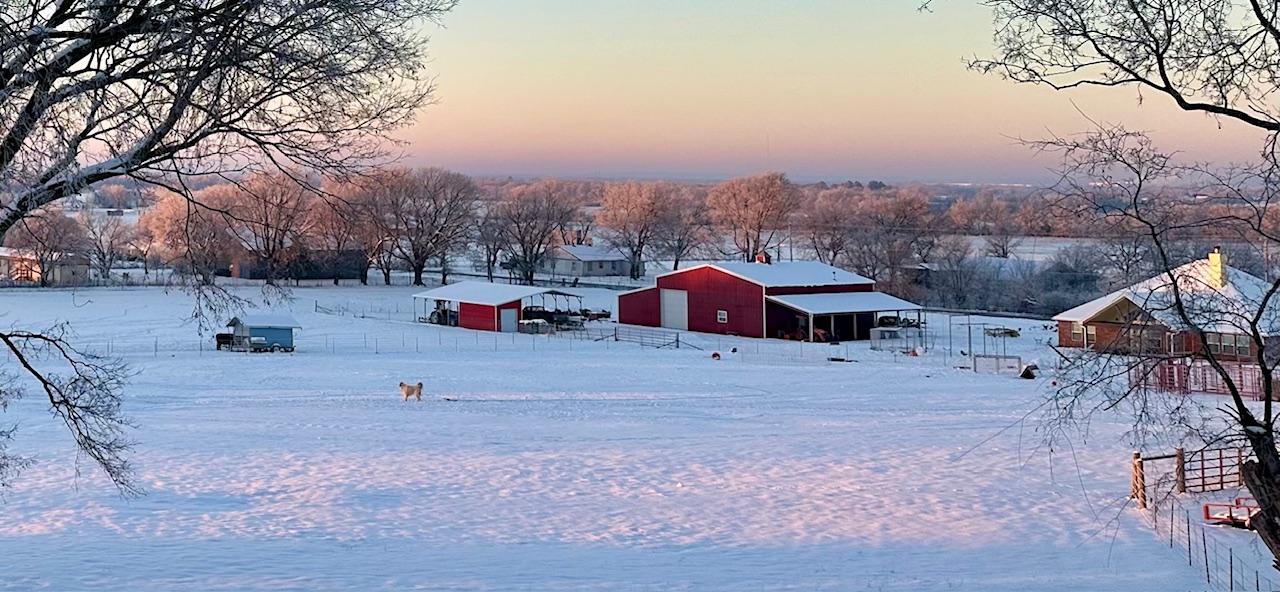
Photo by me, capturing a “moonbeam” of a sunrise view outside my kitchen window the other day
Tim Ferriss asks a question of most of his podcast guests:
“If you had a billboard that millions of people would see every day, what would you put on that billboard?”
Tim’s guests have given answers ranging from the comedic to the serious. Some have talked about a cause that is their passion, or an inspirational passage they’d like people to see.
Each time I hear the question, I come up with the same three words:
Serve others first.
Serving others first means:
taking others’ needs and desires into account before our own
looking out for their best interest first
our decisions are more thoroughly considered because we’ll be taking time to think about how our decisions impact others
trying to make someone else’s job easier and more rewarding
showing someone gratitude for the work they’re doing
minding our manners (as my mom used to say when I was a kid)
listening to, and respecting others (even if we disagree with them)
looking for ways to improve a situation rather than making things worse
being the first to forgive.
It’s easy to focus on our own interests and challenges first. It’s easy to think everything happening in the world is directed toward us, personally. This “me first” mindset is hard-wired into our DNA…our DNA is selfish about 99.99% of the time.
The tougher path?
It’s the one that leads to serving others first. It goes against our wiring, which takes significant effort.
None of us will be perfect on this path. We’ll stumble, and we may even wander a bit. But, we can be a blessing for others along our journey, and that’s what we should be seeking.
The good news is that following this path gets easier with practice.





 Grandpa Bob Encouraging Leadership
You must be logged in to post a comment.