Climbing in Times of Change

René Daumal titled his unfinished novel, Mount Analogue. It describes a peak, “whose summit is inaccessible by ordinary means.” The mountain can only be reached through inner transformation, making it both a place and an analogy for our journey of struggle toward resilience and clarity in the fog.

Leadership in upheaval can feel similar. Our map runs out. The ground shifts. We carry only our memories. Some sharp with regret, others shining with joy. Yet even scars can become footholds for our climb.

Daumal wrote, “You cannot stay on the summit forever; you have to come down again. So why bother in the first place? Just this: what is above knows what is below, but what is below does not know what is above.”

The summit gives leaders perspective. From above, we see connections hidden from the valley floor. The shape of the landscape, how the streams converge, where the shadows fall and light breaks through. We descend changed by what we’ve seen, and those who walk beside us are steadied by our vision.

History shows us that change always reshapes our climb. The printing press, the steam engine, electricity, space travel, and global connectivity to name a few. Artificial intelligence is the latest steep slope, bringing fear, excitement, and possibility all at once.

Leaders can steady others by naming the change clearly, framing the opportunities, modeling ways to adapt, and keeping purpose at the center of the change.

Daumal died before finishing his book. It breaks off mid-sentence. A fitting metaphor for leadership. Unfinished, unresolved, always in motion.

Leadership is the willingness to prepare others for the climb, walking faithfully with them, and offering perspective so they can see what’s possible…and dare to tackle the climb themselves.

h/t – James Clear for showing a quote from this book that sent me down the path to learn more about Mount Analogue. 

Photo by Caleb Lumingkit on Unsplash
Splitting Logs – The Firewood’s Promise (and my “Why”)

If you were to visit me on my mountainside, next to a huge pile of bucked-up logs that I’ve cut and collected over the past year, using my fancy new log splitter, what would you see? 

A grandpa dressed in a snow suit and beanie, warding off the low-teens temperature and wind chill, wearing eye and ear protection, splitting one log after another. 

I’m stacking the split firewood into an “outdoor fire” bin (the crummy stuff that’s showing some signs of water damage that may or may not burn so great), and an “indoor fire bin” for the good stuff.  We have so much that I use IBC totes that I can forklift and move around with my tractor.   

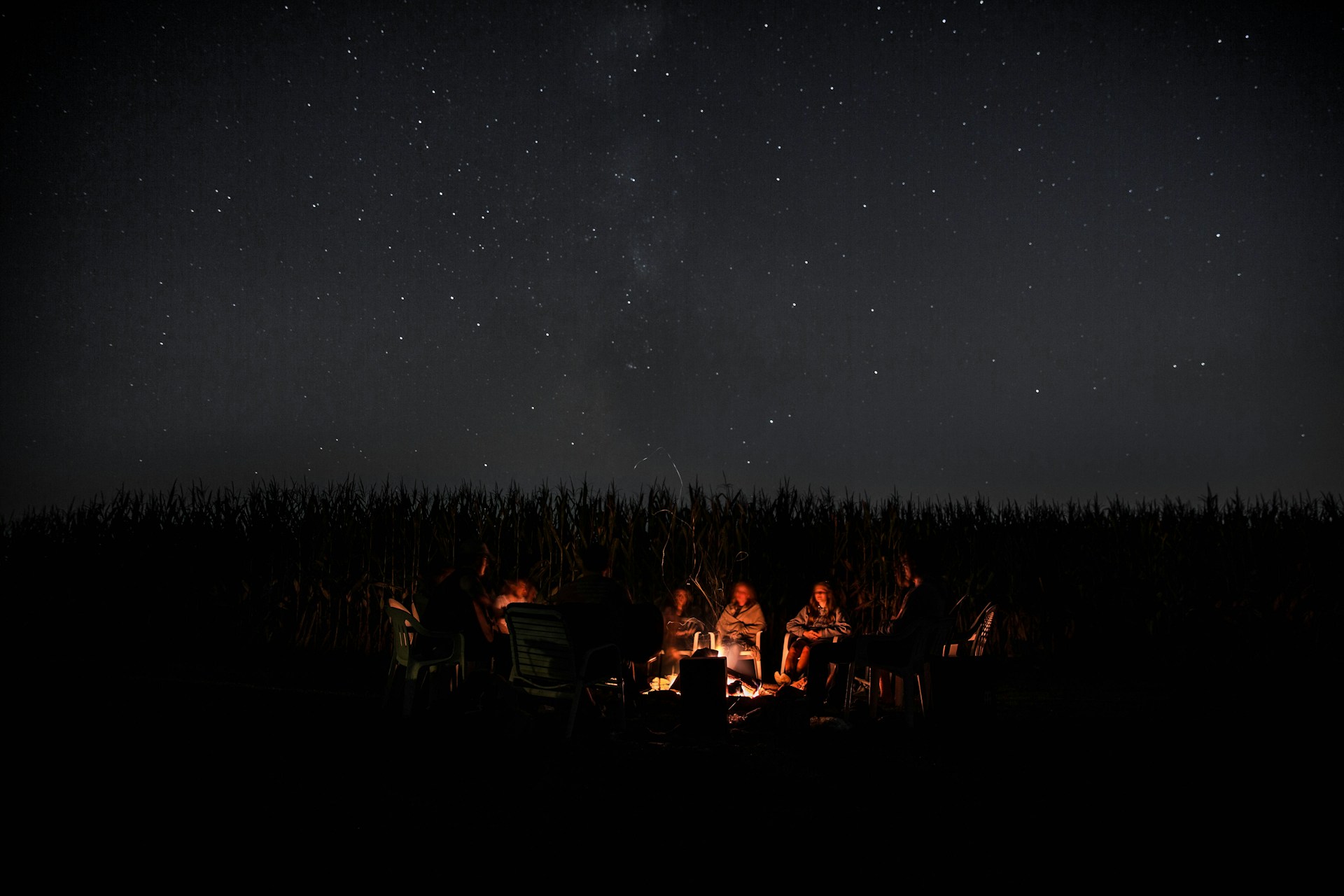
What you’d miss is what this guy’s thinking.  Of all the campfires these logs will deliver.  The warmth, the beauty, and the cheery faces reflected in the golden firelight.  The togetherness, the raucous fun, and always the smoke that’ll chase each of us in time.    

Lately, I’ve been thinking about words that rhyme with stories, memories, starlight, marshmallows, love, and family. Of a way to express my “why” behind all this work.

My new splitter hums, its rhythm is true,
Each log cracks clean, split in two.
And with each piece, I see what’s ahead—
Fires that warm, where stories are said.

Golden flames dance in their eyes,
Joyful voices filling the skies.
Kids with marshmallows on sticks they will hold,
Turning white fluff to crispy gold.

The stars above will steal their gaze,
A quiet pause from the firelight’s haze.
But soon enough, they’ll leap to their feet,
Cousins chasing cousins, the night complete.

This work is heavy, my labor long,
But in each log, I hear a song.
A promise of warmth, connection, and love,
Of smoke below and stars above.

Each crack of the wood a memory in waiting,
Moments of joy we’ll spend creating.
I keep splitting, I’ll keep the pace,
Knowing the fire will hold its place.

One split, one stack, one stick at a time,
Building a future that’s warm and divine.
A pile of firewood, yes—but so much more,
It’s family, it’s laughter, it’s life to the core.

I can’t think of a better “why” than this. 

Photo by Kevin Erdvig on Unsplash

The Strangeness of September

As a kid, September marked the end of summer’s glorious freedom and the start of another school year. Truth is, by mid-August, all the kids on my street were getting bored and restless, ready for something new.

My birthday is in September. But because it coincided with back-to-school season, my presents were school clothes. Useful, yes, but hardly the exciting stuff of childhood fantasies. My brother, whose birthday is also in September, was in the same boat—more school clothes. Still, it usually meant two cakes in one month, which always felt like a win.

Fast forward to adulthood.  September takes on a new meaning, especially if you own or run a business. It’s the last month of the third quarter—the point where you should have a pretty good idea if your business is on track for the year. Strategic planning for next year is underway — the annual cycle never stops. Little time to pause and reflect.  There’s always a new deadline, a new target. September is less about questions and more about answers and execution.

Then life throws in its own strange layers. In 2019, my father passed away on my birthday. A heavy twist of fate that turned my annual day of celebration into something far more complicated. In a strange twist of symmetry, last year, my mom died on my brother’s birthday.

Now, both of our birthdays are marked not just by the passage of time, but by the memories of losing our parents, their passing dates forever linked to our birth dates.

September marks the birth of my oldest son-in-law, my youngest daughter (32 years ago tomorrow), and one of our eight grandchildren (also tomorrow).  Lots of celebrating and gift giving…and some ice cream, of course.

All of it adds up to a certain strangeness in September for me—a month of beginnings and of endings. A mix of personal milestones and bittersweet memories.

p/c – Blessing Ri on Unsplash

The Power of Multiplying Yourself: Why Training and Supporting Your Team Leads to Success

The belief that doing everything yourself is faster can limit growth. Training and empowering your team leads to expanded capabilities, time for strategic initiatives, and a strong organizational culture.

p/c: Andrea Gian – Unsplash

“It’ll be faster for me to just handle this task now and get it done.”

“It’ll take me more time to train someone how to do this than it will take me to do it myself.”

“I’ll just take care of this task myself and get it out of the way.”

Sound familiar? 

It’s easy to fall into this trap of thinking that doing everything yourself is the most efficient way to get things done. This mindset not only limits your own growth and potential but also minimizes your team’s and your organization’s potential.

Investing your time in training and supporting your direct reports is not just beneficial—it’s essential for long-term success.

Here’s why:

  • Trust and Empowerment: When you take the time to train your team members, you show them that you trust their abilities. This trust fosters a sense of empowerment, motivating them to take on new challenges and responsibilities with confidence.
  • Expanded Capabilities: By preparing your team for their next levels of challenge, you expand their capabilities and push their limits outward. Consider this: Instead of just solving today’s problems, imagine if your team could handle tomorrow’s challenges without you needing to intervene. As they tackle new tasks and acquire new skills, they become stronger and more versatile contributors to the organization.
  • Time Management: While it may seem faster to handle tasks yourself in the short term, investing in training your team ultimately frees up your time for higher-level responsibilities. Imagine if you could focus on strategic initiatives, process improvement, and growth opportunities for the organization, rather than being bogged down in day-to-day tasks.
  • Cultural Impact: Creating a culture of learning and growth within your team not only boosts morale but also strengthens the entire organization. When your team members feel challenged and supported in their professional development, they’re more engaged and motivated to contribute their best work.
  • Preparation for Growth: By nurturing the skills and talents of your team members, you’re preparing the organization to adapt and grow. A team that is continuously learning and evolving is better equipped to handle the new challenges that are just around the corner (whether you see them coming, or not).

Neglecting your team’s development can have serious consequences. Employees who feel stagnant and unchallenged are more likely to become disengaged. Disengaged employees will leave, or worse, they’ll choose to stay and become seat warmers—adding nothing valuable to the organization.

People want to learn. They want to be challenged. They are most engaged when they’re pushing the boundaries of their capability, taking on new skills, and becoming more valuable to their organization.

The adage of “it’s faster to do it myself” is short-sighted and will limit your career growth.

Take the time to train and support your team. You will multiply your effectiveness and create a powerful culture of empowerment and continuous improvement within your organization.

The Delicate Balance of Telling and Teaching

Your role as the teacher and mentor is to prepare your mentee to work independently and effectively…

“I can’t believe she can’t tie her own shoes.  She’s old enough to know by now.”

My friend was talking about his 5-year-old daughter at the time. 

I asked if he’d ever taken the time to teach her how to tie her shoes.  He stared at me and said that wasn’t his job and that she should have figured it out by now. 

Why tell this story (which really happened!)? 

To illustrate how important it is to teach and mentor others…whether they’re our kids, grandkids, employees, family, or friends. 

It should be obvious that if you don’t teach, your student misses out on the chance to truly learn and grow.  By choosing not to teach, you’re short-changing your mentee of the lessons you’ve learned through hard-earned experience.

In moments of urgency or simplicity, direct instructions are most appropriate, providing a clear roadmap for immediate action (telling).

But true teaching is the art of imparting understanding – the “why” behind actions. It requires a commitment of time and energy, and showcases the significance of tasks, the interconnections between steps, and the importance of specific approaches…usually through storytelling.  

What kinds of stories?  Stories that provide a personal connection, illustrate key points, and allow your learners to connect emotionally to what you’re teaching.  Stories also help students drop their defensiveness toward receiving new information.

Another great teaching method is to ask questions. Questions encourage critical thinking.  Ask the student why they think something is important, or how they view a situation.  What would they do in the situation?  What’s happening that may not be obvious? If their answers are incomplete or miss the nuances of a situation, you can provide additional perspectives and help them understand what to look for.

How can we tell stories and ask questions about something when it’s urgent?  We already learned that in urgent situations, telling is often the most appropriate way of getting the right action quickly.  To create truly teachable moments resulting from an urgent event, it’s critical that you take the time after the urgency has passed to discuss lessons learned, and maybe even how to avoid the urgency next time.  

Your role as the teacher and mentor is to prepare your mentee to work independently and effectively.  Not only how to tie their shoes, but why it’s important to tie them in the first place. 

I have one favor to ask:  If you find this information useful, please forward and recommend it to someone else.  Thanks! 

Are You a Time Billionaire?

If you live to the end of your 90th year, you will have lived 2,838,240,000 seconds…

I heard the term, Time Billionaire, a few weeks ago on the Tim Ferris Podcast (which I highly recommend, by the way).

There are 31,500,000 seconds in a year.

If you live to the end of your 90th year, you will have lived 2,838,240,000 seconds.

Each of us is a time billionaire.  We have billions of seconds at our disposal.

To date, I’ve used about 1.67 billion of my seconds.  If I’ve slept for a third of my life (wouldn’t 8 hours per night be nice?), I’ve been awake and actively (?) living for 1.1 billion seconds.  I have roughly 770 million more active seconds remaining (if I live to be 90).

How many billions of seconds have you used?  How many do you have left?

It’s easy to answer the first question, impossible to answer the second one.

One thing is certain.  If you’re reading this post, you’ve already used billions of your seconds, and you probably have millions more.

The most important question is:  What do you want to do with your remaining seconds?

Love.  Work.  Play.  Explore.  Rest.  Watch.  Avoid.  Climb.  Run.  Accumulate.  Distract.  Hate.  Support.  Waste.  Invest.  Achieve.  Overcome.  Reach.  Reduce.  Enhance.  Ignore.  Engage.  Imagine.  Share.  Write.  Read.  Produce.  Consume.  Hide.  Encourage.  Recover.  Experiment.  Challenge.  Destroy.  Create.  Build.  Live!

We decide how we use our seconds (even when we choose not to decide, or let someone else decide for us).

None of us gets a second helping of seconds.  It’s worth investing some valuable seconds to consider what to do with the rest of our seconds before they’re gone.


Photo by Aron Visuals on Unsplash

Yahtzee Lessons

I was probably seven when Grandma Anne taught me to play Yahtzee.  I’d spend the night at her house with my cousin, Devin, and invariably, we’d be at her kitchen table, playing Yahtzee all afternoon.

It’s a simple game…on the surface.

Each player gets thirteen turns to complete their score card.

The top section of the score card consists of numbers 1 thru 6.  You need to roll three ones, three twos, three threes, etc. to get your “minimums.”  You could also roll four fives (or four of anything), which comes in handy if you were only able to roll two threes on a previous turn.  The idea on the top section is to score at least 63 total points, so you can get the 35-point bonus.

Yahtzee! scores 50 points.  That’s when you get all five dice to be the same during your turn.  Some players focus solely on getting Yahtzee at the expense of everything else.  The theory being that 50 points is huge, and if you get a second Yahtzee that one’s worth 100.  Of course, the odds of getting a Yahtzee are against you, but the payoff is big when it happens.

Grandma was always clear that while a Yahtzee is nice, the most consistent winning strategy is to get your bonus on the top section.  Rely on those 35 points as your foundation.  A Yahtzee, or a big four-of-a-kind on the bottom section of the score card would be icing on the cake.

Relying on the foundational 35 and less on the Yahtzee probably explains many of the best decisions I’ve made in life.

Each turn, you roll five dice to start.  You get two more rolls in your turn.  Depending on what the dice show after your first roll, you may not need to take those additional rolls.  Life is good when you roll a complete large straight or a Yahtzee on your first roll!

The bottom section of the score card has three-of-a-kind, four-of-a-kind, full house, small straight, large straight, Yahtzee! and Chance.

Chance comes into play when you’re rolling for something that doesn’t happen.  Like, you already have your small straight, and now you’re rolling to complete a large straight.  Unfortunately, that last number doesn’t come up.  You count-up the total of all the dice and enter that number into Chance.

Chance is a lot like a mulligan in golf.  A do-over.  In this case, you get to capture some points even though the rolls failed to produce.  They say there are no do-over’s in life, but I disagree.  There are plenty of second chances, if you’re willing to ask for forgiveness (mostly from yourself), learn from your mistake(s) (hopefully), and try again.

How often do three sixes come up in a roll?  How likely is it that you’ll be able to roll that one specific number you need to complete your straight or full house?  When you’ve used up your Chance spot, and your rolls have led to nothing, which slot are you willing to sacrifice to end this turn?  Odds and decisions.

Yahtzee seems like a game of chance.  It’s much more.  It’s a game of decisions and imperfect trade-offs.

After a while, we graduated to playing Triple Yahtzee, which entails playing three games simultaneously.  You get 39 turns.  One column is worth triple points, one is double points, and the last column is regular points.

The decisions and trade-offs from the “Single Yahtzee” game are in play, but now you want to maximize the point values in your triple column and consider sacrificing some of the slots in the regular column.

Don’t be fooled.  Mastering Triple Yahtzee isn’t just triple the challenge.  As in real life, something that should be only triple the challenge is often exponentially more challenging than it first appears.

What is the answer to all this exponential chaos?  Methodical effort and focused strategy.  The priorities and the strategy are defined.  The decisions that follow from these priorities become clear.  Maybe even simple.

There’s a certain genius in showing a seven-year-old the game of Yahtzee.  They haven’t fully formed their approach to decision making.  Success, failure, decisions, and sacrifices are in play with every turn.  Excellent practice for the real thing.

Yahtzee illustrates how something completely random and driven by chance can be managed within a solid set of priorities and strategies.

I didn’t just get to learn about rolling dice, counting numbers, and making decisions.  Grandma gave me the gift of lasting memories that I cherish to this day, playing Yahtzee at her kitchen table.

Now that I have six (!) grandkids of my own, I can’t wait to teach them the game of Yahtzee…and then, Triple Yahtzee!

Photo by Lea Böhm on Unsplash


Did You Add Value Today?

It’s a simple question, but a powerful one to ask yourself every day…

I often ask people this question, and I never define what I mean by the word “value.”  I enjoy hearing the range of responses as the person quickly reviews in their head the times in the day where they added value.

No matter what you do each day, where you work, whether you’re paid for the work you do, whether you interact with lots of people, or toil in solitude.  The question matters.

Did you add value today?

Did you improve something?  Did you add a new idea to the world?  Did you help someone else today?  Did you listen?  Did you motivate?  Did you share?  Did you forgive?

If you manage people, did you help your direct reports add value today?  Did you congratulate them on the value they added?

Did you add value today?

A simple question.  It’s most powerful when you ask yourself this question a couple of times a day.

Photo by Nathan Lemon on Unsplash


Momma’s Song

We’ll always sing along!

I have a friend.  I haven’t seen him in at least 40 years.  Though all these years have passed, I have nothing but fond memories of our childhood together…usually in the desert, climbing on rocks, playing in the dirt, getting too close to the campfire.

His name is Jack now, but he’ll always be Jackie to me.  Just like I’m Bob now, but I’ll always be Bobby to him.

I couldn’t believe it when I heard Jackie’s wife had died.  It was sudden and unexpected.  There he was, facing this tragedy, trying to tell their daughter where her mom had gone.  I couldn’t imagine the heartbreak.

For some reason, each time I thought about Jackie and his daughter, I couldn’t help thinking about playing momma’s song and singing along.  I had no idea what any of it meant, but still, this refrain continued…singing along to momma’s song.

A couple weeks later, I was sitting in an airport (as I often do nowadays) waiting for a delayed flight to take me home.  I decided to pull out a yellow pad and see where this refrain about momma’s song would take me.

Here’s what was on that yellow pad when they finally called us for our flight:

Momma’s Song

Looking back…

We were so complete

Everything was sweet until that day

we heard the news.

Our silence grew

How could this be?


We never knew until that day

The doctor said it was too late

Her momma was gone, all too fast

There was nothing the doc could do

He shook my hand and held me close.


My only thought was of her song

That one I used to sing along

It was our Endless Summer

It had just begun

And now, alone, I faced her setting sun.


Oh Lord, please won’t you play her song!

I only want to sing along

You know the one I need, won’t you help me sing along!


And there she was, our sweet Lorraine

I could see through all her tears

All she felt was numbness and pain

Who would ever play her song?

Especially now that momma’s gone.


Oh Lord, please won’t you play her song!

She only wants to sing along

You know the one she needs—won’t you help her sing along!


We sat and cried

I held her close

I felt so weak, but it was our sweet Lorraine

Who gave me strength.

There we sat, I had no plan

What should we do now that momma’s gone?

And there it was, her words so sweet

The melody we knew complete

She was singing to us once again

The sun was rising, her new day was born

We could feel her in those words

We couldn’t help but sing along.


It’s been many years since that day

It’s our sweet Lorraine’s wedding day.

As we started to dance the Father’s dance, my daughter cried

Oh Daddy please won’t you sing her song

The one momma used to sing

I only want to sing along

You know the one, won’t you help me sing along!


And so we danced, and her momma sang

Her words so clear, she’s singing now and that’s all we can hear

Oh, momma, we can hear your song

We’ll always sing along!

Photo by Olivier Fahrni on Unsplash

The Bobbin Effect

The thing about sewing isn’t the patterns.  It isn’t the precise cutting, the pins that hold the fabric pieces together, or even the stitches.

It’s all about the bobbin.

That little spool of thread that sits underneath the needle and somehow makes the stitches possible.  I say “somehow,” since I’ve never spent the time required to either load a bobbin or to make one work.

I know from watching others that sewing requires a ton of time loading the bobbin, untangling the bobbin, and generally managing the health and welfare of that hidden spool of thread.  A healthy bobbin is the key to any successful sewing project.

Watch a good painter and you may notice that they spend far more time preparing and sanding the surfaces to be painted, masking off the unpainted areas, mixing the paint, and then cleaning up the area after painting…than they spend painting.

The same is true for a musician.  Watch a musician perform.  It’s easy to forget how much time was spent learning to play their instrument, selecting or creating material, rehearsing, and then setting up for the show.  As an audience member, we get to see the final product and that’s all that matters.

How about your favorite mechanic?

That person who can diagnose and fix anything that’s wrong with your car…usually the same day you bring it to their shop.  How much time has he (or she) spent working under the hood of countless cars, learning and honing their craft, studying the specifications of all the new vehicles that arrive each year, and finding the best way to finesse those hard-to-reach bolts?  Your mechanic has spent years, maybe decades, preparing to fix your car today.  That’s all great, but your main question is, “Can I pick up my car by 5pm?”

It’s easy to forget or ignore all the preparation, expertise, and hard work that goes into creating just about any product, any service, and any organization that we value.  We allow most of it to be hidden from our consideration.

At the same time, we’re disappointed when others forget or don’t appreciate all the hard work and preparation we’ve put into being the best “fill-in-the-blank” that we want to be.

We wonder why our contributions, our dedication, and our work aren’t appreciated, and yet we’re probably unwittingly doing the same thing to other people.

Each of us is a bobbin for someone.  A hidden key to happiness and success for someone else, whether we realize it or not.  Maybe not today, but someday.

We’ve prepared, we’ve practiced, we’ve toiled in silence.  We’ve cared for ourselves, knowing without fully understanding that we make things possible, and maybe even tolerable for others.  Our efforts, our dedication, our emotional commitment may seem invisible, but they matter.  They are important.

It’s time to give that little bobbin some attention.

Photo by LAIS on Unsplash