Things I Wish I Knew When I Was Your Age

I sat down recently to write a letter to my cousin (technically my first cousin once removed), who just started basic training in the Air Force.

What began as a quick note turned into something more. A personal reflection, a bit of a manifesto, and a stack of lessons I wish someone had handed to me when I was just setting out.

By the time I hit “save,” I realized this may be worth sharing with any young person taking their first real steps into the adult world.

The letter was full of life updates, jokes, birthday party planning, movie recommendations, and the occasional 10-year-old version of myself asking random questions. But the main message was you can do hard things, and you’re not alone.

What follows are some ideas that come from years of learning, leading, failing, and reflecting. These are lessons for anyone who finds themselves on the edge of something new.

Leadership begins and ends in your head. Most of your real battles are internal. That voice in your head? It can lift you up or hold you back. Especially in an environment full of rules and pressure, how you think will define who you become. Supportive self-talk, resilient thinking, steady choices.  These are the foundational traits for leadership.

Start before you’re ready. Showing up takes more courage than people realize. You will rarely have everything figured out before you begin. Your best opportunities for growth will come from figuring things out while under pressure. That discomfort you feel is a sign that you’re on the edge of growth.

Do the next right thing. When life gets overwhelming (and it will), it helps to stop trying to solve everything all at once. Pause. Breathe. Do the next right thing. That’s enough. The bigger picture tends to take care of itself when we’re faithful and focus on the next indicated step.

You belong here. The feeling that maybe you’re not ready, or that someone else would be better suited for the challenge in front of you. That’s normal. But it doesn’t mean you don’t belong. The truth is you do belong. You’ve earned the right to be where you are. And you’re growing stronger every day, even if it doesn’t feel like it in the moment.

Respect is the foundation of everything. Not just the kind of respect that comes from rank or titles, but the kind you live out through humility, consistency, and quiet honor. When you offer that kind of respect, you build trust. And trust is what makes people want to follow your lead.

When the going gets tough, remember why you started. Every hard day will test your resolve. Every early morning, every setback, every lonely hour…these are the places where you’ll either lose sight of your purpose or anchor more deeply into it. Purpose doesn’t remove difficulty, but it gives meaning to the difficulty. And that’s enough to carry you through.

Discipline equals freedom. I shared this piece of advice that comes from Jocko Willink, former Navy SEAL, war veteran, and a powerful voice on discipline and leadership. He says, “Discipline equals freedom.” The more discipline you have, the more freedom you gain.

Discipline gives you control. Over your body, your mind, and your choices.  Freedom to choose your future. Freedom to trust yourself. Freedom to follow through, especially when motivation fades.

You won’t always feel motivated. That’s okay. Stay disciplined. Show up. Do the work. That’s how you earn freedom. One decision at a time.

“Don’t wish it were easier. Wish you were better.” A classic quote from Jim Rohn. There’s no shortage of obstacles. The goal isn’t to escape them. It’s to grow strong enough to rise above them. The learning curve is real.  Learn, adapt, overcome…become better and things will become much easier. 

About those movie recommendations I mentioned earlier. It’s probably more accurate to call them story recommendations.  Stories about honor, resilience, human ingenuity, and the willingness to keep going when things are difficult. 

We Were Soldiers, an amazingly good movie about strategic servant leadership (which is my preferred style of management), bravery, and the love that comrades in arms have for one another.  It’s a great tribute to the men who fought (many who gave their lives for the guy next to them) and their brave families back home.  I think I’ve seen it at least 25 times and I’m happy to watch it anytime. Each time I watch it, I tear up in at least 2 or 3 places in the movie. 

Ocean’s 11 and The Sting, two films that focus on creative problem solving and teamwork…though our “heroes” in these movies are con men and thieves. 

The Princess Bride made the list. The value of honor (even among combatants), mixed with the comedic and spoofy scenes make it a classic. Even in a world of duels and danger, kindness, respect and loyalty still matter.

I suggested Seveneves by Neal Stephenson. A science fiction novel (my favorite genre for at least the past 10 years) about human survival, adaptation, and rebuilding civilization after catastrophe. The premise is that an asteroid causes the moon to shatter.  What starts out as an oddity in the sky becomes a calamity as the moon breaks up into a ring and then begins to rain down to Earth (something they call the Hard Rain).  Great sci-fi, lots of human ingenuity and adaptability, and a story that covers about 5,000 years.  It’ll take some time to read, but it’s worth it.

Two books by Andy Weir.  The first is The Martian (which became a movie starring Matt Damon), and the second is Project Hail Mary.  Andy wrote The Martian in 2011 and self-published it on Amazon.  It picked up fans and became a bestseller without an “official” publisher.  His second book was called Artemis (takes place on the Moon).  It was good, but not quite as good as The Martian (which is a high standard, so I’m probably being unfair). 

His third book was Project Hail Mary.  This one is also being made into a movie, starring Ryan Gosling. It is excellent. 

The big thing about Andy’s books is that they are scientifically accurate. His characters deal with extremely complex challenges that require thinking and ingenuity to overcome. He writes in a way that entertains and teaches things you never knew.

I love that Andy wrote his first book from beginning to end without any publisher involved. Nobody was there to tell him what he was doing was the right thing.  He believed in himself, believed in the story he was telling, focused on the work, delivered a high-quality product, and proceeded to find his audience one reader at a time.     

All these stories reflect truths about the path ahead. Your journey will be hard. You’ll need grit, creativity, and perseverance. You’ll need others (family, friends, mentors, even strangers). More often than not, the tools to overcome life’s challenges will come from within yourself, quietly shaped by the stories you carry and the habits you form.

Whatever new thing you’re stepping into, whether it’s basic training, a new job, a cross-country move, or a new phase in your life, know that it’s okay to be unsure. It’s okay to feel stretched. Just remember your “why,” do the next right thing, and keep showing up with courage.

And who knows? Maybe decades from now you’ll be the one writing a letter like this, passing along what you’ve learned…

Photo by Justin Cron on Unsplash

Time Does Not Heal All Wounds

“Time heals all wounds,” people say when someone we love dies. It’s a phrase offered like a Band-Aid for a broken bone. Well meaning, but inadequate for the depth of what we’re facing.

For those who have lost a daughter, a son, a spouse, a parent, a sibling, a dear friend, the truth is something different. Time doesn’t heal. It changes things, yes. It allows us to move, to function, to smile even, but it does not erase their absence. That lives inside us, a permanent resident.

When I searched for quotes and stories from others who had walked this path before me (writers, psychologists, fellow travelers through loss), I discovered that my feelings aren’t unique or abnormal.

The bereaved across time echo the same truths I’m living.

I’ve heard that grief follows a pattern of denial, anger, bargaining, withdrawal, and finally, acceptance. That may all be true. It sounds like a clean process. Just a series of steps we must go through to get to the other side.

But that path has no clean endpoint. It can stall, restart at the beginning, skip and repeat steps while never reaching a conclusion. The grieving process never ends. We merely learn to function with our grief, and we do so in our own way, as imperfectly as we do everything else in life.

Author Jamie Anderson found words for what many of us feel but struggle to express: “Grief, I’ve learned, is really just love. It’s all the love you want to give but cannot. All that unspent love gathers up in the corners of your eyes, the lump in your throat, and in that hollow part of your chest. Grief is just love with no place to go.”

This captures exactly what happens when we reach for the phone to call them or save up a story we can’t wait to tell them. Only to remember a second later that they’re gone.

Grief isn’t a single event but a series of small realizations, each one a fresh cut.

C.S. Lewis, after losing his wife Joy, wrote about the persistence of absence: “Her absence is like the sky, spread over everything.” In his book “A Grief Observed,” Lewis documented what it feels like to live inside loss. “No one ever told me that grief felt so like fear. I am not afraid, but the sensation is like being afraid. The same fluttering in the stomach, the same restlessness, the yawning. I keep on swallowing. At other times it feels like being mildly drunk, or concussed.”

This is the lived experience of a body trying to process what the mind struggles to accept.

Joan Didion echoed this truth when she lost her husband, John Gregory Dunne. In “The Year of Magical Thinking,” she wrote, “Grief turns out to be a place none of us know until we reach it. It’s a foreign country with its own customs, its own weather, its own bewildering geography.”

There is no timeline. No tidy arc where pain transforms into peace according to some predetermined set of rules.

Dr. Lois Tonkin, working as a grief counselor in the 1990s, discovered a different truth about what healing actually looks like. A client whose child had died years earlier drew her a picture showing how her grief had initially filled her entire life. A small circle almost completely consumed by loss.

But over time, something unexpected happened. The grief didn’t shrink. Instead, her life grew larger around it. There was now space for new experiences, relationships, and meaning alongside the loss. This became known as Tonkin’s Model of Grief.

Like a tree growing around a piece of metal embedded in its trunk. We don’t absorb or eliminate the foreign object. We grow around it, incorporating it into our new shape.

This model shows us that time doesn’t diminish our grief. But it expands our capacity to hold other things along with it. Some days our grief surprises us with its suddenness. A song, a scent, a birthday or anniversary, seeing a classic car they used to drive. Other days we’re living fully in the expanded space around our grief, discovering we can hold both the wound and the wonder.

We must learn to carry the sharp pain of their absence while having gratitude for the gift of having known them at all. Our capacity to feel gratitude for the life we shared can provide much needed comfort, even though we’ll never stop missing them.

Some of the most tender truths come from those who’ve lost children. Elizabeth Edwards, who lost her 16-year-old son Wade in a car accident, offered this reminder, “If you know someone who has lost a child, and you’re afraid to mention them because you think you might make them sad by reminding them that they died, you’re not reminding them. They didn’t forget they died. What you’re reminding them of is that you remembered that they lived, and that is a great gift.”

Writer Megan O’Rourke, in her memoir “The Long Goodbye” about losing her mother, captured the peculiar contrasts of grief. “You look fine. You act fine. But inside, you are not fine. And you know it will never be the same.”

This is the hard reality of grief. The simultaneous existence of functioning and not-functioning, of healing and not-healing, of being okay and not-okay. We learn to carry both states, often within the same moments.

So no, time does not heal all wounds.

Time teaches us that we can be broken and whole simultaneously. That we can miss someone terribly and still find reasons to laugh. That love doesn’t end with death. It merely changes form, expressed as the very grief we wish we could escape.

In learning to live with our wounds, we hopefully discover something about ourselves. Our capacity to grieve deeply is evidence of our capacity to love more deeply than we ever thought possible.

And maybe that’s the real truth about time and grief.

“Blessed are those who mourn, for they shall be comforted.” – Mathew 5:4

“The Lord is near to the brokenhearted and saves the crushed in spirit.” – Psalm 34:18

“Love never ends.” – 1 Corinthians 13:8

Photo by Noah Silliman on Unsplash

What Your 70-Year-Old Self Knows That You Don’t

We know about Maslow’s Hierarchy of Needs and how our wants and desires are like a pyramid that goes from our basic needs up to our desire for self-actualization. The Pareto Principle reminds us that 80% of our results come from 20% of our efforts, helping us focus on what truly moves the needle. Saint Ignatius’s Spiritual Exercises guide us through discernment, teaching us to distinguish between what brings life and what drains it.

But there’s another framework worth considering: the evolution of what we consider important throughout our lives.

As kids, we know what’s most important. It usually revolves around attention, followed by winning at whatever we are doing, which we think will get us more of that attention we crave. Everything feels urgent. Every disappointment feels permanent. The world revolves around us, and that’s exactly as it should be for a child learning to navigate life.

Teenagers start to focus on freedom, independence, and figuring out what they’re going to do when they grow up (whatever that means). They often reject what their parents value. Sometimes for good reasons, sometimes solely because rebellion feels necessary for finding their own path. What matters most is breaking free from the constraints that feel suffocating, even when those constraints were designed to protect them.

As young adults, we’re getting started, establishing our independent life, our financial foundations, our career foundations…at least we’re trying to get these things established. We’re in acquisition mode: getting the job, the apartment (maybe a house), the relationship, the respect (something we crave more than attention at this stage). We often dismiss advice from older generations, convinced they don’t understand how different the world is now.

Then something interesting happens.

As the decades flow by, what was important a few years ago, isn’t. We start to think about how to serve others, help our kids flourish, help their kids flourish. The shift is gradual but profound. From getting to giving, from proving ourselves to improving the lives of others.

Major life events accelerate this evolution. A health scare makes us realize that all the success in the world doesn’t matter if we’re not here to enjoy the fruits of our labor. The birth of a child or grandchild suddenly makes legacy more important than achievement. The loss of a parent reminds us that time is finite, and relationships are irreplaceable.

Sometimes the shift happens more quietly. Earlier this week, two co-workers were discussing the NBA finals and asked me what I thought of Game 2.  I had to admit that I haven’t followed basketball since the Magic Johnson era of the Lakers. As we talked, it became clear to me that I haven’t followed any sports—except for the Savannah Bananas baseball team’s shenanigans—in many years.

What captures my attention now? I’m drawn to watching people live their best lives in rural settings, building homesteads for themselves and their families. I find myself rooting for others to succeed in their chosen vocations, nothing more, nothing less. It’s not that sports became unimportant because they were bad. They just became less important than something else that feeds my soul more deeply.

As we get older, preserving our health, and the freedom that comes with it, moves toward the top of our priority list. Interesting how the freedom we sought as teenagers is still important to us in our senior years, but for different reasons. Then, we wanted freedom and thought we were ready for responsibility.

Now, we want freedom to focus on what truly matters. Freedom to be present for the people we love, freedom to contribute in meaningful ways, freedom from the noise that once seemed so important.

There’s a beautiful irony in how we often spend the first half of our lives accumulating things, achievements, and accolades, only to spend the second half learning to let go of what doesn’t serve us. We chase complexity when we’re young and value simplicity as we mature.

Questions worth considering:

– What would happen if we could skip ahead and see what our 70-year-old self considers important? What about our 80-year-old self? Would we make different choices today knowing what they know?

– Why do we have to learn the hard way that some of the things we chase don’t matter? Is there wisdom in the struggle, or are we just stubborn?

– How can we be more intentional about evolving our priorities on our terms instead of waiting for time to do it?

– What if we could honor the lessons each life stage provides without completely losing face and dismissing what came before?

The evolution of importance isn’t about getting it right or wrong at any particular stage. It’s recognizing that growth means what we value will shift.

That’s not a bug in the system. It’s a feature. The teenager’s desire for freedom isn’t foolish. It’s necessary for their development. The young adult’s focus on building a foundation isn’t shallow. It’s essential for future stability.

Perhaps the real wisdom comes in staying curious about what matters most. Knowing that the answer will keep evolving. And maybe, just maybe, we can learn to trust that each stage of life has something valuable to teach us about what’s truly important.

The key is staying awake to the lessons, even when they challenge what we thought we knew for certain.

Photo by Filip Kominik on Unsplash

Tacos and Time Travelers…a Dinner Conversation About the Future (and Everything That Matters)

The other night, over a casual taco dinner, one of my grandkids hit me with a question I wasn’t expecting.

“Grandpa, how old will you be in the year 2100?”

Without missing a beat, I shot back, “Nearly 140. Way too old to still be around!”

I may have been off by a few years, but we all agreed: the odds are stacked against me making it to 2100.

Then we started doing the math together, and that’s where things got interesting. They’ll be in their 90s by then. Their children and grandchildren—my great-grandchildren and great-great-grandchildren—will be alive and thriving in that future world. A reminder that we’re part of something much bigger. Connected to the past, but carried forward by those who will come long after we’ve gone.

“Okay, but how old will you be in 2050?”

That one felt closer, more real. “Well,” I said, “not quite 90, but almost. And you’ll be under 50.”

“What will we be doing in 2050, Grandpa?”

That’s a question only they can answer. I won’t pretend to know. I hope I’m there for at least part of it. I hope I get to laugh with them, to listen, to remind them where they came from, and to cheer them on wherever they’re headed.

Our conversation turned into something more than tacos and timelines. We started talking about how every generation builds on what came before. We carry what we’ve learned from our parents and grandparents, along with our own experiences, and hand all of that to our children and grandchildren. And they, in turn, will do the same.

Their children, my great-grandchildren, aren’t here yet, but I already have high hopes for them. I look forward to holding them, hearing their stories, and watching them discover the world just as their parents are starting to do today.

I hope they’ll learn the big things:

-How a starry sky can quiet our soul.

-How to throw and catch with confidence (it’s baseball season, so this one is top of mind right now).

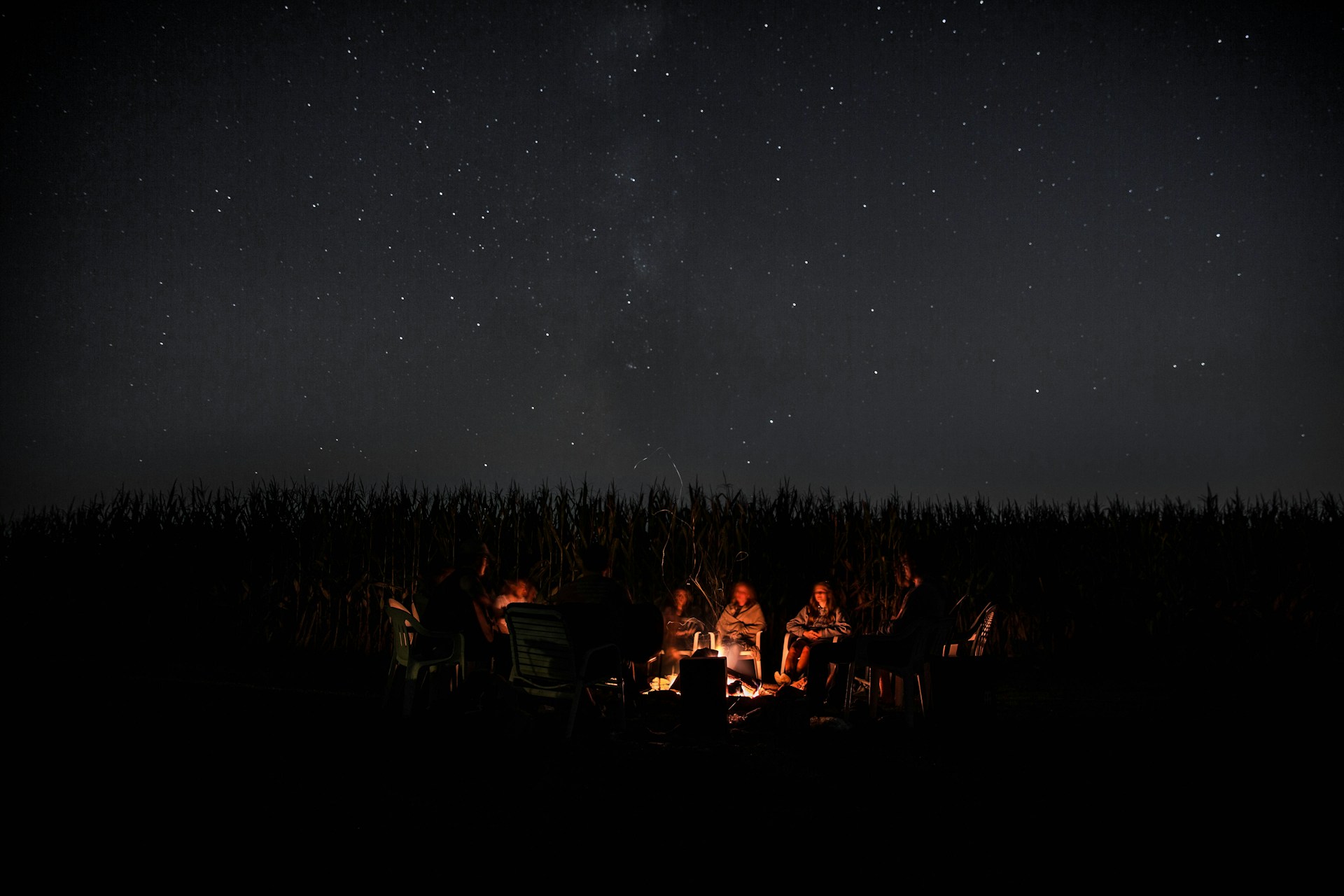
-How warm and magical a campfire can be…and that S’mores taste better when your hands are sticky.

-How good it feels to help without being asked.

-How to sit quietly with someone we love and say nothing at all.

-How to cheer for someone else, even when the spotlight isn’t ours.

-The peace that comes from a walk in the woods or along a sandy shore.

But I also know they’ll learn things I’ll never understand. Things I can’t even imagine. And that’s exactly as it should be.

My deepest hope is that they’ll carry forward the timeless lessons. That love matters more than being right. That kindness isn’t weakness. That telling the truth is not only brave, but also the only way.

And that family stories are worth retelling…especially the funny ones.

So, here’s to future taco dinners, to great-grandkids I haven’t met, and to the storytellers of tomorrow.

May they keep the best of us within them always.

A Poem for My Grandkids

We sat with tacos, our chips in hand,
When you asked a question I hadn’t planned.
“Grandpa, will you still be here in 2100?”
“Not likely,” I laughed, “I’d be too old by then.”

And then we wondered who’ll be around,
Your kids and theirs, with dreams unbound.
Building a world we won’t see,
Carrying forward the best from you and from me.

We talked of shooting stars and catching balls,
Of S’mores by the fire and the night’s gentle call.
Of helping for nothing, of walking alone,
And learning to love with a heart fully grown.

You’ll learn things I’ll never know,
With gadgets and wonders I can’t imagine.
Even so, I hope what we’ve lived still finds its place,
In stories you tell with a smile on your face.

Here’s to the moments that grow into more,
To questions and memories, and tales we explore.
May love be your guide in all that you do,
And may our stories stay with you, and echo on through time.

p/c – That’s Charlie (in the cowboy hat) and Marcus from a few years ago, perfecting their marshmallow roasting techniques. 

A Love Letter to My Grandchildren

My Dear Grandchildren,

Thinking about how to tell you about the infinite power of love, I realize how important it is to share this letter with you.  To help you understand just how much love will shape your lives.

You’re still growing, discovering who you are and what you want from the world. As I reflect on everything I’ve learned and everything I’ve seen, I can’t help but realize that love has been the guiding force in all of it. If there’s one truth I want you to know, it’s this: love is the one thing that never runs out. It is truly infinite.

Love has no limits.  It’s a gift from God that never empties. “True love is infinite. It has no end, no limits, and no boundaries” (Unknown).  I want you to remember this when life gets tough or when you start to feel like there’s not enough love to go around. The love you give will always come back to you. It grows, just like a tiny mustard seed turns into a mighty tree. The more you pour out, the more you’ll have. And love? It keeps on giving.

Love has the power to change things.  To transform everything. It’s not just a feeling. It’s something far more powerful than that. Love is what changes hearts. It softens the hardest of feelings and brings people together.

I’ve seen this truth unfold many times in my life. When you approach someone with love, even if they’ve hurt you, that love has the power to melt away your bitterness, to open a door where there was once a wall. “Love is the only force capable of transforming an enemy into a friend” (Martin Luther King Jr.). That’s the kind of love I want for you. The kind that can heal, the kind that builds bridges instead of walls.

Love isn’t passive. It’s not something that just happens to you. It’s something you choose every day.  Love calls for action, for intention. It’s an active force. And when you lead with love, you’ll see the world differently. I’ve learned that love moves you in ways you can’t predict, but it will always be the guide that matters most.

You will never have all the answers. Just choose love. “To love is to will the good of another” (St. Thomas Aquinas). That’s the essence of it. When you love someone, you are choosing to want the best for them, to care for them, and to be there for them, even when it’s hard.

Sometimes, we make mistakes. We hurt each other. There are moments when we carry the burden of regret or hard feelings. But love, I’ve learned, is about letting go. It’s about forgiving. You can’t move forward while holding on to old wounds. Love is what frees you from that burden. It’s what gives you the strength to keep going, even when it feels impossible. “Love is an endless act of forgiveness” (Maya Angelou).  This resonates deeply with me, even when I forget its lesson. You see, when you forgive, you allow love to take root again, to grow and bring healing.

And the beautiful thing about love is that it never ends. Even when someone leaves us, their love remains. It stays with us. It lives on in the memories we carry and in the ways we continue to love others by their example. The love we give and receive stays with us, shaping us, and guiding us through the rest of our lives. “Love has no age, no limit; and no death” (John Galsworthy). When someone you love passes away, their love is still alive within you. It never dies. It’s a part of who you are forever.

I want you to know that love isn’t something you will always understand. It’s not something that always makes sense. Sometimes it feels irrational or confusing, but that’s what makes it so powerful.

Love comes from a place deep inside that logic can’t explain. It’s a mystery. “The heart has its reasons of which reason knows nothing” (Blaise Pascal).  That’s the beauty of love. It doesn’t need to be explained. You feel it. You know it. And that’s all there is.

Love is also not confined by time or space. It’s already free. “Love is an infinite ocean, where every drop is a reflection of the entire universe” (Unknown). Love stretches. It connects us all, no matter where we are, no matter what we’ve been through. It doesn’t have walls. Love is limitless.  It grows as we share it, and the more we live it.

I think about St. Paul’s words to the Corinthians when he wrote about love. It’s a love that’s patient and kind, that doesn’t boast or get angry easily. It’s love that seeks the good, that keeps no record of wrongs, that always protects, always trusts, always hopes. “Love is patient, love is kind. It does not envy, it does not boast, it is not proud. It does not dishonor others, it is not self-seeking, it is not easily angered, it keeps no record of wrongs. Love does not delight in evil but rejoices with the truth. It always protects, always trusts, always hopes, always perseveres” (1 Corinthians 13:4-7). That’s the love I want you to know. 

At its core, love is what makes life worth living. Without love, we would have nothing. Without love, we would be lost. “Love is the only reality, and it is not a mere sentiment. It is the ultimate truth that lies at the heart of creation” (Rabindranath Tagore). God’s creation.  It’s love that drives us to seek goodness for others, not just ourselves. It makes the world a better place, one loving act at a time. 

There’s one last thing I want you to know. Love never runs out. Its supply is unlimited. “There is no remedy for love but to love more” (Henry David Thoreau). That’s the key. The more you love, the more you’ll understand, the more you’ll see. Love opens new possibilities that you didn’t even know were there. It’s a wellspring that you can always draw upon, as long as you’re willing to give.

Love is the one thing that will always be with you. It doesn’t matter where life takes you or how far you go. It will be there. Love is constant, unchanging, but always expanding. And in that love, you’ll find the freedom to be who you’re meant to be, to live fully, by loving deeply.

The more you love, the freer you become. The more love you give, the more you’ll find in return.

As your grandpa, I love each of you with all my heart and soul. I want nothing more than for you to lead lives filled with love—guided by love, surrounded by love, and sharing love with everyone you meet.

A life full of love is a life full of joy and meaning.

Love always,

Grandpa Bob

Photo by Diane Anderson – That’s 7 of our 8 grandkids…and we have another on the way in May.  Diane is their great grandmother.  God is good.  

Breaking the Rhythm of Mediocrity

Each of us has a natural speed.  A rhythm that feels comfortable. Some of us move fast, always pushing, never stopping. Others take a slow, methodical approach. And some avoid movement altogether.

Occasionally, we can shift gears and speed up for a short-term need. But the comfort of our standard speed usually draws us back.

Dialing up is hard. It’s difficult to imagine doing more than we’re doing now. It’s harder still to visualize the better outcomes that could come from pushing ourselves and our organizations beyond the status quo.

Even worse is when we deliberately slow our pace to fit in.  To blindly match our rhythm to those around us, in our workplace, our social circles, our environment. The groups we allow to shape us.

The slow, almost imperceptible tick-tock of our internal metronome feels safe, especially if it’s set to someone else’s rhythm. It’s predictable. It gives us a (false) sense of control when we have no control at all.

We tell ourselves that changing our settings would bring chaos.  Better to stay safe and avoid the challenge. 

If we’re willing to turn our settings down to accommodate others, why not turn them up to pursue our own goals?

Why not push beyond our comfort zone to improve, to evolve?  Why not try to inspire those around us to ramp up? 

The things we don’t change are the things we’re actively choosing. Doing nothing is a choice.

Life moves at a relentless pace, largely outside our control. What we can control is our response.  We can set our internal rhythm to match what’s happening or set it to create what we want to happen.

Here’s a brutal truth: The outside world doesn’t grant or deny us anything. It keeps moving, with or without us.

It’s up to us to set our own tempo—not for the group, not for the organization, but for ourselves and the people who matter most.

Photo by Lance Anderson on Unsplash

Splitting Logs – The Firewood’s Promise (and my “Why”)

If you were to visit me on my mountainside, next to a huge pile of bucked-up logs that I’ve cut and collected over the past year, using my fancy new log splitter, what would you see? 

A grandpa dressed in a snow suit and beanie, warding off the low-teens temperature and wind chill, wearing eye and ear protection, splitting one log after another. 

I’m stacking the split firewood into an “outdoor fire” bin (the crummy stuff that’s showing some signs of water damage that may or may not burn so great), and an “indoor fire bin” for the good stuff.  We have so much that I use IBC totes that I can forklift and move around with my tractor.   

What you’d miss is what this guy’s thinking.  Of all the campfires these logs will deliver.  The warmth, the beauty, and the cheery faces reflected in the golden firelight.  The togetherness, the raucous fun, and always the smoke that’ll chase each of us in time.    

Lately, I’ve been thinking about words that rhyme with stories, memories, starlight, marshmallows, love, and family. Of a way to express my “why” behind all this work.

My new splitter hums, its rhythm is true,
Each log cracks clean, split in two.
And with each piece, I see what’s ahead—
Fires that warm, where stories are said.

Golden flames dance in their eyes,
Joyful voices filling the skies.
Kids with marshmallows on sticks they will hold,
Turning white fluff to crispy gold.

The stars above will steal their gaze,
A quiet pause from the firelight’s haze.
But soon enough, they’ll leap to their feet,
Cousins chasing cousins, the night complete.

This work is heavy, my labor long,
But in each log, I hear a song.
A promise of warmth, connection, and love,
Of smoke below and stars above.

Each crack of the wood a memory in waiting,
Moments of joy we’ll spend creating.
I keep splitting, I’ll keep the pace,
Knowing the fire will hold its place.

One split, one stack, one stick at a time,
Building a future that’s warm and divine.
A pile of firewood, yes—but so much more,
It’s family, it’s laughter, it’s life to the core.

I can’t think of a better “why” than this. 

Photo by Kevin Erdvig on Unsplash

The Manger and the Memories: A Christmas Story

It happens to all of us this time of year. The days get shorter, the winds grow crisper.  Something stirs within us that doesn’t quite fit the mold of any other season. There’s joy, sure—joy enough to make us believe in miracles again. But alongside that joy, like the shadows cast by twinkling lights, there’s a touch of sorrow. Like an old friend who shows up every December, pulls up a chair, and says nothing at all.

Words that lie dormant eleven months out of the year come alive at Christmas time. Jingle Bells. Rudolph. Good tidings. Noel. The Manger. Words so beautiful and strange, yet they create beautiful poetry on our hearts.  Sugarplums dancing in dreams. Mulling spices on the stove. Decorations we see only in this season but remember more fondly with each passing year—twinkles of joy at their best, empty reminders at their worst. And somehow, merriment and brightness find their way in, even when the years haven’t always been kind.

If you listen closely, you can hear hymns calling us across the cold and lonely nights:

“O come, O come, Emmanuel”

“Silent Night”

“What Child is This?”

There’s a funny thing about Christmas—it’s a season of paradox. A time for rejoicing, and a time for remembering. For celebrating, and for mourning. All in the same breath.

Every year, the world gathers around a single story. A manger in Bethlehem, where our Savior came as a child. It’s a story that whispers hope into the cracks of our broken hearts.

“Fear not, O Zion, be not discouraged!” That’s what the prophet Zephaniah said. “The Lord, your God, is in your midst.” And somehow, two thousand years later, we do believe. We light candles and sing songs of joy—because we need to. Because joy matters.

It’s funny how much effort we put into this season. Trees trimmed. Ornaments hung. Villages built. Wishes made. And when the last batch of cookies or Cornish pasties come out of the oven, we sit at tables crowded with food, and laughter, and the people we love. Sometimes we even catch a glimpse of something eternal in it all—the way the lights reflect off the fancy silverware, or how a child’s eyes light up at the first sight of presents.

But there are empty chairs. They’re harder to discuss. Maybe it’s a father, a mother, a grandparent, or a sister. Maybe it’s a friend, a brother, an aunt or an uncle who have gone far too soon. We feel their absence even more at Christmas. We see them in the lights we hang, and the hot chocolates that we make. We hear them in old songs, the ones we used to sing.

And then there are the faces we miss in another way—our family who are still with us but just too far away. The ones across states, oceans, and time zones. We think of them when we pull out the old family recipes and photo albums.  We wish they could be here to see the kids open presents, to share in the laughter over the pies that we burned, or took out too soon.  But instead, we send texts and pictures, leave voicemails, and whisper a prayer hoping they know how much they’re loved, even from so far away.

Yet even in sorrow, there’s something beautiful. Because love never really leaves us. And maybe that’s the greatest promise of Christmas—the one hidden behind all the ornaments and stockings, and twinkling lights. That the Child who came to a manger promises us something more. He promises that the story isn’t over. That one day, we’ll all sit at a table that never empties, in a place where joy knows no end.

For now, we celebrate as best we can. We bake our pies and pour our cider. We listen for sleigh bells in the distance and leave room in our hearts for joy to enter—just like it always does.

And when the night gets quiet, and the fire burns low, we remember. We remember the ones we’ve loved, the ones we’ve lost, the ones too far away to join us, and the One who came to bring us home.

That’s Christmas. A little light, a little shadow. A little merry, a little sorrow. A season that changes the very words we speak and, if we let it, changes the very hearts we carry.

So if you’re out there tonight, sipping mulled cider by the window, just know this:

You’re not alone. The Savior is here. He’s in the manger. He’s in the laughter. And He’s in the quiet, too.

And maybe—just maybe—He’s singing over you, as one sings at a festival.

The Bible verse that inspired this post when I heard it in Church last Sunday:

Shout for joy, O daughter Zion!
        Sing joyfully, O Israel!
    Be glad and exult with all your heart,
        O daughter Jerusalem!
    The LORD has removed the judgment against you
        he has turned away your enemies;
    the King of Israel, the LORD, is in your midst,
        you have no further misfortune to fear.
    On that day, it shall be said to Jerusalem:
        Fear not, O Zion, be not discouraged!
    The LORD, your God, is in your midst,
        a mighty savior;
    he will rejoice over you with gladness,
        and renew you in his love,
    he will sing joyfully because of you,
        as one sings at festivals.

– Zep 3:14-18a