Everyone loves the big idea. The bold plan. A strong vision of what can be.
It’s easy to get excited about an amazing result. A finished project, a better version of ourselves, a breakthrough moment. But big plans mean nothing without the tools and materials to carry them out.
Goals and aspirations get a lot of attention. Preparation, usually not so much.
Preparation isn’t glamorous. No one sees the early mornings, the quiet practice, the reading, the repetitions, the small decisions and adjustments that come from thinking deeply about how to be better. But that’s where everything starts. That’s the real work.
You can’t build a tower by imagining the top floor. You start by stacking bricks. And before that, you must gather the bricks. Along with mortar. Along with the tools to lift, cut, measure, and shape. That’s what preparation is. Gathering what you’ll need to be ready when it’s time to build.
This applies to everything in life.
Want to be a better leader? Prepare by learning how to listen, how to stay calm and think under pressure, how to help your team to be their very best.
Want to level up at work? Prepare by always sharpening your skills, staying curious, looking for problems that need solutions, becoming someone your team can rely on.
Want to be a better friend, spouse, or parent? Prepare by learning to listen, to be present, and to lead with patience and love.
Want to face hard times with strength? Prepare by choosing the hard things before they choose you.
Don’t wait for life to demand something from you before you get ready. Always prepare so you willbe ready.
Ask yourself: -What materials am I gathering?
-What tools am I building?
-What productive habits am I forming when no one’s looking?
Preparation isn’t just a phase. It’s a mindset. A lifestyle.
You’re either gathering bricks—or you’re preparing to fail.
Because in the end, you won’t rise to the level of your ambition.
You’ll fall to the level of your preparation.
h/t – my friend Pete Hilger as we were discussing how to get building supplies to a rural Guatemalan city for a medical facility build project. He tossed out the line, “You can’t build a tower without first gathering a lot of bricks and mortar.”
Almost everyone claims to be busy. Many will even describe their endless to-do list—what they’ve done, what they’re doing, and what’s next—justifying their busyness.
Lots of articles explore different types of busyness. One that stands out for me, Busyness 101: Why Are We SO BUSY in Modern Life?, lists the following types:
-Busyness as a badge of honor and trendy status symbol
-Busyness as job security
-Busyness as Fear of Missing Out (FOMO)
-Busyness as a byproduct of the digital age
-Busyness as a time filler
-Busyness as a necessity
-Busyness as escapism
The last one stands out to me: busyness as escapism.
When we’re constantly busy, we get to avoid the hard things in life. No time to reflect on priorities. No time to find smarter ways to work. No time to focus on meaningful goals…ours or our organization’s.
Busyness lets us sacrifice our other responsibilities. We convince ourselves that our sacrifices are necessary, without questioning what they truly cost us or those around us. And we tell ourselves that once we’re “less busy,” we’ll focus on the important things we’ve been neglecting. The problem? We rarely become “less busy” (at least, from our perspective).
But the busiest effective people operate differently. These individuals aren’t just busy for the sake of it. They work with intention, with purpose. They prioritize. They seek smarter ways to work. They focus on meaningful goals rather than just checking off task lists.
These are the people who not only get things done but get the right things done. And they do it faster than everyone else. Why? Because they’re too busy to be distracted by nonsense and trivialities. They tackle the big things first, and often, the smaller things take care of themselves.
When I managed large organizations, I valued these employees the most. They weren’t just productive, but they were leaders. They inspired everyone around them to be more effective. Whenever a new project or opportunity arose, I sought them out. I knew they’d prioritize the new project well and deliver great results.
The difference between being busy and being effectively busy comes down to mindset. The most productive people don’t just fill their days. They own them.
Next time you catch yourself saying, “I’m so busy,” pause and think. Are your tasks productive and effective, or just occupying your time?
You may find that you’re not as busy as you thought.
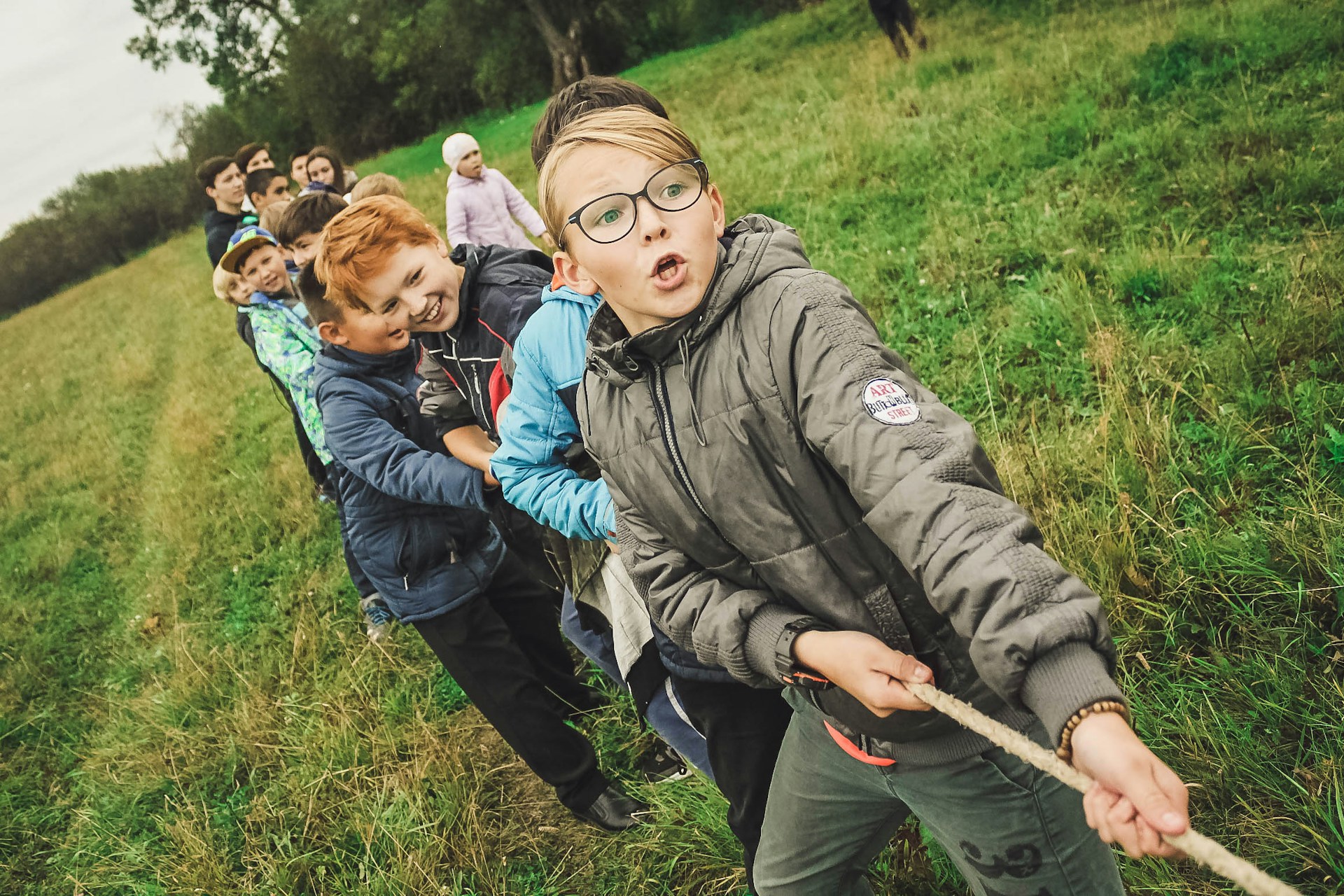
Photo by Anna Samoylova on Unsplash…my eye is on the girl in pink who’s walking away from the rope (I bet you didn’t notice her at first)
Each of us has a natural speed. A rhythm that feels comfortable. Some of us move fast, always pushing, never stopping. Others take a slow, methodical approach. And some avoid movement altogether.
Occasionally, we can shift gears and speed up for a short-term need. But the comfort of our standard speed usually draws us back.
Dialing up is hard. It’s difficult to imagine doing more than we’re doing now. It’s harder still to visualize the better outcomes that could come from pushing ourselves and our organizations beyond the status quo.
Even worse is when we deliberately slow our pace to fit in. To blindly match our rhythm to those around us, in our workplace, our social circles, our environment. The groups we allow to shape us.
The slow, almost imperceptible tick-tock of our internal metronome feels safe, especially if it’s set to someone else’s rhythm. It’s predictable. It gives us a (false) sense of control when we have no control at all.
We tell ourselves that changing our settings would bring chaos. Better to stay safe and avoid the challenge.
If we’re willing to turn our settings down to accommodate others, why not turn them up to pursue our own goals?
Why not push beyond our comfort zone to improve, to evolve? Why not try to inspire those around us to ramp up?
The things we don’t change are the things we’re actively choosing. Doing nothing is a choice.
Life moves at a relentless pace, largely outside our control. What we can control is our response. We can set our internal rhythm to match what’s happening or set it to create what we want to happen.
Here’s a brutal truth: The outside world doesn’t grant or deny us anything. It keeps moving, with or without us.
It’s up to us to set our own tempo—not for the group, not for the organization, but for ourselves and the people who matter most.
There’s a saying that often floats around in entrepreneurial circles: “Fail fast, fail often.” While the origins of this phrase are up for debate, its lesson is clear. Failure isn’t just an inevitable part of leadership. It’s one of the most defining. How a leader reacts to failure (their own or their team’s) can reveal their true character and shape the trajectory of their future success.
But here’s the thing: writing about failure and leadership can quickly sound like a series of cliches. We’ve all heard the platitudes about “learning from mistakes” and “rising stronger.” But there’s a deeper message about what truly separates those who lead with integrity and vision from those who crumble when things go wrong.
When failure strikes, leaders face a choice. They can own it, adapt, and come back stronger. Or they can point fingers, wallow in resentment, and stall out. The decision often happens in an instant, but its impact can last a lifetime.
Great leaders take ownership of failure, even when it’s not entirely their fault. Why? Because owning failure builds trust. When a leader says, “This didn’t go as planned, let’s discuss what we’ll do to fix it,” they inspire confidence. They create a culture where the team feels safe to take risks, knowing that mistakes are part of growth, not reasons for punishment.
When leaders blame others, they erode trust. Pointing fingers, whether at the team, external circumstances, or bad luck, signals an unwillingness to reflect and adapt. Over time, this creates a toxic environment where innovation dies and progress stalls.
“Fail fast, fail often” isn’t about being reckless. It’s about embracing experimentation and accepting that not every idea will succeed. Failing quickly means you can pivot sooner, learn faster, and ultimately get to a better solution.
This idea requires two things:
Humility: The willingness to admit when something isn’t working.
Agility: The ability to adapt and try again without becoming paralyzed by setbacks.
Elon Musk is a great example. From continual iterations of experimentation and failure at SpaceX—including multiple RUDs (rapid unscheduled disassembly in rocket speak)—to the challenges Tesla faced in scaling production and support, he’s built companies on the idea of learning through failure. Musk doesn’t see failure as an end point. He sees it as feedback. A necessary step on the path to success.
To handle failure effectively, leaders need more than optimism. They need a process. Here’s a simple approach that works (notice I didn’t say it’s an easy approach):
-Recognize the failure and what it means. Be transparent with your team.
-Reflect on what went wrong without assigning blame. Focus on systems and strategies, not personal shortcomings.
-Identify key takeaways. What worked? What didn’t? What’s worth trying again?
-Adjust your approach based on lessons learned.
-Recommit to the goal with a renewed focus and determination.
Failure doesn’t only teach leaders how to solve problems. It shapes their emotional intelligence (if they allow it). Leaders who’ve faced setbacks tend to have more empathy and patience. They’ve had to overcome multiple failures themselves, so they know how challenging failures can be for their teams.
When leaders normalize failure, they create cultures where people aren’t afraid to take risks or push boundaries. That’s where breakthroughs happen.
The mark of a true leader isn’t perfection. It’s how they handle failure. Whether they embrace it as a teacher or fear it as an enemy. The choice of owning mistakes, adapting, and persevering defines not just their success, but the success of everyone they lead.
The next time failure arises, ask yourself: Will I let this moment shape me for the better? Will I lead my team through it with grace and determination? Will we learn from this failure?
The answers will set the course for everything that follows.
“…climbing 10% of the mountain ten times is not as useful as climbing to the top once.” – Adam Mastroianni
This quote reminds me of the old adage about project resourcing: sometimes projects can’t be completed faster merely by adding more people to it. After all, the story goes, nine women can’t make a baby in a month.
Does this climbing quote ignore our preparation? Route scouting, equipment testing, and countless workouts that make the summit climb possible. Not to mention the like-minded team we built to support the climb.
Maybe it’s not about preparation. Maybe it’s about the false-starts, the simulated progress, the big talk and no action that we engage in to make it seem like we’re climbing when we’re not. We think we’re fooling everyone, but we’re only fooling ourselves as we take the comfortable way out and choose not to climb at all.
It’s easy to climb 10% of the mountain or achieve 10% of the goal. It’s easy to get 50%. 60%. Even 75%. But as the challenges compound near the top, we let doubts creep in. The grinding effort becomes exhausting. We lose sight of the summit or forget why we’re climbing in the first place.
We make excuses. We can come back another day and try again. The summit will always be there, and maybe next time…
That’s just it. We’re rarely “ready” for the climbs that matter, whether in business, fitness, or life’s hardships. Waiting for the perfect time often means waiting forever.
You have the power to choose the summit run every time. Committing 100% effort, even when you feel 60% ready. Trusting that you’ll figure out the rest along the way.
Life’s summits rarely wait for us to feel ready. The question is: will you take the first step…and then push beyond 10%, all the way to the top?
Maybe it’s all my time spent working in businesses over the past four decades. We often start each year with a set of specific strategic goals. Some are grounded and achievable; others are wish casting—a small dream of what we might accomplish if everything aligns perfectly (spoiler alert: it rarely does).
This year my goals are simple, but not easy:
Serve the quests of others over my own. True fulfillment comes from supporting others in their quest, even if that means setting aside my own ambitions.
Offer insights and advice, not direction. The path others take isn’t mine to choose. My role is to illuminate possibilities, not dictate outcomes.
Push beyond my comfort zone and (hopefully) inspire others to do the same. Growth begins at the edge of what’s familiar. By challenging my own boundaries, I hope to encourage others to stretch theirs as well.
Bring the loaves and fishes—and trust God with the rest. (h/t to Dallas Jenkins for this beautiful idea) It’s a reminder to offer what I can and trust in someone much greater to amplify my impact.
I’ve probably hiked or biked hundreds, maybe thousands of trail miles in my life. Most of the trails had been there for many years…even decades.
Other than clearing some fallen branches from a trail or participating in a trail volunteer day, I never gave much thought to how the trails were built, or who originally built them. They were always there. It didn’t matter if the trails started out as animal paths, or were built by hand, carved through the forest. The trails seemed to belong right where they were.
My perspective shifted when we were fortunate enough to purchase acreage that includes a forested hillside, a mostly dry pond, rocky escarpments, and a meadow thick with trees and scrub brush.
Where others may have seen a tangle of impenetrable forest, I could see trails winding through it, paths crisscrossing up and down the hill, around the pond, and maybe a little campsite down in the meadow under the tall trees.
I had no idea where to start or where exactly the trails would go. I just knew the hillside and meadow were calling for a trail system and a campsite that my family and friends could enjoy exploring for years to come.
When we moved here, I didn’t own a chain saw, a tractor, or any of the fancy attachments that make tractors such useful (and fun) tools. I had the standard set of homeowner hand tools from our lifetime of living in a tract home that didn’t have a yard big enough for a lawn.
The real work began when our new property was hit by a 90 mile per hour derecho that effectively found all the unhealthy trees and snapped them in half or knocked them to the ground. As I worked my way across our property over the next six months, cutting and clearing all of the downed trees (40-50 trees in all), I got a ton of practice with my new chainsaws, my upgraded tractor (the small one we purchased initially didn’t cut it, so I did what every tractor guy worth his salt does when faced with this dilemma…I upsized), the 5-foot brush hog attachment, and the front loader grapple attachment.
As I worked to complete the clearing process, I could see where new trails might go. As I brush-hogged large swaths of overgrown scrub brush and brambles, new openings showed themselves. In the areas where I cleared away the dead and fallen trees, nice new grassy areas greeted the sunlight that finally penetrated to the ground. I could see how trimming up some of the remaining trees would improve the sight lines through the area.
Once the land clearing process was mostly done, the real trailblazing process began. Deciding exactly where to cut the trails, which routes worked best given the lay of the land, the gradient of the hillside, natural features, and tree coverage. Could I veer up and to the right a bit to maintain the trail flow while leaving more trees intact? Will a hiker be able to maintain their footing if I use the existing (slightly) flatter terrain on the hillside? Can I make this trail intersect in an interesting way with the other one that’s 200 yards away?
So far, I’ve been talking about literal trails and the (rewarding) process of carving a trail system by hand into my property. I’ve known my share of trailblazers in life and work, and I’ve even been one myself on occasion. It’s funny how, like the paths I was carving through the woods, new trails—whether they’re businesses, inventions, ideas, or methods—often seem inevitable after the fact.
Once they’re established, they feel as if they’ve always been there. But every one of those trails began with someone willing to face the unknown, to push forward without a clear end in sight, risking failure or embarrassment in the name of carving a new path.
Only the people who actually built these trails know what it took to get there. The obstacles that had to be moved, the dead ends they hit along the way, their moments of doubt. They alone understand the learning curve, the time, and the sheer energy it took to bring the trail to life. And as they move forward, bit by bit, the final route often ends up looking different from what they first imagined.
Our new trail system is amazing. It has straight sections, switchback sections, offshoots, shortcuts, climbs, and descents. Parts of the trail are under a tunnel-like canopy of thick forest and other areas open to the sky, providing amazing hilltop views. Walking along the trails feels like the landscape was made for them…even though there were countless hours of planning, experimenting, cutting, clearing, and adapting along the way.
Sometimes the trailblazer is driven by an obsessive need to see where the trail can go. To see what lies over the next hill, or around the next bend. Others visualize how their trail will be enjoyed for years (decades?) to come.
While their motivations may differ, the result is often the same. A path that seems to have always been, enjoyed by countless people who may never stop to wonder how it got there.
For those who wonder, the trail offers something more than just a route. It’s a reminder that someone, somewhere, once walked an untamed path and decided it was worth carving a trail for those who’d come later.
Your mood when you wake up. Waking up on the wrong side of the bed is your choice. You alone decide how you’ll approach each new day.
Your morning routine. What’s included or excluded? How much time are you providing for yourself in the morning? Are you rushing, or welcoming the day at the pace of your choosing?
The tone of interactions you have with others. Are you smiling when you’re talking (whether in person or by phone)? Are you looking for faults in others, or the good in others? The energy you bring is your choice.
Your career choice. Unhappy at work? What are you doing to change it? Are you changing your situation, or just complaining. Not sure if you should work in your chosen profession? What are you doing to figure it out? If this profession isn’t for you, what concrete steps are you taking to prepare to work in another profession? You decide all of it.
Whether you choose to manage your day, or let it manage you.
The places you visit and frequent.
Your hobbies. Do you even have a hobby, or are you too “busy” for anything that brings you joy or peace outside of work?
Your friends. Are they lifting you up or bringing you down? Jim Rohn said, “You are the average of the five people you spend the most time with.” Choose wisely.
The organizations you choose to join or support.
This list only scratches the surface.
It’s easiest to let someone, or something, else make the decisions for you. But remember—choosing not to decide is a decision, and you own it.
So, what kind of day will you have? What kind of life will you live?
A professional manager understands that managing is an active role. It requires proactive effort, not just sitting back and overseeing tasks. A good manager knows how to delegate responsibility and authority. It’s a key skill that helps multiply their impact and develop the next generation of leaders.
There’s no shortage of books and articles that dive deeply into the art of delegation. Many are worth reading and putting into practice. But here’s the thing: no matter how much you delegate, you can’t delegate your influence. That personal touch—the way you listen, share your perspective, and guide the conversation—is something only you can bring to the table.
Managers have a unique viewpoint. They understand the critical questions facing the organization in a way others often don’t. Their value lies in their ability to communicate directly, to really hear what’s being said (and often what isn’t), and to guide the organization toward the right path. That’s what makes their influence so crucial.
Now, picture this: a manager sends one of their team members to a meeting with internal customers. The goal? For the subordinate to represent the manager’s ability to listen, understand, and guide the discussion. Sure, it can work if that person has full decision-making authority and can make agreements that hold the manager accountable. But that’s rarely the case.
So, we come back to the reality: a manager has to prioritize where they spend their time and energy, making sure they’re showing up where their influence is most needed. It’s not just about sitting in meetings or making decisions on the fly—it’s about really understanding the dynamics in play, both spoken and unspoken.
A manager’s influence over the direction of projects, processes, and people can’t be handed off. At best, subordinates can carry a “shadow” of that influence. It might get the job done, but it’s not likely to push the organization in the bold direction it needs to go.
In the end, while delegation is a powerful tool, influence is personal. And if you’re serious about leading, you need to make sure you’re showing up where it counts.
Living next to a farm with about forty sheep has given me a front-row seat to their daily lives. Over the past year, I’ve seen them at all hours and noticed some interesting patterns that remind me of a lot of human behavior.
Sticking Together
Sheep love being in groups. They usually form smaller sub-groups of 5-7 sheep within the larger herd. Reminds me of people having their close-knit circles within bigger communities, generally preferring company over solitude.
Group Dynamics and Hierarchy
Within these small groups, there’s occasional head-butting and shoving, but mostly they’re focused on grazing, lounging around, or scratching against trees. Similar to humans at work or in social settings, where there’s a bit of jockeying for position, but everyone hopefully gets on with their day.
Follow the Leader
One of the funniest things I’ve seen is how a couple of sheep will suddenly start trotting off for no apparent reason. The rest of their group will follow, clearly not knowing why they’re running. The “leaders” that start the trotting vary from day to day. How often have you seen this type of “herd mentality,” where people follow trends or actions without really knowing why.
Fear of Missing Out (FOMO)
If a sub-group that has decided to run catches the attention of another sub-group, the two sub-groups might quickly merge. The sheep don’t know why they’re running, or where they’re going…but they don’t want to miss out. FOMO is a big deal for sheep…much like humans.
The Scramble for Resources
When the farmer’s family arrives with grain, the entire herd rushes to the troughs, leading to a chaotic scramble. Despite having abundant grass resources in the pasture, each sheep’s behavior reflects their drive to secure for themselves what they perceive as limited (before any of the other sheep can do the same). Humans, too, often scramble for limited resources or opportunities, even when there are other alternatives.
Jostling for Position
Despite having lots of shade and pasture available, sheep still push each other around to control certain spots. This behavior shows their competitive nature and a focus on what others have, reflecting human tendencies to compete for the best spots or the latest trends, even when they’re not necessary.
Sheeple?
Watching sheep has given me some surprising insights into human behavior. Their actions highlight our social nature, competitive streak, and tendency to follow others for fear of missing out. Next time you find yourself in a crowd or following the latest trend, ask yourself: are you leading, following, or just trying to keep up with the flock?
It’s surprising how much we have in common with our woolly friends—even if we’d rather not admit it.








 Grandpa Bob Encouraging Leadership
You must be logged in to post a comment.