Everyone loves the big idea. The bold plan. A strong vision of what can be.
It’s easy to get excited about an amazing result. A finished project, a better version of ourselves, a breakthrough moment. But big plans mean nothing without the tools and materials to carry them out.
Goals and aspirations get a lot of attention. Preparation, usually not so much.
Preparation isn’t glamorous. No one sees the early mornings, the quiet practice, the reading, the repetitions, the small decisions and adjustments that come from thinking deeply about how to be better. But that’s where everything starts. That’s the real work.
You can’t build a tower by imagining the top floor. You start by stacking bricks. And before that, you must gather the bricks. Along with mortar. Along with the tools to lift, cut, measure, and shape. That’s what preparation is. Gathering what you’ll need to be ready when it’s time to build.
This applies to everything in life.
Want to be a better leader? Prepare by learning how to listen, how to stay calm and think under pressure, how to help your team to be their very best.
Want to level up at work? Prepare by always sharpening your skills, staying curious, looking for problems that need solutions, becoming someone your team can rely on.
Want to be a better friend, spouse, or parent? Prepare by learning to listen, to be present, and to lead with patience and love.
Want to face hard times with strength? Prepare by choosing the hard things before they choose you.
Don’t wait for life to demand something from you before you get ready. Always prepare so you willbe ready.
Ask yourself: -What materials am I gathering?
-What tools am I building?
-What productive habits am I forming when no one’s looking?
Preparation isn’t just a phase. It’s a mindset. A lifestyle.
You’re either gathering bricks—or you’re preparing to fail.
Because in the end, you won’t rise to the level of your ambition.
You’ll fall to the level of your preparation.
h/t – my friend Pete Hilger as we were discussing how to get building supplies to a rural Guatemalan city for a medical facility build project. He tossed out the line, “You can’t build a tower without first gathering a lot of bricks and mortar.”
The blinking cursor on a blank document. The empty stretch of land where you’ll soon be building a shop. The new web application your company wants to develop that will revolutionize your industry. These are just a few examples of standing on the edge of something new, something important, yet feeling completely unsure of where to begin.
You might have a vision of the final result—the finished document, the completed shop, the fully functioning app. But that doesn’t mean you know how to get there.
It’s easy to get lost in the variables and the endless possibilities. What if I make the wrong decision? Are there more resources out there? What do other people think? Should I read more articles? Watch more videos? Seek more advice? What if I mess it all up?
In every case, the hardest part is starting.
It’s taking that first step. Writing the first sentence. Sketching out the first screen of an app. Nailing the first stakes into the ground—the ones you’ll attach a string to, so you can visualize where your new shop will go.
It’s a commitment to action over hesitation. A moment of bravery that marks the beginning of making something real.
An amazing thing happens when you start. Your mind shifts from a place of endless “what-ifs” to a place of positive motion. You begin to focus on the next steps and real solutions. All the challenges you imagined before starting—that, in many cases, won’t even come to pass—are forgotten. The path ahead becomes clearer, and each small step forward makes your next decision easier.
Does this mean everything goes perfectly after you start? Of course not. You’ll make mistakes, adjust, learn, and pivot along the way.
But here’s where starting becomes crucial: it provides a tangible foundation. It gives you something to measure against, something to refine, something to edit. You might completely change your initial idea, but you wouldn’t have discovered the need to change if you hadn’t started.
Starting is hard, but it’s also the most important part.
Take the first step, even if it feels uncomfortable. You’ll learn more from those first few steps than you will from standing still…wondering what might happen.
Once you start, momentum kicks in. And from there, the possibilities are endless.
I sit uncomfortably and motionless in the back of the plane. Two hours into our flight. The Credence channel beckons. I nestle into the channel’s first song, and I’m visited by a memory like a warm blanket on a frosty morning.
Someone told me long ago There’s a calm before the storm I know; it’s been comin’ for some time
It was the summer of ’78, or close to it. My dad was proud as he could be of our 19-foot jet ski boat. He couldn’t wait to hit the glassy sunrise waters of Lake Havasu and watch his sons ski. One, then the other.
When it’s over, so they say It’ll rain a sunny day I know; shinin’ down like water
Putting on a single ski binding requires a blend of finesse and strength. At least as much strength as a seventh grader can muster. The secret is to let the ski vest do the heavy lifting and just relax.
I wanna know Have you ever seen the rain?
Moments later, the rope pulls taut, my ski is aligned just right. I’m ready and yell, “Hit it!”
I wanna know Have you ever seen the rain Comin’ down on a sunny day?
All 455 cubic inches of the inboard Oldsmobile engine roar to life. In seconds, the boat and the kid behind it launch out of the water.
There’s a moment, right as you break free of the lake, when all the pulling eases off at once. Water skims effortlessly under the ski.
Thoughts of speed and daring take over. I lean into my first glassy turn. My ski hums a high note as my grip tightens against the pull of the rope.
Yesterday and days before Sun is cold and rain is hard I know; been that way for all my time
It’s a blur of jumps and splashes. Long pulls to the side. Deep, slow turns in the opposite direction. Always a glance back to admire the rooster tail…especially when the sun catches it just right, holding the spray in the air like magic.
No time to admire it too long. Time to hammer the oncoming wake, trying to clear the other side, then do it all again. Pull wide. Pause. Dig in. Turn hard. Admire the rooster tail.
‘Til forever, on it goes Through the circle, fast and slow I know; it can’t stop, I wonder
The song ends, and I’m back where I started. My neighbor taps my shoulder. He needs to get to the bathroom.
We’re on our way to live new stories and make new memories. Life’s adventure continues.
I wanna know Have you ever seen the rain?
But it sure is nice to visit with a cherished memory. Like that friend who we see less than we should…but always pick up our conversation right where we left off.
I wanna know Have you ever seen the rain Comin’ down on a sunny day?
Thinking about how to tell you about the infinite power of love, I realize how important it is to share this letter with you. To help you understand just how much love will shape your lives.
You’re still growing, discovering who you are and what you want from the world. As I reflect on everything I’ve learned and everything I’ve seen, I can’t help but realize that love has been the guiding force in all of it. If there’s one truth I want you to know, it’s this: love is the one thing that never runs out. It is truly infinite.
Love has no limits. It’s a gift from God that never empties. “True love is infinite. It has no end, no limits, and no boundaries” (Unknown). I want you to remember this when life gets tough or when you start to feel like there’s not enough love to go around. The love you give will always come back to you. It grows, just like a tiny mustard seed turns into a mighty tree. The more you pour out, the more you’ll have. And love? It keeps on giving.
Love has the power to change things. To transform everything. It’s not just a feeling. It’s something far more powerful than that. Love is what changes hearts. It softens the hardest of feelings and brings people together.
I’ve seen this truth unfold many times in my life. When you approach someone with love, even if they’ve hurt you, that love has the power to melt away your bitterness, to open a door where there was once a wall. “Love is the only force capable of transforming an enemy into a friend” (Martin Luther King Jr.). That’s the kind of love I want for you. The kind that can heal, the kind that builds bridges instead of walls.
Love isn’t passive. It’s not something that just happens to you. It’s something you choose every day. Love calls for action, for intention. It’s an active force. And when you lead with love, you’ll see the world differently. I’ve learned that love moves you in ways you can’t predict, but it will always be the guide that matters most.
You will never have all the answers. Just choose love. “To love is to will the good of another” (St. Thomas Aquinas). That’s the essence of it. When you love someone, you are choosing to want the best for them, to care for them, and to be there for them, even when it’s hard.
Sometimes, we make mistakes. We hurt each other. There are moments when we carry the burden of regret or hard feelings. But love, I’ve learned, is about letting go. It’s about forgiving. You can’t move forward while holding on to old wounds. Love is what frees you from that burden. It’s what gives you the strength to keep going, even when it feels impossible. “Love is an endless act of forgiveness” (Maya Angelou). This resonates deeply with me, even when I forget its lesson. You see, when you forgive, you allow love to take root again, to grow and bring healing.
And the beautiful thing about love is that it never ends. Even when someone leaves us, their love remains. It stays with us. It lives on in the memories we carry and in the ways we continue to love others by their example. The love we give and receive stays with us, shaping us, and guiding us through the rest of our lives. “Love has no age, no limit; and no death” (John Galsworthy). When someone you love passes away, their love is still alive within you. It never dies. It’s a part of who you are forever.
I want you to know that love isn’t something you will always understand. It’s not something that always makes sense. Sometimes it feels irrational or confusing, but that’s what makes it so powerful.
Love comes from a place deep inside that logic can’t explain. It’s a mystery. “The heart has its reasons of which reason knows nothing” (Blaise Pascal). That’s the beauty of love. It doesn’t need to be explained. You feel it. You know it. And that’s all there is.
Love is also not confined by time or space. It’s already free. “Love is an infinite ocean, where every drop is a reflection of the entire universe” (Unknown). Love stretches. It connects us all, no matter where we are, no matter what we’ve been through. It doesn’t have walls. Love is limitless. It grows as we share it, and the more we live it.
I think about St. Paul’s words to the Corinthians when he wrote about love. It’s a love that’s patient and kind, that doesn’t boast or get angry easily. It’s love that seeks the good, that keeps no record of wrongs, that always protects, always trusts, always hopes. “Love is patient, love is kind. It does not envy, it does not boast, it is not proud. It does not dishonor others, it is not self-seeking, it is not easily angered, it keeps no record of wrongs. Love does not delight in evil but rejoices with the truth. It always protects, always trusts, always hopes, always perseveres” (1 Corinthians 13:4-7). That’s the love I want you to know.
At its core, love is what makes life worth living. Without love, we would have nothing. Without love, we would be lost. “Love is the only reality, and it is not a mere sentiment. It is the ultimate truth that lies at the heart of creation” (Rabindranath Tagore). God’s creation. It’s love that drives us to seek goodness for others, not just ourselves. It makes the world a better place, one loving act at a time.
There’s one last thing I want you to know. Love never runs out. Its supply is unlimited. “There is no remedy for love but to love more” (Henry David Thoreau). That’s the key. The more you love, the more you’ll understand, the more you’ll see. Love opens new possibilities that you didn’t even know were there. It’s a wellspring that you can always draw upon, as long as you’re willing to give.
Love is the one thing that will always be with you. It doesn’t matter where life takes you or how far you go. It will be there. Love is constant, unchanging, but always expanding. And in that love, you’ll find the freedom to be who you’re meant to be, to live fully, by loving deeply.
The more you love, the freer you become. The more love you give, the more you’ll find in return.
As your grandpa, I love each of you with all my heart and soul. I want nothing more than for you to lead lives filled with love—guided by love, surrounded by love, and sharing love with everyone you meet.
A life full of love is a life full of joy and meaning.
Love always,
Grandpa Bob
Photo by Diane Anderson – That’s 7 of our 8 grandkids…and we have another on the way in May. Diane is their great grandmother. God is good.
“Garbage In, Garbage Out” doesn’t just apply to computers—it applies to your life. The people you spend time with, the content you consume, and the habits you build shape your future. Want better results? Choose better inputs.
“You are the average of the five people you spend the most time with.” – Jim Rohn
“You are what you repeatedly do.” – Aristotle
“Show me your friends, and I’ll show you your future.” – John Kuebler
“Your life is controlled by what you focus on.” – Tony Robbins
The old phrase, “garbage in, garbage out” doesn’t only apply to computers and databases. It applies to how we live our lives.
Our inputs—the people we surround ourselves with, the information we consume, and the habits we cultivate—shape our outcomes.
If you spend time with amazing, imaginative, productive, and adventurous people, chances are you’ll start adopting some of those same qualities. At a minimum, you’ll develop personal goals that push you to emulate those qualities in your own way.
On the other hand, if you surround yourself with negative, self-destructive, bitter, or complacent people, their mindset and behaviors will slowly seep into your own life. Even if you think you’re immune, habits and attitudes are contagious.
Small Choices Compound Over Time
Consider this simple example.
If you exercise at least three days per week, you’ll see progress. Do it five days per week, and your results will be even better.
But if you instead have the habit of drinking a large chocolate shake for lunch every day, the impact won’t be immediate, but with time you’ll notice a negative shift in your health and energy levels.
Neither of these changes happen overnight. But over months and years, they define who you become.
Our small choices create big results.
The Status Quo Trap—It’s Hard to Change
It’s obvious that if you run toward a cliff, ignoring all the warning signs, you’re in for a big fall. But in real life, it’s rarely that clear.
Like the boiling frog who doesn’t realize the water is heating up until it’s too late, many people stay in toxic environments, bad habits, or unproductive routines because the declining results are slow and gradual. It doesn’t feel urgent—until suddenly, it is.
Our Inputs Dictate Our Outputs—So Choose Wisely
Our mind works like an algorithm. What we feed it shapes what it returns to us.
If we constantly consume negative news, gossip, or toxic social media, our mindset will reflect it.
If we surround ourselves with people who challenge us to grow, read books that inspire us, and engage in meaningful conversations, our perspective will shift toward productivity and fulfillment.
The good news? We choose. And by making intentional choices, we set the trajectory for our future.
Challenge: Take an Inventory of Your Inputs
For the next week, pay attention to what’s influencing you. Your environment, the content you consume, and the habits you engage in.
Who are the five people you spend the most time with? Are they making you better?
What are you reading, watching, and listening to? Is it fueling growth or draining your potential?
What small habit could you start today that would improve your future?
The inputs you choose today will shape who you become tomorrow, next year, and a decade from now.
There are some paintings that do more than just depict a subject. They capture an entire story, an entire lifetime, in a single moment. This piece is one of those rare works that demands to be seen. It grips its viewer, pulling them into a world of experience, emotion, and wisdom.
I see far more than just an old man with a pipe. I see the passage of time written across his face. Lines carved by laughter, sorrow, resilience, and acceptance.
His piercing gaze holds stories of joy, regret, belief, triumph, failure, love, admiration, and appreciation. His expression speaks of a man who has not just existed but has truly lived, embracing all that life has offered, both the good and the bad.
Beyond his gaze, I see a hand that tells a story all its own. His hands have endured hard work. They’ve held the people he loves. These hands have fought, and they’ve also comforted. They are worn, yet steady. A testament to a life of resilience, labor, and tenderness.
His grip on the pipe isn’t just a habit. It’s a ritual. A moment of reflection held between calloused fingers that have stood the test of time.
I didn’t know Richard Hatch personally before his recent passing. But I can see through his painting that he had a remarkable ability to portray humanity on canvas. He wasn’t just painting a face. He was capturing the soul of this man for each of us to see.
Every brushstroke tells a story. Every shade of color conveys emotion, and every detail reflects a life filled with lessons. His is the kind of art that doesn’t just sit on a wall. It reaches out, starts a conversation, and lingers in your mind long after you’ve looked away.
Our days become years, our years become decades, and before we know it, our decades are a lifetime. This painting reminds me of that stark reality. Not in a sad way, but in a way that urges me to embrace every moment while I can. To live fully, to love deeply, and to accept this journey for the adventure that it is.
Mr. Hatch’s painting reminds us of the beauty in aging, the dignity in experience, and the wisdom of acceptance.
For years, we’ve heard that Artificial Intelligence (AI) will revolutionize industries. The idea is so prevalent that it’s easy to stop actively thinking about it. We acknowledge AI in headlines, in passing business conversations, and in abstract discussions about the future. Yet, much like a fish is unaware of the water surrounding it, we’ve been immersed in AI without fully recognizing its impact.
That impact is now undeniable. The question is: will we embrace it—or ignore it at our peril?
AI as the Invisible Force
AI is no longer a futuristic concept, or a background presence. It’s embedded in the tools we use every day, from the smartphones in our pockets to the chatbots handling our customer inquiries. It powers business decisions, optimizes operations, and influences nearly every industry.
Yet, because AI is so familiar, we often overlook it. The term itself has become a cliché—almost old news. Something we assume we understand. But do we? How much do we really know about its capabilities, its limitations, or its potential disruptions?
Many still view AI as a distant idea, relevant only in the future or in industries far removed from their own. This perspective is outdated.
The Shift from “Known” to “Obvious”
AI is a driving force that can shape how we work, compete, and innovate. Organizations that continue treating AI as an abstract concept risk being blindsided by its rapid evolution.
This shift—from AI being “known” to becoming “obvious”—is critical. The moment we stop seeing AI as some far-off development and recognize it as an immediate force, we can take meaningful action.
Make no mistake: AI will transform your organization, whether you engage with it or not. The only choice is whether you’re leading that change or struggling to catch up.
The Cost of Waiting
A passive approach to AI is no longer viable. Waiting for the “right time” to adopt AI means falling behind competitors who are already leveraging its power. Yes, AI is complex, and yes, there are risks. But the greater risk lies in hesitation.
I’m old enough to remember the early days of the internet (I’m that old). Most businesses dismissed it as a fad. Others chased the new idea with reckless abandonment and wasted tons of time and money. But a relative few (at the time) experimented, learned, made incremental changes, and ultimately thrived in their use of the new “internet-powered” approach. Not to mention all the new multi-billion (trillion) dollar businesses that were made possible by the internet.
AI is following a similar trajectory. Many are ignoring, even shunning, AI as something other people will figure out. They don’t want to be the one pushing these new ideas within their organization. It’s easier to stay in the background and wait for someone else to take the leap.
But others are already leaning in (to coin a phrase), experimenting, and learning. They are incrementally (and sometimes dramatically) shaping a new future…and remaining relevant in the process.
Learn the Basics
AI adoption doesn’t require immediate mastery. It starts with small, intentional steps.
You don’t need to be an AI expert, but understanding its core functions and business applications is essential.
Start by exploring industry-specific AI tools already in use. How did I make this list? You guessed it, I asked ChatGPT to give me a list of industry-specific AI tools in use today. Will each one be a winner? Not sure, but it’s a great list to use as a starting point:
–Retailers use Amazon Personalize and Google Recommendations AI for AI-driven product suggestions, improving customer engagement and sales.
–Marketers leverage HubSpot AI for automated email campaigns, Persado for AI-powered ad copywriting, and Seventh Sense for optimizing email send times.
–Financial analysts turn to Bloomberg Terminal AI for market insights, Kavout for AI-driven stock analysis, and Zest AI for smarter credit risk assessments.
–Healthcare professionals rely on IBM Watson Health for AI-assisted diagnostics and Olive AI for automating administrative hospital tasks.
–Manufacturers use Siemens MindSphere for AI-powered predictive maintenance and Falkonry for real-time industrial data monitoring.
–Customer service teams integrate Forethought AI for automated ticket triaging and Zendesk AI for intelligent chatbot interactions.
–HR and recruitment teams utilize HireVue AI for AI-driven candidate screening and Pymetrics for bias-free talent assessment.
Experiment with Broad-based AI Tools
Don’t wait for the perfect strategy. Start small. Generalized AI tools can improve various aspects of your business (again, I asked ChatGPT for this list):
–Conversational AI & Research: Tools like ChatGPT, Claude.ai, or Anthropic’s AI help generate content, answer complex questions, summarize reports, and assist in brainstorming sessions.
–Automation: Platforms such as Zapier AI, UiPath, and Notion AI automate workflows, streamline repetitive tasks, and generate notes and summaries.
–Data Analysis: Solutions like Tableau AI, ChatGPT’s Code Interpreter (Advanced Data Analysis), and IBM Watson process and visualize data for better decision-making.
–Customer Engagement: AI-driven tools such as Drift AI, Intercom AI, and Crystal Knows enhance customer service, lead generation, and sales profiling.
These are just a few of the many AI-powered tools available today. The landscape is constantly evolving. Exploring AI solutions that fit your specific needs is the key to personal and professional growth.
Cultivate a Growth Mindset
Learning AI is a journey, not a destination. It’s okay to make mistakes. It’s actually necessary. Feeling uncomfortable is a sign of growth. The more you experiment, fail, and adjust, the more effectively you’ll integrate AI into your work. AI isn’t about instant perfection. It’s about continuous learning.
Lead from the Front
If you’re in a leadership role, set the tone. Your team will look to you for guidance. Show them that AI adoption isn’t just an IT initiative. It’s a mindset shift.
Encourage experimentation, provide resources, and support a culture of AI-driven innovation. Companies that will thrive with AI aren’t the ones waiting for a complete plan. They’re the ones embracing AI through hands-on learning and iterative improvement while incorporating these new discoveries into their future plans.
The Future is Now
AI is not a distant disruptor—it’s an active force shaping today’s workplace. Organizations that recognize this and take action will thrive. Those that don’t will be left behind.
It’s time to stop treating AI as a theoretical innovation and start engaging with it as a business reality.
The future isn’t waiting, and neither should you.
Photo credit: The graphic was generated by DALL-E. I asked it to generate an image of an office on the ground floor that captures the essence of the blog post I had just written.
In its first few attempts, it tossed in robots sitting amongst the office workers. I like to think of myself as a forward thinker, but I’m not quite ready to accept that reality…even though I’m sure it’s rapidly approaching. I asked DALL-E to eliminate the robots (for now).
Thought leaders play a critical role in any organization. Sometimes, they have titles like CEO, COO, CIO, etc. Other times, the real thought leaders are deep within the organization—formally or informally influencing the speed and direction of progress. Often, it’s a mix of both (most ideal, in my opinion).
It doesn’t take long working with people (in business or everyday life) to recognize some common personality types. See if any of these sound familiar:
The Opportunist – “What’s in it for me?”
The Rule Follower – “What will our boss think?”
The Naysayer – “Let me tell you all the ways this won’t work.”
The Over-Analyzer – “Shouldn’t we think about this more?”
The Idea Generator – ”What about this new approach to the problem?”
The Go-Getter – “Why are we sitting here doing nothing… let’s move!”
The Rebel – “Who cares what the boss thinks?”
The Doer – “We’ve got all we need, so let’s start.”
The Supporter – “How can I help you with your goals?”
The Invisible Worker – “I don’t want to get noticed.”
The Minimalist – “How can I get by doing the least amount of work?”
The Escape Artist – “If this goes wrong, I wasn’t here.”
Which one is best?
That depends on the situation.
I tend to gravitate toward those who accept responsibility, take risks, and aggressively seek solutions. I like working with people who act first, ask for forgiveness later, and push organizations toward innovation and progress.
But even the most action-driven person benefits from a counterbalance. Someone who asks the tough questions, who sees the risks, who insists on analyzing every angle. Their input can temper an ambitious plan, provide a broader perspective, and uncover blind spots the team might otherwise miss.
Too many cautious over-analyzers, and an organization stalls. But completely ignoring their input? That’s a recipe for reckless decision making.
Look around your organization, your circle of friends, and the people you admire. How many of them fit into one or more of these categories? More importantly, which one(s) fits you?
And if you’re building a team for your next big project, who do you want on that team? Who will give your project the highest chance of success?
The key to a successful team isn’t about having just one type of person. It’s about striking the right balance. Recognizing that the strengths and weaknesses of each personality type will allow you to build a team that works effectively together, balancing momentum with careful consideration.
The best teams blend different perspectives and working styles to make smarter decisions and drive lasting progress.
Choose wisely, because the right mix can be the difference between failure and success.
Almost everyone claims to be busy. Many will even describe their endless to-do list—what they’ve done, what they’re doing, and what’s next—justifying their busyness.
Lots of articles explore different types of busyness. One that stands out for me, Busyness 101: Why Are We SO BUSY in Modern Life?, lists the following types:
-Busyness as a badge of honor and trendy status symbol
-Busyness as job security
-Busyness as Fear of Missing Out (FOMO)
-Busyness as a byproduct of the digital age
-Busyness as a time filler
-Busyness as a necessity
-Busyness as escapism
The last one stands out to me: busyness as escapism.
When we’re constantly busy, we get to avoid the hard things in life. No time to reflect on priorities. No time to find smarter ways to work. No time to focus on meaningful goals…ours or our organization’s.
Busyness lets us sacrifice our other responsibilities. We convince ourselves that our sacrifices are necessary, without questioning what they truly cost us or those around us. And we tell ourselves that once we’re “less busy,” we’ll focus on the important things we’ve been neglecting. The problem? We rarely become “less busy” (at least, from our perspective).
But the busiest effective people operate differently. These individuals aren’t just busy for the sake of it. They work with intention, with purpose. They prioritize. They seek smarter ways to work. They focus on meaningful goals rather than just checking off task lists.
These are the people who not only get things done but get the right things done. And they do it faster than everyone else. Why? Because they’re too busy to be distracted by nonsense and trivialities. They tackle the big things first, and often, the smaller things take care of themselves.
When I managed large organizations, I valued these employees the most. They weren’t just productive, but they were leaders. They inspired everyone around them to be more effective. Whenever a new project or opportunity arose, I sought them out. I knew they’d prioritize the new project well and deliver great results.
The difference between being busy and being effectively busy comes down to mindset. The most productive people don’t just fill their days. They own them.
Next time you catch yourself saying, “I’m so busy,” pause and think. Are your tasks productive and effective, or just occupying your time?
You may find that you’re not as busy as you thought.
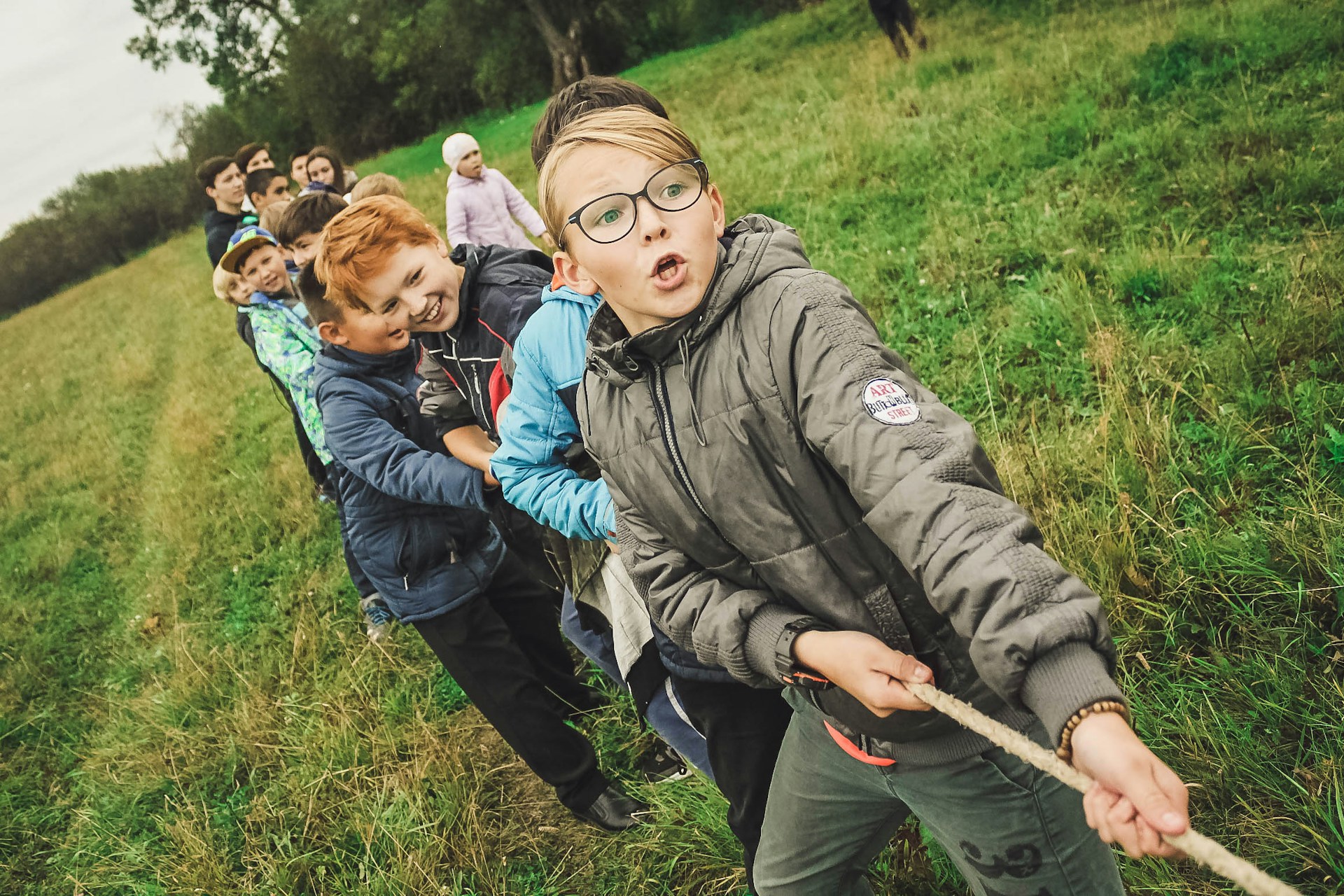
Photo by Anna Samoylova on Unsplash…my eye is on the girl in pink who’s walking away from the rope (I bet you didn’t notice her at first)
Each of us has a natural speed. A rhythm that feels comfortable. Some of us move fast, always pushing, never stopping. Others take a slow, methodical approach. And some avoid movement altogether.
Occasionally, we can shift gears and speed up for a short-term need. But the comfort of our standard speed usually draws us back.
Dialing up is hard. It’s difficult to imagine doing more than we’re doing now. It’s harder still to visualize the better outcomes that could come from pushing ourselves and our organizations beyond the status quo.
Even worse is when we deliberately slow our pace to fit in. To blindly match our rhythm to those around us, in our workplace, our social circles, our environment. The groups we allow to shape us.
The slow, almost imperceptible tick-tock of our internal metronome feels safe, especially if it’s set to someone else’s rhythm. It’s predictable. It gives us a (false) sense of control when we have no control at all.
We tell ourselves that changing our settings would bring chaos. Better to stay safe and avoid the challenge.
If we’re willing to turn our settings down to accommodate others, why not turn them up to pursue our own goals?
Why not push beyond our comfort zone to improve, to evolve? Why not try to inspire those around us to ramp up?
The things we don’t change are the things we’re actively choosing. Doing nothing is a choice.
Life moves at a relentless pace, largely outside our control. What we can control is our response. We can set our internal rhythm to match what’s happening or set it to create what we want to happen.
Here’s a brutal truth: The outside world doesn’t grant or deny us anything. It keeps moving, with or without us.
It’s up to us to set our own tempo—not for the group, not for the organization, but for ourselves and the people who matter most.





 Grandpa Bob Encouraging Leadership
You must be logged in to post a comment.